Losing a parent or spouse often leaves families in an unfamiliar place. You're grieving, trying to handle practical tasks, and then a bank, title office, or court clerk asks for probate paperwork. If your loved one died without a will and left a modest estate, you may have heard about a Small Estate Affidavit in Texas and wondered whether it can spare your family a long court process.
For many families, it can. But only if every requirement is met and every detail is handled carefully. Texas created this option in Texas Estates Code Chapter 205, which is part of the broader probate framework in Titles 2 and 3 of the Texas Estates Code. In plain English, a Small Estate Affidavit, often called an SEA, is a simplified, court-approved way for heirs to collect certain property when someone dies intestate, meaning without a valid will.
A common example looks like this. A mother dies owning a homestead, a car, household items, and a modest bank account. Her children agree on who the heirs are. No executor was named because there is no will. In the right case, the family may be able to use an SEA instead of a full probate administration.
If you're still in the first days after a loss, this Texas legal checklist after a loved one dies can help you steady the basics before you move into probate decisions.
Navigating a Loved One's Estate with a Small Estate Affidavit
The hardest part for many families isn't just the paperwork. It's the uncertainty. You may be asking simple questions that suddenly feel complicated. Can we access the bank account? Can we transfer the car? Do we have to open a full probate case? What happens to the house?
A Small Estate Affidavit exists for exactly this kind of situation. It isn't a private family agreement. It is a formal document filed with the probate court, and once approved, it can allow heirs to collect certain assets without going through the full administration process that larger or more complex estates require.
What an SEA really does
An SEA helps the court confirm who the legal heirs are and whether the estate qualifies for this shorter path. That matters because Texas probate law doesn't let families divide property based on informal understandings. If there is no valid will, property passes under intestacy laws, which are found in Title 2 of the Texas Estates Code. Those laws decide who inherits.
In practical terms, an approved SEA can help heirs do things like:
- Collect bank funds that belonged to the deceased
- Transfer vehicle title into the proper heir's name
- Update certain records tied to estate assets
- Address the homestead in the limited way Texas law allows
A Small Estate Affidavit is simpler than formal probate, but it still requires court approval, complete information, and full family cooperation.
Why families are drawn to it
Families often choose this path because formal probate can feel overwhelming when the estate is modest and everyone agrees. The SEA was designed to reduce court burden in smaller intestate estates and to give families a more manageable process.
That said, the words small and simple can be misleading. The court still expects accuracy. A grieving daughter who leaves out one heir, misvalues an account, or misunderstands what counts as exempt property can end up with a rejected filing and more delay than if she had asked questions at the start.
A good way to think about an SEA is this: it is a shortcut, but not a shortcut around the rules.
Is a Small Estate Affidavit Right for Your Family
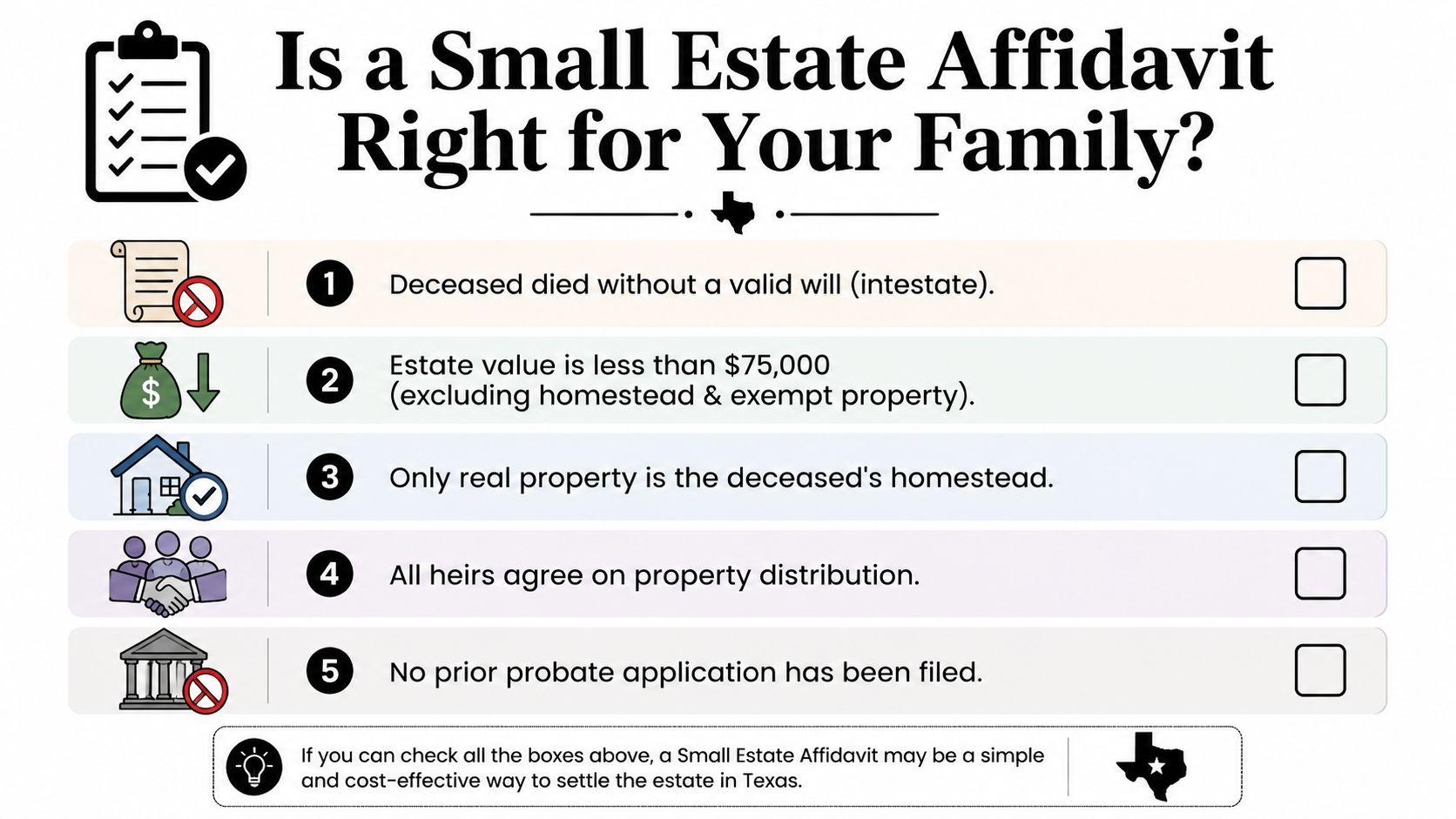
Before you spend time drafting forms, check whether your family qualifies. Texas is strict here. Under Texas Estates Code § 205.001, an SEA is available only in a narrow set of circumstances. If one requirement is missing, the court can deny the filing.
Five questions to ask first
Start with these questions:
Did your loved one die without a valid will?
An SEA is only for an intestate estate. If a valid will exists, this isn't the right tool.Has at least 30 days passed since the date of death?
Texas requires a waiting period before filing.Are the non-exempt assets worth $75,000 or less?
In Texas, a Small Estate Affidavit is legally permissible only when the total value of the decedent's non-exempt assets does not exceed $75,000, excluding the homestead and exempt property under Texas Estates Code § 205.001, and the decedent must have died intestate with at least 30 days elapsed since death before filing, as explained in this discussion of common mistakes that can invalidate a Small Estate Affidavit in Texas.Is the estate solvent?
In plain English, the estate's assets must be greater than its debts, not counting a homestead mortgage in the way Texas law treats it for this purpose.Is the only real property the homestead?
If there is other real estate, that usually stops the SEA process.
What confuses families most
The biggest point of confusion is often the $75,000 cap. Families sometimes add everything, including exempt property and the homestead, and assume they don't qualify. Others do the opposite and leave out items that should have been counted.
Here is the plain-language distinction:
- Exempt property can include certain personal property that Texas law protects.
- Non-exempt property is what generally counts toward the limit.
- Homestead is excluded from the asset cap, but that doesn't mean every house or piece of land can pass through an SEA.
If you want a focused overview, The Small Estate Affidavit in Texas describes this option as a simplified path for modest estates with no will.
A simple example
Suppose your father died owning a homestead, one vehicle, furniture, and a small checking account. The family home may be excluded from the asset cap. Certain personal property may also be exempt. The checking account may count. That means the analysis isn't just "What did he own?" It's "What counts under Chapter 205?"
For families weighing this against a full probate case, this guide on probate vs. small estate affidavit in Texas can help frame the decision.
Practical rule: If you're unsure whether an asset is exempt, don't guess. Asset classification errors are one of the fastest ways to turn a manageable filing into a rejected one.
How to Prepare and File the Texas Small Estate Affidavit
Once you've confirmed the estate appears to qualify, the work becomes very practical. You're gathering records, identifying heirs, completing the right county form, and making sure every required signature and sworn statement is in place.
The process requires four distinct phases: (1) collecting the death certificate, a detailed asset and liability inventory, and proof of heirship, (2) drafting the affidavit using the county-specific form with two disinterested witnesses and all heir signatures, (3) filing with the county probate clerk, and (4) presenting the court-approved affidavit to financial institutions to collect assets, as outlined in this guide to Texas probate and small estate procedures.
Start with documents, not forms
Most families want to download the affidavit immediately. Usually, that's backwards. The smarter first step is building the file.
You will usually need:
- A certified death certificate
- A full asset list with values tied to date of death
- A debt list showing what the decedent owed
- Family history information showing who the legal heirs are
- Proof related to funeral expenses, because some counties require it
- The correct county form, not a generic form from another county
The county matters because probate procedure is local in practice. Texas law provides the framework, but clerks and courts often expect county-specific formatting or attachments.
Heirship is where many families slow down
"Heirship" means identifying who inherits under Texas intestacy law. That may sound simple if everyone knows the family, but the court needs clarity, not assumptions. Marriages, divorces, children from prior relationships, adopted children, and predeceased heirs can all affect who must be listed.
If you're trying to confirm property ownership before preparing the affidavit, public land and deed records can help you check how real property is titled. A practical outside resource is PropLab's guide to public deeds, which explains how deed records are generally maintained and why they matter.
When families say, "We all know who the heirs are," the court's next question is usually, "Can you prove it clearly on paper?"
Two disinterested witnesses means exactly that
Texas requires two disinterested witnesses. In plain English, these are people who do not inherit from the estate and who can swear to the family history and relevant facts. They must know enough to support the affidavit, not just know one branch of the family vaguely.
This catches many families off guard. A neighbor who only knew the decedent casually may not be enough. A relative who inherits is not disinterested.
Every heir must sign
This is one of the most important requirements in a Small Estate Affidavit Texas case. All legal heirs must sign the affidavit. The document also needs witness verification and notarization. One missing signature can stop the process.
A realistic example helps. Suppose a widowed father dies with three adult children. Two children live in Texas and are cooperating. The third child lives out of state and hasn't responded to messages. The family cannot file without that third heir. Until all required heirs participate, the SEA may not be workable.
Filing and using the approved affidavit
After the affidavit is complete, signed, witnessed, and notarized, it is filed with the probate clerk in the county where the decedent resided. The court reviews it. If approved, the time-stamped affidavit can then be shown to banks and other institutions to collect assets or transfer titles within the limits of the order.
This is often the point where families finally feel some relief. But institutions may still review the paperwork carefully. If the affidavit is incomplete or unclear, the problem may show up at the bank counter rather than at your kitchen table. That's why careful preparation matters.
Common Pitfalls That Invalidate a Small Estate Affidavit
A family can do almost everything right and still have a Small Estate Affidavit rejected.
That often happens after weeks of gathering papers, calling relatives, and waiting for the court. The problem is usually not bad intent. It is that an SEA is a narrow tool, and courts expect the facts to fit that tool exactly. A good way to understand this section is to treat it as a failure-proofing checklist. These are the trouble spots that cause families the most frustration.
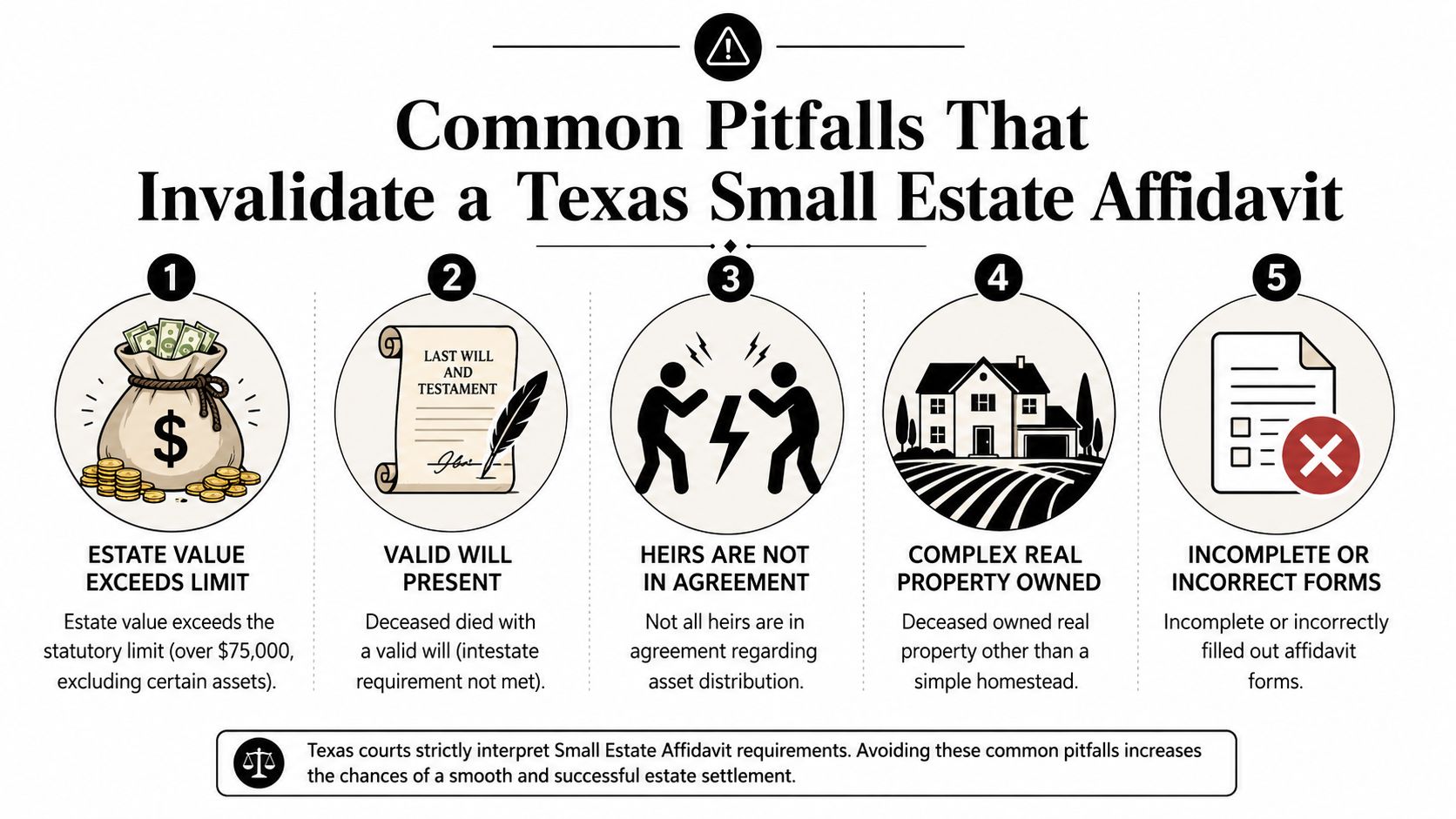
The non-homestead real estate problem
This is one of the biggest reasons an SEA falls apart.
A Texas Small Estate Affidavit is not a general deed-transfer shortcut. It is usually limited to modest estates and, for real property, it is aimed at the decedent's homestead. Families get into trouble when they try to include a rental house, mineral interests, farmland, a vacant lot, or a second home. Courts regularly reject SEA filings for that reason, as discussed in this explanation of Small Estate Affidavits in Texas.
A simple way to test this issue is to ask, "Was this property the decedent's home?" If the answer is no, stop and examine that asset closely before filing. One wrong parcel can sink the whole affidavit.
Minor heirs create extra risk
Children who inherit make the process more sensitive. Courts are careful here for a good reason. A judge has to be confident that a minor's rights are fully protected.
Families often assume a surviving parent can just sign for the child and move on. Sometimes the court will want more clarity about who inherits, how the child's share is being handled, and whether the SEA is the right procedure at all. The earlier source also notes that filings involving minor heirs draw closer scrutiny and often face delay or rejection.
If a child, incapacitated adult, or heir under a disability is involved, do not treat the affidavit as routine paperwork. Treat it like a warning light on the dashboard. It does not always mean the SEA is impossible, but it does mean extra care is needed.
Other rejection triggers families miss
Some problems look small on paper but cause large delays in court:
- Incorrect asset values. If exempt assets, non-exempt assets, or debts are listed the wrong way, the estate may appear ineligible.
- Heirship mistakes. A missing child from a prior relationship, a deceased heir with descendants, or an unclear family tree can make the affidavit unreliable.
- Improper witness details. The two disinterested witnesses must be qualified and must know the family history well enough to swear to it.
- Filing before the facts are settled. Rushing to file before confirming debts, assets, and heirs often leads to amendments or rejection.
- Using the wrong county form or missing attachments. Courts may require county-specific formatting, exhibits, or proposed orders.
- Leaving out hard facts. Omitting a disputed asset or an estranged heir does not make the problem disappear. It usually makes the judge doubt the whole filing.
Here is how this plays out in real life. A daughter is trying to help after her mother dies. She includes a small rental lot because the family has always thought of it as part of "Mom's property." She also assumes her late brother's child does not need to be listed until the family sorts things out. From the court's perspective, those are not minor cleanup items. They are core eligibility problems.
Why precision matters so much
An SEA works like a narrow gate. If the estate fits, the process can save time and expense. If the facts do not fit, the court will not stretch the rules to make it work.
That is why precision matters so much here. The affidavit is sworn probate paperwork. Every asset, debt, heir, and signature has to line up with Texas law. Families who slow down, verify each fact, and watch for these common rejection points have a much better chance of getting the affidavit approved the first time.
Alternatives When an SEA Is Not an Option
A common hard moment in probate looks like this. A family starts with a Small Estate Affidavit because it seems like the simplest path. Then they learn the deceased owned a rental lot, a grandchild inherited through a deceased parent, or one heir will not sign. At that point, the question changes from "How do we finish the affidavit?" to "What legal path fits this estate?"
That shift is frustrating, but it is also useful. An SEA only works for a narrow group of cases. When the estate falls outside those rules, choosing the right alternative early can save months of delay and avoid a rejected filing.
One common reason families have to change course is authority. An SEA does not appoint someone with full legal power to gather assets, deal with creditors, or sign on behalf of the estate. If a bank, title company, or buyer wants formal court authority, a different probate procedure is often the better tool. The same is true when there is a valid will, non-homestead real estate, disagreement among heirs, or a child's inheritance that raises added court concerns. This article on Texas Small Estate Affidavit requirements and signature rules explains why missing signatures and similar issues can block SEA approval.
Two common alternatives
The two alternatives families most often consider are Muniment of Title and formal probate administration.
Muniment of Title
This option is often a good fit when the deceased left a valid will and the estate does not need a personal representative to stay involved. It works best when the main job is proving title, usually for a home or other property, rather than managing ongoing estate business.Formal probate administration
This is usually the safer choice when the estate includes non-homestead real estate, unclear heirs, debts that need attention, missing beneficiaries, or family conflict. It allows the court to appoint someone, often an executor or administrator, with legal authority to collect property, deal with creditors, and complete transfers.
A simple way to compare these options is to picture tools in a toolbox. An SEA is a narrow tool for a narrow job. Muniment of Title is helpful when there is a valid will and little else needs to happen. Formal administration is the broader tool for estates that have complications the court will want handled through a supervised process.
Texas probate alternatives at a glance
| Method | Best For | Typical Cost | Typical Timeline |
|---|---|---|---|
| Small Estate Affidavit | Intestate estates that meet Chapter 205 requirements and have full heir agreement | Lower than formal probate in many situations | Often shorter than formal probate |
| Muniment of Title | Estates with a valid will and no need for ongoing administration | Varies by case | Often faster than full administration |
| Formal Probate Administration | Larger, disputed, debt-heavy, or more complex estates | Higher than SEA in many situations | Often longer due to court process and administration duties |
A practical way to decide
Start with four questions.
- Is there a valid will? If yes, an SEA is usually not the right fit.
- Did the deceased own real estate other than the homestead? If yes, that is one of the most common reasons an SEA fails.
- Are any heirs minors, incapacitated, missing, or in conflict with the rest of the family? If yes, expect the court to require a more formal process.
- Does someone need official legal authority to act for the estate? If yes, formal administration is often the better path.
If you are stuck between options, it often helps to get a second set of eyes before filing anything. A Texas probate attorney near you for estate administration guidance can usually tell you quickly whether your case calls for Muniment of Title, full probate, or another solution.
The main goal here is not to force an SEA to work. It is to choose the procedure that the court, the bank, and the title company are most likely to accept the first time.
Key Takeaways and When to Consult a Probate Attorney
A family often reaches this point after doing a lot of work already. You have gathered account statements, listed heirs, and tried to follow the court's instructions, only to realize one detail could cause the whole Small Estate Affidavit to be rejected. That is usually the moment to pause and get legal advice before more time is lost.
The clearest takeaway is simple. A Texas Small Estate Affidavit works best when the facts are clean, the heirs are easy to identify, and the property fits the court's narrow rules. It tends to fail when a family treats it like a shortcut for every small estate instead of a tool for the right estate.
One Texas law firm reports that a correctly prepared SEA can succeed often and save time and legal expense compared with formal probate, but those results depend on the case and the quality of the paperwork, not a universal guarantee. The larger lesson is the one that matters most for families. Small filing mistakes can create big delays.
A helpful way to view the SEA is as a lock with several pins that all have to line up at once. If one pin is off, such as a minor heir, a missing heir, a questionable will, or non-homestead real estate, the court may refuse to open the door.
You should consider talking with a probate lawyer if any of these warning signs are present:
- An heir is a minor or has a legal disability
- The deceased owned real property other than the homestead
- Someone in the family is unsure who the legal heirs are
- An heir cannot be located or will not cooperate
- There is family conflict about debts, assets, or who should inherit
- You found a will, even if it seems old, informal, or possibly invalid
- A bank, title company, or court clerk has already questioned the affidavit
- You are not confident the asset and debt lists are complete and accurate
These are not small technicalities. They are common rejection points.
Legal help is also wise when the problem is not just paperwork but risk. For example, if an SEA is filed even though the estate includes non-homestead real estate, the family may spend weeks getting court approval only to have a title company refuse to rely on it later. If a minor heir is involved, the court may expect stronger protections than an affidavit can provide. In both situations, filing the wrong procedure first can cost more than choosing the right procedure from the start.
If you want a lawyer to review the facts before you file, speaking with a Texas probate attorney near you for SEA and estate administration guidance is often the safest next step.
If you're facing probate in Texas, Law Office of Bryan Fagan, PLLC can help explain your options, prepare the needed filings, and guide your family through the process from start to finish. Schedule a consultation if you want case-specific guidance before deciding whether an SEA is the right path.