Skip to content
When a parent or spouse dies, the legal paperwork can feel cruelly out of step with real life. You may still be planning a funeral, sorting through a home, or trying to answer basic family questions, and suddenly someone asks who owns the house now.
For many Texas families, that question leads to an Affidavit of Heirship. It can be a practical tool when the main asset is real estate and the family wants a path short of full probate. It isn't magic, and it isn't right for every estate, but in the right case it can help preserve a clear record of who inherited property under Texas law.
Losing a Loved One and Facing an Uncertain Estate
A common situation looks like this. A mother dies, there was no probate opened, and the family home is still in her name. Her children want to keep the home, refinance it, or sell it later, but they don't know how to move title out of her name without going through a full court process.
That is often where an Affidavit of Heirship Texas becomes part of the conversation. In plain English, it is a sworn document used to identify the family members who inherited real estate under Texas inheritance rules. It is most useful when the estate is simple and the property is the main concern.
Texas law limits when this tool fits. It works when a person died without a will, or when a will exists but was not probated within the four-year statutory window described in this Texas heirship overview. That detail matters because many families assume a will automatically blocks the affidavit route. Sometimes it doesn't.
Why families look for another option
Full probate can be necessary, but it isn't always the only path. If the estate mostly consists of a house or land, and the family isn't dealing with a broad mix of assets, an affidavit may offer a narrower solution focused on real property records.
Practical rule: If your main question is “How do we deal with the house?” an affidavit may be worth discussing. If your questions involve bank accounts, creditor claims, or family conflict, the answer is often more involved.
Texas Estates Code Titles 2 and 3 contain the broader rules governing probate, estate administration, and related proceedings. Those laws matter because an affidavit doesn't replace the probate system. It works inside a limited space that Texas law allows.
A realistic example
Suppose your father owned a home in Harris County. He died years ago, and no probate was opened. He had adult children, no family dispute, and the house is still the only significant asset anyone is trying to address.
In that setting, an affidavit may help create a public record showing who inherited the home. That can be a meaningful first step toward cleaning up title, especially when the family is trying to avoid a more formal administration that may not match the estate's needs.
What Is an Affidavit of Heirship in Texas
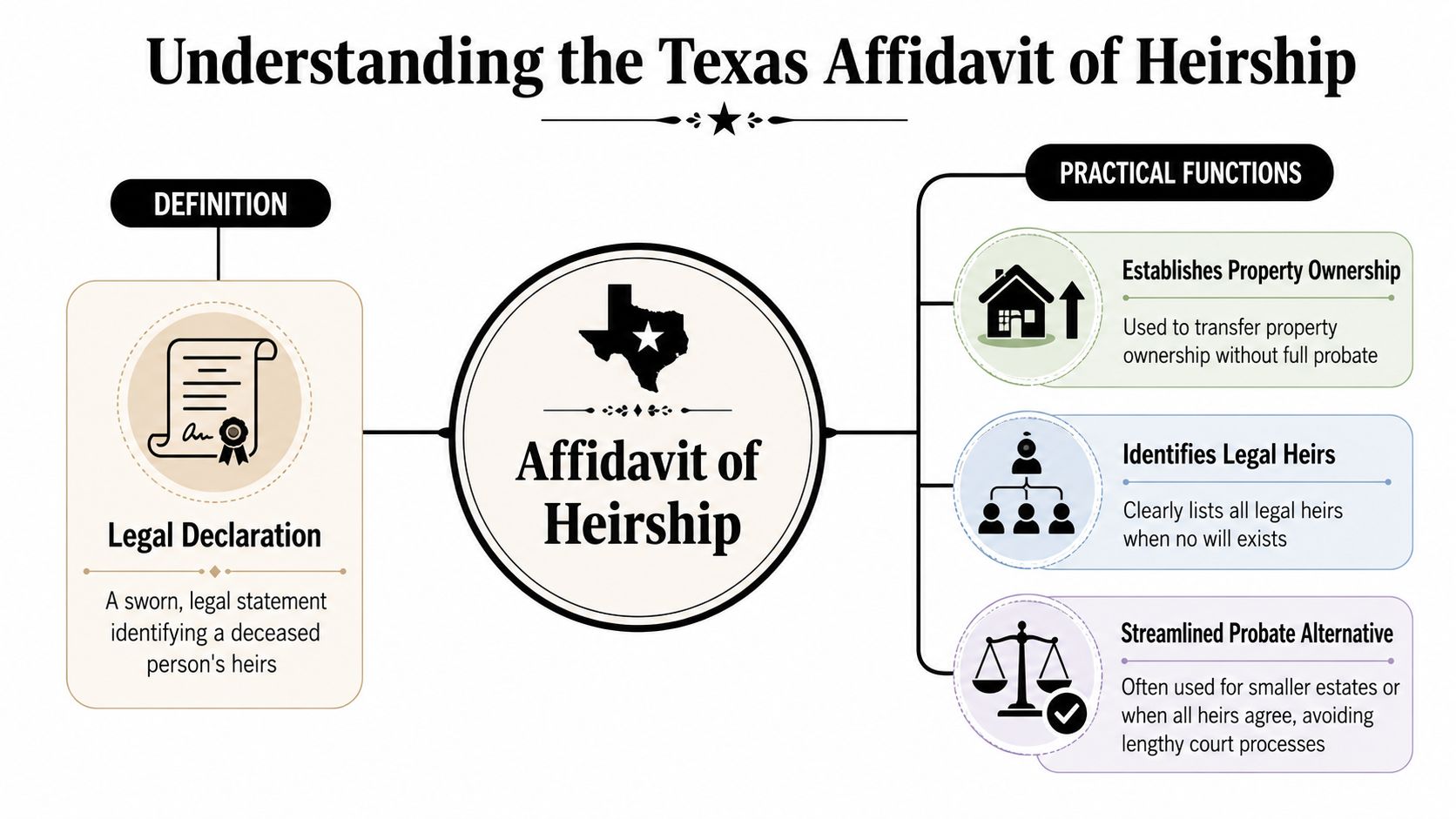
An affidavit of heirship is a sworn statement placed in the county deed records to identify who inherited a deceased person's real property under Texas law. In plain English, it tells the property's family story so title companies, buyers, and courts can see who likely owns the land or house now.
It works much like a written family map. The document names the person who died, identifies the heirs, explains the relationships, and ties those facts to a specific piece of real estate.
What the document actually does
An affidavit of heirship helps clear up the public record. It does not give heirs the same kind of court order a probate judge can sign, but it can create evidence of who inherited the property and why. That distinction matters because families often believe recording the affidavit "changes title" by itself. The better way to understand it is this: the affidavit supports the title record by documenting the inheritance facts behind it.
Families often use this tool for a house, ranch, vacant lot, or mineral interest when the main problem is the land records, not the full administration of an estate. If you want to see what these documents typically look like, reviewing Texas affidavit of heirship forms can make the structure easier to follow.
Texas Estates Code § 203.001 gives a properly recorded affidavit added evidentiary value over time. When it has been on file in the deed records for more than five years, it can serve as prima facie evidence of the heirship facts stated in it, as explained in this discussion of Texas Estates Code § 203.001.
That timing point causes a lot of confusion. Recording the affidavit can still help immediately by placing the family's heirship history in the public record. The statute gives that record stronger weight after enough time has passed.
It can apply even if a will exists
Many Texas families are told an affidavit of heirship is only for a person who died without a will. That is too narrow. In some cases, the document may also be used when a valid will exists but was not probated within the four-year period allowed for routine probate.
This catches families off guard. A son may find his mother's signed will years later and assume the will alone solves the title problem. Often, it does not. Sometimes the key issue is whether the will was admitted to probate in time.
When that deadline has passed, an affidavit of heirship may still help create a record of ownership for real property, depending on the facts. That does not mean it is the right answer in every estate. It means the presence of a will does not automatically end the analysis.
If you're trying to decide whether the estate needs legal help beyond a form, When to Hire a Texas Probate Attorney discusses why most Texas probate matters require a lawyer.
Required Information for a Valid Affidavit
An affidavit of heirship is only as helpful as the facts it contains. If the family history is incomplete or the property is described loosely, the document may create more questions than answers. That risk is even higher when a family is using the affidavit because no will was probated within Texas's four-year deadline and they are now trying to show who owns the real estate.
An easy way to think about this is that the affidavit needs to tell a title company the same story a careful probate file would have told. It should explain who the decedent was, who survived them, and why those people inherited under Texas law or under a will that was never timely probated.
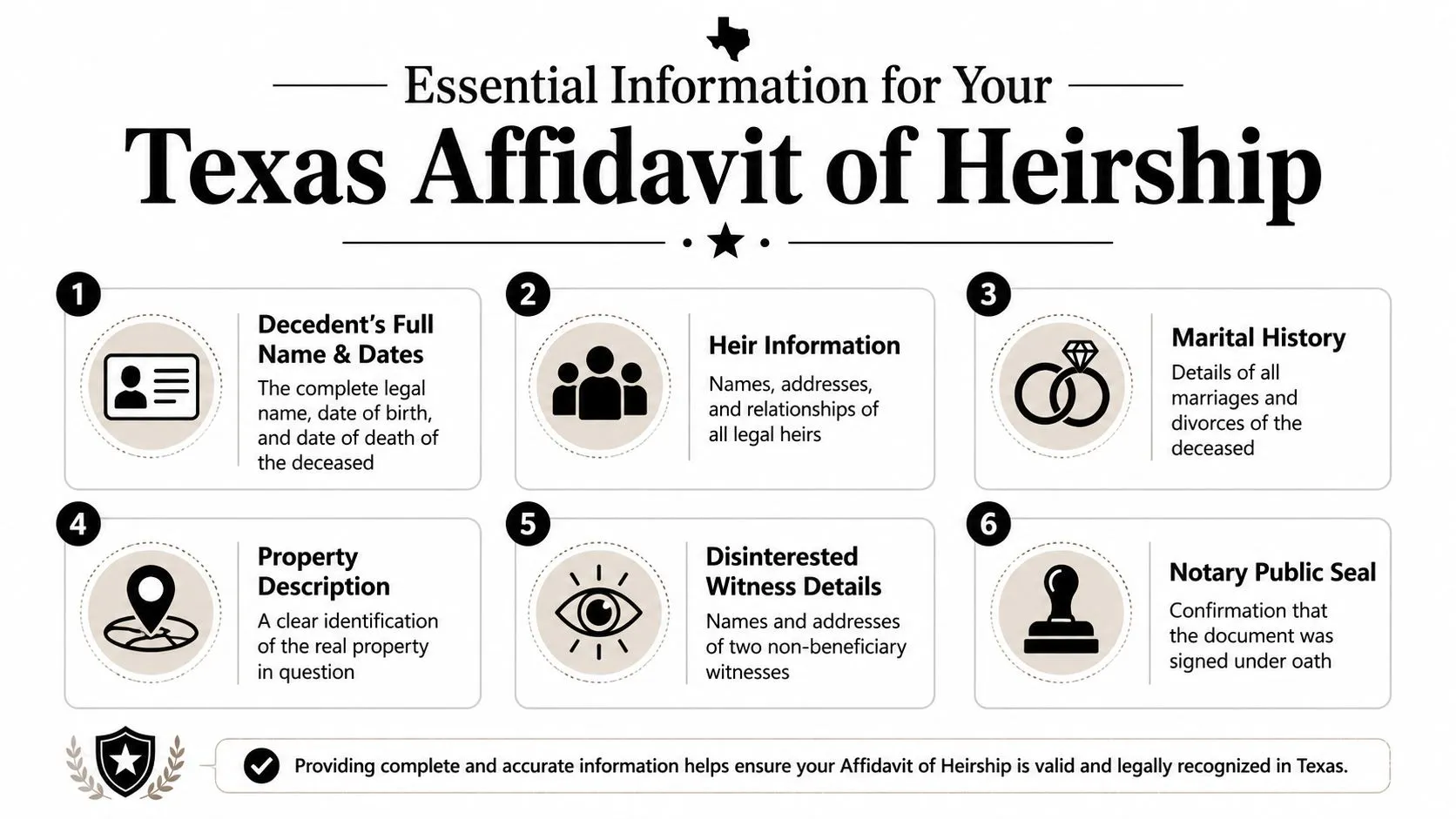
An affidavit usually needs three kinds of information: a complete family history, an exact property description, and credible witness testimony.
The family history must be complete
Texas inheritance rules depend on relationships. For that reason, the affidavit should lay out the decedent's family history with enough detail that someone reading it years later can follow the chain of inheritance without guessing.
That usually includes:
- Every marriage: when each marriage began, when it ended, and whether it ended by death or divorce
- All children: biological children, adopted children, and non-marital children
- Relatives beyond spouse and children when needed: parents, siblings, nieces, nephews, or other kin if they matter under Texas heirship rules
- Deaths that affect inheritance: for example, a child who died before the decedent but left children of their own
Families often miss one of these details because they assume it is not important. A prior marriage from decades ago may affect whether property was community or separate property. A deceased child may still matter because that child's share could pass to their descendants.
If you want to see how these family details are typically gathered, these Texas affidavit of heirship forms are a useful starting point.
The property description has to be exact
For real property, precision matters. The affidavit should identify the land exactly as it appears in the deed or county property records. A street address by itself is often too general.
Families often find the property description challenging. "Dad's house in Houston" may be clear at the kitchen table, but county records and title companies need the legal description. Lot, block, subdivision, or metes and bounds language may all be necessary.
A small error can follow the property for years. It may delay a sale, create extra title work, or force the family to correct the record later.
The witnesses matter as much as the written facts
The affidavit also needs signatures from the heirs and two disinterested witnesses who know the decedent's family history well. The witnesses should not be people who inherit from the estate or expect to benefit from the property.
Their role is simple but important. They are there to confirm that the family story in the affidavit is true based on long-term personal knowledge, not rumor or guesswork.
A common example helps. If a mother dies leaving two sons, the sons may sign as heirs. They should not be the two disinterested witnesses. Better witnesses might be a longtime neighbor, a family friend, a pastor, or another person who knew the decedent and the family relationships over many years.
Before anyone signs, read every name, date, and relationship one more time. In heirship work, small details often decide whether the affidavit clears title or creates another obstacle.
Your Step-by-Step Guide to Filing the Affidavit
The days after a death often feel scattered. One person is looking for the deed, another finds an old will in a drawer, and someone else is asking whether anything can still be done because no probate was opened years ago. An Affidavit of Heirship can help in that situation, but only if the family handles each step with care.
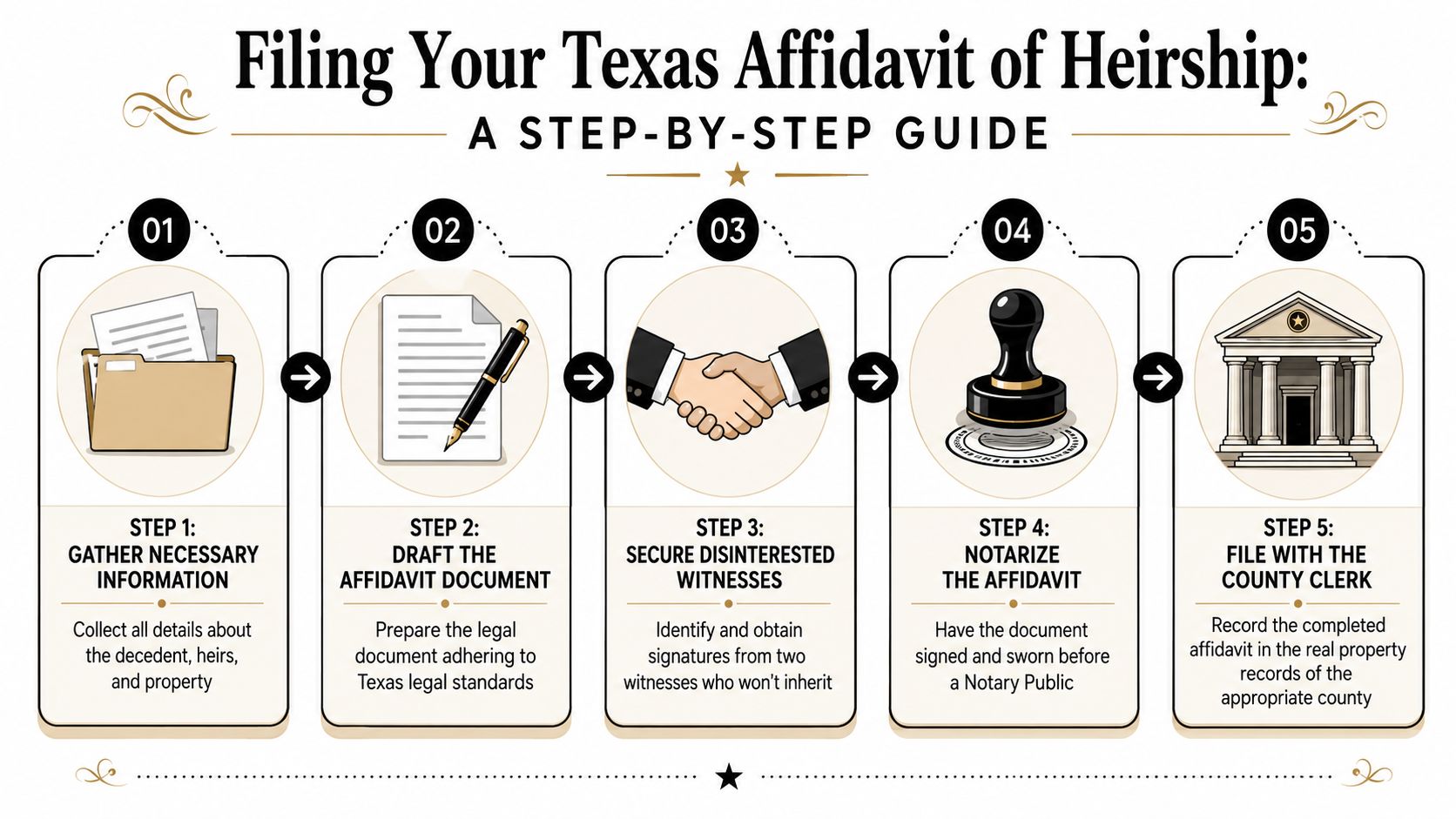
Step 1 Gather the documents before anyone signs
Start by building a clean timeline of the decedent's life and property ownership. Pull together the death certificate, any deed, names of spouses and children, divorce or death records from prior marriages, and any available information about the home or land.
If a will exists, do not ignore it just because it was never probated. In Texas, that detail can change the analysis. Families are often surprised to learn that an affidavit may still play a role even when there was a valid will, if the will was not probated within the four-year window and the family now needs a practical way to address title issues.
Step 2 Confirm whether an affidavit is the right tool
Before drafting anything, pause and ask a simple question. Are you trying to create a record of who inherited real property, or do you need a court process to deal with debts, disputes, or multiple assets?
An Affidavit of Heirship works best as a title-clearing tool for real estate. It does not replace every probate procedure. If you are unsure whether this route fits your facts, this guide on Affidavit of Heirship vs. probate in Texas can help you compare the options.
Step 3 Prepare the affidavit with exact family history
The affidavit should tell a complete family story in legal form. That includes marriages, children, children who died before the decedent, adopted children, and other facts that affect inheritance under Texas law.
Accuracy matters more than speed. A missed child, an incorrect date, or an incomplete marital history can create the same title problem the family was trying to fix. If the decedent left a will that was never probated on time, the affidavit should also be drafted with that missed-probate issue in mind so the title record matches the legal reality as closely as possible.
Step 4 Select witnesses who can prove the history
The two disinterested witnesses should be people who know the family's background from long personal experience. A longtime neighbor, pastor, family friend, or family business associate may be a good fit. An heir should not serve in that role.
Their job is straightforward. They confirm that the family history stated in the affidavit is true based on personal knowledge, not guesswork.
For additional context on the process, this video gives a useful overview:
Step 5 Sign and notarize the affidavit correctly
Everyone who must sign should appear before a notary and review the document carefully first. Names, dates, and property descriptions should match the supporting records.
Treat this like recording the family's history in permanent ink. Once the affidavit is filed, title companies, buyers, and future heirs may rely on it.
Step 6 Record it in the county where the real property sits
File the completed affidavit in the property records of the county where the land is located. Recording it anywhere else usually does not solve the title issue.
That filing step gives the affidavit practical value. Without recording, the document may be accurate but still ineffective for title purposes.
Comparing an Affidavit of Heirship to Other Options
A common point of confusion comes up after a family finds a will in a drawer, then learns no probate was opened within four years of the death. At that moment, many people assume the will is useless or that nothing can be done without full probate. Texas law is more nuanced than that. In some cases, an affidavit of heirship may still help clear the title history for real estate, even though a valid will exists and missed the probate deadline.
That does not mean the affidavit is always the best tool. It means the family needs to match the problem to the right procedure.
Texas Probate Alternatives at a Glance
| Procedure | Best For | Handles Debts? | Transfers Real Estate? | Court Involvement |
|---|---|---|---|---|
| Affidavit of Heirship | Real property where heirs need a recorded history of who inherited | No, not with the authority of a formal estate administration | Yes, for title and record purposes | No court order required |
| Small Estate Affidavit | Smaller estates that meet Texas statutory rules, usually involving limited assets | Limited | Sometimes, but only in narrower circumstances | Court filing required |
| Muniment of Title | A valid will and little need for ongoing estate administration | No, not as a general debt resolution process | Yes | Court order required |
| Full Probate Administration | Estates with debts, multiple asset types, disputes, or unclear inheritance facts | Yes | Yes | Full court process |
How the affidavit differs from a Small Estate Affidavit
These two tools get mixed up often because their names sound similar and both can avoid a full administration in the right case.
They solve different problems.
A Small Estate Affidavit is a court-filed shortcut for certain qualifying estates. An affidavit of heirship is usually a title-clearing document for land records. A useful way to view the difference is this: one is aimed at a qualifying small estate, and the other is aimed at proving family history so the county real property records reflect who took ownership.
How it differs from muniment of title
Muniment of title is often the cleaner option when there is a valid will and the estate does not need a full administration. The court admits the will and signs an order that can be used to transfer title.
An affidavit of heirship usually enters the conversation in a different posture. The decedent may have died without a will, or the family may have a valid will that was never probated within the four-year period. That missed deadline is the nuance many families do not expect. They hear "there was a will" and assume affidavit of heirship is off the table. Sometimes it is. Sometimes it is not. The answer depends on the facts, the property, and what the title company will accept.
When full probate is still the better answer
Some estates need the authority of the court, not just a recorded affidavit. If there are creditor issues, fights among heirs, unclear marital history, questions about children from prior relationships, or assets beyond real estate, full probate may be the safer path because it gives a personal representative legal authority to act.
If you are comparing procedures, affidavit of heirship vs probate in Texas gives a helpful side-by-side explanation. You may also want to review the firm's Texas Probate Process, Guardianship, Wills & Trusts, and Probate Litigation pages if the situation extends beyond a straightforward title issue.
Law firms also publish educational guides to help families understand complicated probate choices and attract more legal clients. What matters to your family is choosing the option that fits the estate, instead of forcing an affidavit to do a job it was never designed to do.
Key Insights and When to Hire a Probate Attorney
An affidavit of heirship is a focused tool. It helps with real property records. It does not function like a general transfer document for bank accounts, retirement funds, vehicles, or other non-real-estate assets. It also doesn't wipe out valid creditor issues tied to the estate or the property.
Takeaway
If you remember only a few points, remember these:
- It is limited: This tool is for heirship and real estate record purposes.
- It depends on accuracy: Missing heirs or incomplete marital history can create serious title problems.
- It doesn't solve every estate issue: Debt, disputes, and complex assets often require probate.
- A will doesn't always block it: A will that wasn't probated within the four-year window may still leave room for this procedure under Texas law.
Signs you shouldn't handle it alone
You should speak with a probate attorney if any of these are true:
- There are debts: Mortgages may be manageable, but broader creditor issues need closer review.
- The family tree is complicated: Prior marriages, half-siblings, adopted children, or uncertain paternity can change the legal analysis.
- An heir is a minor: Extra protections may be needed.
- The heirs disagree: An affidavit won't fix a family conflict.
- A title company refuses the document: That often signals a deeper title or heirship problem.
For readers interested in how law firms educate families online and attract more legal clients, Digital Skyrocket offers a marketing-focused perspective on legal content strategy. For your own case evaluation, a more practical next step is reading do you really need a probate lawyer in Texas when it's worth it and then discussing the facts with counsel. This is also the point where many families review their future planning needs, including Wills & Trusts, or seek help with disputes through Probate Litigation.
If you're facing probate in Texas, our team can help guide you through every step, from filing to final distribution. Schedule your free consultation today.
For compassionate guidance on affidavits of heirship, probate administration, and related estate matters, contact Law Office of Bryan Fagan, PLLC.