When a loved one dies and there's no will in the drawer, no letter of instruction, and no one quite agrees on what happens next, families usually ask the same question first: who can legally sign anything to transfer the house, land, or other property?
That moment feels bigger than paperwork because it is. Grief is already heavy, and uncertainty about title, access, debt, and family rights can make simple decisions feel impossible. Texas law does provide a path forward. A person who dies without a will is called intestate, which means the State of Texas decides who inherits under the Texas Estates Code rather than under the person's written wishes.
A common example is an adult child trying to help after a parent dies. The parent's home is still in the parent's name. Utility bills are coming in. A sibling thinks the house should be sold. Another believes the surviving spouse automatically owns it. Someone else asks whether a deed can just be signed at the county clerk's office. Those are practical questions, and they need practical answers.
The right path depends on three things more than anything else: what kind of property is involved, how large the estate is, and whether the heirs agree. Some families can use a recorded affidavit and avoid formal probate. Others need a court to declare heirship and appoint an administrator. The key is choosing the method that matches the facts, not the method that sounds easiest.
Navigating a Loved One's Estate Without a Will
Families often come in feeling like they've already missed something important. They haven't. In many cases, the first step is getting organized and understanding what Texas law requires before title can move from the deceased owner's name to the legal heirs.
The legal process after an intestate death isn't one single road. It's a set of options. Some are simplified. Some require court supervision. All of them start with the same basic question: who are the heirs under Texas law? If the answer is clear and the estate is simple, the transfer can sometimes happen without a full probate administration.
For many readers, it also helps to understand the financial side of the estate before taking action with property. Questions about mortgages, credit cards, and final bills often come up alongside title issues, so a plain-English overview of how an estate handles debt can be useful while you gather records and sort out next steps.
What intestate means in plain English
“Intestate” sounds technical, but the meaning is simple. It means the person died without a valid will that directs who receives probate property. Instead of following a written estate plan, the estate follows Texas default inheritance rules found in Titles 2 and 3 of the Texas Estates Code, which govern matters such as intestate succession, heirship, and estate administration.
That matters because title companies, county records offices, and probate courts won't rely on family assumptions. They need a legally recognized path. If you're trying to understand the basic framework first, this guide on probate without a will in Texas is a useful starting point.
Practical rule: Before anyone signs, sells, or transfers real estate, confirm whether the property can pass through a non-court method or whether the court must first declare the heirs.
The first decisions families should make
In the early days, the best approach is steady and simple:
- Secure the property: Make sure the home is locked, insured, and maintained.
- Collect ownership records: Pull the deed, tax statements, and any mortgage information.
- Identify family relationships: Spouse, children, parents, siblings, and children from prior relationships all matter under Texas intestacy law.
- Pause major decisions: Don't promise a sale, deed transfer, or distribution before confirming who legally inherits.
Those early choices reduce mistakes later. Most probate problems don't begin with a court fight. They begin with a family acting on assumptions.
Who Inherits Property Under Texas Intestacy Law
A family can agree on what feels fair and still be wrong about who legally inherited the property. Under Texas intestacy law, ownership passes by statute, not by family consensus, and the starting question is always the same. Who survived the decedent, and what kind of property did the decedent own?
That second question matters more than many families expect. In Texas, the answer often turns on whether the asset was community property or separate property, and whether the decedent left a spouse, children, parents, siblings, or relatives from a prior relationship. If you want a fuller breakdown of who inherits in Texas when there is no will, review that first. It helps families choose the right transfer path before they spend time on the wrong paperwork.
Community property and separate property
Families often assume a surviving spouse inherits the house automatically. Sometimes that is correct. Sometimes the spouse shares ownership with children, parents, or siblings.
Texas treats community property and separate property differently, as the Texas State Law Library probate guide explains. A home purchased during marriage may be community property. A home owned before marriage, or received by gift or inheritance, is often separate property. Those categories can change the result in a major way.
For example, if a married person dies without a will and leaves no child from another relationship, the surviving spouse may inherit the decedent's share of community property. Separate real property works differently. The surviving spouse may receive only a life estate in part of that real property, while children or other relatives hold the remaining interest. That creates a practical problem for any family hoping to sell or refinance soon.
If there is no spouse or child
When the decedent leaves no surviving spouse and no descendants, Texas follows a family order of inheritance. Parents come first. If both parents survive, they generally share the estate. If only one parent survives, that parent may inherit all or may share with the decedent's siblings, depending on who else survived.
If no parent survives, the estate usually passes to siblings and, if a sibling died earlier, that sibling's children may inherit that share. If the decedent left no qualifying family on either side, the property can eventually escheat to the State of Texas.
This is one reason families should slow down before signing deeds or listing a property for sale.
A realistic decision point
Take a common situation. A husband dies without a will. He is survived by his wife, no children, and one sister. If the home was purchased during the marriage with community funds, the surviving wife may end up owning the decedent's interest. If the husband owned that same home before marriage, the sister may have an inheritance interest along with the surviving spouse because the property is separate real property.
The deed does not answer that by itself. The family has to examine when the property was acquired, how it was paid for, and whether any reimbursement or tracing issue exists. In practice, grief and legal confusion often collide.
What spouses and children may inherit
Children change the analysis quickly. If the decedent leaves children, especially children from a prior relationship, the surviving spouse may inherit less than the family expects. Texas also separates real property from personal property. Those rules affect who receives cash, vehicles, household items, and land.
A surviving spouse may receive all of the decedent's share of community property in some cases, but separate personal property and separate real property are divided under different rules, as summarized by Romano & Sumner. The practical takeaway is simple. Before choosing an affidavit, probate shortcut, or court filing, confirm three things: who survived, whether any child is from outside the current marriage, and whether the property is community or separate.
For a more detailed discussion of the inheritance rules themselves, see Dying Without a Will in Texas: Intestate Succession.
Streamlined Options to Avoid Formal Probate
Many estates don't need a full, traditional probate administration. That's good news for families who are trying to transfer property efficiently and avoid unnecessary court involvement. In Texas, the most common simplified options after a death without a will are the Affidavit of Heirship and the Small Estate Affidavit.
Both are useful, but they solve different problems. Choosing the wrong one can waste time.

Affidavit of Heirship
An Affidavit of Heirship is a sworn statement that identifies the decedent's heirs and their shares. It can be used to transfer title when the decedent died without a will and the asset at issue is real property solely titled in the decedent's name. It must be signed by two disinterested witnesses, meaning people with no financial interest in the estate who knew the decedent, then notarized and filed with the county clerk where the property is located, according to Robbins Estate Law's discussion of settling an estate without a will in Texas.
Once recorded in the property records, title companies typically rely on it to transfer title without court involvement. In practice, this is often the most efficient path when the family tree is clear and the estate is centered on real estate.
Small Estate Affidavit
A Small Estate Affidavit is different. Texas Estates Code Chapter 205 allows heirs of a person who died intestate to use this procedure as an alternative to formal probate if the estate meets the legal requirements, including a waiting period of 30 days after death and eligibility rules tied to estate value and asset type, as described by Texas Law Help.
For smaller estates, this can be a practical tool. The version described in the verified guidance allows use when the decedent has no will and the total known financial assets equal less than $75,000, with real property generally treated differently than cash or accounts.
Side-by-side comparison
| Option | Best fit | Court involvement | Key requirement |
|---|---|---|---|
| Affidavit of Heirship | Real estate titled only in decedent's name | No formal court proceeding | Two disinterested witnesses and accurate heirship facts |
| Small Estate Affidavit | Modest intestate estates meeting Chapter 205 requirements | Judge approval required | Must wait 30 days and satisfy eligibility rules |
What works and what doesn't
The Affidavit of Heirship works well when the family relationships are straightforward, the property history is clear, and no one is disputing who inherits.
The Small Estate Affidavit works better when the estate is modest and the legal requirements line up. It is not a universal shortcut for every estate with a low asset value, especially when real estate title questions are involved.
A streamlined option only stays streamlined if the facts are clean. Unclear marriages, missing heirs, family disputes, or conflicting property records can push the estate into court.
Families also ask about other probate-light tools. If a valid will exists but no full administration is necessary, a different Texas procedure may apply. That's where muniment of title in Texas sometimes enters the conversation, although that procedure is for estates with a will, not for a true intestate case.
When Court Involvement Is Necessary
A common turning point looks like this: the family agrees there is no will, but no one agrees on what happens next. One relative believes the house should pass to the surviving spouse. Another says children from a prior relationship also inherit. A title company raises questions about prior marriages, or a bank refuses to release funds without court papers. At that point, the right question is no longer whether probate can be avoided. The question is what level of court involvement will solve the problem with the least cost and delay.
Court involvement is usually the right path when the facts are disputed, the family tree is incomplete, a minor heir is involved, or title to real estate needs an order that third parties will rely on. It is also the safer choice when the estate includes both community and separate property and the family is not sure how those categories affect inheritance. That confusion is common, and it changes who inherits.
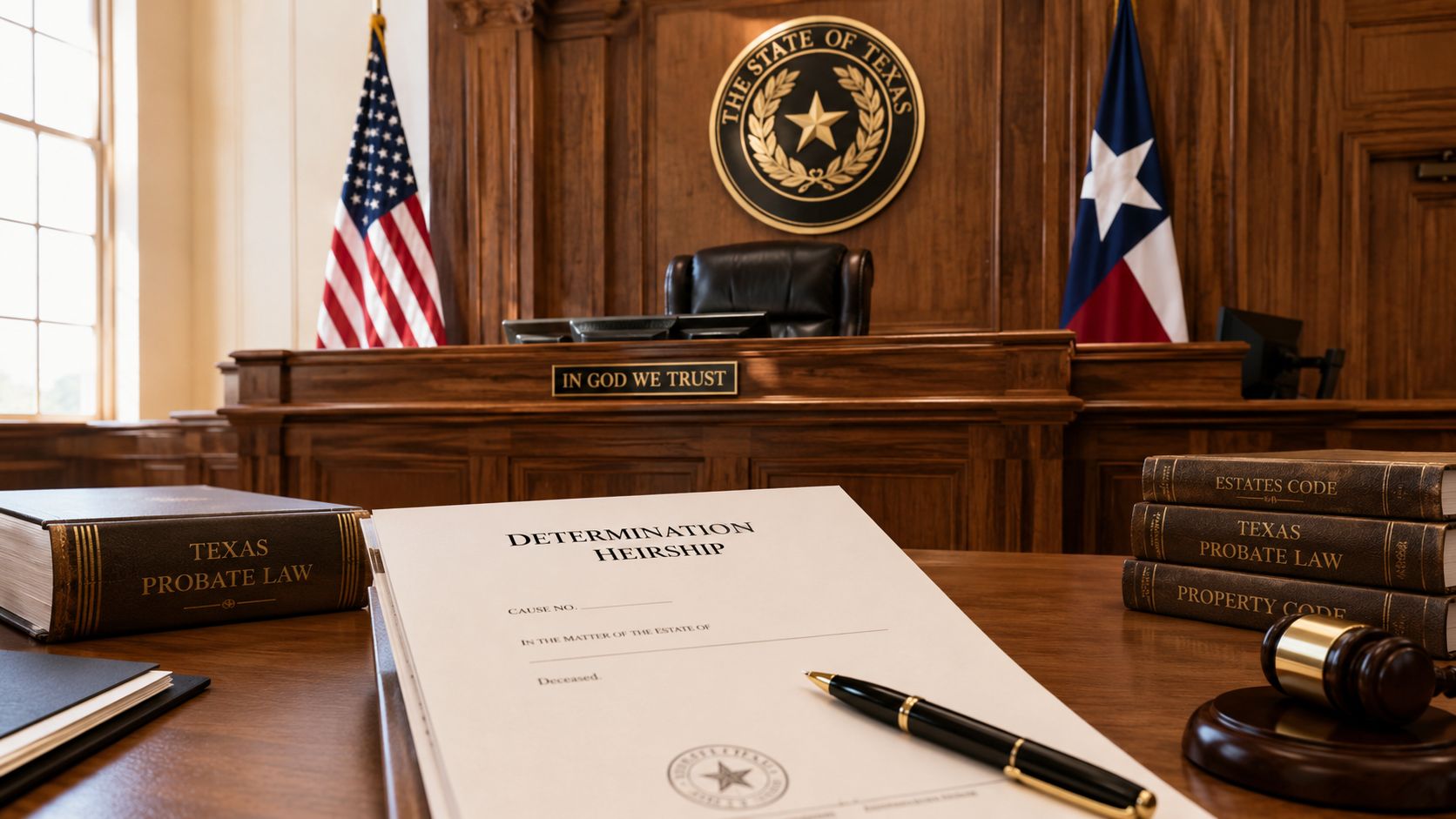
That court process is often called a Determination of Heirship or Declaration of Heirship. The court is asked to identify the legal heirs under Texas intestacy law and, if needed, appoint someone with authority to act for the estate.
What the court process usually involves
In a typical heirship case, someone files an application in the proper county, the court appoints an Attorney Ad Litem to investigate and protect the interests of unknown or missing heirs, and disinterested witnesses testify about the decedent's marriages, children, and family history before the judge signs an order. A practical overview of that process, including a general timeline in an uncontested case, appears in this Texas heirship process video overview.
An Attorney Ad Litem is not there to slow the case down. The ad litem serves as the court's safeguard when a missing heir, an unknown child, or an uncertain marriage could affect title later. Families sometimes resist that expense at first. In practice, it often prevents larger problems, especially if the property may be sold or refinanced after the estate is settled.
Independent administration and dependent administration
After the court determines heirship, the next decision is whether the estate needs an administration. Administration gives a personal representative legal authority to collect assets, deal with creditors, sign closing documents, and distribute property. Texas procedure for estate administration is governed by Title 3 of the Texas Estates Code.
The two main forms are:
- Independent administration: Lower court involvement after appointment. This is usually the better fit when heirs can cooperate and the estate needs someone with authority to act without asking the judge for repeated approvals.
- Dependent administration: Ongoing court supervision. This is more common when there is conflict, a missing heir, a minor's interest, creditor pressure, or concern that an asset could be mishandled.
The practical trade-off is straightforward. Independent administration usually costs less and moves faster. Dependent administration provides more oversight, which can protect the estate when trust is low or the facts are messy.
Independent administration is not available in every intestate case. Consent issues, timing issues, and the presence of certain heirs can push the estate into dependent administration instead.
Here's a helpful visual explanation of the broader probate process and where heirship fits into it.
A realistic court-based scenario
A father dies owning a house in his name alone. He has children from two relationships. One adult child claims there was an informal marriage. Another denies it. One heir is a minor, and no one agrees on who should manage the estate.
That estate usually belongs in court. The judge may need to determine whether a surviving spouse exists, identify the heirs, classify property interests correctly, and decide what kind of administration will protect everyone involved.
In situations like this, trying to force an affidavit solution often creates a second problem later. The deed may remain uninsurable, a sale can fall apart, or an omitted heir can challenge the transfer. A court order takes more effort up front, but in the right case it gives the family a result that buyers, lenders, and title companies are more likely to accept.
Your Action Plan and Common Pitfalls to Avoid
When families ask how to transfer property after death without a will in Texas, the best answer usually starts with a checklist. Not because every estate is identical, but because grief makes even ordinary tasks hard to track. A written action plan keeps the process moving.
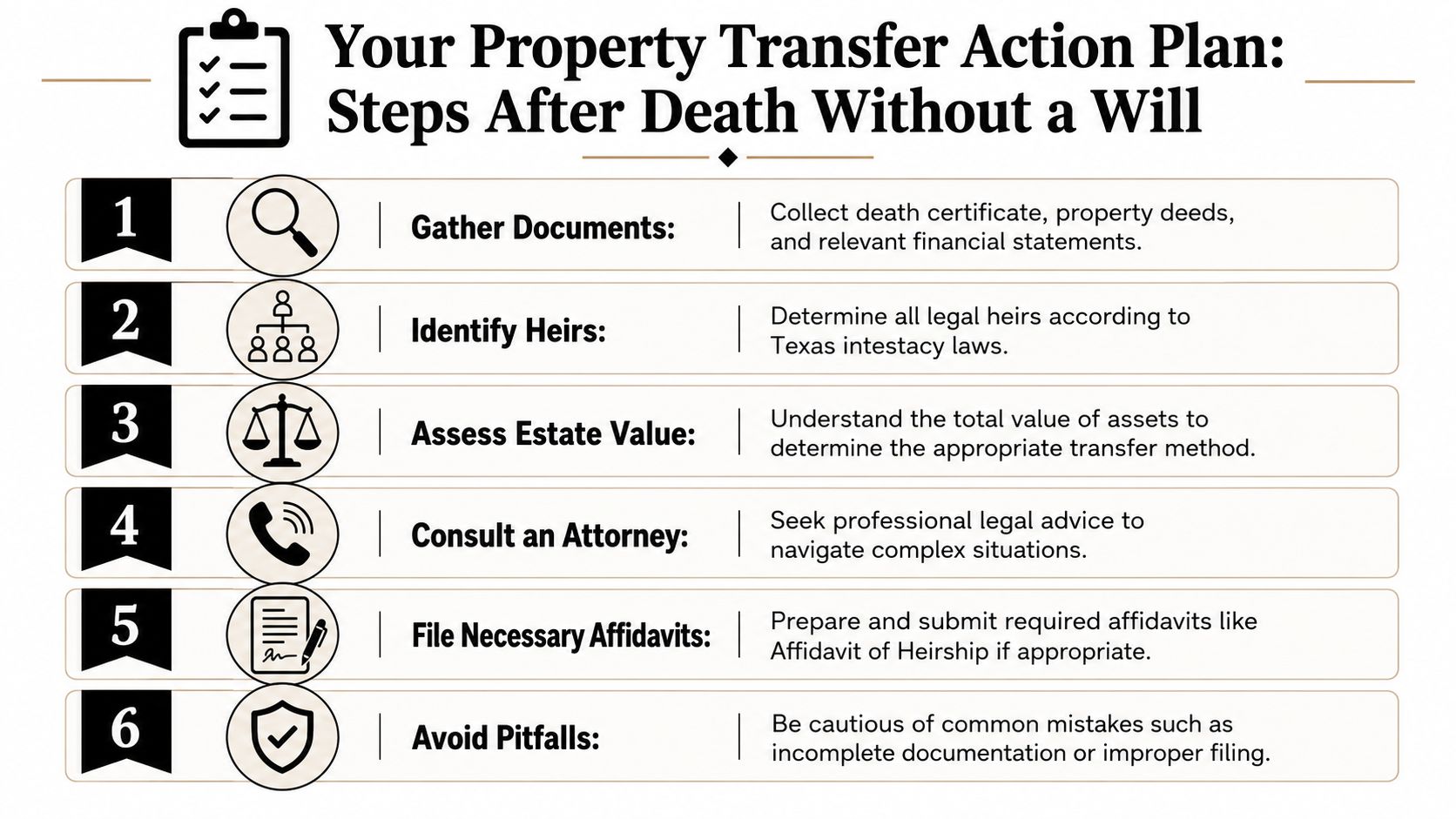
A practical first-week checklist
Get certified death certificates
You'll need them for banks, title work, insurance questions, and court filings.Locate the deed and confirm how title is held
The deed helps answer whether the property was solely owned, jointly held, or already set up to pass outside probate.Build a family tree before filing anything
List spouse, children, deceased children with descendants, parents, siblings, and prior marriages. Heirship depends on facts, not assumptions.Separate real estate issues from non-real-estate issues
The method that works for a house may not be the method that works for a bank account.Match the facts to the right process
Some estates fit an Affidavit of Heirship. Some fit a Small Estate Affidavit. Others need a court proceeding.Talk early if conflict is brewing
Disputes don't improve with delay. They usually become more expensive and harder to unwind.
The TODD mistake families make
One of the most common dead ends involves the Transfer on Death Deed, often called a TODD. Families hear about it and assume they can still sign one after death to avoid probate.
They can't.
A TODD is a pre-death planning tool. It must be signed by the owner, notarized, and filed with the county clerk while the owner is still alive, and after death the beneficiary transfers title by filing an affidavit of death facts with the clerk, as outlined by Texas Law Help's Transfer on Death Deed toolkit. It is impossible to create one retroactively after the owner has died.
If your parent or spouse already passed away without filing a TODD, stop looking for a way to “do one now.” The practical alternatives are the Affidavit of Heirship, a Small Estate Affidavit when available, or a court heirship proceeding.
Other errors that slow everything down
- Signing too soon: Heirs sometimes sign private agreements before confirming who legally inherits.
- Using the wrong affidavit: A form that works for one asset type may not clear title to real estate.
- Ignoring local filing rules: County clerk and court practices matter.
- Waiting too long to ask for help: Delay can reduce options and increase court involvement.
If you want legal guidance with affidavits, administration, or related filings, the Law Office of Bryan Fagan, PLLC handles Texas probate and estate administration matters, including intestate estates, heirship issues, and property transfer questions.
Key Insights and When to Get Legal Help
A common turning point comes a few weeks after the funeral. The family is ready to deal with the house, a bank account, or a vehicle, but no one is sure which path fits the facts. That is usually the moment to stop guessing and sort the estate into a few practical questions.
Start here. What property needs to be transferred? Was the property community or separate property? Are all heirs known, available, and in agreement? The answers usually point to the right tool faster than the estate's dollar value alone.
Key insight
- Real estate often decides the process: A house, land, or mineral interest usually needs more than informal family agreement because title problems can surface years later during a sale or refinance.
- Community and separate property can change who signs and who inherits: A surviving spouse may have strong rights, but those rights depend on whether the asset was acquired during marriage, owned before marriage, inherited, or received as a gift.
- Family agreement affects cost and timing: If heirs agree on the facts and the property is a good fit for an affidavit-based option, the process is usually simpler. If facts are disputed, court involvement is often the safer route.
- Delay can close doors: Texas law generally imposes a four-year deadline for applying to probate a will or seek administration, and delay in an intestate estate can make title work and court options harder.
The practical reason to get legal advice early is simple. A short consultation can help a family choose the correct path before they spend time and money on the wrong forms.
Legal help is especially useful when the estate includes minor children, children from another relationship, an unclear marriage history, a missing heir, or a disagreement about the home. Those cases tend to create title defects, stalled closings, and disputes over who has authority to act.
It also helps to get advice when the family is trying to decide between “good enough for now” and “clean title for later.” An affidavit may solve the immediate problem for one asset, but a court order may be the better choice if the property will be sold, refinanced, or held by multiple heirs. That trade-off is where families often need clear guidance.
The Law Office of Bryan Fagan, PLLC handles Texas probate and estate administration matters, including intestate estates, heirship issues, and property transfer questions. If you are facing probate in Texas, our team can help you assess the property involved, identify the right procedure, and avoid mistakes that are expensive to fix later.