Losing a family member is hard enough without having to make legal decisions in the same week. Many people start with one urgent search: Probate attorney near me in Texas. What they really mean is, “Who can help me do this correctly, keep family conflict down, and tell me what this is going to cost?”
That's the right question.
Choosing a probate lawyer in Texas isn't just about finding the closest office. It's about finding someone who understands the county where the case belongs, explains options in plain English, communicates clearly, and gives you a realistic picture of fees, timing, and what your role will be. A good fit can make a difficult season manageable. A poor fit can create confusion, delay, and unnecessary expense.
First Steps Understanding the Texas Probate Process
Before you hire anyone, it helps to know what probate is and what it isn't. In plain English, probate is the court process used to recognize a will, appoint the person handling the estate, and allow property to pass to the right people. Texas probate law sits primarily in Titles 2 and 3 of the Texas Estates Code, which govern wills, administration, probate procedure, and related estate issues.
If you've just had a death in the family, start with the practical tasks first. Gather the will if one exists, order death certificates, secure the home, and make a list of major assets and debts. A basic legal checklist can help you avoid early mistakes, especially when emotions are running high, and this Texas legal checklist after a loved one dies is a useful place to organize those first steps.
The main paths an estate can take
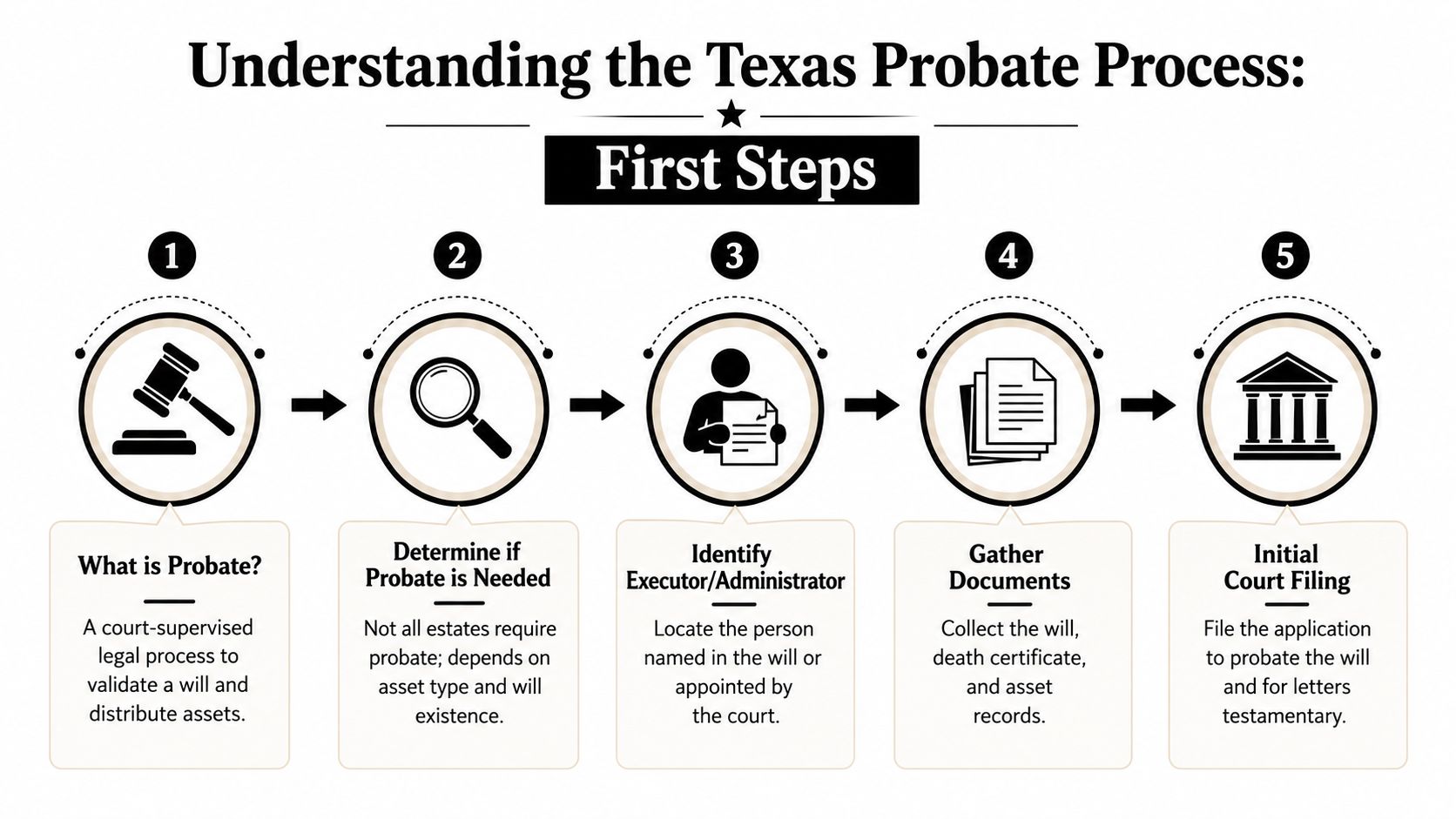
Texas gives families more than one route. That matters because the right lawyer should talk to you about the right procedure, not assume every estate needs the same kind of case.
- Independent administration often gives the executor more freedom to handle the estate without constant court supervision. In plain terms, that usually means fewer court check-ins and a more efficient process.
- Dependent administration involves more court oversight. This may be necessary when there is no will, conflict among heirs, creditor concerns, or other complications.
- Muniment of title may work in limited situations where there is a valid will and little or no need for a full administration. It is often used to transfer title to property.
- Small Estate Affidavit is a simplified option for certain smaller estates.
One Texas rule is especially important: for estates valued at less than $75,000, excluding the decedent's home, where debts do not exceed assets, Texas allows a Small Estate Affidavit as a simplified alternative to formal probate, significantly reducing costs and time, as explained in Granbury Law's overview of Texas probate.
Practical rule: If a lawyer starts talking about full administration before asking whether the estate might qualify for a simpler path, keep asking questions.
Plain-English terms that matter
A few probate words come up in almost every consultation.
| Term | Plain-English meaning |
|---|---|
| Executor | The person named in a will to handle the estate |
| Administrator | The person the court appoints if there isn't a valid executor in place |
| Letters Testamentary | The court document proving an executor has authority to act |
| Intestate | Dying without a valid will |
| Estate | Everything the person owned and owed at death |
These terms come from the Texas probate system under the Estates Code, but they don't need to feel mysterious. A probate lawyer should translate them into what they mean for your family, your timeline, and your responsibilities.
A realistic example
Suppose your mother died in Texas with a will, a house, one bank account, and no family dispute. Her will names you as executor. That estate might move through a more efficient route than a contested estate with unclear heirs or unpaid creditor issues.
Now change one fact. There is no will, and family members disagree about who should handle the estate. That usually points toward a more formal process and a stronger need for county-specific probate counsel.
The right attorney won't just define probate. They'll tell you which lane your case likely belongs in, and why.
How to Locate a Probate Attorney in Your Texas County
“Near me” matters in probate for a legal reason, not just a convenience reason. Texas probate proceedings must be filed in the proper court. Texas Estates Code § 32.001 requires probate matters to be filed and heard in a court exercising original probate jurisdiction, which is typically the county court where the decedent resided at the time of death, as reflected in Texas Estates Code § 32.001.
That means a Harris County estate usually belongs in Harris County. A Denton County estate usually belongs in Denton County. Even if you live elsewhere, the case follows the decedent's county in most situations.
Build a short list the smart way
A broad internet search is a starting point. It shouldn't be the whole strategy.
Look for attorneys using a few channels at once:
- County-based searching because local filing rules, scheduling practices, and clerk procedures matter.
- Referrals from accountants, financial advisors, or real estate professionals who regularly see estate administration issues.
- Firm websites that explain Texas probate procedures clearly instead of using only generic marketing language.
- Educational material focused on county differences, such as this overview of how probate laws differ across Texas counties.
A useful question during your search is whether the lawyer regularly works in the county where the estate must be opened. Probate practice is statewide, but local familiarity often helps with filing expectations, hearing settings, and document preferences.
What “local” should mean to you
Some families think they need the office closest to their home. That's not always the right measure. The better question is whether the lawyer is local to the court that matters.
The attorney doesn't need to live down the street from you. The attorney needs to understand the court handling the estate.
That's also why educational resources like When to Hire a Texas Probate Attorney can be helpful. The core issue isn't just whether you can find a lawyer. It's whether the matter is one of the many Texas probate situations that usually require one.
A quick screening approach
When you identify candidates, check for these signs early:
- County focus: Do they mention work in your decedent's county or surrounding counties?
- Probate concentration: Do they discuss probate, estate administration, wills, or disputes in detail?
- Clarity: Do they explain process choices plainly, or do they bury everything in vague language?
- Responsiveness: Do they make it easy to request a consultation and ask practical questions?
A short list of three to five serious candidates is usually enough to move into the next step, which is vetting them carefully.
Your Vetting Checklist for Texas Probate Lawyers
Families often make the hiring decision too quickly. They're grieving, deadlines feel urgent, and the first lawyer who answers the phone can seem “good enough.” In probate, that shortcut can cost time, money, and peace inside the family.
A careful vetting process helps you compare lawyers based on facts, not stress. That matters because a standard Texas probate often takes 6 to 12 months, while independent administration can reduce time and legal expense by limiting ongoing court supervision, as described in this discussion of hiring a probate attorney in Texas. If the process may stay open for months, communication style and case management aren't small issues. They are central issues.
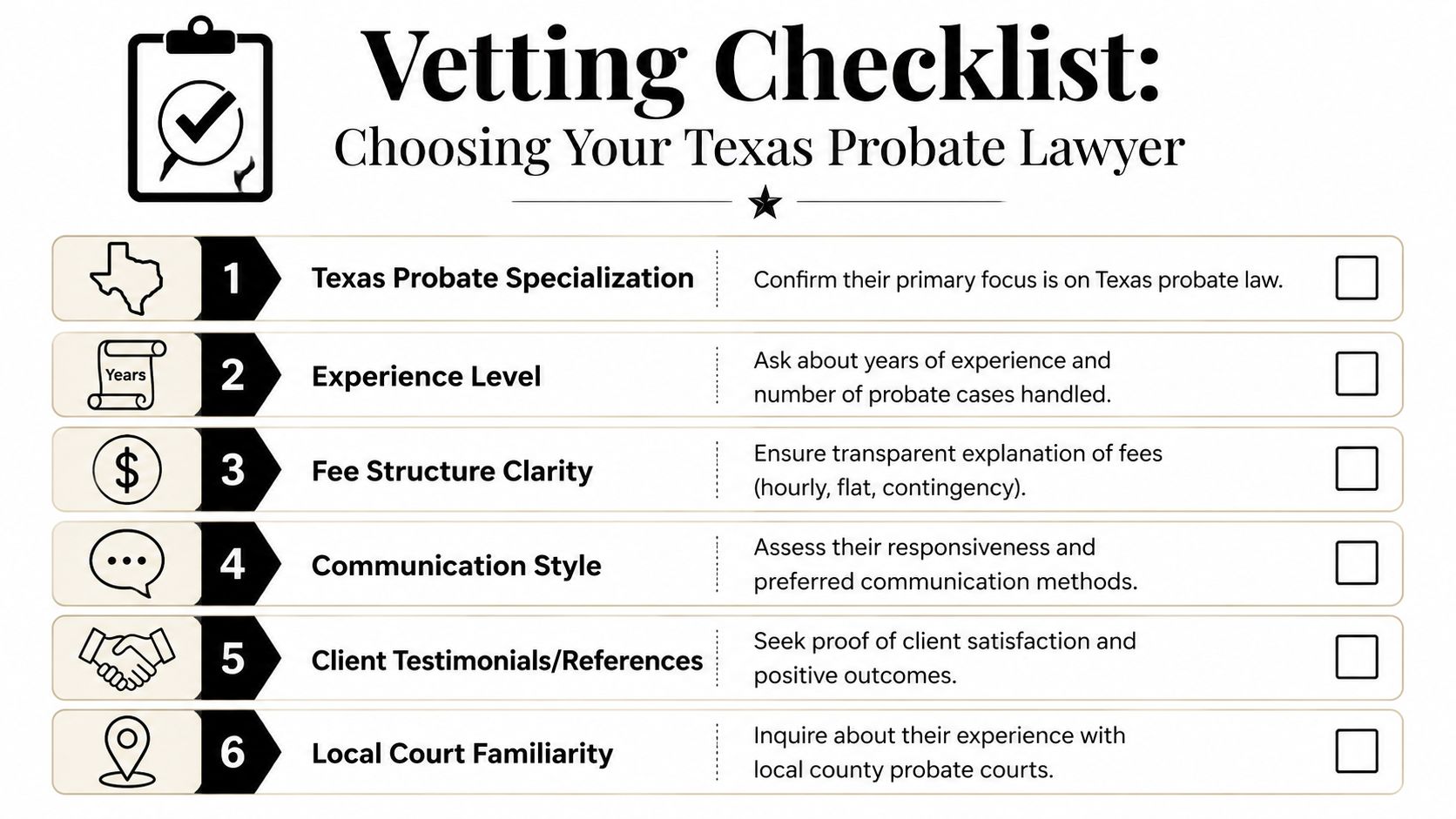
What to check before you hire
Use this list like a filter, not a formality.
- Probate is a real practice focus: A lawyer who “also handles probate” may not be the same as one who regularly opens estates, obtains Letters Testamentary, prepares inventories, and addresses heirship or title issues.
- County familiarity is specific: Ask whether the lawyer has handled probate matters in the court where your case belongs. General Texas knowledge is good. County-level experience is better.
- The lawyer explains the likely probate route: You want someone who can tell you whether your facts suggest independent administration, dependent administration, a muniment of title, or a simplified alternative.
- Communication expectations are clear: Ask who returns calls, who drafts documents, and how updates are provided. If a firm is vague before you hire them, that usually won't improve later.
- The attorney addresses family dynamics directly: Good probate counsel asks about conflict early. Silence around potential disputes is not reassuring. It can be a warning sign.
Signs that should give you pause
Some red flags show up fast.
| Red flag | Why it matters |
|---|---|
| The lawyer gives a firm legal answer before seeing the will or asset picture | Probate depends on facts |
| Fees are discussed vaguely | Confusion later often means conflict later |
| The firm treats every estate as a full probate case | You may miss a simpler option |
| No one asks where the decedent lived | Venue is basic and critical |
| Communication feels rushed or dismissive | Probate requires steady guidance |
A probate lawyer should make a hard process feel clearer. If the conversation leaves you more confused, keep looking.
A realistic fit test
Consider two lawyers. One has a polished website and a broad practice. The other spends most of the consultation asking where the decedent lived, whether there is an original will, what assets are probate assets, whether there are unpaid creditors, and whether all heirs agree.
The second lawyer is usually asking the better questions.
If you want one option among many, the Law Office of Bryan Fagan, PLLC handles Texas probate and estate administration, including independent and dependent administration, heirship-related matters, and probate disputes. The point isn't to choose a firm based on branding. It's to choose counsel based on whether they can match the legal path to the facts in front of you.
The personal side of vetting
Technical skill matters. So does bedside manner.
You may need to ask this lawyer about a sibling who isn't cooperating, a parent's handwritten notes, a home that can't be sold yet, or accounts you can't access. Probate is legal work, but it lands in the middle of real grief. The right attorney won't speak down to you or hide behind jargon. They'll tell you what works, what doesn't, and what comes next.
Key Interview Questions and Understanding Attorney Fees
The consultation is where many families either gain confidence or lose it. Bring your questions in writing. If you're emotional, overwhelmed, or handling calls for several relatives at once, a written list keeps the meeting productive.
A strong consultation should cover strategy, timeline, likely court procedure, your responsibilities, and fees. It should not feel like a sales pitch with no substance.

Questions worth asking
These questions usually produce useful answers quickly:
- What probate route do you think fits this estate, and why?
- What documents do you need before you can confirm that recommendation?
- Have you handled probate matters in this county's court?
- Will I be working directly with you, or mostly with staff?
- How do you prefer to communicate, and how often should I expect updates?
- What problems do you see right now, if any?
- Do you expect this matter to stay routine, or are there signs it could become contested?
- What will you need from me as executor or applicant?
One of the best fee conversations also starts with process. If a lawyer can't explain the expected work, it's hard to evaluate whether the fee structure makes sense.
What Texas probate fees commonly look like
In Texas, probate attorneys typically charge between $250 and $500 per hour, and average flat fees for straightforward estates range from $2,500 to $5,000. In major metropolitan areas like Houston or Dallas, hourly rates tend to be on the higher end of that range, according to this explanation of Texas probate attorney fees.
That means you should ask whether the quote is:
- Hourly, where you pay for time spent
- Flat fee, where a routine scope of work is priced in advance
- Mixed, where basic probate work is flat fee but unusual issues are billed separately
Ask what is included. A flat fee for probating a will may not include deed work, tax filings, disputes, or hearings beyond the expected first setting.
For a fuller discussion of billing structures and what families should ask about, review this guide to probate attorney fees in Texas.
Costs beyond the attorney's bill
Attorney fees are only one part of the expense picture. Court filing fees, certified copies, notice costs, and other estate expenses can also apply. In some cases, the lawyer's fee is paid from estate funds rather than from your personal funds, but that depends on the posture of the case and timing.
Here's a helpful overview to watch before your consultation:
A fee answer that should concern you
Be careful if a lawyer says something like, “Don't worry about fees, we'll figure it out later.” Probate work often lasts months. Unclear billing at the start can create serious friction by the middle.
Ask for the scope in plain English. If the fee changes when the scope changes, that's understandable. If the scope is never defined, that's a problem.
A straightforward consultation should leave you understanding not just the price, but what the attorney will do for that price.
Can Texas Probate Be Handled Remotely?
Yes, in many cases it can. That matters because many executors live in a different city than the decedent, and some live outside Texas entirely. A search for a probate attorney near me in Texas often starts as a local search, but for many families the better question is whether the lawyer can manage the matter efficiently without requiring repeated in-person appearances.
Texas probate practice has adapted. Data shows that 34% of probate estates involve non-resident executors. Texas courts have increasingly accepted virtual hearings, and Texas State Bar guidance permits up to 90% of probate filings to be completed digitally, according to Texas Probate Attorney's discussion of remote probate trends.
What remote probate usually includes
A capable probate firm should be able to tell you which parts of your matter can be handled from a distance. That often includes:
- Virtual consultations to review the will, family tree, and asset picture
- Electronic sharing of documents so the lawyer can review what exists before filing
- Remote communication with executors and heirs by phone, video, and secure email
- Digital filing in many probate matters depending on court procedure
- Virtual hearing options in some settings when the court allows them
That doesn't mean every step is remote in every county. Some courts still have county-specific preferences. Some documents still need original signatures or formal notarization. A good lawyer won't promise a fully virtual experience in every case. They'll tell you exactly which pieces can be handled remotely and which can't.
What to ask if you live outside Texas
If you are an out-of-state executor, ask these questions early:
| Question | Why it matters |
|---|---|
| Can you open this probate without me coming to Texas immediately? | Helps with planning and travel |
| Which documents need original signatures? | Avoids mailing delays |
| Will I need to appear for any hearing? | Sets expectations early |
| How do you handle notarization and document delivery? | Prevents last-minute scrambling |
A lawyer who already works with remote executors should answer those questions easily. If the firm sounds uncertain about basic remote logistics, keep searching.
Remote capability isn't a luxury anymore. For many Texas families, it's part of competent probate representation.
Your Next Steps and Final Takeaways
If you're standing at the beginning of this process, don't try to solve every probate issue at once. Focus on the next right decision. For most families, that means choosing counsel carefully, gathering the right papers, and getting a clear explanation of the probate route before filing anything.
Texas probate law under Titles 2 and 3 of the Estates Code can feel technical, but the first part of the job is practical. Find the original will if there is one. Confirm the county where the decedent lived. Make a rough list of assets, debts, and family members. Then speak with a lawyer who can tell you what needs court action and what may pass outside probate.
Key Insight
Key Insight: The best probate attorney near you in Texas is not simply the closest lawyer. It's the lawyer who understands the correct county, identifies the right probate path, explains fees clearly, communicates consistently, and can handle your case in the way your family actually needs, whether that's in person or remotely.
What to gather before the first consultation
Bring as much of this as you can. If you don't have everything yet, that's normal.
- Original will if one exists: A copy helps, but the original matters.
- Death certificate: The court and financial institutions will often require it.
- Names and contact information for heirs and beneficiaries: This helps the attorney spot notice issues early.
- Basic asset list: Real property, bank accounts, vehicles, business interests, and anything else significant.
- Debt information: Mortgage statements, credit cards, medical bills, and known claims.
- Any prior court paperwork: Guardianship, divorce, trust documents, or deeds can affect probate strategy.
Related legal issues families often discover
Probate often overlaps with other legal needs. Depending on your situation, these resources may help:
- Texas Probate Process
- Guardianship
- Wills & Trusts
- Probate Litigation
A realistic example is a surviving spouse who starts by asking about probating a will and then learns there are title issues on the home, concerns about an aging family member's capacity, or disagreement among children about what the will means. Those issues are common. They don't mean the case is hopeless. They mean the legal advice needs to fit the facts.
A steady way forward
You don't need to know every probate rule before making the first call. You do need someone who can explain your options in plain English, tell you what can wait and what can't, and help you avoid expensive detours.
If you're unsure whether you need full probate, a Small Estate Affidavit, a muniment of title, or something more formal, that uncertainty is exactly why the consultation matters. The right attorney will narrow the questions, not multiply them.
If you're facing probate in Texas, our team can help guide you through every step, from filing to final distribution. Schedule your free consultation today. Contact the Law Office of Bryan Fagan, PLLC to talk through your situation with a Texas probate team that helps families, executors, and heirs move forward with clarity.