Skip to content
Sorting through a loved one's affairs often starts the same way. Someone hands you a box, a folder, or a kitchen-table stack of papers. There may be a car title, a bank statement, an unpaid bill, and maybe a will. At the same time, your family is grieving, fielding calls, and trying to decide who's supposed to do what.
That's when one of the most common Texas estate questions shows up. Does this estate need probate, or can the family use a Small Estate Affidavit?
The answer depends on more than whether the estate seems “small.” In practice, the right choice turns on a mix of legal rules and human realities. Was there a will? Are all heirs easy to identify? Is everyone an adult? Are there debts? Is there real estate involved? Those details matter because the process that looks simpler on paper isn't always available in real life.
If you're still in the early days after a loss, this Texas legal checklist for what to do immediately after a loved one dies can help you get organized before you make decisions about the estate.
Navigating Your Next Steps After a Loss
A daughter loses her father and finds two checking account statements, a vehicle title, and a few medical bills. Her brother says, “We don't need court. It's a small estate.” Another relative says, “Everything has to go through probate.” Both are speaking from instinct, not from the Texas Estates Code.
That kind of confusion is normal. Families are trying to make legal decisions while they're also planning services, caring for children, and dealing with the emotional shock of a death. What helps is reducing the choice to two paths in plain English.
Two different tools for two different situations
Formal probate is the standard court process for settling an estate. It's the structured route the court uses to recognize a will, appoint the person in charge, deal with debts, and transfer property to the right people.
A Small Estate Affidavit, often called an SEA, is a limited shortcut. It can work well in the right case, but only if the estate and the family situation fit the rules closely.
Most families don't need more jargon. They need a practical question answered: which option fits this case?
Probate isn't a punishment. It's the court's way of giving someone clear authority to act when the estate needs that protection.
What families usually need to know first
Before choosing a path, focus on a few facts:
- Whether there is a valid will: A will changes the analysis right away.
- What property exists: Bank accounts, vehicles, a homestead, or other real estate can lead to different legal steps.
- Who the heirs are: A clean family tree is easier to document than a blended or disputed one.
- Whether debts are manageable: Even a modest estate can become more complicated when liabilities are involved.
For many readers, the central issue isn't “Which option is faster?” It's “Which option will the court accept without causing delays later?” That's the question worth answering carefully, especially when title to property, bank access, or family conflict may be on the line.
Understanding Formal Probate in Texas
Formal probate is the default path for many Texas estates. Under Title 2 of the Texas Estates Code, the court supervises the process of recognizing the decedent's legal affairs and authorizing someone to act for the estate.

What probate actually does
Probate has a few core jobs:
- It confirms the controlling document, if there is one. If the person left a valid will, the court can admit it to probate.
- It appoints the person in charge. That may be an Executor if a will names one, or an Administrator if there's no will.
- It creates legal authority. When the court issues Letters Testamentary or Letters of Administration, think of them as a court-issued permission slip. Banks, title companies, and others rely on those papers.
- It gives a framework for handling debts and distributions. The estate can be gathered, claims can be addressed, and remaining property can be transferred properly.
If you want a closer look at the filing side, this guide on filing a probate application in Texas explains how the court process begins.
Why formal probate is often the safer choice
Families sometimes worry that probate automatically means conflict, delay, or public fighting. Often, it's an orderly process. It works especially well when there is a valid will, when assets need clear authority for transfer, or when there are questions that shouldn't be handled informally.
A few situations commonly point toward probate:
- A valid will exists
- Property needs clear title transfer
- Debts or creditor issues need formal handling
- Family members disagree about who should receive what
- A third party, such as a bank or title company, wants court papers
Later in the process, many families benefit from hearing a plain-language overview like this:
Plain-English probate terms
Here are the terms that usually cause the most stress:
- Executor: The person named in a will to carry out the estate process.
- Administrator: The person the court appoints when there is no will or no executor able to serve.
- Letters Testamentary: Court papers that show the executor has authority to act.
- Estate administration: The actual work of collecting assets, dealing with debts, and distributing what remains.
A lot of probate anxiety comes from not knowing who has authority. Formal probate answers that question clearly.
When an estate has moving parts, that clarity matters more than convenience.
Exploring the Small Estate Affidavit Shortcut
A Small Estate Affidavit is not a mini version of full probate. It's a separate procedure under Chapter 205 of the Texas Estates Code that can allow heirs to collect and distribute certain estate property without opening a full administration.
The appeal is obvious. If the estate qualifies, the process can be more direct and less burdensome than formal probate. But eligibility is strict, and families often discover that the shortcut only works for a narrow group of cases.
If you're comparing your situation against the statutory requirements, this page on the Texas Small Estate Affidavit process is a useful starting point.
The core eligibility rules
Texas's Small Estate Affidavit is designed for estates that are relatively modest. The estate must generally have $75,000 or less in assets, excluding the homestead and exempt property, there must be no valid will, and there must be no prior petition for administration filed, according to the Texas State Law Library's overview of informal probate methods.
That same Texas State Law Library guidance also explains another rule families miss. The assets must be sufficient to pay debts other than certain mortgage or exempt-property-secured obligations. In plain terms, an estate can be under the dollar cap and still fail to qualify because the liabilities are too high.
What that means in everyday terms
An SEA is usually strongest when the facts are simple:
- No will exists
- The family can identify every heir clearly
- The estate is mostly personal property
- Debts don't overwhelm the available assets
- No one has already started a formal administration case
This is why the phrase “small estate” can be misleading. Small doesn't always mean simple. A modest bank account and a family in full agreement may fit the affidavit route well. A modest estate with unclear heirship, debts, or difficult property issues may not.
Practical rule: The Small Estate Affidavit works best when the estate is small, intestate, and easy to document from the start.
Why Chapter 205 matters
Chapter 205 gives the procedure legal structure. That matters because the court isn't just rubber-stamping a family agreement. The court has to be satisfied that the estate fits the statute and that the affidavit contains the information needed to justify using this shortcut.
For grieving families, that leads to an important takeaway. An SEA can save time and effort when it fits. It can also waste time if the family forces it into a case that really calls for administration. The smartest first move is usually not “How do we avoid probate?” It's “Which process matches the facts we have?”
Probate vs SEA A Side-by-Side Comparison
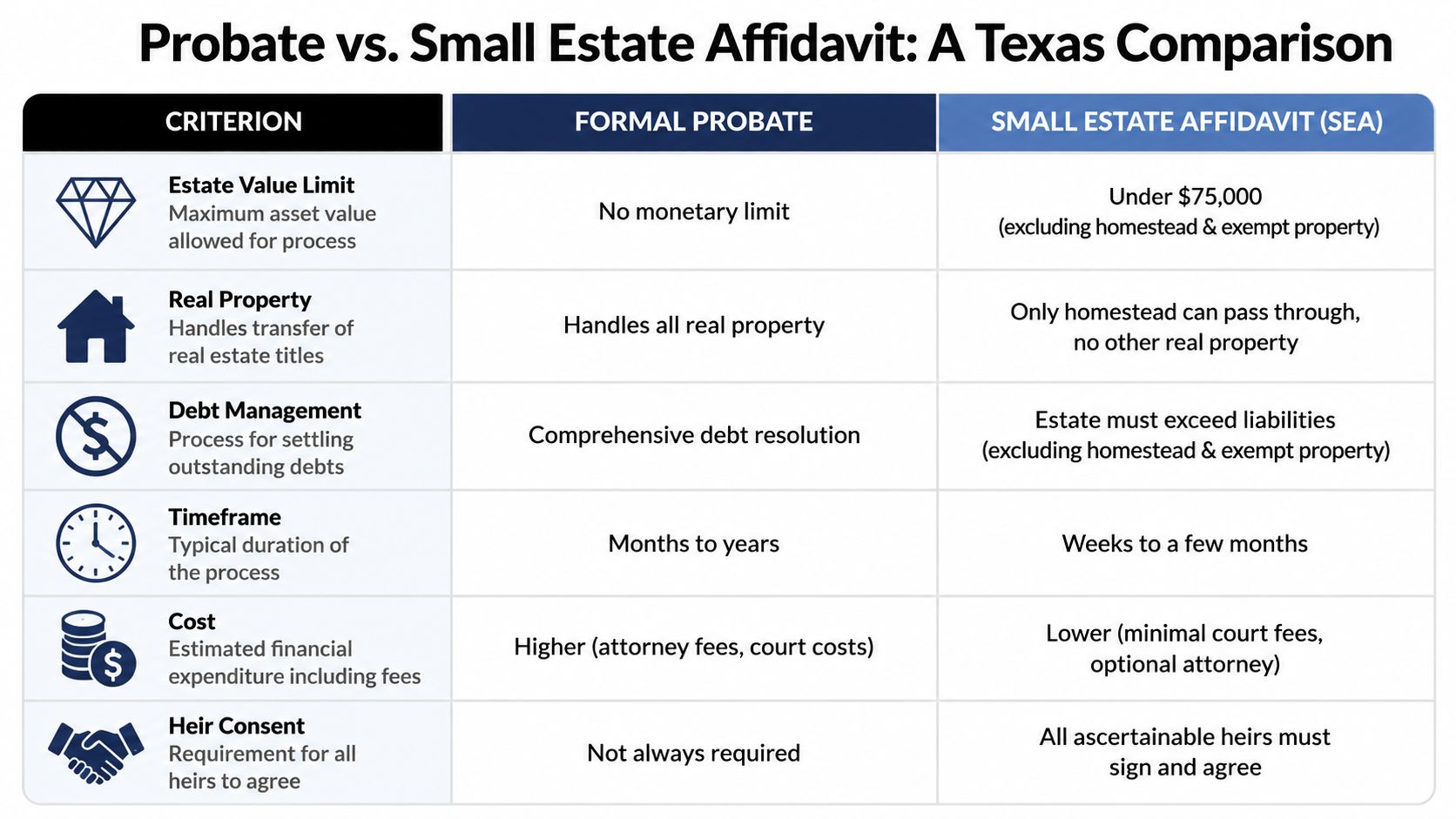
When families compare probate vs Small Estate Affidavit in Texas, they usually care about authority, speed, cost, paperwork, and whether the estate will qualify. The table below gives a practical snapshot.
| Criterion | Formal Probate | Small Estate Affidavit |
|---|---|---|
| Will | Commonly used when there is a valid will, or when a court needs to appoint an administrator if there is no will | Not available when there is a valid will |
| Estate value | No fixed value cap discussed here | Limited to $75,000 in assets excluding homestead and exempt property, as noted earlier |
| Court involvement | Ongoing court-based process with appointment authority and formal orders | Court-approved affidavit process, but narrower and more limited |
| Debts | Better suited for estates that need structured debt handling | Assets must be sufficient to pay debts under the statutory framework |
| Real property | Better for estates involving title issues or property beyond a straightforward homestead situation | More limited in practice, especially where property questions complicate the estate |
| Family conflict | Better equipped to handle disagreement, unclear heirship, or contested issues | Works best when the family situation is clean and undisputed |
| Authority for third parties | Stronger and clearer for banks, buyers, title companies, and other institutions | May work, but only within the narrower scope of the affidavit process |
What usually matters most in the real world
A side-by-side list only gets you so far. In practice, these are the trade-offs families feel first:
- Control and certainty: Probate gives the person in charge clearer authority.
- Simplicity: SEA can be simpler, but only when the facts are clean.
- Tolerance for complications: Probate handles complications better. SEA has less room for mistakes.
- Family cooperation: SEA depends heavily on agreement and documentation.
That last point is often the hidden issue. If one heir is estranged, one child is a minor, or no one can agree on the family tree, the “simple” option may stop being simple.
Related planning concerns
Many estate disputes could have been reduced by stronger planning before death. A valid will or trust-based plan can make later decision-making far more manageable. If you're thinking beyond the current estate, it may help to review the firm's pages on Wills & Trusts and Probate Litigation.
The cheapest-looking option at the start isn't always the least expensive path if it fails and the family has to start over.
Realistic Scenarios When to Choose Each Path
Legal rules make more sense when you can see how they play out in a real family.
When an SEA is a good fit
Sarah's father dies without a will. He leaves a checking account, a modest savings account, and a paid-off car. There's no business, no rental property, and no dispute about family members. Sarah is the only adult child, and there aren't competing claims from other relatives.
That's the kind of case where a Small Estate Affidavit may fit well. The estate is modest, heirship is straightforward, and there isn't a complicated debt picture pulling the family into a larger administration.
What usually helps in a case like Sarah's:
- Clean documentation: death certificate, account information, vehicle information
- Clear heirship: no uncertainty about who inherits
- Manageable debts: no creditor tangle that makes administration necessary
In a situation like this, the affidavit route can serve the purpose the statute was built for. It gives heirs a practical way to move forward without opening a full probate administration.

When probate is the better answer
Now consider the Martinez family. Their mother's estate appears modest at first glance. But she left a valid will, some credit card debt, and a small rental property. Three children are involved, and one lives out of state. One sibling wants to sell the property quickly. Another wants to keep it.
This is not a Small Estate Affidavit case, even if the family hoped it might be. The will alone changes the analysis. The rental property creates title and transfer issues. The debt picture also calls for more structure.
Formal probate gives this family what they need:
- A recognized decision-maker through court appointment.
- A legal framework for dealing with debts and estate obligations.
- A reliable path for transferring title and addressing disagreements.
A third kind of case lawyers see often
Some estates fall in the middle. The family thinks the estate should qualify for an SEA because the numbers seem modest, but the practical facts are messy. Maybe there was a prior marriage. Maybe there are children from different relationships. Maybe one heir can't be located, or the family has no neutral witnesses who can support the heirship paperwork.
That's where careful legal review matters. The issue isn't only the asset level. The issue is whether the estate can be proven cleanly enough for the affidavit route to work.
A firm such as the Law Office of Bryan Fagan, PLLC can review those threshold questions, prepare probate filings when administration is needed, and help families decide whether an SEA is realistic before they lose time on the wrong process.
Common Pitfalls Why an SEA Might Be Denied
Many online summaries make the Small Estate Affidavit sound like a math test. If the estate is under the threshold, the family assumes it qualifies. That's one of the most common mistakes.
The harder question is whether the family can present a clean, fully documented, legally acceptable picture of heirship and need.
Minor heirs and family complexity
Texas Law Help notes that some courts will not approve a Small Estate Affidavit if any heirs are minors, and the court must determine that no administration is needed before heirs can collect assets, as explained in its guide to Texas Small Estate Affidavits.
That matters because minors often need added protection. If a child's interest is involved, the court may prefer a more formal process, and in some cases families may need to consider related issues such as guardianship proceedings.
Other common failure points
Even where there are no minor heirs, these issues can derail an SEA:
- Disputed heirship: family members disagree about who the legal heirs are.
- Blended family questions: children from different relationships can make documentation harder.
- Out-of-state heirs: signatures, coordination, and records often become harder to gather.
- Incomplete paperwork: missing asset lists, debt schedules, funeral expense proof, or witness information can stop the filing.
- Need for disinterested witnesses: courts often want neutral people who can support the family history.
Some of the toughest SEA cases aren't legally large. They're factually messy.
Why courts scrutinize these filings
An SEA asks the court to allow property transfer without full administration. Because of that, judges often expect careful, complete, and credible paperwork. If the affidavit leaves gaps, the court may deny it or require a different process.
That's why families should be cautious about self-diagnosing eligibility. A case can look simple from the kitchen table and still fail once the court asks harder questions about heirs, debts, or whether administration is unnecessary.
Your Decision Checklist and Key Takeaways
By the time a family reaches this decision, they usually want something simple. Not simplistic. Just simple enough to act on.
Decision checklist
Use these questions as a first-screen review of your case:
- Is there a valid will? If yes, formal probate is often the starting point.
- Is the estate under the statutory limit for an SEA? Remember that the earlier section explained the $75,000 cap and the exclusions that apply.
- Are all heirs clearly identifiable? Unclear family history can block the affidavit route.
- Are all heirs adults and generally in agreement? If not, probate may be the safer path.
- Does the estate include real property issues that need formal title work? Those cases often need stronger court authority.
- Are debts simple and manageable, or do they raise questions that need structured handling?
- Has anyone already filed a petition for administration? That can affect whether the shortcut is even available.

Key Insight
The Small Estate Affidavit is a strong tool for the right case, but only for the right case. It tends to work when the estate is modest, there is no valid will, heirship is easy to prove, debts are manageable, and the family situation is clean.
Formal probate is usually the better fit when the estate involves a will, difficult property issues, family conflict, minor heirs, unclear heirship, or debt problems. It may feel more formal, but that structure protects everyone involved and often prevents bigger problems later.
If you're unsure which category your family falls into, that uncertainty itself is a sign to get legal guidance. A short review on the front end can save months of frustration, rejected filings, and conflict between relatives.
If you're facing probate in Texas, our team can help guide you through every step, from filing to final distribution. Schedule your free consultation today with Law Office of Bryan Fagan, PLLC.