Skip to content
Probate for a straightforward, uncontested estate in Texas usually costs $3,000 to $7,000. If the estate qualifies for a Small Estate Affidavit, total cost can be as low as $300 to $2,000.
If you're reading this after losing a parent, spouse, or other loved one, you're probably balancing grief with paperwork, deadlines, and family questions. One of the first practical concerns is cost. That's understandable. You want to do things correctly, but you also don't want surprises.
The most important thing to know is that the legal path chosen often affects probate cost more than the estate's size alone. Two estates with similar values can have very different costs if one qualifies for a simplified procedure and the other requires a full court-supervised administration. Texas Estates Code Titles 2 and 3 govern much of this process, including who inherits, how wills are admitted to probate, and how personal representatives manage estates.
Understanding Probate Costs While Grieving a Loss
When a loved one dies, families often need answers before they have all the documents in front of them. You may not yet know every bank account, whether there's a valid will, or whether a house was titled in one name or two. Even so, you're trying to estimate legal expenses and decide what comes next.
For many Texas families, the starting point is this: a straightforward, uncontested estate using Independent Administration typically costs $3,000 to $7,000, with attorney fees making up the largest share according to this breakdown of Texas probate expenses. That range often applies to the kind of probate people imagine when there's a valid will, no major dispute, and the executor can act with limited court involvement.
A simple example helps. Suppose your mother left a valid will, owned one home and a few bank accounts, and your siblings agree on everything. That estate may move through probate in a much more efficient way than an estate with no will, multiple parcels of real estate, or family conflict. The court still matters, but the procedure matters more.
Practical rule: The biggest cost question usually isn't "How much was the estate worth?" It's "Which probate process does this estate actually need?"
If you're still at the beginning, this checklist on what to do immediately after a loved one dies in Texas can help you organize the first steps before filing anything.
Texas probate can feel opaque because people hear one number and assume it applies to every case. It doesn't. Costs are made up of several pieces, and some procedures avoid many of those pieces altogether. Once you understand where the money goes and which legal path fits the estate, the process becomes much less intimidating.
Breaking Down the Four Key Probate Expenses
A family often calls my office after hearing one alarming number from a friend or a neighbor. Then they assume that number will apply to them. Probate rarely works that way in Texas. The total usually comes from four separate buckets of expense, and the size of each bucket depends heavily on the legal route the estate has to use.
That last point matters. The same estate can cost very different amounts to handle depending on whether it qualifies for a simpler procedure or requires a fuller administration.
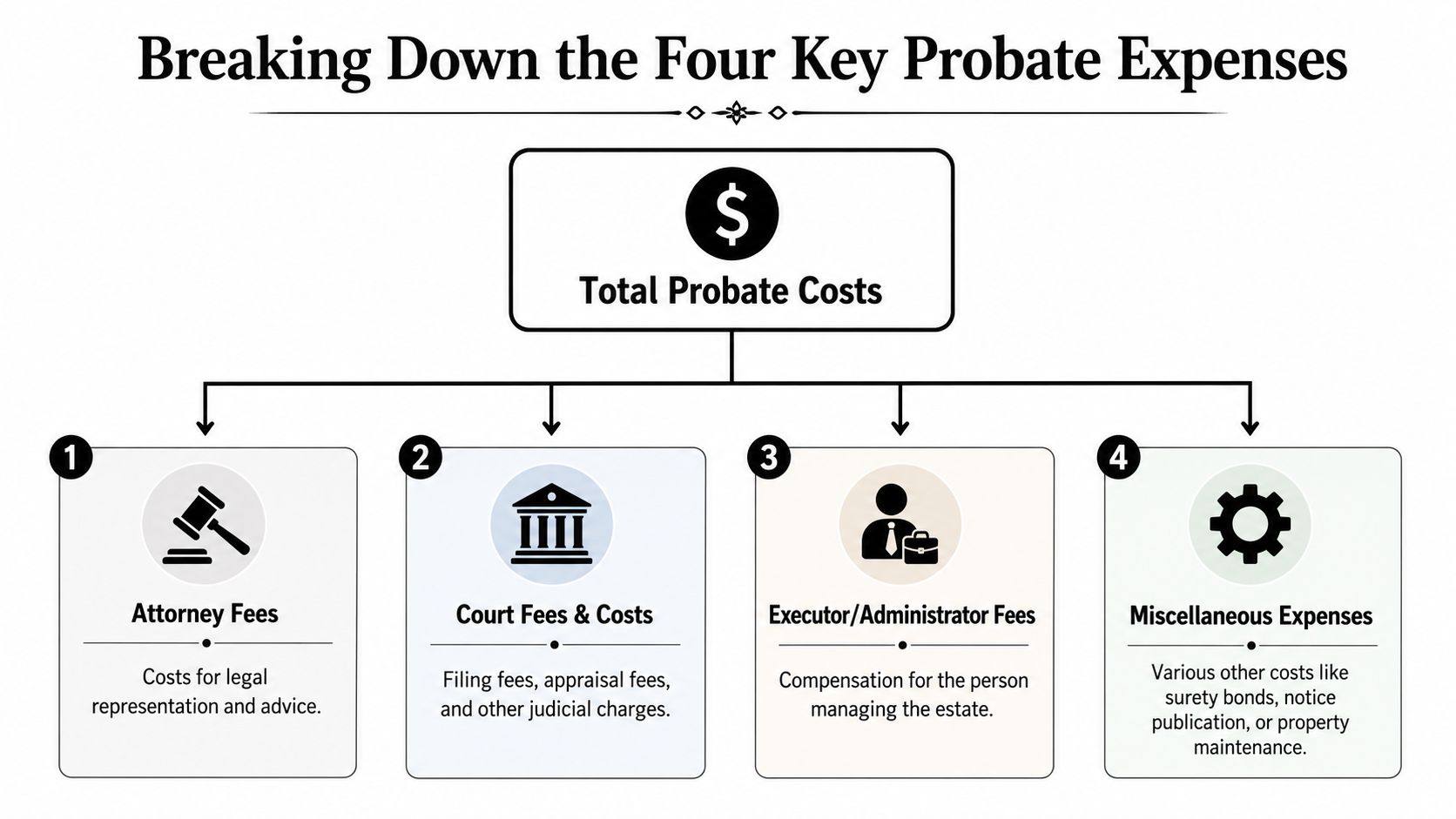
Attorney fees
Attorney fees are usually the largest probate expense because legal work expands or shrinks based on procedure. A straightforward independent administration with a valid will and cooperative heirs often involves a predictable set of tasks, so many lawyers quote a flat fee. A case with missing heirs, title problems, creditor issues, or court supervision usually takes more time, which can lead to higher flat fees or hourly billing.
According to this Texas probate fee discussion, routine matters may fall into a flat-fee structure, while more complex estates can cost much more. The same source also discusses fee reasonableness under Texas Estates Code § 352.051.
For families, the practical question is usually not whether the estate is "big" or "small." It is whether the estate can use a simpler process with fewer court steps. That choice often affects the legal bill more than the raw dollar value of the assets.
If you're comparing fee structures, probate appraisal costs explained can help because valuation issues often create extra legal work. For a broader overview, What Does Probate Cost in Texas? discusses the fees and attorney costs involved in a Texas probate.
Court fees and case expenses
Court costs are the second bucket. These are the charges tied to opening and processing the case, along with the paperwork that supports it.
Common examples include filing fees, issuance fees for notices, publication costs, certified copies, and recording fees for real estate documents. Some estates also need appraisals, deed preparation, or tax return assistance. A simple probate with one house and a few bank accounts may have only a handful of these charges. An estate with several parcels of land or unclear values can generate many more.
That is why procedure matters here too. A shorter, narrower process usually means fewer filings and fewer supporting services. A more involved process often creates more administrative cost even before anyone argues about anything.
Here is what these expenses usually cover in plain English:
- Court filing fees open the probate case.
- Publication fees pay for required public notice.
- Certified copies give the executor official court documents to show banks, title companies, and others.
- Appraisal fees establish the value of property when a professional valuation is needed.
- Deed preparation and recording update county real property records after a transfer.
- Tax or accounting help addresses estate income tax issues or final filings when needed.
Later in the process, many families find it helpful to hear the steps explained visually.
Executor and administration-related costs
The executor or administrator handles the estate's day-to-day work. That can include collecting assets, dealing with financial institutions, arranging notices, keeping records, paying approved claims, and distributing property at the end.
Texas law may allow compensation for that work, but families are often surprised by how uneven this category can be. In one estate, the executor waives any fee because the job is modest and the family is close. In another, the representative spends months tracking down documents, speaking with creditors, and managing property. The amount of work, and whether the court requires closer supervision, often matters more than the estate's headline value.
Administration costs can also include practical tasks that are easy to overlook. Mailing, bond premiums when a bond is required, document retrieval, property security, and house cleanout services all fit here.
Debts, taxes, and cleanup work
The fourth bucket is the one families least expect. These costs are not always labeled as probate fees, but they affect what the estate spends to get through the process.
An estate may need to pay funeral reimbursements, final medical bills, mortgage arrears, property taxes, homeowner's insurance, storage charges, or costs to clear title problems. Sometimes the actual expense is the labor created by disorder. Missing account statements, an unsigned deed, a vehicle with no clear title, or a house full of personal property can add hours of legal and administrative work.
That is why probate costs can feel confusing at first. Two estates can look similar on paper and still end up with very different totals. The difference is often the path required to transfer the property and the amount of cleanup that path demands.
Not All Probate Is Equal Comparing Texas Procedures and Costs
A family comes in after a loss and says, "The estate is not very large, so probate should be cheap, right?" Sometimes yes. Sometimes no.
In Texas, the bigger cost question is usually not the dollar value of the estate. It is which legal path fits the estate. Two estates with similar bank balances can have very different probate bills if one qualifies for a limited procedure and the other requires months of court supervision.
That point relieves some families and surprises others. Probate cost is not just about how much the person owned. It is often about how much legal work the court process requires.
The four main paths
Independent Administration is the route many families hope for. The personal representative can handle much of the estate work without asking the court for permission at every step. If there is a valid will, cooperative beneficiaries, and no unusual problems, this is often the more direct full-administration option.
Dependent Administration involves closer court oversight. The representative may need approval before taking actions that would happen more directly in an independent case. More hearings, more filings, and more attorney time usually mean higher total cost.
Muniment of Title is a limited procedure for a narrower set of estates. It is commonly used when there is a valid will, no unsecured debts other than debt tied to real property, and the family mainly needs a court order to clear title to property. In plain terms, it is often a title-transfer tool rather than a full estate administration.
Small Estate Affidavit is not full probate at all. It is available only if the estate meets Texas legal requirements, including the statutory value cap that excludes the homestead and certain exempt property. When it fits, it is often the least expensive route because it avoids much of the work that makes probate costly.
Texas Probate Options at a Glance 2026 Estimates
| Procedure | Typical Total Cost | Typical Timeline | Best For |
|---|---|---|---|
| Small Estate Affidavit | Often the lowest-cost option | Often faster than full administration | Small estates that meet the statutory limit and other legal requirements |
| Muniment of Title | Often lower than full administration | Often shorter than full administration | A valid will, no unsecured debts, and a need to transfer title efficiently |
| Independent Administration | Mid-range in many uncontested cases | Often several months | Valid will or agreement among heirs, limited conflict, ordinary estate administration needs |
| Dependent Administration | Often the most expensive procedural path | Varies widely | Estates with disputes, complications, or circumstances requiring closer court oversight |
Why procedure usually drives the bill
Probate procedure works a bit like choosing a road before a long trip. If the estate qualifies for the direct road, the family reaches the destination with fewer stops, fewer filings, and fewer attorney tasks. If the estate must take the road with checkpoints at every turn, cost rises even if the assets look ordinary on paper.
Consider two estates. Each has a house, a car, and one bank account. The first includes a valid will, no unsecured debts, and heirs who agree on the basics. The second has no will, unclear family information, and disagreement over who should serve. Those estates may look similar in value, but they are not similar in legal workload.
That is why families should pay close attention to the difference between procedures, especially independent vs dependent administration and which is better in Texas. The choice can affect filing volume, court involvement, attorney hours, and the total amount paid from the estate.
A practical way to sort out the likely path
Start with a few grounding questions:
- Is there a valid will the court can admit to probate?
- Are there unsecured debts that make full administration more likely?
- Could the estate qualify for a Small Estate Affidavit under Texas law?
- Do the heirs and beneficiaries agree, or is conflict already present?
- Does someone need ongoing authority to gather assets, pay bills, and sign documents, or does the family mainly need a court order to transfer title?
These questions matter because the wrong filing can create duplicate work. A family may spend money starting one procedure, then spend more money correcting course after the court or the facts point to a different one.
Texas Estates Code Title 2 contains many of the rules that govern wills, intestacy, and estate administration. For cost purposes, the practical lesson is simple. The least expensive probate is often the one that matches the estate from the start.
Hidden Costs and Red Flags That Increase Probate Expenses
A family can walk into probate expecting a simple court filing and discover, a few weeks later, that the actual cost problem is not the estate's size at all. It is the path the estate is forced onto once missing documents, conflict, debt, or title problems come to light.
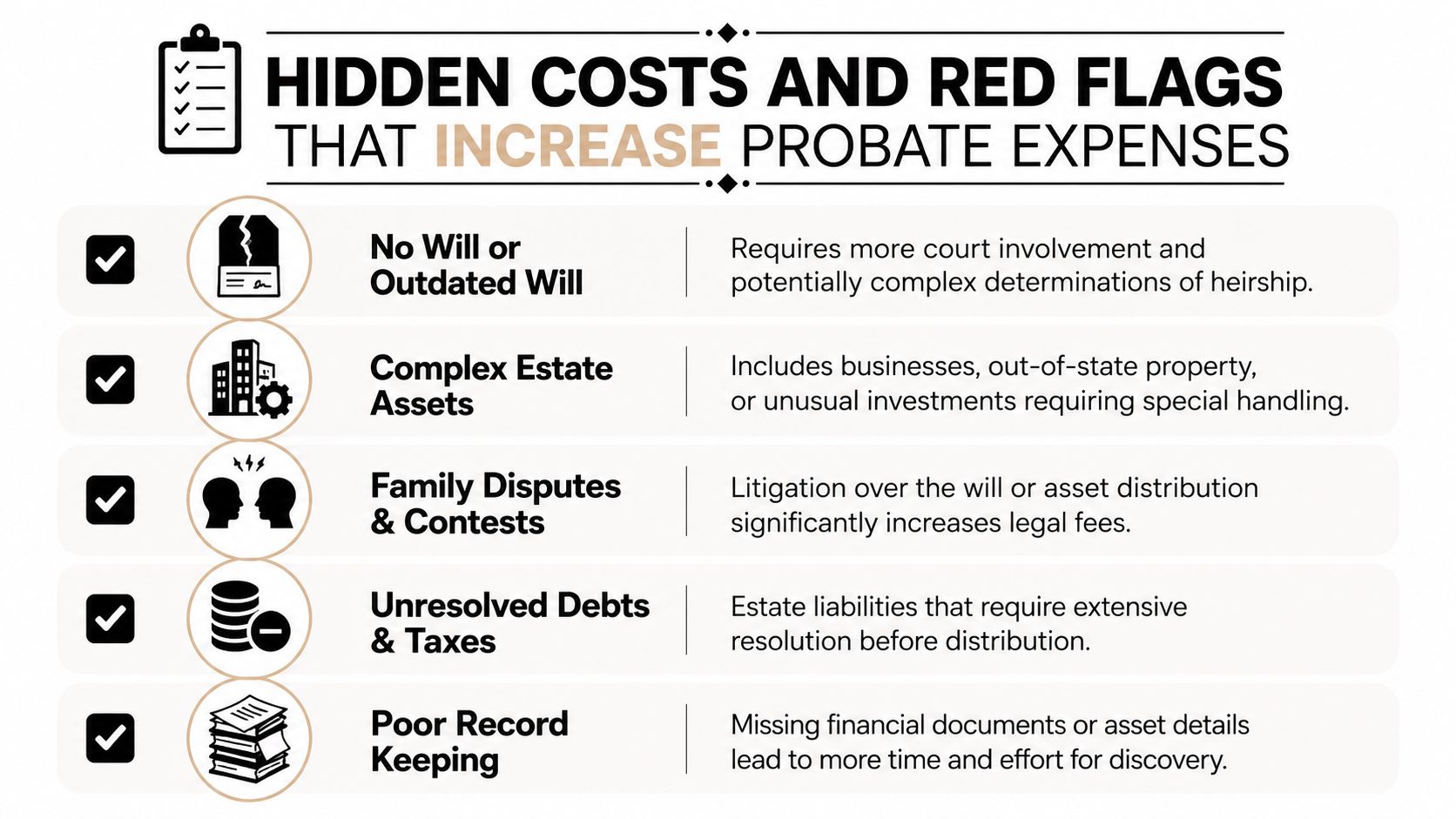
The warning signs families often miss
Probate costs often rise the way a home repair bill rises. The first issue may look small, but once you open the wall, you find other problems behind it. In probate, that usually means the family starts with one procedure in mind, then learns the estate needs a more involved one.
For example, a family may hope to use a simplified option, but then find there is no original will, no clear list of debts, or no agreement on who should handle the estate. That can mean more hearings, more attorney time, and more delay.
Some of the most common red flags are:
- No original will or questions about validity: The court may require extra proof, and the case may shift into a more formal process.
- Assets that are hard to transfer: Real estate with title issues, mineral interests, business ownership, or accounts with incomplete records often create added legal work.
- Disagreement among heirs or beneficiaries: A cooperative estate may stay in Independent Administration. A disputed estate may require much more court involvement.
- Unclear debts or tax issues: Before property can be distributed, someone has to sort out what the estate owes and who must be paid.
- Poor records: Missing deeds, account statements, beneficiary designations, or vehicle titles increase the time needed to prepare filings and close the estate.
The pattern matters. These issues do not just add a few extra tasks. They can push the estate from a lower-cost route into a more expensive one.
The legal path often matters more than the estate value
This is the point many families miss.
A $250,000 estate with a valid will, organized records, and cooperative beneficiaries may cost far less to handle than a $75,000 estate with no will, family conflict, and unclear ownership of property. The reason is practical. Court supervision, repeated filings, contested hearings, and corrective work usually drive fees more than the raw dollar value of the assets.
That is why red flags should be viewed through one question first: Will this issue force a different probate procedure?
If the answer is yes, total cost can change quickly. A matter that looked like a straightforward Independent Administration can begin to resemble a dependent administration or a contested case. A family that expected to avoid full probate may learn the estate does not qualify for the simplified route after all.
Disputes about control and compensation can become expensive fast
Executor compensation can become a source of conflict, but it is rarely just about the fee itself. In many families, an argument about payment is really an argument about trust, fairness, or whether the person in charge is doing the job properly.
Once that kind of dispute starts, legal costs can rise sharply because the court may need to resolve objections, review conduct, or address requests for removal or other relief. The same is true when beneficiaries challenge inventory decisions, property sales, or distributions. At that point, the estate is no longer paying only for basic administration. It may also be paying for litigation.
If the family already sees warning signs such as accusations, mistrust, or fights over money, those concerns deserve prompt attention. In some cases, they lead to court action through probate litigation.
The estates that become most expensive are often the ones that start on the wrong procedural track, then require the court to step in and correct the course.
Putting It All Together Sample Texas Probate Scenarios
Examples often make these rules easier to apply. No two estates are identical, but these situations resemble what many Texas families face.

A straightforward will and cooperative family
Angela's father died with a valid will. He owned one house, a checking account, and a vehicle. Angela is named executor, and her brother agrees with the will's terms.
This is the kind of estate that often fits Independent Administration. In a straightforward uncontested case, the family may be looking at the general $3,000 to $7,000 range discussed earlier. The main reasons are simple. The court admits the will, the executor receives authority, and there isn't constant judicial oversight.
A smaller estate that may avoid full probate
Carlos's mother didn't leave a large estate. She had a modest bank account, personal belongings, and a car. The family home may qualify as homestead property, and the non-exempt estate appears to fall under the Texas limit for a simplified transfer.
This situation may qualify for a Small Estate Affidavit if all statutory requirements are met. When that option works, the process is usually far less expensive than full probate and often much less burdensome for the family. Instead of opening a full administration, the heirs use a narrower legal tool designed for smaller estates.
A conflict-heavy estate with rising costs
Denise dies without a clear plan. Her children disagree over who should handle the estate. One sibling claims certain property was promised to them. Another questions whether the proposed administrator should be paid.
This estate may require a more supervised administration and possibly court hearings over disputed issues. The estate's dollar value matters, but the conflict matters more. The more the court must decide, the more the family usually spends in time, filing requirements, and legal fees.
These examples all answer the same question differently. That's why asking only "how much does probate cost in Texas" can be too broad. The better question is, "Which Texas probate process fits this estate?"
Your Key Insights and How to Get a Personalized Cost Estimate
A few ideas matter more than the rest.
Takeaway
- The legal path often drives the cost. A Small Estate Affidavit, muniment of title, and independent administration can produce very different bills even when estates look similar at first glance.
- A clear estate plan lowers future friction. A valid will, updated titles, and organized records can keep an estate in a simpler lane under Texas Estates Code Title 2.
- Trying to save money too early can cost more later. Families sometimes choose a filing method based on guesswork, then have to correct course after delay, rejection, or dispute.
If you're planning ahead, Wills & Trusts can help families reduce uncertainty before a crisis. If your situation involves a minor, an adult with diminished capacity, or someone who may need a court-appointed decision maker, Guardianship may also become part of the broader conversation under Texas Estates Code Title 3.
Some families want a general educational resource first. Others want a case-specific estimate right away. One practical option is Texas Probate Lawyer, which provides representation through Texas probate and estate administration.
The only reliable way to estimate cost in your case is to review the will, asset list, debt picture, and likely procedure together. A house with title issues is different from a house with clean records. A cooperative family is different from a divided one. A short consultation can often identify whether you're dealing with a simplified transfer or a full administration.
Your Texas Probate Cost Questions Answered
A daughter often calls after finding a will in a desk drawer and asks the question almost every family asks first: "How much is probate going to cost us?" The honest answer is that the legal route usually matters more than the account balance alone. Two estates with similar value can end up with very different bills if one qualifies for a simpler Texas procedure and the other requires full court supervision.
Can I handle probate myself without a lawyer to save money
Sometimes, for a very limited filing, a family can complete paperwork without much help.
But full probate is different. In many Texas cases, the person filing is acting for the estate, creditors, and beneficiaries, not just for themselves. Courts take that role seriously. A filing error can mean a hearing reset, rejected documents, or a case that shifts into a more expensive process.
That is why the first question should not be "Can I do this alone?" It should be "Which probate path fits this estate?" If the estate may qualify for a Small Estate Affidavit, a muniment of title, or another simplified option, identifying that early can save far more than trying to cut out legal advice at the start.
Who pays the probate costs
Usually, the estate pays approved probate expenses. That can include court filing fees, attorney fees, appraisal costs, bond premiums if a bond is required, and other necessary administration expenses.
Families still feel those costs personally because every dollar spent on administration is one less dollar available for heirs. That is why choosing the right procedure matters so much. A simpler path often reduces both the time involved and the amount the estate must spend to get assets transferred.
Does having a living trust help avoid these costs
Often, yes. Assets that were properly transferred into a living trust during life usually pass outside the probate court process.
That does not mean every task disappears after death. The trustee may still need to gather assets, pay bills, and distribute property. Still, trust-based planning can reduce court costs for assets titled in the trust. The key is follow-through. A trust only helps avoid probate for property that was moved into it.
How long do I have to start probate in Texas
Texas generally allows four years to admit a will to probate in many situations. Waiting can shrink your options and create extra expense.
This deadline confuses families because they assume delay only affects timing. It can affect cost too. If the easier route is no longer available, the estate may need a more complicated court process than it would have needed earlier. If you are anywhere near that deadline, it is wise to get case-specific advice quickly.
Is there a cheaper option than full probate for a small estate
Yes, sometimes. Texas offers simplified procedures for certain estates, and a Small Estate Affidavit is one example. Whether it works depends on the legal requirements, the type of property involved, the debts, and whether the family meets the statutory conditions. It is not based on a rough guess about value.
Often, families get tripped up. They hear "small estate" and focus only on the dollar amount. The better question is whether the estate fits the rule set for that procedure. If it does, costs can be much lower than a full administration. If it does not, filing the wrong paperwork first can waste time and add expense.
If you're facing probate in Texas, our team can help guide you through every step, from filing to final distribution. Schedule your free consultation today with Law Office of Bryan Fagan, PLLC.