Losing a loved one can leave you in two worlds at once. In one, you're grieving. In the other, people are asking who has the will, whether the mortgage is being paid, and how to access a bank account that suddenly seems frozen.
If you've been named executor, that pressure can feel immediate and personal. You may be sorting through papers at a kitchen table, wondering whether the estate even needs probate, or whether one wrong step could create conflict inside the family. That uncertainty is common, especially in Houston where probate often moves through specialized county courts and the choices you make early can affect cost, timing, and stress.
A Probate Attorney in Houston doesn't erase the loss. What good legal guidance can do is make the path clearer, protect you from avoidable mistakes, and help you carry out your loved one's wishes with confidence and dignity.
Navigating a Loved One's Estate in Houston
Maria had barely finished calling relatives after her father's death when she found an envelope in his desk labeled “Will.” By the next morning, she had three new worries. Was the will valid, did she need to go to court, and what exactly was an executor supposed to do?
That kind of moment is where many families begin. Grief doesn't wait for paperwork, and paperwork doesn't wait for grief. Bills keep arriving. A house may need attention. Family members may ask questions you don't yet know how to answer.
For some families, the first practical step is locating the core documents and understanding what they say. If you're still trying to identify the will itself, a basic FaxZen will and testament PDF can help you recognize the kinds of clauses and signatures people usually look for before a lawyer reviews the original. If the death was very recent, this Texas checklist for what to do immediately after a loved one dies can help you organize the first urgent tasks.
What a probate lawyer actually does
A probate lawyer isn't just someone who files forms. In plain English, this attorney helps move the estate from confusion to closure. That can include:
- Reviewing the will to see whether it can be admitted to probate
- Explaining your role as executor so you know what decisions you're allowed to make
- Preparing court filings for the proper probate court
- Guiding notice requirements to beneficiaries and creditors
- Helping with inventory and distribution so assets pass correctly
Probate isn't only about court approval. It's about making sure the right person has legal authority to act.
In Houston, families often need both legal clarity and emotional steadiness. Some want to avoid conflict between siblings. Others need help selling a home, transferring title, or handling a relative who lives out of state. A thoughtful lawyer should speak in plain language, answer practical questions, and help you avoid turning a difficult season into a legal mess.
The first fear most executors have
Most executors worry about getting blamed. That fear is understandable. You're stepping into a fiduciary role, which means Texas law expects you to act for the estate's benefit, not your own.
That sounds technical, but the everyday version is simple. Keep good records. Follow the will. Treat beneficiaries fairly. Don't guess when legal authority is required.
If you're feeling overwhelmed, that doesn't mean you're failing. It means you're carrying a serious responsibility during one of the hardest times in life.
Do I Actually Need a Probate Attorney in Houston
The answer depends on what your loved one owned, whether there was a will, and whether anyone is likely to disagree. Some estates require formal probate. Others may qualify for a simpler route.
The fork in the road
If the estate includes a house titled only in the deceased person's name, multiple accounts without named beneficiaries, or family tension over who should inherit, legal help is usually important. In those situations, the estate often needs a court process to transfer authority and property.
If the estate is smaller and there is no will, Texas law may offer a simpler path. Texas Estates Code Section 205.001 allows beneficiaries to avoid formal probate entirely if there is no will and the probate estate value does not exceed $75,000, enabling heirs to prepare and present an affidavit of heirship to receive their inheritances under intestate succession laws. You can read that discussion in this overview of Texas probate statutes and Section 205.001.
A related option some families explore is The Small Estate Affidavit in Texas, which is a simplified path for modest estates with no will.
Situations where a lawyer often matters most
A probate attorney is especially useful when any of these apply:
- Real estate is involved because title usually can't be cleaned up by informal family agreement
- The will names an executor who needs formal authority from the court
- Creditors may make claims and someone needs to sort valid debts from invalid ones
- There are stepchildren, second marriages, or estranged relatives because inheritance questions can become complicated quickly
- No one knows which process fits because choosing the wrong one can cause delay
For many readers, this question isn't really “Do I need a lawyer?” It's “Do I need the full probate process?” That distinction matters. A careful attorney should help you identify the least burdensome lawful path, not automatically push every family into the same court procedure. This guide on when a probate lawyer is worth it in Texas can help frame that decision.
Practical rule: If you're asking whether you have authority to collect assets, sell property, or sign for the estate, that's usually the moment to get legal guidance.
A simple example
Suppose your mother died with a checking account, a car, and a home in her name. She had a will naming you executor. Even if your siblings agree on everything, the house changes the analysis. Title companies and financial institutions often want court-recognized authority before they deal with the estate.
Now change the facts. Your uncle died without a will, rented his apartment, and left a modest account. That estate may fit a more limited process. The legal answer changes because the assets changed.
The right starting point isn't fear. It's classification. First identify what kind of estate you have, then match it to the correct Texas procedure.
A Walkthrough of the Texas Probate Process
The probate process often feels longest right after the funeral, when someone hands you a will and asks, "What happens now?" In Harris County, that question usually turns into a series of decisions about authority, deadlines, and how much court supervision the estate will need.
It helps to picture probate as transferring control in an orderly way. The court is not deciding whether your loved one mattered or second-guessing your grief. The court is confirming who has legal authority to act, making sure notice rules are followed, and creating a path to gather assets, pay valid debts, and pass property to the right people.
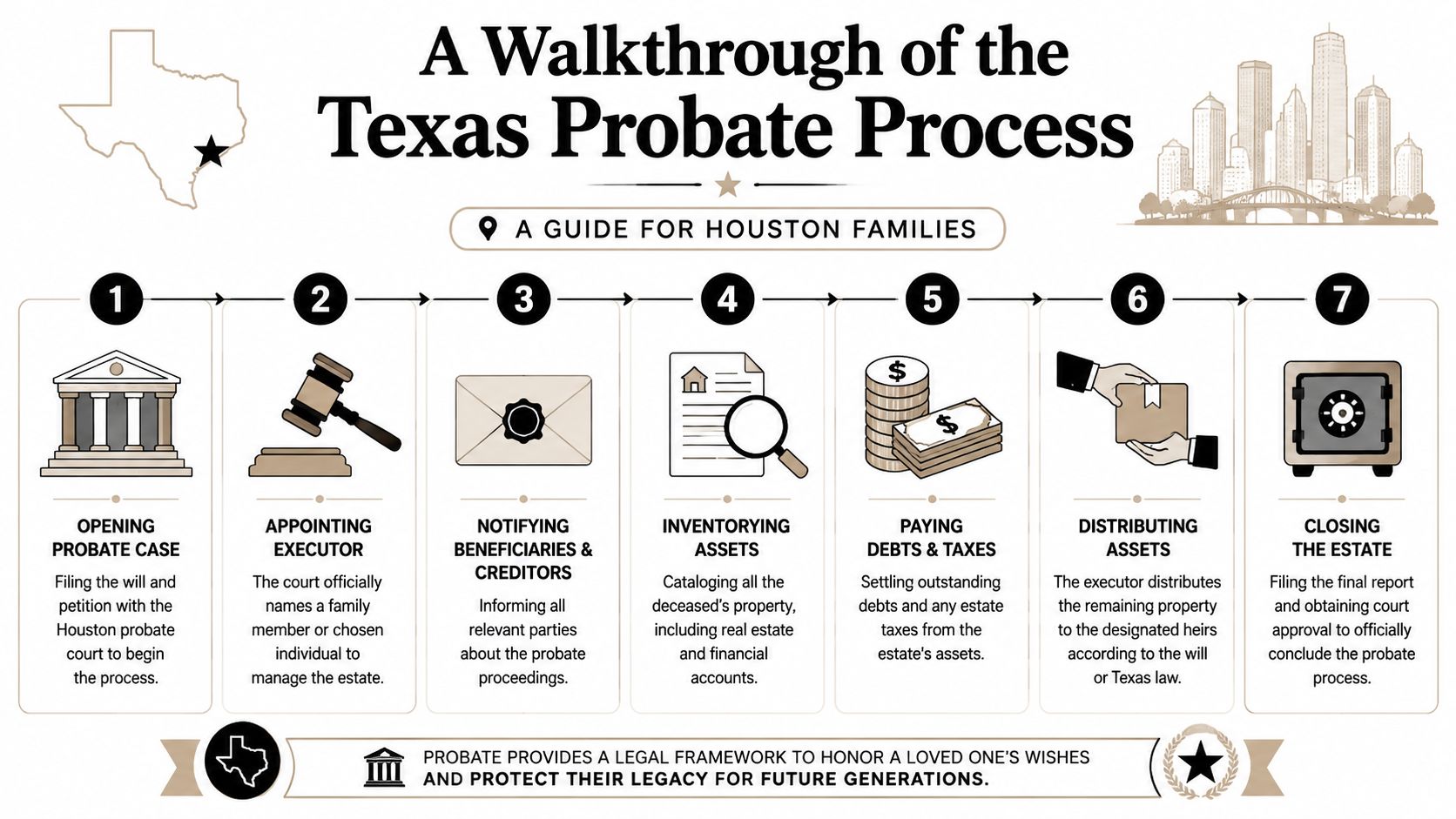
How a Houston probate case usually begins
Suppose David dies in Harris County with a valid will naming his daughter Jasmine as executor. Under Texas Estates Code Section 256.052, the probate application is filed in the proper county court, usually where the decedent lived, with the will attached through the Texas e-filing system. In Houston, that usually means one of the Harris County probate courts.
From there, the case follows a fairly familiar path in an uncontested will-based probate:
- File the application to probate the will
- Wait for the clerk to post notice
- Prepare the proof needed for the hearing
- Attend the hearing so the judge can admit the will to probate
- Receive Letters Testamentary, which are the documents banks, title companies, and others often want to see
- Send required notices to beneficiaries under Texas Estates Code Section 308.004
- Address creditor notice requirements
- Prepare and file the inventory, affidavit in lieu of inventory, or other required follow-up filings
The filing is only the front door. Executors often feel relieved once the hearing is over, then realize the main work begins after appointment, when assets must be identified, secured, valued, and transferred correctly.
Costs also matter early because they affect what path makes sense. Harris County court fees are set by the county, and attorney fees vary by estate complexity, whether there is a valid will, and whether conflict is expected. For a county-level reference point on probate filing costs, the Harris County Clerk probate fee schedule is more useful than a generic estimate. If you want to compare how different lawyers explain fees, communication, and staffing, this guide on choosing the right probate attorney in Texas can help.
Independent and dependent administration
This is often the first major fork in the road.
Independent administration usually lets the executor act with much less court involvement after appointment. Dependent administration requires the executor to return to court for approval more often. A good everyday analogy is the difference between managing a household budget on your own and needing permission before each large transaction. Both systems can work. One involves more supervision, more filings, and often more expense.
For many Houston families, the practical question is not which label sounds safer. It is which process fits the estate. If the will authorizes independent administration, family members are cooperative, and there is no serious dispute about assets or debts, independent administration is often the more efficient route. If there is mistrust, a contested issue, missing records, or concern about how funds will be handled, the extra court oversight in a dependent administration may be appropriate.
Texas law itself reflects this distinction. The Estates Code provides for independent administration to reduce unnecessary cost and delay in suitable estates. You can review that structure in the Texas Estates Code provisions on independent administration. The financial difference can be meaningful because each added request for court approval usually means more attorney time, more preparation, and more waiting.
Houston executors who live outside Texas need to pay even closer attention here. An out-of-state executor may still serve in many cases, but practical problems come up fast. Opening an estate account, signing real-estate documents, securing local property, and appearing for court-related matters can all become harder when you are handling everything from another state. That does not mean the job is impossible. It means the administration choice should be made with those logistics in mind, not as an afterthought.
The smartest probate decision is often the one that reduces unnecessary supervision while still protecting the estate.
A short explainer can help if you'd like a visual overview before digging into court paperwork.
Where executors often get into trouble
Problems usually arise after authority is granted, not before. An executor may assume that getting appointed means everything else is routine. It rarely is.
Common trouble spots include:
- Missing creditor notice deadlines or sending the wrong type of notice
- Failing to track estate assets carefully, especially if a house, vehicle, or business interest is involved
- Filing the inventory late, or filing the wrong alternative document
- Not giving beneficiaries the required information after the will is admitted to probate
- Acting too quickly with property sales or distributions before debts, taxes, or title issues are resolved
These mistakes are common because probate has two layers. One layer is court procedure. The other is day-to-day estate administration. Families often prepare for the hearing and underestimate the paperwork that follows. A fuller overview of the Texas Probate Process can help you compare the formal court steps with what executors are expected to do once they have authority.
How to Choose the Right Houston Probate Attorney
Not every probate lawyer is the right fit for every family. Technical skill matters, but so does the attorney's ability to communicate clearly while you're under stress.
What to listen for in the first consultation
The best early sign isn't a polished sales pitch. It's whether the attorney can explain your options in normal language. If a lawyer can't describe the difference between administration paths, notice obligations, and likely court steps without drowning you in jargon, you may struggle later when decisions become more difficult.
Ask questions that reveal how the attorney works:
- Who will be my main contact if I call with a question next week?
- How often will I receive updates during the case?
- Do you regularly handle matters in Harris County probate courts
- What documents should I gather first so we can move efficiently?
- How do you approach estates with potential conflict between heirs?
A useful comparison point is this article on how to choose the right probate attorney in Texas, which highlights the practical side of selection.
Communication matters more than people expect
Probate clients are often making decisions while exhausted. They may be handling funeral matters, sorting mail, speaking with banks, and trying to keep peace in the family. In that setting, a good attorney doesn't just know the law. That lawyer reduces uncertainty.
Look for someone who does these things consistently:
| What to look for | Why it matters |
|---|---|
| Clear explanations | You need to understand what you're signing and why |
| Realistic timelines | False reassurance causes frustration later |
| Process transparency | Probate has steps. You should know where the case stands |
| Respectful tone | Families in grief need steadiness, not pressure |
A lawyer who answers your first five questions with patience will probably handle your tenth question the same way when the case gets harder.
Questions about cost and scope
Fees matter, but don't stop there. Ask what's included. One attorney may quote a flat fee for opening probate, while another may include document preparation, court appearance, beneficiary notices, and follow-up filings in a broader scope of work.
A trustworthy consultation should also cover whether your matter appears uncontested, whether independent administration is likely, and whether there are signs of future conflict. If there are warning signs, it's better to hear that early.
For families comparing options, Law Office of Bryan Fagan, PLLC is one Texas-based option that handles probate and estate administration matters, including independent and dependent administration, heirship issues, guardianship applications, and probate litigation.
A small test that reveals a lot
Before you hire anyone, ask the attorney to explain one probate term in plain English. Try “Letters Testamentary” or “independent administration.”
If the answer makes immediate sense, you're probably talking to someone who understands not just the law, but the client experience.
Common Probate Pitfalls and Special Situations
A lot of Houston probate cases look manageable at first. Then one decision changes the cost, the timeline, or the level of court involvement.
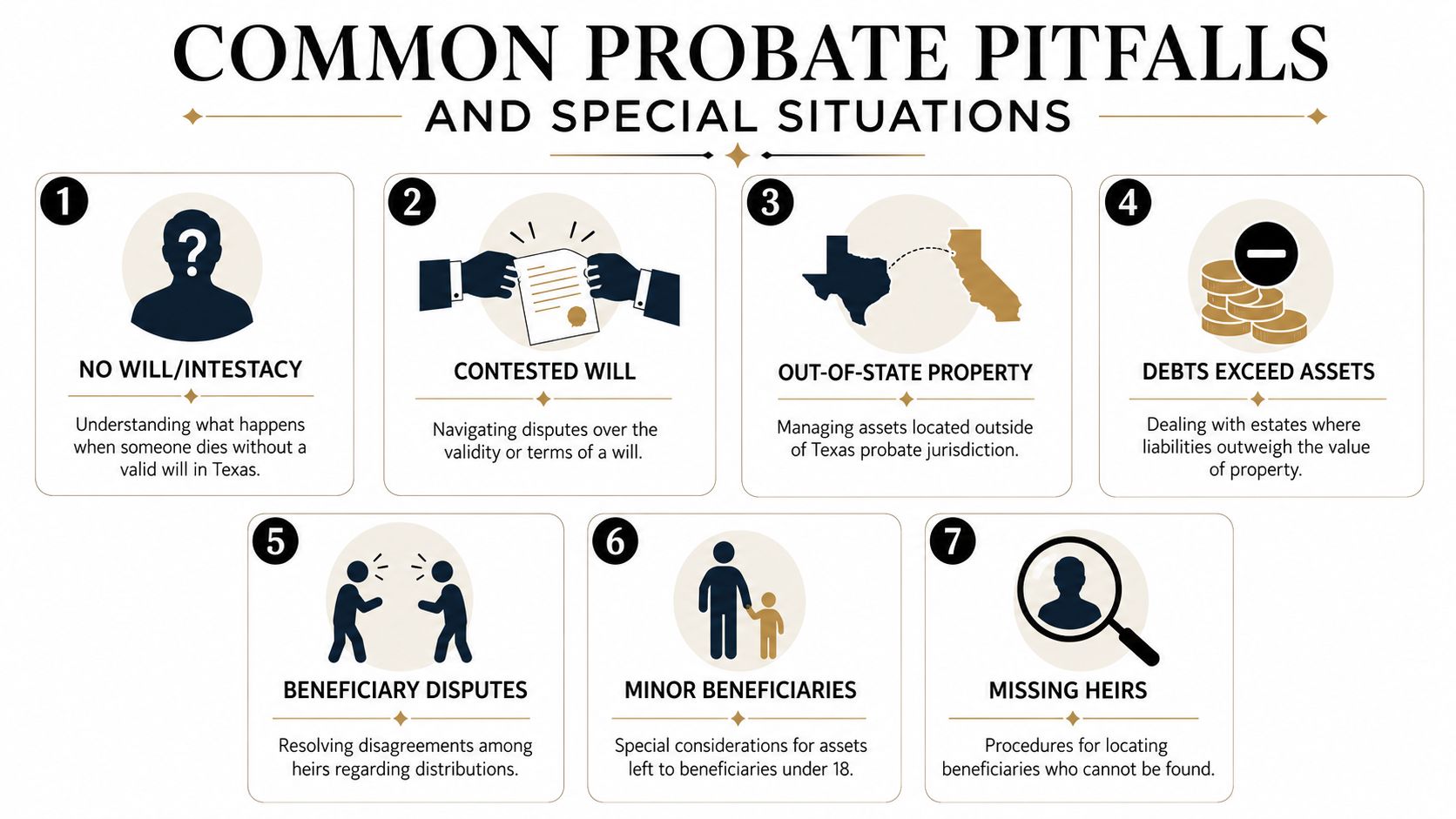
This is often the stage where an executor realizes probate is not just a list of forms. It is a series of judgment calls. Who has authority. What needs court approval. Which problems can wait a week, and which ones cannot.
Out-of-state executors
A common Houston scenario looks like this. Your mother lived in Harris County. Her will names your sister in Colorado as executor. She is trustworthy, organized, and willing to help. Even so, distance creates real friction.
Texas courts may still appoint a nonresident executor in many situations, but the process can involve extra steps and paperwork. The Texas Estates Code addresses qualifications for personal representatives, including rules that affect nonresident executors, in Texas Estates Code, Sec. 304.003.
The practical problems usually appear before families expect them to. Someone has to secure the house, locate the original will, forward mail, gather statements, and respond when a bank or title company asks for specific Texas probate documents. An executor who lives nearby can often do those tasks in an afternoon. An executor who lives out of state may need local help, certified copies, and a tighter paper trail.
That does not mean an out-of-state executor is a bad choice. It means the family should plan early.
Helpful steps include:
- Ordering certified copies early so banks, title companies, and financial institutions can confirm authority
- Creating one shared estate file for deeds, account statements, tax returns, insurance papers, and the original will location
- Confirming who can access the home and personal property so locks, vehicles, mail, and valuables are not left in limbo
- Asking the attorney which tasks require personal appearance and which can be handled by mail, email, or remote coordination
- Giving beneficiaries regular written updates so silence does not turn into suspicion
For many families, this is one of the first major decision points. The question is not just, "Can my sister serve?" The better question is, "What support will she need to serve well?"
Will contests and family disputes
Probate can change tone very quickly. A case that begins with filing a will can turn into a dispute the moment someone says the document is fake, unfair, or signed under pressure.
In plain English, a will contest means someone is asking the court to question the validity of the will or the conduct of the executor. The legal labels vary. You may hear terms like undue influence, lack of capacity, forgery, or breach of fiduciary duty. Underneath those labels is a familiar family conflict. One person believes the process is not honest or not fair.
Text messages rarely fix that kind of problem. They usually make the record messier.
If a dispute seems likely, protect the estate the way you would protect evidence after a car accident. Save documents. Keep a timeline. Preserve voicemails, emails, and account records. Do not hand out property informally in the hope that everyone will calm down later. Once assets are distributed, getting them back is expensive and sometimes impossible.
When grief mixes with old family tension, even small decisions can be questioned later. Good records help the executor show what happened and why.
Minor heirs and guardianship issues
A gift to a child often sounds simple in the will. In administration, it rarely is.
A minor usually cannot receive and control inherited property directly. If a child is entitled to part of the estate, the adults may need a separate legal structure to hold and manage that share. Sometimes that means a guardian of the estate, depending on the amount involved and how the asset is being transferred.
Families are often surprised here. A parent may assume, with good intentions, that the money can just be deposited into the parent's account and used for the child. Probate courts usually want more protection than that, because the money legally belongs to the child, not the parent. The existing Guardianship page offers a basic overview of that separate process.
Intestacy, debts, and title problems
When there is no will, the hardest question is often not who should inherit. It is who the law says inherits.
Texas intestacy rules follow a fixed order, and that order can surprise blended families, unmarried partners, and relatives who assumed verbal promises would control. If the family tree is unclear, the court may require heirship proof before anyone can safely transfer property. Real estate creates even more trouble when deeds, death records, and heirship affidavits do not line up cleanly.
Debt issues create another decision point for the executor. Some claims are valid. Some are overstated. Some should be challenged. What matters is that the executor treats debts as part of the job instead of distributing assets too soon and hoping the numbers work out later. That is one of the biggest differences between orderly administration and personal liability risk.
The choice between dependent and independent administration also matters here. Independent administration usually gives the executor more freedom to act without asking the court for repeated permission. Dependent administration involves closer court supervision, which can add time, filings, and expense. If the estate has family conflict, creditor pressure, missing records, or title defects, that distinction can have a real financial effect.
For families trying to prevent these same problems in the future, the firm's Wills & Trusts page explains some of the planning tools that can reduce confusion later.
Your Path Forward and Key Insights
When families search for a Probate Attorney in Houston, they're usually asking for more than legal representation. They're asking for order, explanation, and a steady hand at a time when details feel hard to manage.
Key insights
- Start by identifying the type of estate. Some matters require full probate, while others may fit a simpler path under Texas law.
- Independent and dependent administration are not the same. The choice affects cost, speed, and how much court supervision the executor will face.
- The executor's job continues after appointment. Notices, inventory, creditor handling, and recordkeeping all matter.
- Out-of-state executors need a plan. Distance adds practical problems, but those problems can be managed with the right preparation.
- Choose your lawyer for clarity, not just price. Good communication often prevents mistakes before they become disputes.
A realistic way to think about probate
Probate is a legal process, but it is also a family process. People are carrying memories, expectations, old grievances, and practical worries at the same time. That's why the right legal approach isn't just technically correct. It should also be organized, calm, and understandable.
If you're holding a will and wondering what to do next, you don't need to solve the entire estate tonight. Gather the documents you can find. Don't distribute property informally. Write down the questions that are keeping you up at night.
Then get guidance that matches your actual facts.
Probate becomes more manageable when the next step is clear. Most families don't need every answer at once. They need the right answer first.
A good lawyer should help you separate urgent tasks from tasks that can wait. That includes checking whether probate is necessary, identifying the proper court, deciding what authority the executor needs, and protecting the estate from preventable problems.
If your situation includes a contested will, a minor heir, real estate, or a nonresident executor, early advice can make the rest of the process much smoother. If the estate may qualify for a reduced procedure, honest advice can help you avoid unnecessary expense and delay.
Families in Texas deserve practical explanations, not intimidation. They deserve a clear map, careful legal work, and respect for the fact that probate usually begins in the middle of grief.
If you're facing probate in Texas, our team can help guide you through every step, from filing to final distribution. Schedule your free consultation today.
If you need help with probate, heirship, guardianship, or estate administration, contact Law Office of Bryan Fagan, PLLC for a free consultation. We can help you understand your options, protect the estate, and move forward with a clearer plan.