Yes, you can sometimes handle probate without a lawyer in Texas, but only in very limited situations. In many Texas estates, a lawyer is effectively required, and a will generally must be probated within four years of death or the estate can be treated as if there were no will at all.
If you're reading this after losing a parent, spouse, or other loved one, you're probably trying to solve two problems at once. You want to do the right thing, and you don't want to make an already hard season more expensive or stressful than it needs to be. That's understandable.
Many families start with the same thought: "Can I just file the paperwork myself?" Sometimes that instinct comes from wanting to save money. Sometimes it's because the estate looks simple on the surface. A bank account, a vehicle, maybe a home. It can seem manageable until you learn that Texas draws a sharp line between a simple transfer procedure and formal estate administration.
That difference matters. Filling out forms for your own affairs is one thing. Asking the court to appoint you to deal with a deceased person's property, debts, creditors, and beneficiaries is something else entirely. Texas probate law, especially under the Estates Code in Title 2 and Title 3, treats that role as a serious legal responsibility, not a casual do-it-yourself project.
The Sobering Reality of Texas Probate Law
The hard truth is that Texas doesn't treat most probate administrations as self-help matters. The reason is simple. When you serve as an executor or administrator, you're not only speaking for yourself. You're acting for heirs, beneficiaries, and sometimes creditors too.
The Texas State Law Library's probate guide explains that most estate administration in Texas requires an attorney because the estate representative is acting on behalf of multiple interested parties. In plain English, the court sees you as managing other people's legal interests, not just your own.
Why self-representation usually doesn't apply
A lot of people hear "pro se" and assume it means anyone can represent themselves in probate court. That idea breaks down fast in estate cases.
If you sue someone over your own contract, you're representing yourself. But if you open an estate, you are stepping into a fiduciary role. That means the law expects you to act carefully and in the best interests of everyone the estate affects.
Practical rule: If the court is asking you to protect the rights of other people, Texas is much less likely to allow you to handle the matter alone.
Grieving families often get caught off guard. They don't see themselves as practicing law. They see themselves as a daughter trying to help, or a surviving spouse trying to transfer the house. But probate court looks at the legal function of the job, not the emotion behind it.
Why families underestimate probate
Probate isn't just "filing the will." In a typical estate, someone may need to:
- Validate the will and ask the court to recognize it
- Identify estate property and separate it from property that passes outside probate
- Address debts and other claims against the estate
- Distribute assets to the right people in the right way
- Follow court procedures required by the Texas Estates Code
For families dealing with a home, practical reading on streamlining probate for homeowners can help clarify the property side of the process. For a broader foundation on court procedure, this guide to understanding Texas probate laws is also useful.
A simple analogy helps. DIY probate is a little like trying to repair your own roof during a storm. If the problem is small and everything is visible, you may get by. If there is hidden structural damage, one wrong step can make the whole situation worse.
Texas Probate Exceptions The Narrow Path for DIY
There are limited Texas procedures that sometimes let families move forward without full representation. These are the exceptions people usually mean when they ask whether probate can be done without a lawyer.
They are narrow. That's the key point.
The estates that may qualify
Texas law creates a practical dividing line. One Texas probate resource explains that estates valued at over $75,000 typically require full court supervision, which means an attorney will be necessary in most cases. The same discussion is why small-estate options are limited to much simpler situations, as noted in this explanation of when a probate attorney is needed in Texas.
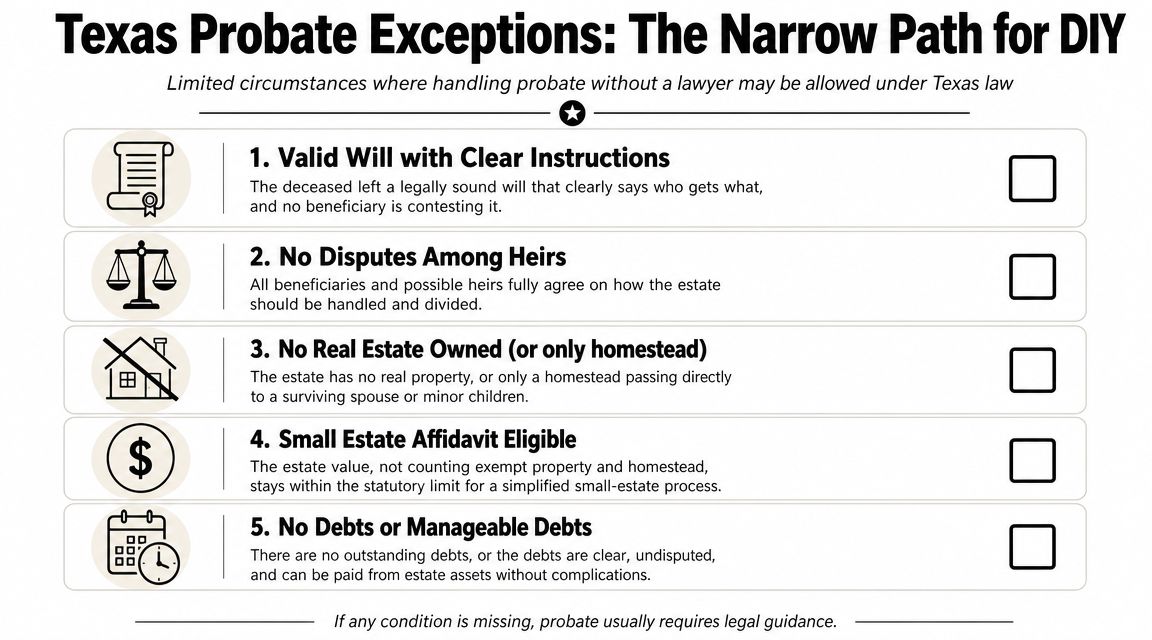
A family may be looking at a narrow DIY path if the situation looks more like this:
- The estate is small: The property subject to the process is limited and uncomplicated.
- There is no real conflict: Heirs aren't fighting over who gets what.
- Debts are minimal or absent: There isn't a long list of claims to sort through.
- The asset mix is simple: No business interests, no tangled title issues, no surprise accounts.
- The procedure fits a simplified route: The facts line up with a process like a small estate affidavit or muniment of title.
Two common examples families ask about
A Small Estate Affidavit is often the first thing people find online. In general terms, this procedure is designed for smaller estates and strict eligibility matters. If the facts don't fit, the shortcut isn't available.
A Muniment of Title is another efficient option. In plain English, it is a way to admit a will to probate mainly as evidence of title transfer, rather than opening a full administration. It can be useful in the right case, especially when the will is clear and the estate doesn't require active administration.
The safest way to think about these options is this. They are not "easy probate." They are limited procedures for estates with very specific facts.
If you're trying to sort out which lane your case belongs in, this overview of probate versus a small estate affidavit in Texas can help you compare the fit.
What usually knocks a case out of the DIY lane? Real estate complications, family disagreement, unclear ownership, debt issues, or uncertainty about the will. Once any of those appear, the narrow path gets much narrower.
The Hidden Dangers of Handling Probate Alone
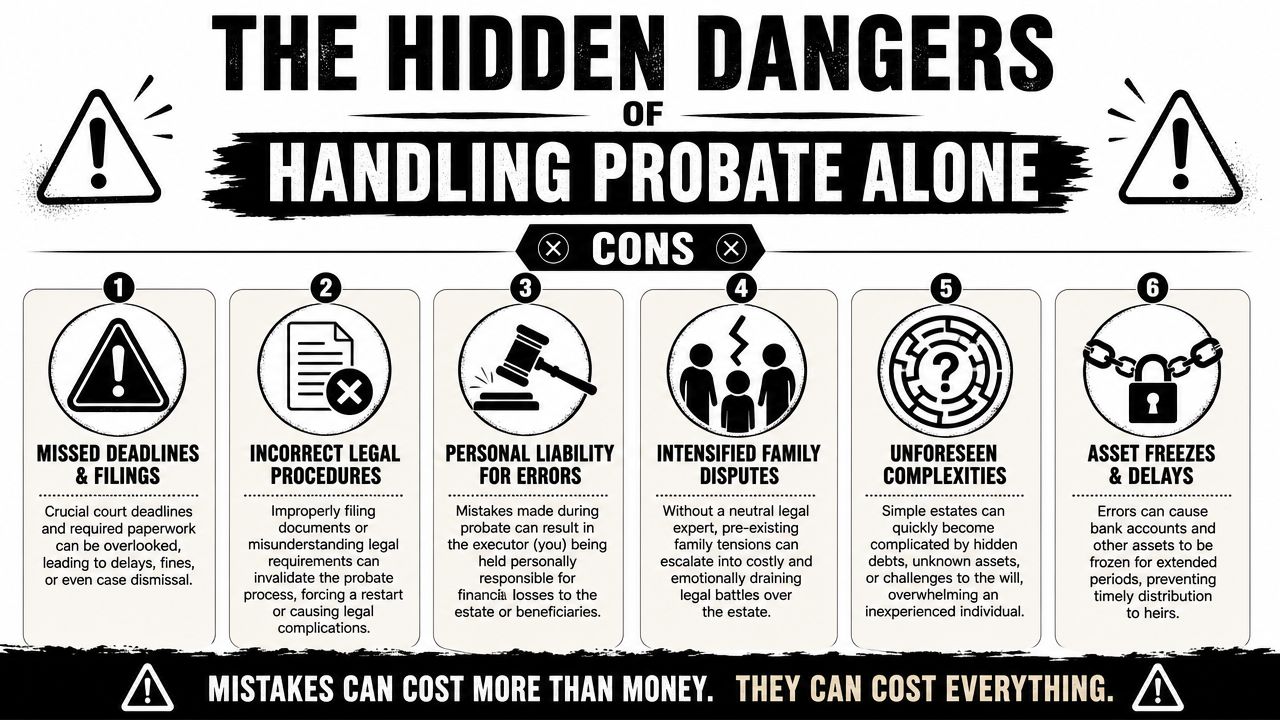
Some probate problems aren't obvious until you've already filed something, transferred the wrong asset, or missed a court requirement. That's what makes DIY probate so risky. The danger isn't only that the process feels confusing. It's that a mistake can change legal rights, delay distribution, or expose the executor to personal trouble.
To make those risks easier to see, start with the broad picture below.
The executor's role carries personal responsibility
Under the Texas Estates Code, a personal representative has duties that aren't optional. You may need to protect property, deal with claims, keep records, and distribute assets correctly. If you cut corners or guess wrong, upset family members may blame you, and sometimes they have grounds to do it.
When you accept the role of executor, you're not just helping out. You're taking on legal duties that can have personal consequences if handled carelessly.
That surprises many people. They thought they were volunteering for paperwork. In reality, they may be stepping into a role with fiduciary obligations.
One mistake with assets can stall the whole estate
Texas law distinguishes between probate property and non-probate property. Some assets pass by beneficiary designation, survivorship rights, or transfer-on-death arrangements. Other assets owned solely by the decedent may need court involvement.
Texas Law Help explains that misidentifying property can lead to delays in title transfers, creditor payments, and final distribution to heirs, especially when an executor handles an asset incorrectly. You can review that distinction in this Texas guidance on minimizing the need for probate.
A common example is a bank account. If the account has no beneficiary and was only in the decedent's name, treating it like a non-probate asset can create immediate problems. The bank may freeze access. Heirs may accuse one another of taking funds too early. Creditors may argue the money should have remained available to the estate.
Here's a short video that walks through the practical side of filing probate without counsel:
The risks tend to come in clusters
DIY probate mistakes usually don't stay isolated. One error can trigger several others.
- Wrong filing choice: A family uses a shortcut that doesn't fit the facts.
- Asset confusion: Property gets treated as outside the estate when it isn't.
- Creditor trouble: Debts aren't addressed in the right order or through the right process.
- Transfer delays: Title companies, banks, or buyers won't accept defective paperwork.
- Family tension: Relatives start questioning motive, fairness, or competence.
That chain reaction is why probate often feels easy at the start and much harder in the middle.
A Realistic Scenario When DIY Probate Fails
Maria lives in Harris County. Her father dies without a will. She wants to do the responsible thing, and she wants to avoid unnecessary legal fees. She reads about simplified probate procedures and decides a Small Estate Affidavit sounds right.
At first glance, the estate seems simple. Her father had a modest bank account, a paid-off car, and household belongings. Maria gathers paperwork, talks to family, and feels relieved that everyone appears to agree. She assumes the biggest challenge will be collecting signatures and waiting for the court.
The tripwire she didn't see
When Maria contacts the bank, she learns there is an old credit card balance tied to her father's records. It isn't large, but it changes the picture. The estate is no longer the clean, debt-free matter she thought she had.
That single detail creates a problem. The shortcut she planned to use may no longer fit. The court filing she prepared now needs a second look. The bank won't release funds based on her assumptions, and family members start asking why the money is still frozen.
Small estates often look simple because the complications are hidden, not because they don't exist.
Maria's stress goes up quickly. She has taken time off work, told relatives she was handling everything, and now has to explain that the process may need to shift into a more formal administration. She also worries that the paperwork she filed was incomplete or incorrect.
What this story gets right about real probate cases
This scenario is fictional, but the pattern is very real. Estates rarely announce their problems up front. A forgotten debt, an account with no beneficiary, an old deed issue, or disagreement among siblings can turn a "simple" matter into one that needs formal court supervision.
Texas Estates Code Title 2 and Title 3 provide the legal framework for administration, creditor issues, heirship, and court-supervised probate procedures. Those rules matter most when a case stops being tidy.
Maria's situation also reflects a common emotional trap. The executor feels pressure to keep things moving because everyone is grieving and waiting. That pressure can lead to fast decisions before the facts are fully known. In probate, speed without clarity usually creates more delay later.
Cost and Timeline A Lawyer vs DIY Comparison
Families often ask the wrong cost question. They ask, "How much does a lawyer cost?" The better question is, "What will mistakes cost if the probate path is wrong?"
DIY probate can look cheaper at the beginning because you're only seeing the filing stage. You're not yet seeing corrected pleadings, rejected paperwork, repeated court trips, delays in access to funds, title issues, or the cost of bringing in counsel after the case has become harder to fix.
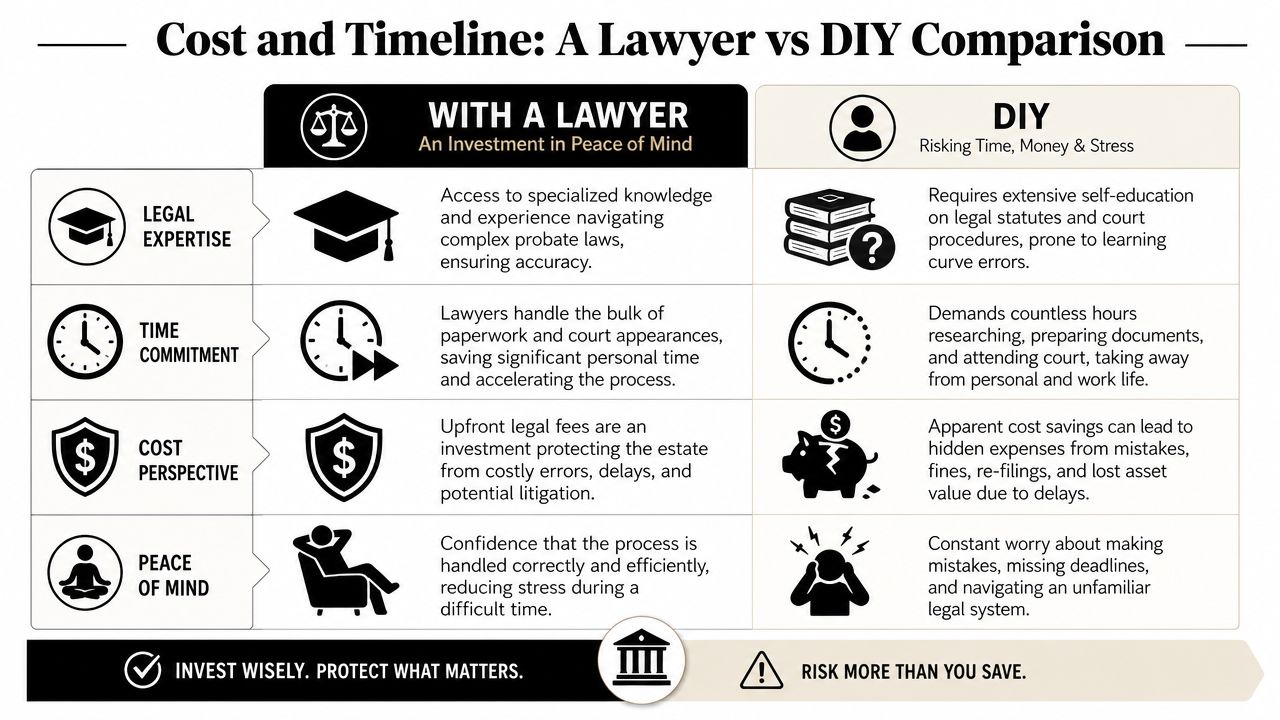
A practical side by side view
| Path | What usually happens |
|---|---|
| DIY probate | You spend personal time researching Texas Estates Code procedures, preparing filings, communicating with the court, and trying to solve title or debt questions as they arise. |
| Lawyer-assisted probate | You pay a predictable legal fee for guidance on filings, court procedure, deadlines, administration steps, and problem prevention. |
The difference isn't only money. It's also bandwidth.
A grieving spouse may already be handling funeral arrangements, family communication, mortgage questions, and locked financial accounts. Adding probate research on top of that can drain the energy needed for careful decision-making.
What "saving money" often leaves out
DIY doesn't eliminate cost. It shifts cost into different categories:
- Time cost: Work hours, missed appointments, and repeated trips to gather or correct documents
- Error cost: Refiling, fixing defective paperwork, or unwinding bad transfers
- Conflict cost: More tension when relatives don't trust the process
- Delay cost: Inability to sell or transfer property on schedule
By contrast, lawyer-assisted probate tends to front-load planning and reduce surprises. For readers who want a broader view of the stages involved, this guide to the Texas probate process is a helpful starting point.
Paying for legal guidance is often less about buying paperwork and more about buying accuracy, timing, and protection from avoidable mistakes.
Some families don't need full-service representation from start to finish. Others do. The important thing is understanding that probate is a risk-management process, not just a filing process.
A Middle Path Limited Scope Representation
A lot of Texas families do not need full-service probate from start to finish. They need a lawyer at the points where one wrong step can create a title problem, delay a hearing, or push the case into a more expensive procedure.
That middle option is called limited-scope representation, sometimes called unbundled services. You stay involved. The lawyer steps in for the parts that carry the most legal risk.
In practice, that often means a probate attorney handles tasks such as:
- Choosing the right procedure: deciding whether the estate may qualify for a simpler route or whether formal probate is required under Texas rules
- Reviewing the filing before it goes to court: checking the application, will, death certificate, and supporting paperwork for problems that trigger rejection or delay
- Preparing the executor for the hearing: explaining what the judge is likely to ask and what documents need to be ready
- Giving targeted advice on pressure points: real estate transfers, creditor notice, executor duties, deadlines, or questions tied to the four-year rule
- Stepping in fast if the case turns urgent: handling problems that need quick court action, such as issues covered in these emergency probate situations that may require immediate court action
The family can still gather records, inventory property, communicate with relatives, and handle routine follow-up. That keeps legal fees more controlled without leaving the riskiest decisions to guesswork.
I often explain it this way to families. Probate is not hard because every step is complicated. Probate gets hard because a few steps carry outsized consequences. Filing the wrong procedure, missing a deadline, or transferring a house before authority is clear can create a problem that costs much more to fix than it would have cost to prevent.
This approach makes sense in a narrow but common set of cases. The estate may look simple at first, yet still have one Texas-specific tripwire, such as a home that needs clear title, questions about whether the small-estate path really fits, or concern that too much time has passed since death. In those situations, limited help can give a family a clear answer before they commit to a path that may not work.
The Law Office of Bryan Fagan, PLLC handles Texas probate matters, including administration and related estate issues. Whether a family works with that office, another probate attorney, or a local referral source, the practical point is the same. There is a safer option between total DIY and handing off every task.
For many families, that middle path is the right fit. It respects the budget, but it also respects the risk.
Key Insight When to Call a Probate Attorney Immediately
Some probate cases should not begin as DIY matters. If any of the red flags below apply, the safest move is to get legal advice before filing anything.
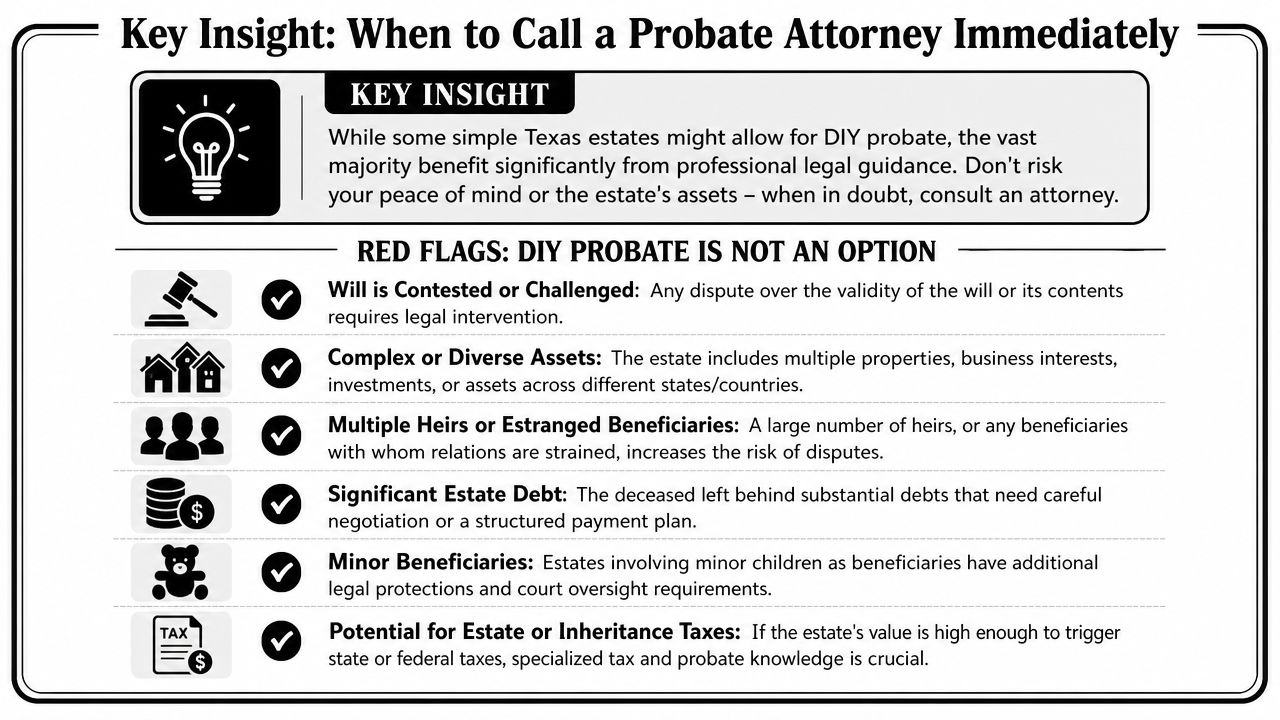
Key Insight
Some simple Texas estates may qualify for a limited do-it-yourself approach, but many do not. If the estate involves conflict, unclear assets, debt, or court-supervised administration, getting legal help early usually prevents larger problems.
Red flags that mean you should call now
- There is real estate beyond a straightforward home transfer: Title issues tend to surface late and slow everything down.
- The will may be invalid or someone is challenging it: That moves the case out of routine administration and into dispute territory.
- The estate includes business interests or hard-to-value assets: These require more than form filing.
- There are serious debts or creditor questions: Executors need to be careful about what gets paid, when, and from which funds.
- Heirs disagree or one can't be located: A calm family conversation can become a legal conflict quickly.
- A beneficiary is a minor or needs added protection: Court oversight may be more involved.
- Emergency court action may be needed: This resource on emergency probate situations in Texas explains when fast legal intervention matters.
If your concern is really an upstream planning issue, not just the current estate, it may also help to review your options for Wills & Trusts. If conflict has already started, information about Probate Litigation can point you in the right direction. Families caring for vulnerable adults or children may also need to look at Guardianship.
As a practical matter, the best time to call a probate attorney is before you file the wrong case, transfer the wrong asset, or make promises to family members that the court process won't support. Asking for help isn't giving up. It's protecting the estate and reducing the chance that grief turns into preventable conflict.
If you're facing probate in Texas, our team can help guide you through every step, from filing to final distribution. Contact Law Office of Bryan Fagan, PLLC for a free consultation and get clear, compassionate guidance suited to your family's situation.