A parent has just died. Before the family has even made funeral arrangements, someone starts removing jewelry from the house. A business partner says payroll can't wait and moves money out of an account. A relative insists they were “promised” the truck and takes the keys. In moments like this, grief collides with urgency.
Most probate cases move through a standard process. But some don't. Some estates need immediate court action because waiting even a few days could mean lost property, unpaid funeral expenses, frozen operations, or evidence that disappears. That's where emergency probate relief matters in Texas.
When a Probate Matter Becomes an Emergency
A son is standing in his mother's driveway the morning after she dies, watching a relative load furniture into a pickup. He does not have letters testamentary. He does not know whether the bank will freeze the account. He does know that waiting until the regular probate timetable catches up may leave the estate short of cash, records, and property.

What makes the moment different
Some probate problems can wait for notice, a hearing date, and the ordinary appointment of an executor or administrator. Others cannot. If someone is taking property, draining an account, shutting down access to business records, or leaving a vacant house unsecured, delay creates a real risk of loss.
That is the practical dividing line. A probate matter becomes an emergency when the estate needs immediate protection before the usual process can do its work.
Texas procedure allows courts to step in on short notice in the right case, but families should not treat every dispute like a court emergency. The first question is more basic. What can be preserved in the next few hours, lawfully and with proof, so the estate is still intact when a judge reviews the file?
A realistic Texas example
A daughter learns that her father's checking account is no longer accessible, even though funeral expenses are due. At the same time, she hears that a cousin has been entering the house and removing firearms, tools, and paperwork. She believes she will be named executor, but she has not been appointed yet.
In that situation, the immediate job is triage.
Secure the house if lawful access is available. Photograph rooms, doors, vehicles, and anything already missing. Gather the death certificate, any will, bank information, insurance papers, deeds, and business records. Write down names, dates, and what each witness saw. Then speak with probate counsel about whether the facts justify an emergency filing and what narrow relief the court can grant quickly.
That early work often determines whether an emergency application succeeds.
Why calm action matters
Families under pressure often make the problem worse. Someone changes locks without confirming authority. Someone confronts a relative and the dispute turns physical. Someone logs into the decedent's online accounts and creates questions about access, consent, or missing funds.
A better approach is controlled and documented action:
- Secure property you can legally secure
- Photograph and inventory what is present
- Preserve mail, account statements, deeds, titles, and digital records
- Record who has keys, passwords, and physical access
- Get legal advice quickly about whether immediate court relief is justified
The court is not there to finish the estate in one emergency hearing. Its immediate role is narrower. Stop the loss, preserve the asset, and hold the situation steady long enough for the probate case to proceed in an orderly way.
Defining a True Probate Emergency in Texas
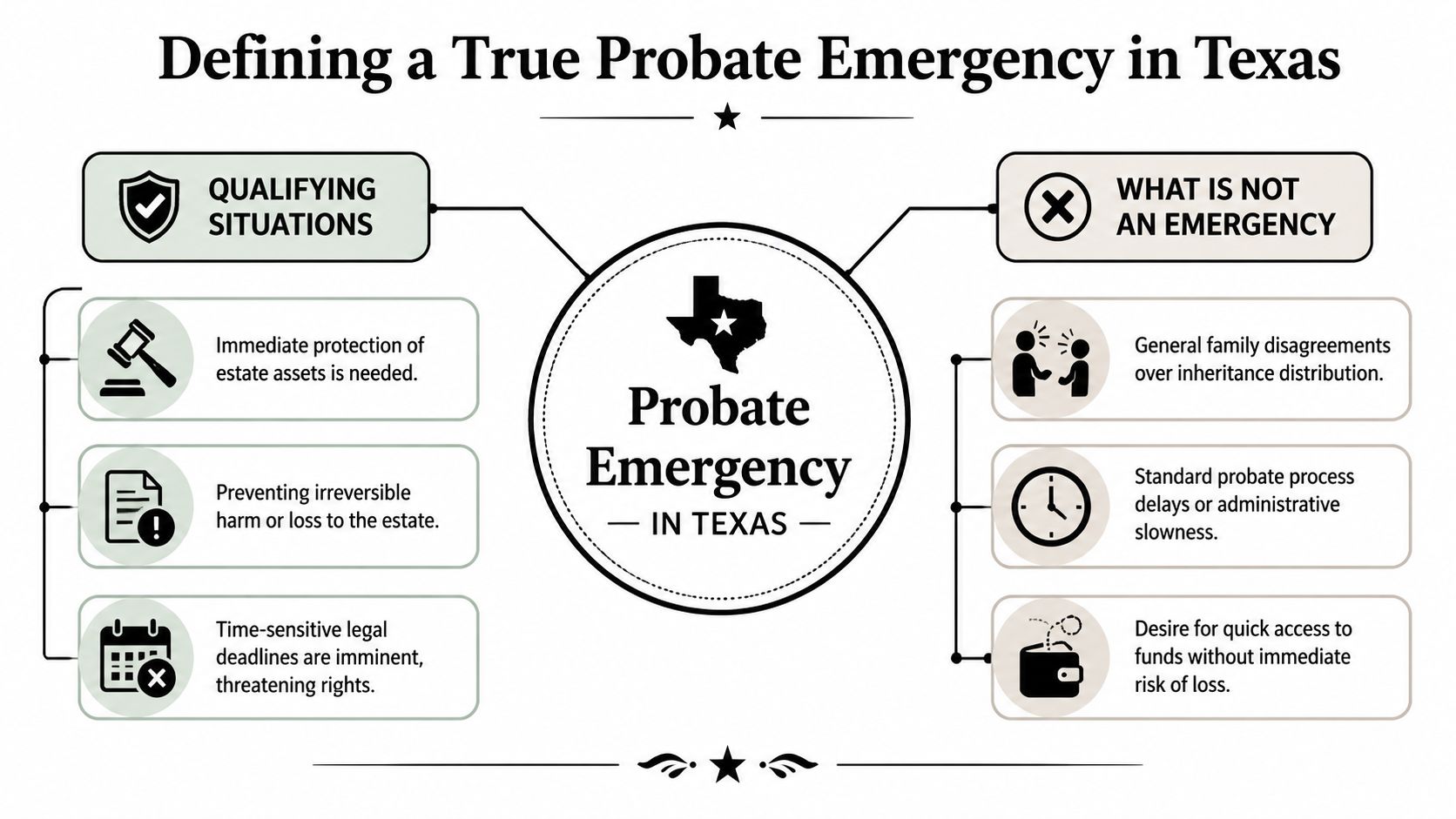
Texas probate courts don't treat every disagreement as an emergency. The legal standard is higher than “this feels unfair” or “I need money quickly.” The test is closer to a legal fire alarm. There must be a present threat that requires immediate intervention.
What Texas courts are looking for
A true probate emergency involves an immediate risk of harm to a person, property, or estate asset. Courts generally require sworn evidence showing imminent danger, not a speculative concern, as explained in this discussion of what qualifies as a probate emergency.
The application must connect the facts to a specific risk. If a safe-deposit box contains the only records needed to access funds for funeral expenses, say that. If a vacant home is being emptied, say who entered, when, and what was removed. If a business has no authorized signer and an immediate operational failure is looming, explain the direct consequence.
The stronger filing is usually the one that shows a short, clear chain: this fact is happening, this harm will follow, and this order prevents it.
Texas emergency-intervention statutes require a sworn application stating the applicant's interest and facts showing “immediate necessity.” That language matters. It separates emergencies from ordinary probate delays.
What usually is not an emergency
Not every probate conflict qualifies for immediate court relief. These situations often feel urgent to a family but usually don't meet the legal threshold by themselves:
- Inheritance disputes: A sibling thinks the will is unfair.
- Process frustration: The court hasn't moved as fast as the family hoped.
- General mistrust: Someone “might” misuse property later.
- Pressure for cash: An heir wants an early distribution without a present risk to the estate.
A simple way to self-check
Ask these three questions:
- What specific asset or right is in danger right now?
- What harm is likely if the court does nothing immediately?
- What evidence can I put in a sworn statement today?
If you can answer those questions with concrete facts, you may have a real emergency. If the concern is still general, emotional, or future-facing, the issue may belong in regular probate administration or probate litigation rather than an emergency request.
Texas Estates Code provisions in Titles 2 and 3 govern probate administration, personal representatives, and related court procedures. In practice, emergency relief is a narrow tool inside that larger framework. Used correctly, it protects the estate. Used too broadly, it often gets denied.
Common Scenarios That Require Urgent Court Action
Some probate emergencies are obvious. Others don't look like probate problems at first. They look like business disruption, a locked account, a digital access problem, or a home that suddenly isn't secure.
Asset dissipation after death
A son learns that his mother died on Friday. By Sunday, another relative has taken her vehicle, removed collectibles, and started telling neighbors that “the family agreed” on who gets what. Nothing has been probated. No one has legal authority to distribute property yet.
That's the kind of situation where families may need immediate relief to preserve assets before informal self-help turns into permanent loss.
A business that can't pause
A small business owner dies unexpectedly. Vendors are calling. Employees expect payroll. The company needs someone with authority to sign, communicate with the bank, and keep operations from collapsing.
Delay can damage the estate itself. The issue isn't convenience. It's preservation of value.
Funeral expenses and blocked access
A widow knows her husband had funds, but the account is inaccessible, and key documents are in a safe-deposit box. The funeral bill is due, and no one can lawfully access what's needed without a court order or proper authority.
That can create the kind of immediate necessity courts recognize, especially when the request is narrowly tied to burial costs or estate protection.
Real estate at risk
A house may be vacant, unsecured, or headed toward serious trouble. Sometimes the risk is physical damage. Sometimes it's an unauthorized attempt to sell, transfer, or strip the property. Sometimes it's that no one is clearly in charge, and that vacuum invites conflict.
In these cases, the most effective early step is often not arguing about ownership. It's preserving the property and asking the court to put someone in a position to act.
Digital assets and account access
Modern estates often include online banking, crypto, cloud-stored records, and platform-based accounts. As noted in this discussion of digital-asset emergency issues in probate, the pressing emergency is often the race to preserve credentials, device access, and platform authorization before accounts are locked or data is lost.
That creates a different kind of probate emergency. A family may know the decedent managed everything through a phone, password manager, or laptop, but nobody has lawful access yet. If the device auto-locks, if a two-factor method becomes unavailable, or if a platform freezes an account, key information can become much harder to recover.
Digital preservation often matters before formal administration begins. Saving devices, account notices, login clues, and communications may be just as important as securing jewelry or deeds.
Your Legal Options Temporary Administration and Court Orders
When a Texas estate needs immediate intervention, the law offers tools that are narrower and faster than full administration. The two most common are temporary administration and injunctive relief, which can include a temporary restraining order.
Temporary administration
Temporary or special administration is often the most practical remedy in a probate emergency. It gives the court a way to appoint an interim fiduciary with limited authority while the larger probate case continues. As described in this overview of temporary or special administration in urgent probate situations, the court can authorize tasks such as opening an estate bank account, signing estate documents, preserving assets, or stabilizing a business.
Texas Estates Code provisions in Title 2, Subtitle F, Chapter 301 address appointment of personal representatives. In an emergency setting, the court can tailor the powers to the specific problem instead of handing over broad authority all at once.
Temporary restraining orders and related relief
A temporary restraining order, often called a TRO, is different. It doesn't appoint someone to run the estate. It tells another person to stop doing something for the moment. That might include stopping removal of property, pausing a sale, or preventing interference with an estate asset until the court can hold a fuller hearing.
A TRO is usually most useful when the immediate danger comes from another person's conduct. Temporary administration is usually more useful when the estate needs someone with authority to act.
Here's a practical side-by-side view.
| Remedy | Primary Purpose | Best For… | Typical Duration |
|---|---|---|---|
| Temporary administration | Put a court-authorized person in place with limited powers | Managing urgent estate tasks, securing property, operating a business, opening an estate account | Short-term, while the underlying probate matter proceeds |
| Temporary restraining order | Stop a specific action before harm occurs | Preventing transfers, sales, removal of assets, or interference by another party | Short-term emergency relief, often followed by further hearing |
| Other targeted probate orders | Address a specific immediate need | Funeral access issues, document control, narrow preservation problems | Limited to the need identified in the order |
What works and what doesn't
What works is a narrow request tied to provable facts. What usually fails is asking the court to resolve every family grievance in one emergency filing.
If your concern is that someone is draining value from the estate, a focused request for temporary authority or short-term injunctive relief may work. If the issue at hand is a larger inheritance fight, that case may still need to be addressed through standard probate litigation. For a closer look at one of these tools, this guide on Texas emergency administrators is a useful starting point.
Your Emergency Probate Checklist What to Do Immediately
The first 24 to 72 hours often matter more than families realize. Before the hearing, before letters issue, before everyone has gathered for a formal conversation, the estate may already be exposed.
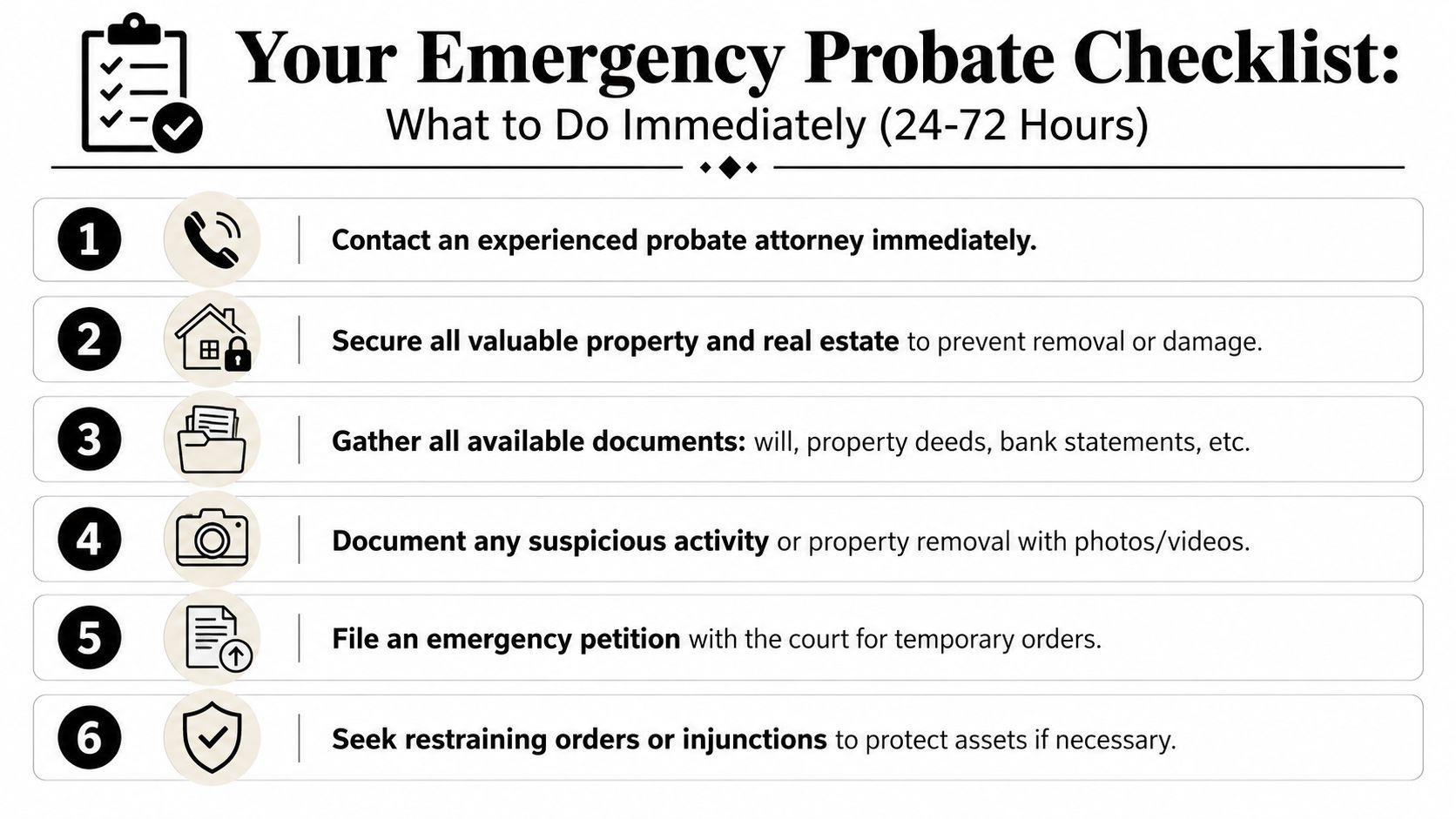
A missed issue in many probate guides is what happens before probate is fully opened. As this article on acting immediately after a probate emergency arises explains, the earliest stage is often about preservation mechanics, including standing, court jurisdiction, and what can be done before letters testamentary issue.
The first moves to make
Call a probate attorney quickly
Don't wait for a family meeting to see if things calm down. In emergency probate situations, delay often hands control to the wrong person.Secure physical property lawfully
If the home is vacant, valuables are exposed, or access is uncontrolled, secure the property in a lawful way. That may include collecting keys, limiting access, or protecting items from damage. Don't overreach. Possession without authority can create new disputes.Gather critical papers
Look for the will, deeds, account statements, insurance information, business records, and death certificate materials. If your family doesn't yet have a will, it's worth understanding how to create a will and testament for future planning so the next generation faces fewer emergencies.
Keep originals safe, but make working copies immediately. Lawyers and courts move faster when the facts are organized.
What to preserve, not disturb
The next priority is proof.
- Photograph rooms and valuables: Capture what is present now.
- Record suspicious conduct: Save dates, times, names, messages, and witness observations.
- Preserve digital clues: Emails, text threads, banking alerts, cloud folders, and phone access may matter later.
- Avoid confrontations: Don't try to forcibly take property back or empty accounts yourself.
A short legal checklist after a death can help families organize those early steps. This resource on what to do immediately after a loved one dies in Texas covers that first stage well.
A short explanation of temporary administration can also help families understand what the court may do next.
One mistake to avoid
Don't assume that being the closest family member gives automatic authority. In Texas, legal authority usually comes from the will, the court, or both. Acting too aggressively before that authority exists can complicate the very emergency you're trying to fix.
The Emergency Filing Process in Texas Courts
A probate emergency usually reaches the courthouse after the first triage work is done. The family has identified the immediate threat, preserved what evidence it can, and needs a judge to put legal authority behind the effort to stop further loss.
That court process moves fast by probate standards, but it is still procedural. Speed helps only if the filing is specific, supported, and filed in the right court.
How the filing usually starts
Counsel begins with a sworn application or other verified pleading that lays out four things plainly: who died, why the applicant has standing, what is happening right now, and what order the court needs to enter today or within days. In emergency matters, details matter. Dates, account information, property addresses, screenshots, text messages, and witness statements often carry more weight than broad accusations about what another relative is "probably" doing.
Venue is the next pressure point. Texas probate filings usually belong in the county with the decedent's domicile or another legally recognized connection to the estate. A rushed filing in the wrong county can delay relief at the exact moment the estate needs protection.
Then counsel asks the court coordinator or clerk for the earliest available setting and, if the facts justify it, immediate temporary relief pending a fuller hearing.
What courts usually want to see
Texas judges handling emergency probate requests usually focus on two questions first. Is there a real and immediate risk to estate property? Is the requested order narrow enough to prevent that harm without deciding the whole case prematurely?
That is why targeted requests tend to perform better. An application asking the court to appoint a temporary administrator to secure a business, collect mail, change locks, and freeze improper withdrawals is easier to evaluate than a filing that tries to resolve every inheritance dispute at once.
In some cases, the right first move is a temporary restraining order rather than an appointment. Families dealing with a pending sale, a threatened account transfer, or interference with estate records should review this guide on temporary restraining orders in Texas probate cases before the hearing so the request is framed correctly.
What the first hearing may accomplish
The first hearing is often short and practical.
The court may appoint a temporary administrator with limited powers, sign an order preserving specific property, restrain a transfer, require an inventory, or set a second hearing on a compressed timeline. The judge is usually trying to stabilize the estate, not finish the administration in one appearance.
Families are often surprised by how narrow that initial order can be. That is normal. Temporary relief works best when it solves the immediate danger and leaves the larger disputes for a later setting, after notice, briefing, and a fuller record.
Why courts use temporary relief in probate cases
Ordinary probate administration can take months, and sometimes much longer. A summary of probate timing and costs notes that many probate matters extend well beyond the first filing stage. Emergency orders exist because some estates cannot wait through the normal timetable while assets are being sold, drained, hidden, or neglected.
The court may also require a bond, depending on the relief requested, the nature of the appointment, and the level of financial risk. The signed order then becomes the working authority for everyone involved. Banks, tenants, business partners, brokers, and family members will usually look to that order to determine who can act, what property is covered, and where the temporary representative's power stops.
Key Insights Navigating Your Probate Emergency
A probate emergency usually starts before anyone reaches the courthouse. A daughter learns her father's truck has been listed for sale. A nephew finds online banking passwords missing. A business partner says payroll cannot wait for a standard probate timeline. In those first hours, the family does not need a lecture on probate theory. They need a triage plan that protects property, preserves evidence, and positions the case for fast court action.
The central point is straightforward. Early action preserves options. Once money is transferred, title changes hands, digital records disappear, or a vacant house is stripped, recovery gets more expensive and more uncertain.
Focus on three priorities:
- Stabilize the asset first: secure real property, redirect mail, preserve devices, freeze or flag accounts where possible, and document current conditions.
- Build proof while facts are fresh: gather bank records, screenshots, texts, lease files, business records, photos, and names of witnesses who can explain the immediate risk.
- Match the response to the threat: some cases need temporary administration, some need a restraining order or turnover relief, and some need a prompt probate filing paired with targeted requests to keep property from disappearing.
That practical sequence matters. Families often assume the case begins with paperwork. In urgent probate matters, the first 24 to 72 hours are often about preventing loss so the later filing has something left to protect.
Texas Estates Code Titles 2 and 3 supply the legal framework for estate administration, representative authority, and probate procedure. In real emergencies, the hard part is applying those rules to a specific problem under time pressure, with incomplete information and a family already under strain.
Broader estate questions may still need separate analysis. Incapacity concerns can overlap with guardianship issues. A dispute over authority, asset control, or the validity of estate documents may develop into probate litigation. Good emergency counsel looks at both tracks at once: what must be done today to stop harm, and what longer probate steps will follow once the immediate risk is contained.
The Law Office of Bryan Fagan, PLLC handles Texas probate, estate administration, guardianship, wills, and probate litigation. That allows families to address the emergency filing and the larger estate issues in one legal process.
If you're facing probate in Texas, our team can help guide you through every step, from filing to final distribution. Schedule your free consultation today with Law Office of Bryan Fagan, PLLC.