Skip to content
A phone call comes in, and everything changes. A parent, spouse, or sibling has passed away. Within days, someone in the family is asked to “handle the estate,” find the will, talk to the court, and figure out what happens to the house, the bank accounts, and the bills.
Those in that position feel two things at once. They want to do right by their loved one, and they have no idea where to start.
That's normal.
In Texas, probate can be simple, highly supervised, or somewhere in between. The attorney you hire can make the process clearer and more manageable, but only if that lawyer regularly handles the kind of probate matter your family has. That's the part many articles miss. They talk about “experience” in a broad sense, when the more important question is whether the lawyer's experience fits your estate's path under the Texas Estates Code, especially the probate and administration provisions found in Titles 2 and 3.
A good probate lawyer should explain the process in plain English, help you avoid preventable delays, and guide you through each filing, hearing, notice, and distribution step with calm, steady advice.
Navigating Grief and Legal Duties
Maria's father dies in Harris County. She finds a will in his desk naming her as executor. Her brother lives out of state. The family home is still in their father's name. Bills are arriving, relatives are asking questions, and Maria keeps hearing the same word from everyone: probate.
She's grieving, exhausted, and worried about making a mistake.
That combination is common. Probate doesn't arrive at a convenient time. It lands in the middle of funeral plans, family emotions, and practical tasks that can't wait. Many executors and heirs assume they just need “a probate lawyer,” as if all probate cases are basically the same. In Texas, they aren't.
Why this choice matters early
The lawyer you choose will shape how the estate moves forward. In plain terms, probate is the court process used to recognize a will, appoint the person who handles the estate, address debts and claims, and transfer property to the right people. Under the Texas Estates Code, Titles 2 and 3 govern many of the rules families encounter in estate administration, wills, heirship, and related proceedings.
Some lawyers focus on straightforward estate administration. Others spend much of their time in contested matters. Some know the local court's filing habits and hearing expectations well. Others may be licensed in Texas but have limited day-to-day probate practice.
Practical rule: The right probate attorney isn't just a lawyer who handles estates. It's a lawyer who handles your kind of estate in your county's probate system.
What grieving families often need most
At this stage, you probably don't need a lecture on legal theory. You need someone who can answer questions such as:
- Do we even need probate: Not every asset passes through probate, and not every estate requires the same court process.
- What happens first: Families often need help locating the will, identifying heirs, and understanding who has authority to act.
- How much court involvement is required: That depends on the probate path.
- Who needs updates: Beneficiaries, heirs, and sometimes creditors all play a role.
The good news is that choosing well becomes much easier once you stop treating probate as one generic service and start matching the lawyer to the estate's actual legal route.
First Match Your Estate to the Right Texas Probate Path
Before comparing attorneys, identify what kind of probate matter you may have. That sounds technical, but it's really a question of fit. If someone needs heart surgery, they don't hire a general doctor for that procedure. Probate works the same way. The legal path should guide the attorney choice.
Texas law library guidance explains that probate may be needed to transfer title, pay creditors, determine heirs, or resolve disputes, and that simplified alternatives may exist depending on the estate and the property involved, as outlined in the Texas probate guide from the State Law Library.
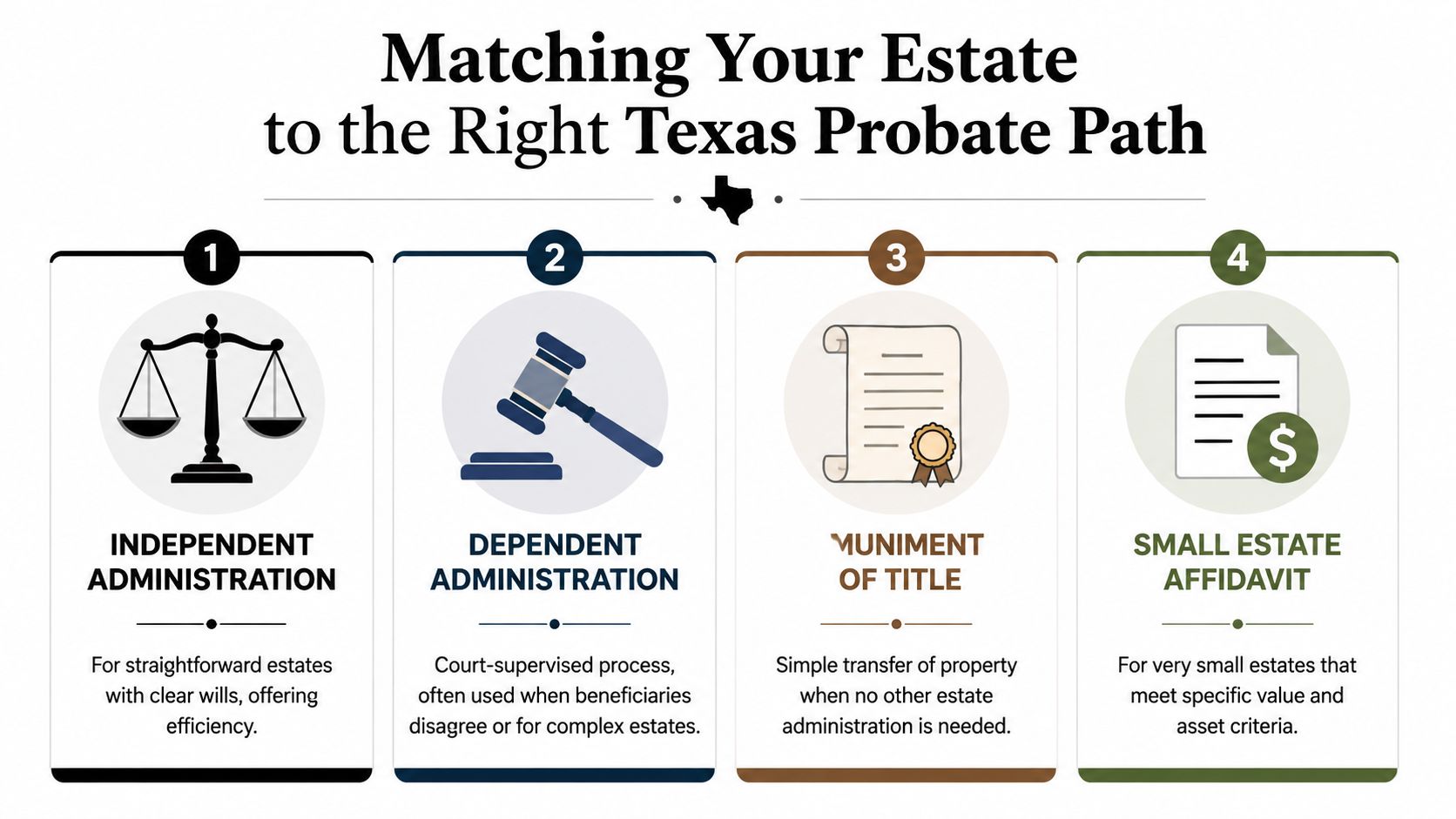
Independent administration
This is often the most efficient formal probate route when there's a valid will and no serious fight among beneficiaries. In plain English, independent administration usually means the executor can handle many estate tasks with less ongoing court supervision.
That can make it a good fit for a lawyer who is organized, deadline-focused, and experienced with routine filings, inventories, notices, and closing steps. It may not require the same kind of litigation-heavy background that a contested estate would.
Dependent administration
Dependent administration involves more court supervision. The personal representative may need court approval before taking actions that would be simpler in an independent case.
This path often appears when there is disagreement, complexity, or a need for tighter oversight. If your estate may fall into this category, you should look for a lawyer comfortable with hearings, court approvals, and more procedural oversight under the Texas Estates Code.
A lawyer who mainly handles streamlined uncontested estates may not be the best fit for a dependent administration or a fight over heirs.
Muniment of title
This option is often misunderstood. Muniment of title is a limited probate procedure that may work when the will needs to be recognized mainly to transfer title, often real estate, and no full administration is needed.
For the right estate, this can be simpler than full administration. For the wrong estate, it can be the wrong tool entirely. That's why you want a lawyer who won't force every family into the same process.
Small estate alternatives and heirship issues
Some smaller estates may qualify for simplified procedures, while others require an heirship determination because there is no valid will or there's uncertainty about family relationships and inheritance rights.
If you're trying to decide between probate and a simplified option, this explanation of probate versus a small estate affidavit in Texas can help you frame the conversation before you meet with counsel.
A simple self-check before you call lawyers
Ask yourself these questions:
- Is there a will: If yes, where is the original?
- Is anyone likely to disagree: Even one family conflict can change the kind of lawyer you need.
- What property is involved: A house, business interests, unpaid debts, or unclear title can affect the path.
- Do all assets even require probate: Some may pass outside court.
- Do we need transfer, oversight, or dispute resolution: Those are very different legal jobs.
When families answer those questions first, they usually make better hiring decisions and avoid paying for the wrong level of representation.
Essential Qualifications for a Texas Probate Attorney
A family can call three probate lawyers and get three very different recommendations. One suggests Independent Administration. Another says a Muniment of Title may work. A third warns that court supervision may be needed because conflict is likely. That difference is why qualifications matter. You are not only hiring someone with a law license. You are hiring someone to identify the right Texas probate path and carry it through correctly.
Texas probate also runs on deadlines and procedure. A missed filing date, a poorly prepared application, or a wrong choice of process can cost time and money. A helpful overview from Greg Hall Law explains why choosing a probate lawyer in Texas should center on Texas probate experience, court procedure, and clear communication.
Match the lawyer's experience to the probate path your estate likely needs
This is the qualification families miss most often.
A probate lawyer may be competent in a broad sense but still be a poor fit for your case. An attorney who mainly handles routine Independent Administrations may not be the right choice for a contested heirship matter. A lawyer who often prepares Muniment of Title cases may not be the best fit if the estate has creditor issues, family conflict, or a need for close court supervision.
Probate paths work like different roads to the same destination. A paved highway, a farm road, and a construction detour all require driving, but you would not choose the same vehicle for each one. Your attorney should regularly handle the road your family is on.
Ask direct questions such as:
- How often do you handle Independent Administrations?
- How many Muniment of Title cases have you filed in the last year?
- Do you handle Dependent Administrations when court supervision is required?
- Have you handled heirship proceedings or will contests?
- If title problems appear, can you address them or coordinate with the right counsel?
Those questions tell you more than a polished intake process ever will.
County familiarity matters
Texas probate is local in a practical sense. The Estates Code sets the rules, but each county has its own habits on scheduling, settings, clerk preferences, and the level of detail a judge expects in filings and testimony.
A lawyer who regularly appears in your county often spots small issues before they become delays. That can mean cleaner filings, better hearing preparation, and fewer surprises. In probate, those practical details matter because grieving families usually want progress, not procedural detours.
Look for probate depth, not just general estate planning experience
Some lawyers prepare wills for many clients but spend little time in probate court. Others focus a large part of their practice on estate administration after death. Those are related skills, but they are not the same.
A strong candidate may be Board Certified in Estate Planning and Probate Law by the Texas Board of Legal Specialization. That credential is helpful, but it is not the only thing to ask about. You also want to know how much of the lawyer's current work involves probate, whether that work includes court appearances, and whether the attorney handles the kinds of complications your estate may present.
For example, a house with title questions calls for different experience than a simple transfer under a will. A disabled beneficiary, a possible guardianship concern, or disagreement among heirs changes the legal job again.
If cost is a concern while you compare experience levels, this guide to Texas probate attorney fees and what affects them can help you ask better questions during consultations.
What competent probate counsel should be able to explain clearly
By the end of an initial consultation, you should have a workable map of the case.
A good probate lawyer should be able to explain, in plain English:
- which probate path appears most likely for your estate
- what documents are needed first
- who has authority to act now, and who does not
- what deadlines or court settings are likely to matter
- whether a dispute could change the process
- how the relevant parts of the Texas Estates Code apply to your facts
If the explanation feels muddy, rushed, or overly abstract, pay attention. Probate is confusing enough without hiring someone who makes it harder to understand.
Clarity is not a bonus. It is part of competence. A lawyer who can teach you the process usually understands it well enough to handle it carefully.
Decoding Attorney Fees and Probate Costs in Texas
Money is one of the hardest parts of this conversation. Families don't want to sound insensitive by asking about cost. They also don't want to hire a lawyer and then discover the bill is far beyond what they expected.
You should ask anyway. A clear fee discussion is part of good representation.
A Texas probate fee article reports that straightforward, uncontested Houston probate matters often involve flat fees of about $2,500 to $4,000, while more complex matters may use hourly billing of roughly $250 to $450 per hour, with court costs adding about $400 to $600. The same article notes that Avvo lists 5,150 probate lawyers in Texas, which gives families room to compare options before hiring, as described in this overview of Texas probate attorney fees and market options.
Flat fee or hourly billing
A flat fee is common when the estate is straightforward and the scope of work is fairly predictable. That can be helpful because it gives families more certainty.
An hourly fee is more common when the lawyer expects complications, disputes, unusual assets, or significant court involvement. Hourly billing isn't necessarily bad. It just requires more careful questions about what could increase the final amount.
For a fuller breakdown of what Texas lawyers may charge and how fee structures work, review this guide to probate attorney fees in Texas.
Comparing common Texas probate attorney fee structures
| Fee Structure | Best For | Typical Texas Cost Range | Key Question to Ask |
|---|---|---|---|
| Flat fee | Straightforward, uncontested probate matters | About $2,500 to $4,000 | What exactly is included in the flat fee? |
| Hourly billing | More complex probate matters | Roughly $250 to $450 per hour | What tasks will be billed hourly, and who performs them? |
| Court costs | Filing and court-related charges | About $400 to $600 | Are court costs separate from attorney fees? |
Questions that keep billing clear
Don't stop at “What do you charge?” Ask these instead:
- What services are included: Filing, hearings, notices, inventory preparation, and routine communication may or may not be part of the quoted fee.
- Who works on the case: A partner, associate, or paralegal may bill differently.
- What can increase cost: Disputes, title problems, missing heirs, or creditor issues often change the budget.
- How are updates handled: Good billing clarity often goes hand in hand with good communication.
The right fee structure is the one that matches the estate. A simple muniment of title shouldn't be priced like a family fight over heirship. A contested estate shouldn't be sold as “simple” just to make the engagement letter look attractive.
How to Interview Attorneys and Identify Red Flags
A probate consultation often happens at a hard moment. You may still be answering sympathy texts while trying to figure out what to do with a house, a will, and a stack of unanswered mail. In that setting, a good interview process matters because the right lawyer will first identify which Texas probate path fits the estate, then explain what that choice means for time, cost, and court involvement.
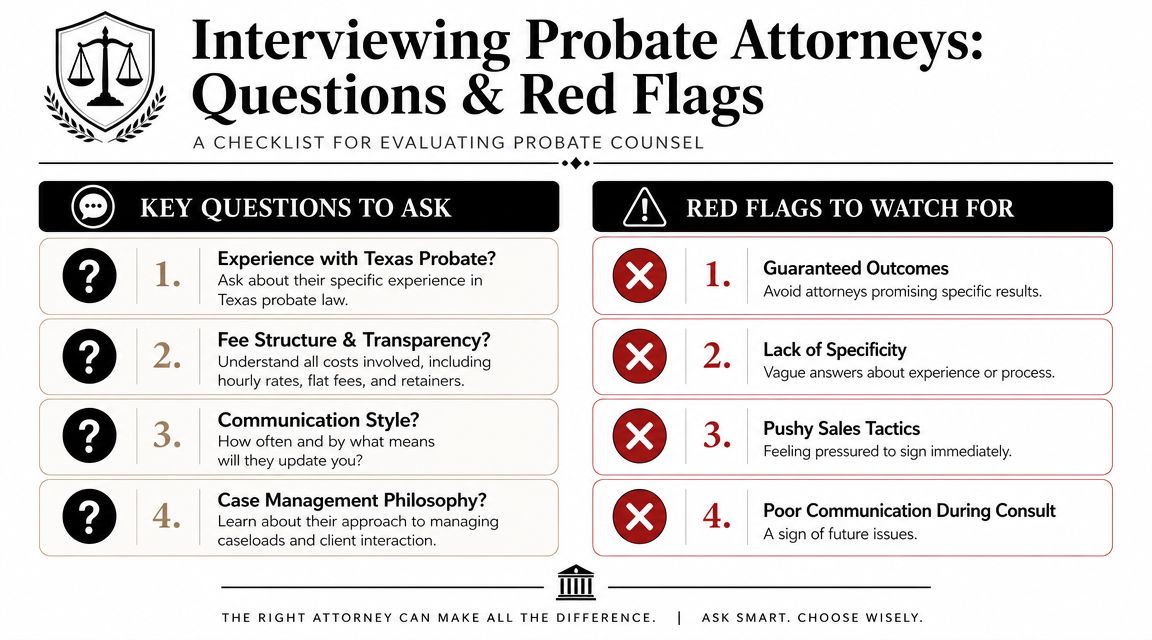
Start with one simple test. Does the attorney ask enough questions to diagnose the estate before suggesting a service?
Probate in Texas is not one single lane. Independent Administration, Dependent Administration, Muniment of Title, and heirship proceedings each solve a different problem. A lawyer who treats them as interchangeable may miss a simpler option or underestimate a difficult one. A lawyer who listens for facts first is more likely to match the representation to the estate you have.
A useful consultation should cover the will, the heirs, the county, the kinds of assets involved, and whether anyone is likely to object. That is how a careful lawyer sorts out whether your matter is closer to a straightforward transfer of title or a court-supervised administration with more filings and oversight. For a general checklist of qualities families often review while comparing firms, this article on what to look for in a good probate attorney offers a helpful outside perspective.
Questions worth asking in every consultation
Ask questions that show whether the lawyer can match skill to your estate's legal path.
- What kinds of Texas probate matters do you handle most often? You are listening for specifics, not a broad statement that the firm handles "all probate."
- Based on what I've told you, which probate path do you think fits this estate, and why? A strong answer should compare options such as Independent Administration, Dependent Administration, Muniment of Title, or heirship.
- How many cases like this have you handled in this county? Local practice can affect scheduling, filing habits, and court expectations.
- What facts could change your recommendation? This reveals whether the lawyer is thinking carefully about hidden issues such as family conflict, missing heirs, or title problems.
- Who will do the work and who will talk with me? Many families are comfortable working with staff, but they should know that arrangement in advance.
- How do you explain the likely timeline and court steps for this kind of case? Clear explanations now often predict clear communication later.
If you're sorting through local options, a directory for finding a Texas probate lawyer near you can help you build a comparison list before you schedule calls.
What a strong consultation sounds like
Consider two meetings.
In the first, the lawyer says the estate should be "easy" and quickly turns to a fee quote. He does not ask whether the original will can be located, whether all heirs are on good terms, whether the home deed creates title issues, or whether the estate might qualify for Muniment of Title instead of full administration.
In the second, the lawyer slows down and sorts the facts. She asks who died, what county has venue, whether there is a valid will, whether debts remain unpaid, and whether any beneficiary is likely to contest the process. Then she explains why those facts point toward one Texas probate procedure rather than another.
That second approach works like a doctor taking a history before writing a prescription. Probate advice is more reliable when it begins with diagnosis.
Good probate counsel sounds careful and precise. In probate, that usually signals preparation, not hesitation.
Red flags that deserve attention
Some warning signs are obvious. Others only become clear if you know what to listen for.
- The lawyer does not start by identifying the probate path. If there is no discussion of Independent Administration, Dependent Administration, Muniment of Title, heirship, or another specific route, the advice may be too generic for your case.
- Guaranteed results. No honest attorney can promise exactly what a judge will do or how long every step will take.
- Vague answers about fees or scope. You should leave knowing what the lawyer expects to handle and what could increase the cost.
- Pressure to sign before your questions are answered. Grieving families need clarity, not speed for its own sake.
- Poor listening. If the lawyer talks over details about family conflict, creditor issues, or property problems, important risks can be missed.
- No clear communication plan. If you cannot tell who will return calls or when updates will come, frustration often follows.
One more practical point. Estates often involve work outside the courthouse, especially when a home must be cleared out, secured, or prepared for sale. Keeping a short list of dependable providers, including TLC Moving's accredited movers, can reduce stress while the legal process is underway.
A short video can also help you think through your interview approach:
If conflict is already brewing, ask one direct question before you hire anyone: "If this becomes contested, do you handle that work or refer it out?" That answer tells you whether the lawyer is built for the case you have today, the case you may have next month, or both.
Preparing for Your First Consultation
Once you've found a promising attorney, the next step is simpler than many anticipate. You don't need a perfect file. You need a workable starting point.
What to gather if you can
Bring what you have, even if the picture is incomplete:
- The original will: If you have it
- Death certificate: A copy or proof that it has been ordered
- Basic family information: Names and contact details for heirs, beneficiaries, and the proposed executor
- A rough asset list: Home, bank accounts, vehicles, business interests, retirement accounts, and anything else you know about
- Known debts: Mortgage, credit cards, taxes, medical bills, or other obligations
- Any court papers or prior legal documents: Trusts, deeds, powers of attorney, or prior probate filings
What the meeting should cover
In Texas, choosing the right attorney means matching the lawyer's experience to the estate's administration method. Independent administration is less court-supervised than dependent administration, and estate administration generally requires the executor or administrator to be represented by a licensed lawyer. The attorney should also understand the filings, hearings, and the 90-day asset inventory, appraisal, and list process that follows the probate hearing, as discussed in this explanation of how probate works in Texas.
Most first meetings cover three things:
- What kind of probate matter this appears to be
- What documents and facts are still missing
- What the next legal step would look like
It's okay not to know everything at the first meeting. A good probate attorney helps turn scattered information into an orderly plan.
Key Insight Your Compass for Choosing a Probate Attorney
Key Insight
The heart of how to choose the right probate attorney in Texas is simple. Don't start with the lawyer. Start with the estate's path.
A family with a routine independent administration needs a different skill set than a family facing dependent administration, heirship questions, guardianship concerns, or litigation. The best choice usually isn't the loudest advertisement, the lowest quote, or the broadest promise. It's the attorney whose Texas probate experience matches the exact procedure your family is likely to face under the Estates Code.
That match protects time, money, and peace of mind. It also helps grieving families move forward with less confusion and more confidence.
If you're facing probate in Texas, the Law Office of Bryan Fagan, PLLC can help guide you through every step, from filing to final distribution. Schedule your free consultation today.