A loved one has passed away. The funeral is over. The family has started sorting through papers, keys, and hard conversations. Then someone asks the question nobody wants to answer: what should happen to the house?
One child wants to sell right away because the estate needs to be wrapped up. Another wants to keep the home because it still feels like Mom's house, not an asset on a spreadsheet. A third thinks renting it out would honor the property and create long-term income. Nobody is being unreasonable, but nobody agrees.
That's often where probate gets personal.
When families search for answers to what happens when heirs disagree on selling property in probate, they're usually not looking for abstract legal theory. They want to know who has authority, whether a sale can be stopped, what court can do, and whether there's any way to solve the dispute without tearing the family apart. In Texas, those questions usually turn on the type of probate administration, the terms of the will, the executor's duties, and whether the heirs have become co-owners of the property.
This is also a grief issue, not just a legal one. Some families benefit from outside emotional support while decisions are being made. If your family is carrying both sorrow and conflict at the same time, resources for support for navigating personal loss can help people communicate more calmly while the legal process moves forward.
A Painful Crossroads for a Grieving Family
Maria dies owning a home in Texas. Her will leaves everything equally to her three adult children. At the kitchen table, the disagreement starts almost immediately.
Elena wants the home sold because she lives out of state and doesn't want an empty property sitting for months. Daniel wants to keep it because he grew up there and still feels connected to every room. Sofia thinks the family should rent it for a while and decide later. Each person has a reason that makes sense to them. That's why these disputes hurt so much.
Why this feels so much harder than people expect
Most families assume inheritance works like a simple handoff. In reality, probate often places the property inside a legal process before anyone gets what they're entitled to receive. The house may need to be managed, protected, insured, maintained, and sometimes sold before final distribution happens.
Texas law also separates emotional ownership from legal authority. An heir may feel strongly tied to the home, but feelings alone don't decide whether a sale happens. The court, the will, the executor's authority, and the estate's needs all matter.
Grief often makes every property decision feel like a decision about the person who died. Legally, it usually isn't. It's a decision about how to administer the estate fairly.
The confusion families usually run into
People often get stuck on a few questions:
- Who decides whether the property is listed for sale?
- Can one heir block the sale if they disagree?
- What if the estate needs money to pay debts, taxes, or expenses?
- What if one heir wants to keep the house and others want cash?
- What happens if nobody gives in?
Under the Texas Estates Code, especially in Title 2 governing estates of decedents and Title 3 governing guardianship-related matters in other contexts, probate is designed to move property through an orderly process. That process can feel cold when a family is grieving, but structure is often what prevents a painful disagreement from becoming total chaos.
The good news is that disagreement doesn't automatically mean a courtroom battle. In many cases, families still have options that protect estate value and give relationships a chance to survive.
Executor vs Heir Who Has the Final Say on a Sale
One of the biggest misunderstandings in probate is this: heirs think being named in the will gives them direct control over estate property right away. Usually, it doesn't.
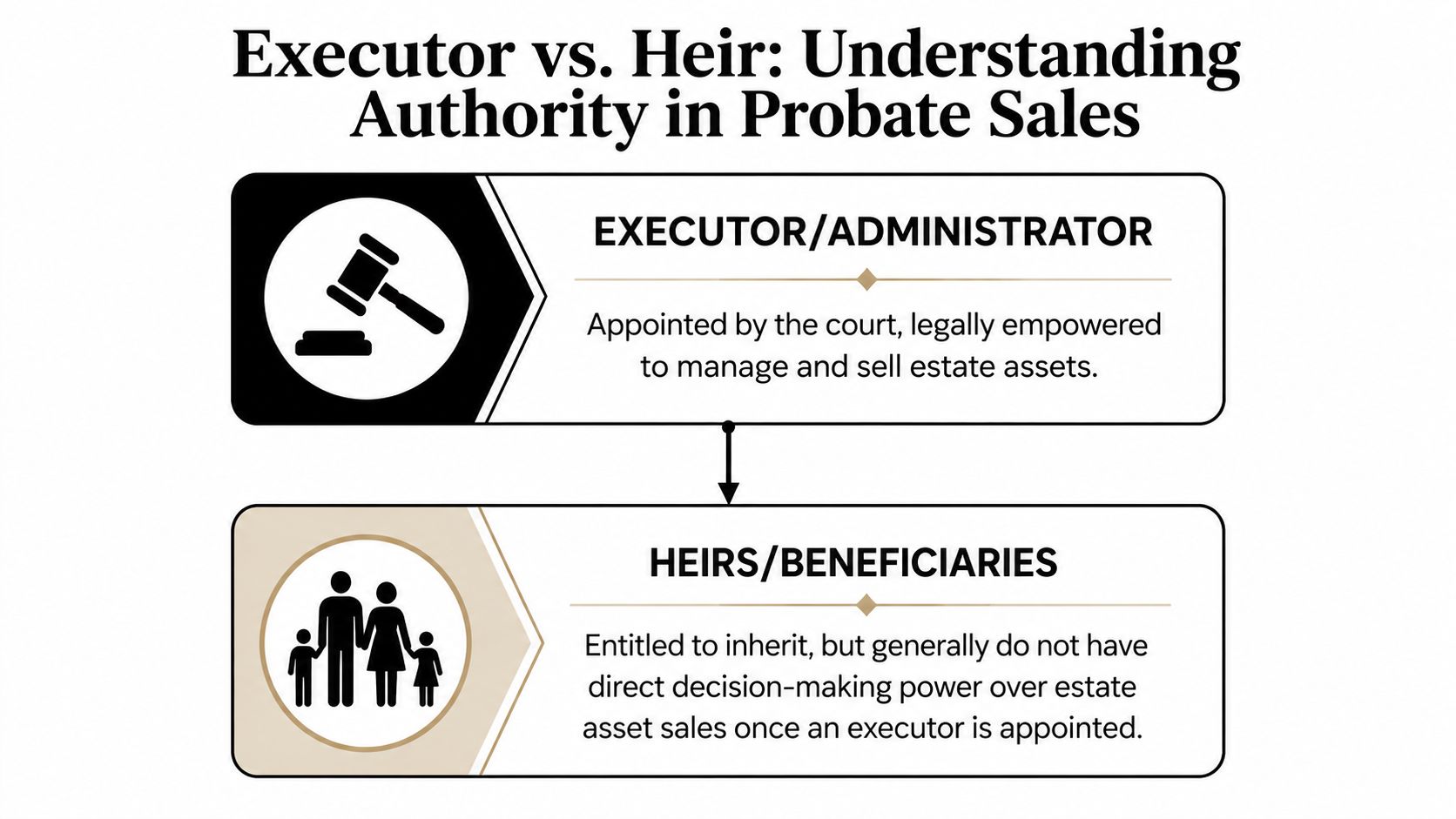
In probate, the executor named in the will, or the administrator appointed by the court if there is no valid will, acts as the legal representative of the estate. Think of that person as the captain of a ship. The heirs are the passengers with a destination interest, but the captain steers the vessel through the probate process.
Who holds legal authority
The executor's job is to gather assets, handle required notices, deal with debts and claims, protect estate property, and carry out the will or court orders. That duty is called a fiduciary duty, which means the executor must act in the estate's best interest, not in favor of one sibling over another.
If you want a broader plain-English overview of the process, this Edinhart guide to probate is a helpful general primer. For Texas-specific authority, the difference between an executor's powers and an heir's expectations becomes even more important.
A Texas estate often proceeds under either independent administration or dependent administration. Under independent administration, the executor usually has more room to act without asking the court for approval at every step. Under dependent administration, the court supervises much more closely.
For a closer look at sale authority in that setting, see this explanation of independent executor powers in Texas.
Why heirs still matter
Even when the executor has authority, heirs aren't irrelevant. They can raise concerns if they believe the executor is acting unfairly, underselling the property, or ignoring the estate's obligations. In some probate disputes, objecting heirs can ask the court to review or restrict a proposed sale.
That's why a sale dispute often becomes a conflict about process as much as outcome.
A simple way to think about it is:
| Person | Role in probate | Main power |
|---|---|---|
| Executor or administrator | Court-recognized representative of the estate | Manages estate assets and may be able to sell property depending on the administration |
| Heir or beneficiary | Person entitled to receive inheritance | Can object, negotiate, seek court review, or later act as co-owner after distribution |
What Texas families should ask early
Before arguing about whether to sell, ask these questions first:
- Is there a will, and what does it say about the property?
- Has an executor already been appointed by the court?
- Is the estate independent or dependent?
- Does the estate need the sale to pay debts or make fair distribution possible?
- Has title passed to the heirs yet, or is the property still part of the estate?
If you're trying to understand the role in more detail, An Executor's Duties in a Texas Probate outlines what an executor must do to administer the estate properly.
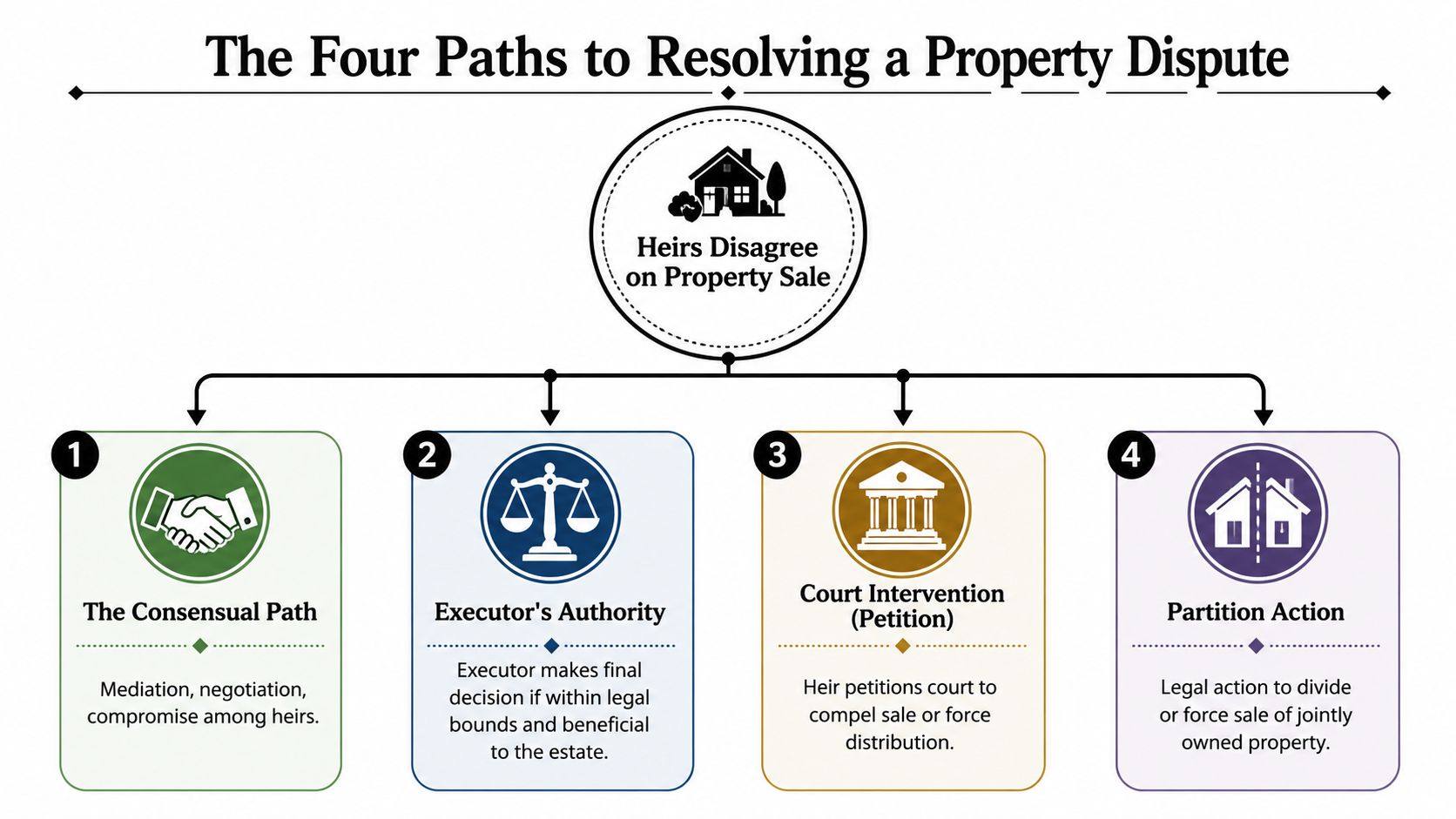
The Four Paths to Resolving a Property Dispute
Once a family reaches deadlock, there usually isn't just one road forward. There are several. The smartest path is often the one that solves the conflict with the least damage to the estate and the fewest scars left on the family.
Path one through agreement
Sometimes the best legal strategy is just a better conversation.
A family may agree to sell after setting a timeline, choosing a neutral real estate agent, getting an appraisal, or dividing personal belongings first. In other cases, they agree to hold the home for a short period and revisit the decision after emotions settle.
This path works best when the dispute is about timing or communication, not deep distrust.
Practical rule: If the family can still sit at one table and exchange documents, there is usually something worth trying before filing suit.
Path two through a buyout
A buyout often gives everyone part of what they want. One heir keeps the property. The others receive the value of their shares in cash or through offsetting assets from the estate.
For example, one sibling may refinance the house and pay the others for their interests. Or if the estate includes investment accounts or land, distributions may be adjusted so the child keeping the home receives less of another asset.
This is often the most relationship-preserving option because it treats the house as both memory and math.
Path three through executor action
Sometimes the executor must move forward because standing still hurts the estate.
The estate may need liquidity to pay debts, expenses, taxes, insurance, or ongoing maintenance. In that situation, the executor may seek authority to sell, or defend a proposed sale, because preserving the estate as a whole matters more than one heir's preference. Under Texas Estates Code procedures in Title 2, court involvement may increase if the administration is supervised or contested.
A disagreement can also create procedural risk. As noted in guidance on probate sale disputes, the technical effect of disagreement is not just delay but value erosion and procedural risk. Probate courts may require mediation or approval of a challenged sale, and in some places beneficiaries can object within a short window, which can freeze the transaction while the court evaluates fiduciary duty, price adequacy, and whether the sale serves the estate's best interest, as discussed in this article on disputes among heirs during a probate sale.
Path four through litigation
When nobody agrees and nobody can buy the others out, court may become the final decision-maker.
The most common lawsuit in this setting is a partition action after heirs hold title together as co-owners. In other situations, an heir may file objections within the probate case itself and ask the court to block, modify, or approve a sale.
Here's a quick comparison:
- Agreement: Lowest conflict, most flexible outcome.
- Buyout: Good when one person wants the home and can fund the transaction.
- Executor action: Necessary when estate administration requires movement.
- Litigation or partition: Final answer, but usually the hardest path emotionally.
Forcing a Sale Through a Partition Lawsuit
A partition lawsuit is what families often threaten long before they understand what it means. In plain English, it is a request for the court to break a co-ownership deadlock.
This usually matters after the property has passed from the estate to the heirs as co-owners. At that point, the executor's role may be limited or complete, and the issue becomes one of shared ownership.
How a partition case usually unfolds
Take a common example. Three siblings inherit a house in equal shares. One wants to sell. One wants to live there. One won't return calls. Months pass. Taxes, insurance, and maintenance continue. The sibling who wants resolution files suit.
Under a long-standing partition framework recognized in common-law systems, any co-owner can seek a partition action that asks the court to divide the property physically or order a sale and split the proceeds according to ownership shares. That means one heir can stop a voluntary deal by refusing to sign, but cannot always prevent a judicial sale, as explained in this discussion of whether all heirs must agree to sell inherited property.
The two outcomes a court considers
Courts usually look at two possible remedies:
- Partition in kind means the property is physically divided.
- Partition by sale means the property is sold and the proceeds are divided based on ownership interests.
For raw land, a physical division may be possible. For a single-family home in Texas, it usually isn't practical. You can't fairly split one kitchen, one roof, and one driveway into separate legal chunks that preserve value.
That's why many inherited-house disputes end with a court-ordered sale rather than a literal division of the property.
A partition suit solves the deadlock, but it rarely solves the family problem that caused it.
Why this route is so hard
Partition gives a frustrated heir an advantage. It also brings real costs.
The case becomes public. Family communications may move from text messages to lawyer letters. The court may need evidence about title, occupancy, repairs, expenses, and sale terms. If one heir has been living in the house or paying the carrying costs, those issues can add friction fast.
For readers dealing with that possibility in Texas, this guide on whether a judge can force the sale of inherited property in Texas gives more detail. If the probate dispute itself is already contested, families often need support through Probate Litigation, especially when a disagreement about a sale is tied to broader questions about the executor's conduct or the estate's administration.
Finding Common Ground with Mediation
Mediation is often the closest thing probate law has to a pressure-release valve.
Instead of asking a judge to impose an answer, the family sits down with a neutral mediator whose job is to help each side move from fixed positions to workable options. The mediator doesn't decide who wins. The family does.
Why mediation works in probate disputes
Many courts and practitioners favor mediation before full litigation because it is typically faster and less hostile than a courtroom fight, and some probate courts may require mediation before certain disputes proceed. A single heir's objection can turn an ordinary estate sale into a multi-step legal process, which is one reason mediation is often a smart first move, as described in this article about heirs who disagree during probate.
That matters because most families aren't really fighting over just one issue. They are often carrying several conflicts at once:
- Money concerns about whether the property should be sold now
- Memory concerns about letting go of a parent's home
- Trust concerns about whether the executor is being transparent
- Fairness concerns about one heir doing more work than others
What a mediated solution can look like
A good mediation doesn't always end with a sale. It may lead to a custom solution, such as:
- A delayed listing after a short hold period
- A sibling buyout with agreed financing terms
- A temporary rental plan followed by a sale date
- Allocation agreements for repairs, taxes, and insurance during the hold period
For Texas families weighing that choice, this discussion of mediation vs litigation in Texas probate can help frame the decision.
The best mediation outcome is not always perfect agreement. Sometimes it's a workable plan that costs less than a family war.
The True Cost of an Estate in Conflict
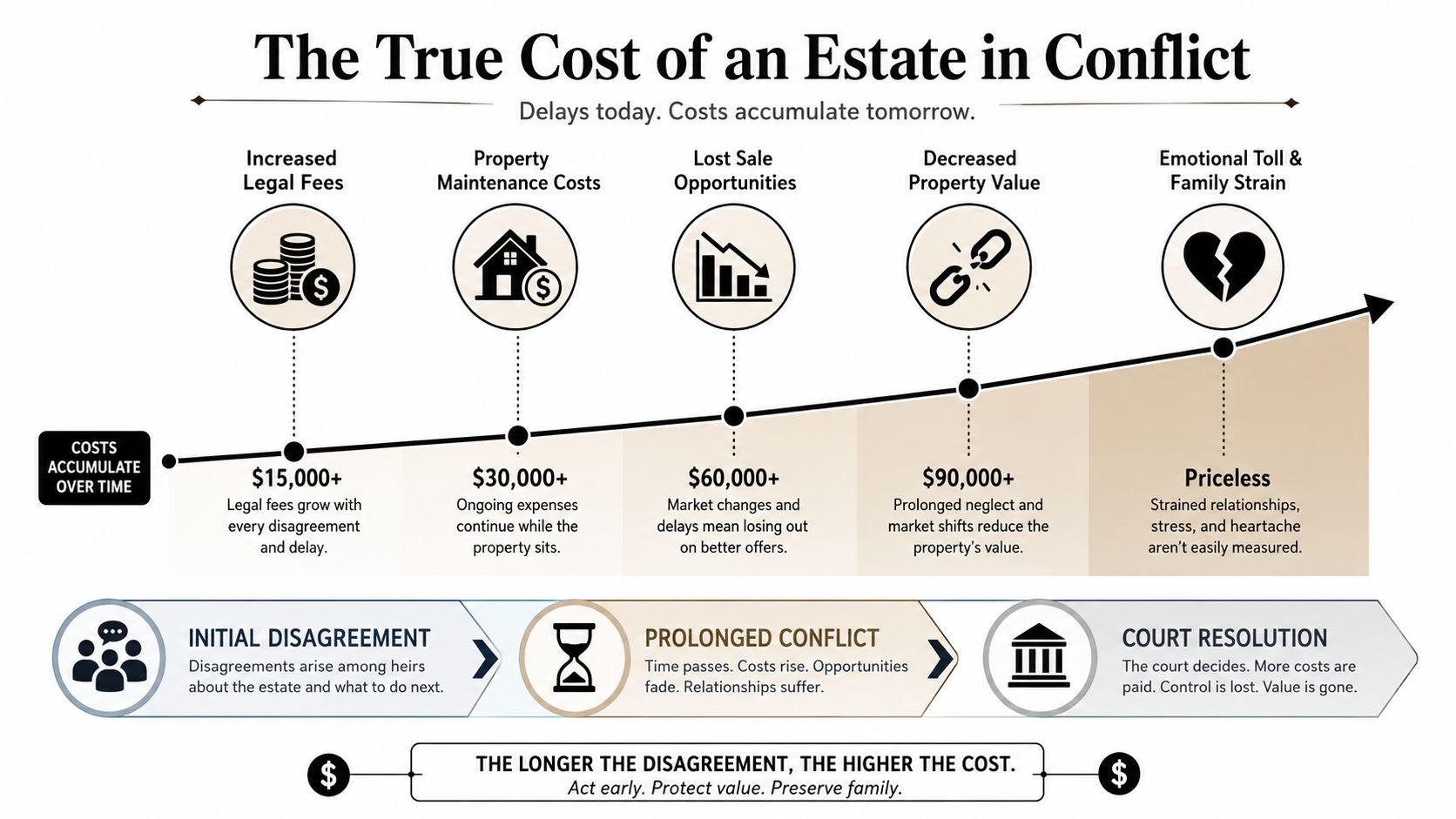
Property disputes drain more than patience. They drain the estate itself.
While the family argues, someone still has to deal with insurance, property taxes, utilities, lawn care, repairs, and security. If the house sits empty, small problems can become expensive ones. If no one agrees on upkeep, the property may begin to show neglect just when the estate needs to preserve value.
Where the losses usually show up
The visible costs are easy to name:
- Attorney fees for the executor and, often, for individual heirs
- Court costs tied to objections, petitions, or litigation
- Property expenses such as taxes, insurance, maintenance, and repairs
- Transaction delays that can interrupt an otherwise straightforward sale
The less visible costs are often worse:
- Family strain that lasts long after probate closes
- Decision paralysis that keeps the estate open longer than necessary
- Distrust that spills into disputes over personal property and final distributions
- Missed opportunities when a ready buyer or favorable market window is lost
A short video overview can also help families think through the financial and practical side of probate administration:
Why delay changes the estate
Texas probate is supposed to move an estate from uncertainty to distribution. Conflict reverses that. Instead of moving assets out to beneficiaries, the estate keeps spending money to hold them together.
That's one reason estate planning matters so much. Clear directions in wills, trusts, transfer planning, and choice of fiduciary can reduce ambiguity before a family is under stress. For many families, proactive work through Wills & Trusts can prevent the exact kind of property standoff that turns a house into a lawsuit.
A useful way to view the problem is this:
| If the family acts early | If the family delays |
|---|---|
| More options stay available | Options narrow |
| The house is easier to maintain and market | Disrepair and mistrust often grow |
| Buyout and mediation are easier to explore | Litigation becomes more likely |
Key Insights and Practical Next Steps
The hardest part of these disputes is that everyone may feel right at the same time. One heir needs liquidity. Another wants to preserve a family home. The executor is trying to follow legal duties. Probate doesn't erase those competing interests. It gives them a structure.
Key insight
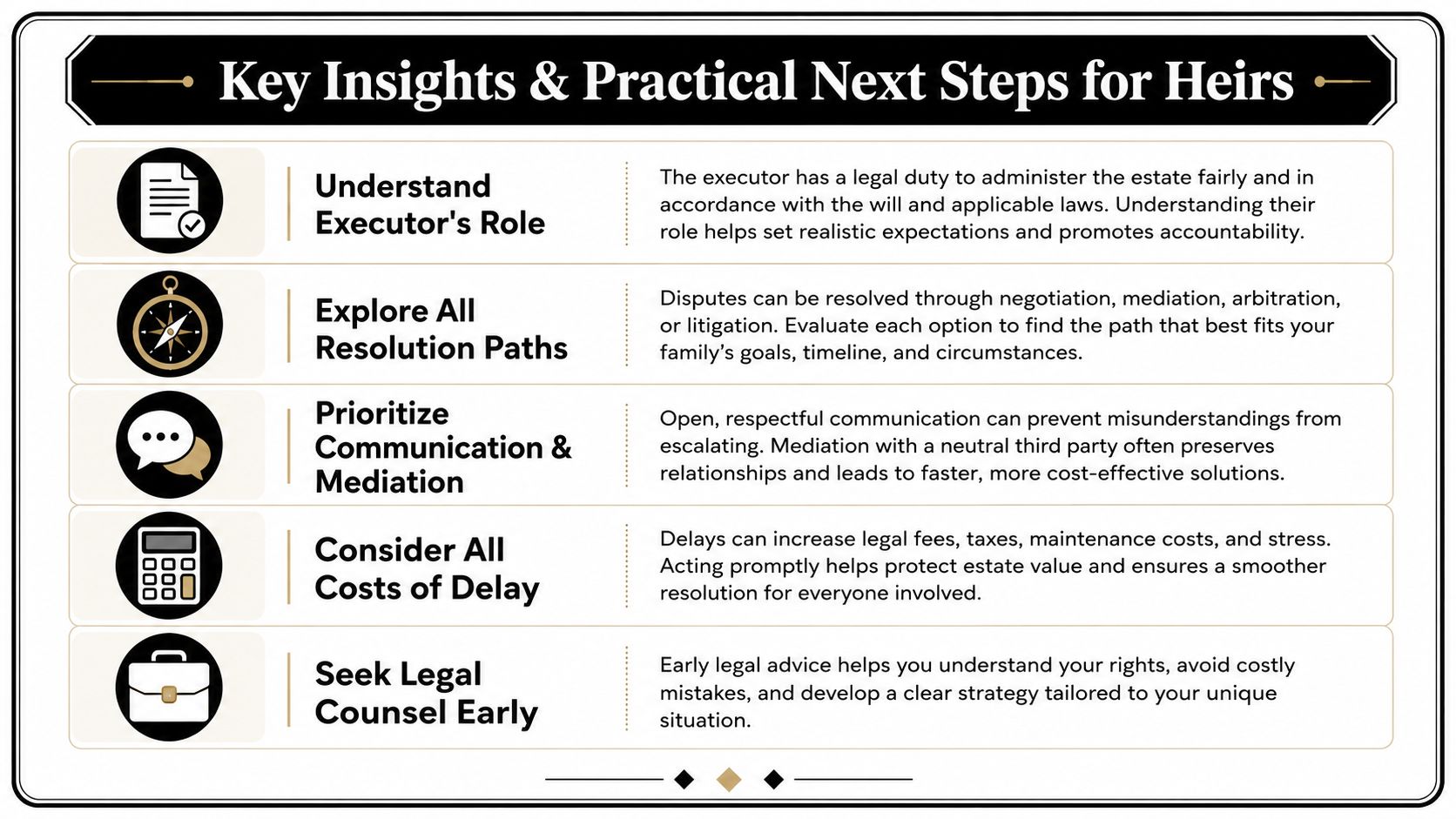
The best legal option is usually the one that resolves the conflict while preserving both estate value and the possibility of future family peace. A buyout, mediated compromise, or carefully handled executor sale often does that better than a scorched-earth court fight.
Texas Estates Code procedures in Title 2 give executors and probate courts tools to move estates forward, but those tools work best when families act early, gather good information, and stop treating silence as a strategy.
A practical checklist for executors
- Confirm your authority: Determine whether the estate is under independent or dependent administration and what the will allows.
- Document everything: Keep records of offers, property expenses, communications, and the reasons for any proposed sale.
- Focus on the estate as a whole: Your fiduciary duty runs to the estate, not to the loudest beneficiary.
- Request legal guidance early: If objections are building, get advice before signing contracts or escalating the conflict.
A practical checklist for heirs
- Ask for information, not assumptions: Request copies of the will, probate filings, and any proposed listing or sale terms.
- State your goal clearly: Do you want to keep the home, delay the sale, challenge the price, or receive your share another way?
- Consider a buyout before a lawsuit: If one person wants the property, that may be the cleanest solution.
- Propose mediation: It gives everyone a chance to be heard without immediately handing the family dispute to a judge.
If you need legal help sorting through these choices, the Law Office of Bryan Fagan, PLLC handles Texas probate, estate administration, guardianship, and contested estate matters. Families dealing with related issues may also need guidance on the Texas Probate Process or, in some situations, Guardianship when decision-making concerns overlap with family conflict.
If you're facing probate in Texas, our team can help guide you through every step, from filing to final distribution. Schedule your free consultation today.