Skip to content
A will does not always have to be probated in Texas. Whether probate is necessary depends mainly on the kind of property your loved one owned and whether those assets pass automatically outside of court.
If you're reading this after a death in the family, you may be holding a will in one hand and a long list of questions in the other. That's a hard place to be. Many Texas families assume that finding a will means they must open a full probate case right away, but that isn't always true. In some estates, probate is necessary. In others, a simpler option works. In a few, formal administration may not be needed at all.
Grief makes legal decisions feel heavier than they are. Simple terms start sounding technical. Deadlines feel intimidating. Family members may already be asking whether the house can be sold, whether the bank account can be accessed, or whether bills must be paid from estate funds. The good news is that Texas probate law gives families more than one path forward.
The question becomes practical when considering these factors. Not just, does a will have to be probated in Texas, but also: What property is involved? Is there real estate? Are there debts? Are there named beneficiaries? Is there a reason to ask the court to appoint an executor?
Understanding Your Next Steps After a Loved One's Passing
Maria's father dies in Harris County. He left a will naming her as executor. She assumes that means she must go to court immediately, open a full probate, notify everyone, file inventories, and manage months of paperwork. Then she learns something important. Her father's life insurance names a beneficiary. His retirement account also names a beneficiary. The only asset in his sole name is a small checking account and a vehicle. Suddenly, the answer is less automatic than she thought.
That kind of confusion is common. Many families hear the word probate and think it means every asset must pass through a judge's hands. In plain English, probate is the court process used to recognize a will and, when needed, authorize someone to handle the estate. Under Texas Estates Code Titles 2 and 3, that process can look very different depending on the estate.
Here's the reassuring part. A will and a probate case are related, but they are not the same thing. A will is the written document that says who should receive property and who should handle things after death. Probate is the legal process that may be used to make that document effective for certain assets.
Practical rule: Start by making a list of assets before deciding on a probate path. The right answer usually becomes clearer once you know what the estate actually owns.
Families also get tripped up by terminology. An executor is the person named in the will to carry out those wishes. Heirs are the people who inherit under Texas law if property passes by intestacy instead of under the will. Administration means the active management of the estate, such as collecting assets, paying debts, and distributing what remains.
The first questions to ask
Before filing anything, slow down and ask:
- What was owned individually: Was there a house, land, or mineral interest in the decedent's sole name?
- What passes automatically: Did accounts, insurance, or retirement assets have named beneficiaries?
- Are there debts: Does the estate owe unsecured debts that may require formal handling?
- Is court authority needed: Does anyone need legal authority to transfer title or deal with a bank or buyer?
Those questions often matter more than the simple fact that a will exists.
When Probating a Will Is Mandatory in Texas
A common Texas probate question comes up when a family finds a will in a desk drawer, then realizes the house is still titled only in the person who died. The will tells everyone what should happen. The title records do not change on their own.
That gap is where probate becomes mandatory.
In Texas, a will generally must be filed with the court after death. But filing the will and fully administering the estate are two different decisions. The executor's real job is to ask a practical question: does the family need court authority to transfer property, deal with creditors, or act for the estate? If the answer is yes, some form of probate is usually required. If the answer is no, a simpler route may work.
Real estate is the clearest example. If a home, ranch, lot, or mineral interest was owned in the decedent's name alone, the will by itself usually does not give the beneficiary marketable title. Title companies, buyers, and county records offices usually want a court order that connects the will to the property. A will works like a set of instructions. Probate is often the court's way of confirming those instructions so other institutions can rely on them.
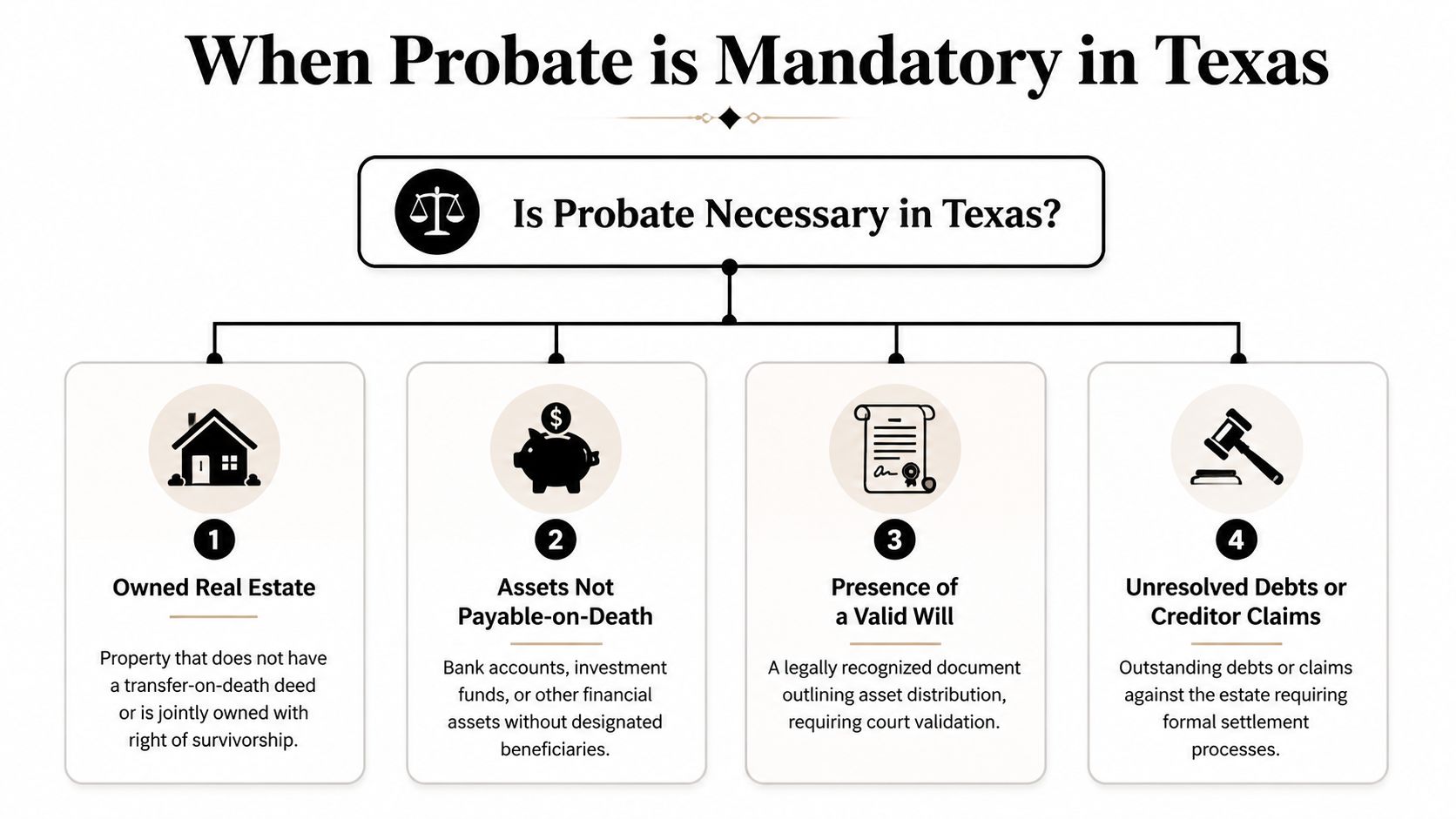
Situations that usually make probate necessary
Probate is often needed when the estate includes property that cannot transfer cleanly without court involvement, such as:
- Real property in one name: A house, land, ranch property, or mineral rights owned solely by the decedent
- Bank or investment accounts with no beneficiary designation: Especially if the institution will release funds only to a court-appointed representative
- Property that must be sold or collected by an executor: For example, when a title company or purchaser asks for letters testamentary or another court order
- Debts that need formal handling: If the estate has creditor issues and someone needs legal authority to gather assets, give notices, and pay valid claims
As explained in this discussion of when probate is required in Texas, the key issue is usually whether title or control can pass without a judge's order.
Situations where a full probate case may not be needed
Families are often relieved to learn that some assets skip probate because they already have their own transfer mechanism. That means the executor may still need to file the will, yet may not need a full estate administration for those assets.
Property commonly passing outside probate includes:
- Life insurance with a named beneficiary
- Retirement accounts with a named beneficiary
- Payable-on-death or transfer-on-death accounts
- Jointly owned property with survivorship rights
- Assets held in a living trust
The practical point is simple. If the asset already has a built-in path to the next owner, the court may not need to step in for that asset.
A realistic example
Suppose James dies with a valid will leaving his house to his daughter. The house is titled only in James's name. His daughter cannot usually record the will by itself and expect the title records to update cleanly. Some probate action is usually needed so the county records, future buyers, and any title company can recognize her ownership.
Now change one fact. James also had a life insurance policy naming his son as beneficiary. That policy usually passes directly to the son without probate because the contract already says who receives it.
That is why the executor's decision matters so much. The question is rarely, "Is there a will?" The better question is, "Which assets require court authority, and which ones do not?" Asking it early can save the family time, expense, and unnecessary legal work.
Exploring Simpler Alternatives to Full Probate
After a death, families often assume there are only two choices. Open a full probate case, or do nothing. In Texas, there is often a third path. File what must be filed, then choose the narrowest court process that solves the problem.
That choice matters. An executor's job is not to create extra procedure. It is to figure out what the estate needs, what it does not need, and which option transfers property with the least cost and delay.
Texas probate alternatives at a glance
| Method | Best For | Key Requirement | Typical Timeline |
|---|---|---|---|
| Muniment of Title | A will exists and the main need is to transfer title to property | No unpaid debts except secured debts like mortgages | Often faster than full administration |
| Small Estate Affidavit | A modest estate without a full probate need | Estate value excluding the homestead is limited by Texas law | Often simpler than full administration |
| Affidavit of Heirship | Situations involving family history and title issues, often when no full administration is opened | Used to help establish who inherited property | Varies based on title and recording needs |
Muniment of title
A muniment of title is often the best fit when the family has a valid will but does not need someone managing an active estate for months. The court admits the will as evidence of ownership, which can be enough to clear title to property without a full administration.
A simple way to view it is this. Full probate is like opening the whole toolbox because the estate needs ongoing work. A muniment of title is closer to using one specific tool for one specific job. If the main issue is getting the house or other property into the right name, this option may do exactly that without appointing an executor to handle a longer estate process.
It commonly works when the estate has no unpaid debts other than secured debts, such as a mortgage, and there is no real need for ongoing court supervision.
Small Estate Affidavit
A Small Estate Affidavit serves a different purpose. It is generally used for certain smaller estates, usually when there is no need for full administration and the estate fits the legal requirements. If you want to see how this works in practice, this guide to a Small Estate Affidavit in Texas walks through the basics.
One point often causes confusion. A Small Estate Affidavit is not just a cheaper version of probate. It is a specific tool for a specific kind of estate. If the facts do not fit, using it can create delays instead of saving time.
For example, if a parent dies leaving a homestead, a modest bank account, and very little else, the heirs may be able to use this option rather than asking the court to appoint an executor for a full administration.
Affidavit of heirship
An Affidavit of Heirship is different from both of those options. It is usually used to create a public record of family history and inheritance, often for real estate. Title companies and future buyers sometimes want that paper trail when no full probate was opened.
This document can be helpful, but it is not a cure-all. If the affidavit is inaccurate, unclear, or signed without careful attention to the family history, the title problem can return years later when someone tries to sell or refinance the property.
A simpler option only helps if it matches the estate. The wrong shortcut can leave the family paying for title problems later.
How to choose among the alternatives
The best choice usually turns on one practical question. What does the family need the court to do?
- Use Muniment of Title when there is a will and the main goal is to transfer title without a full administration.
- Use a Small Estate Affidavit when the estate meets the legal requirements and formal administration is unnecessary.
- Consider an Affidavit of Heirship when the main issue is documenting family inheritance history, often for real property.
This is the strategic point many families miss. A will may still need to be filed, but administering the estate from start to finish is not always necessary. The executor should choose the option that fits the assets, the debts, and the practical goal. That can save money, reduce delay, and spare the family from court steps they do not need.
What to Expect from the Texas Probate Process
When full probate is necessary, families often feel better once they know the steps. Texas probate has a sequence. It is not random, and it is not meant to trap you in endless court appearances.
A key deadline comes first. In Texas, a will must generally be filed for probate within four years of the decedent's death under Texas Estates Code Section 256.003, and once the will is admitted, the executor typically has 90 days to inventory, appraise, and list estate assets, as explained by this discussion of probating a will in Texas after four years.
To get oriented, it helps to see the process visually.
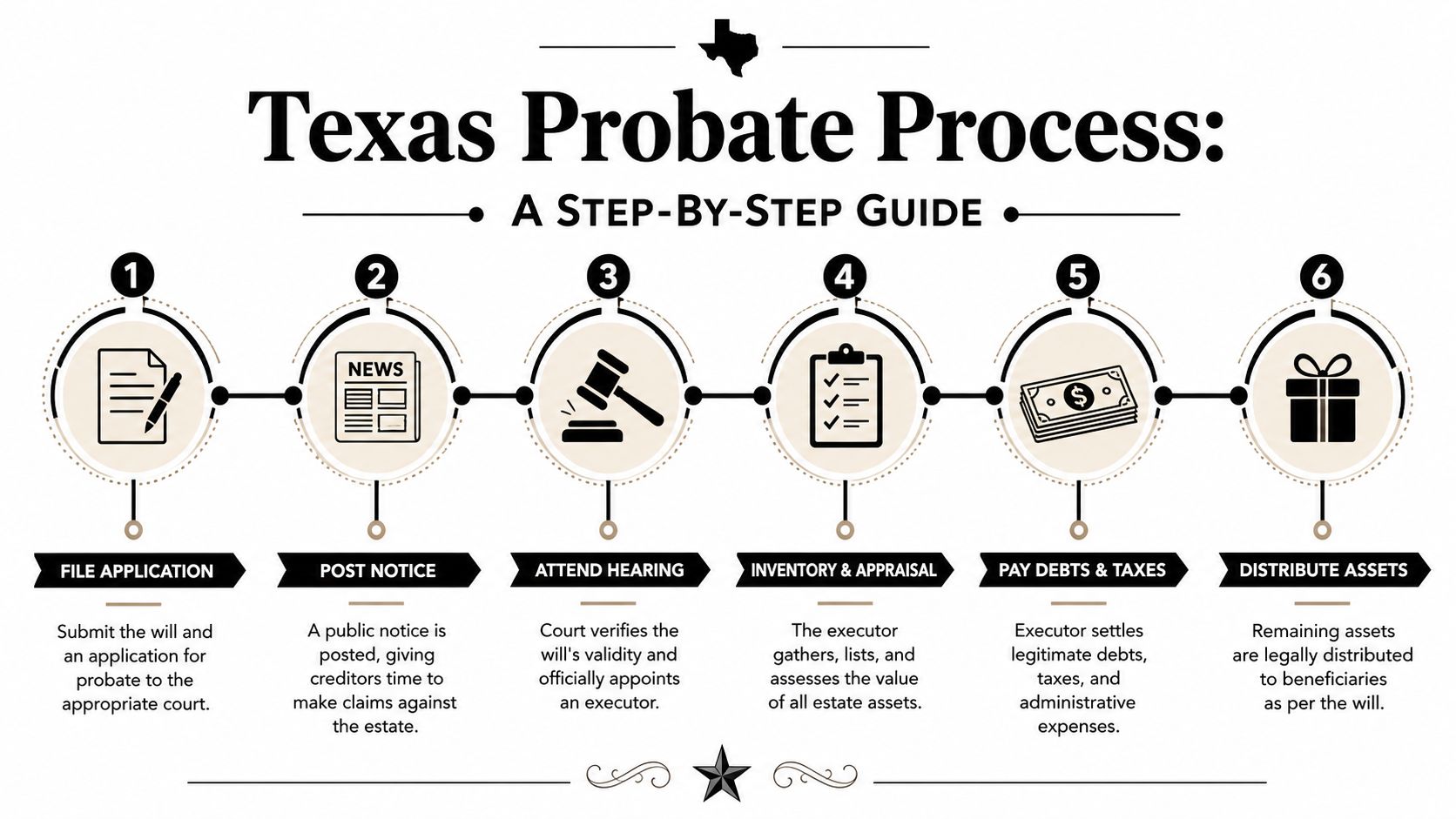
Step one through step three
The probate process usually begins by filing the will and an application in the county where the decedent lived. If you want a broader overview, what probate is in Texas is a useful starting point for understanding the role of the court.
After filing, there is a waiting period before the hearing. Then the judge reviews the will, confirms it is valid, and determines whether the person asking to serve is qualified.
At that hearing, the court may appoint the executor and authorize that person to act on behalf of the estate. In everyday language, this is the point where the executor receives legal authority to gather assets, communicate with institutions, and move the estate forward.
A short video can make that process feel less abstract.
Step four through step six
Once appointed, the executor begins administration. According to Wilson Law on how probate works in Texas, the executor must inventory, appraise, and list estate assets within 90 days after the probate hearing, and the process also involves notifying creditors and beneficiaries, addressing debts, and completing final distribution.
That usually means the executor must:
- Identify estate property and determine what is probate property.
- Notify interested parties such as beneficiaries and certain creditors.
- Handle valid debts and final expenses using estate assets when appropriate.
- Prepare the inventory and file it within the required period.
- Distribute the remaining property according to the will.
What families often worry about most
The emotional pressure usually centers on three concerns:
- The house: Can it be sold, refinanced, or transferred?
- The bank accounts: Who can access them and when?
- The timeline: How long will the family be in limbo?
Probate is often less about conflict and more about authority. The court gives one person a clear lane to act so institutions know who can sign, collect, pay, and transfer.
For many estates, the process takes several months, especially when property, debt, and tax issues need to be sorted carefully. The important thing is that each step has a purpose. The court validates the will, the executor accounts for assets, creditors get addressed, and beneficiaries receive what remains.
Common Pitfalls and Strategic Choices for Executors
Many executors walk into probate believing they have only one option. They think, “I was named in the will, so I must open a full probate and administer everything.” Texas law is more nuanced than that.
One of the biggest pitfalls is missing the filing deadline. Another is assuming administration is mandatory in every case. Those are not the same issue.
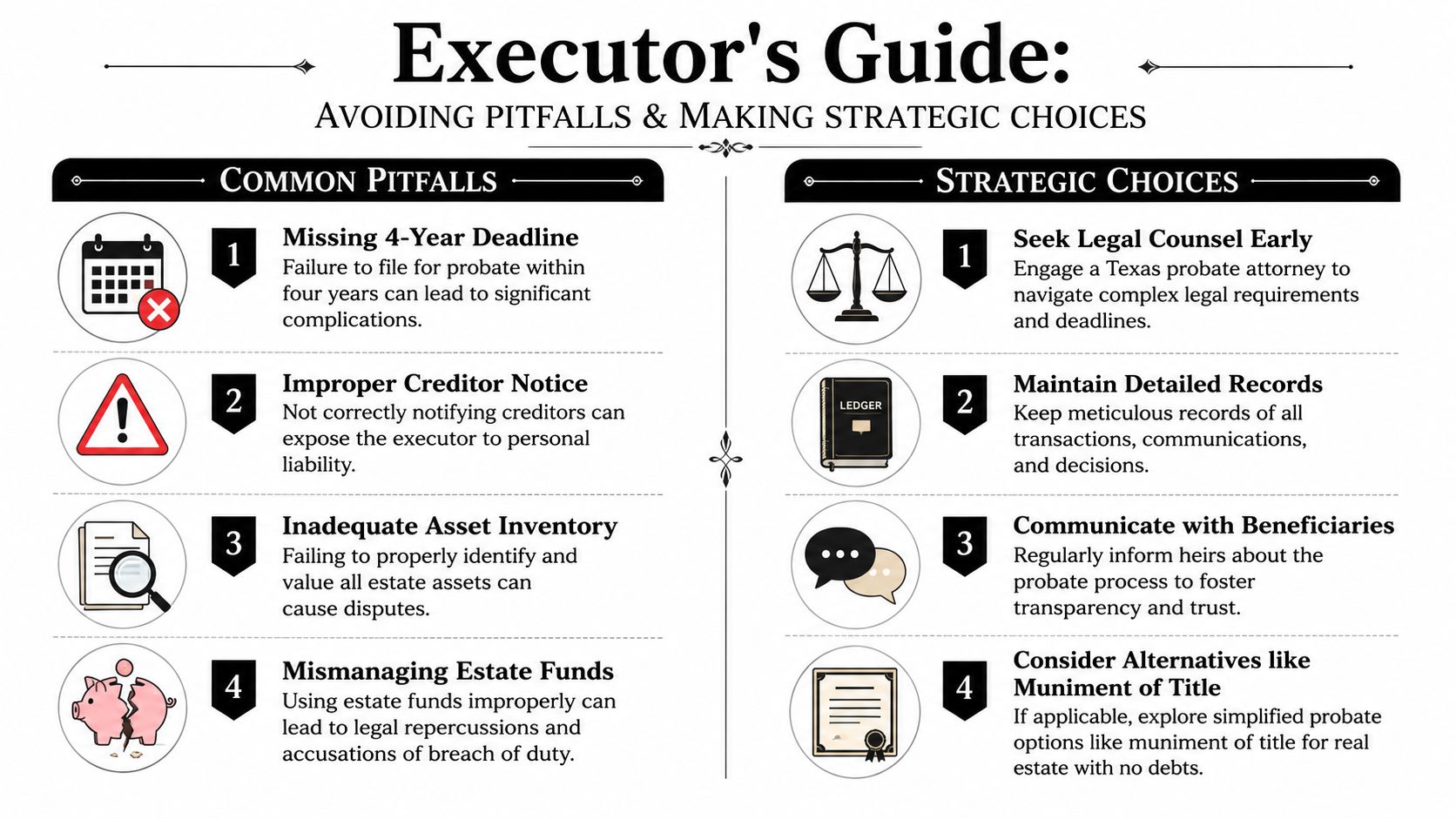
The deadline problem
Texas Estates Code §256.003 sets a four-year deadline to file a will for probate. If that deadline is missed, the consequences can be severe. As explained by Robbins Estate Law on whether all wills go through probate in Texas, failing to meet that deadline can cause the court to treat the estate under Texas intestate succession law instead of the will.
That means property may pass to legal heirs under state law rather than to the people named in the will.
The overlooked executor choice
There is another point families rarely hear clearly. Texas law does not always force an executor to pursue full administration just because a will exists.
According to Springer & Lyle on whether all wills have to be probated in Texas, while a will must be filed, Texas law does not obligate an executor to probate it when there is no necessity for administration. In practical terms, if there are no debts and no assets requiring a court transfer, the executor may surrender the will to the clerk and allow assets to pass by other means or, where applicable, by intestacy.
That distinction matters. Filing a will and administering an estate are related acts, but they are not always the same decision.
Strategic questions an executor should ask
Before moving forward, an executor should think through these issues:
- Is there a real need for administration: Does any asset require court authority to transfer?
- Are there unsecured debts: If creditors must be addressed formally, administration may be wise.
- Is the estate simple and debt-free: A lighter option may fit better.
- Will a bank, title company, or buyer insist on court documents: If yes, some form of probate may still be necessary.
Some estates need a judge. Some need a narrower court order. Some mainly need a careful decision at the beginning.
A practical scenario
Suppose an executor finds a valid will, but the decedent owned no real estate, had no unpaid debts, and most assets passed by beneficiary designation. In that situation, opening a full administration may create work the estate doesn't need.
On the other hand, if the family is already arguing, or if a creditor issue is developing, avoiding administration may create bigger problems later. Strategy in probate is not about avoiding court at all costs. It is about choosing the level of court involvement that matches the estate.
Key Takeaways and When to Seek Legal Guidance
A lot of families reach the end of this question with the same concern: "Do we have to open a full probate case just because there is a will?" In Texas, the answer is often more nuanced. The executor usually has a choice to make.

The will still needs attention. It may need to be filed with the court, but the estate may not need full administration if nothing requires an executor to collect, transfer, or protect it through court authority. That is the key practical point. The right question is not only, "Is there a will?" It is also, "What work, if any, does this estate still need the court to authorize?"
Key insights
- The executor's decision shapes the process: Finding a will does not automatically mean opening the largest or most expensive probate path.
- Court involvement depends on the property: Assets held in a decedent's name alone, especially real estate or certain financial accounts, often determine whether probate is needed.
- Some assets pass without probate: Beneficiary designations, survivorship arrangements, and trust property often transfer outside the estate.
- Texas law allows narrower options in the right case: In some estates, a Muniment of Title or another limited procedure may accomplish the goal without full administration.
- Filing and administering are different choices: A family may need to preserve the will in the public record even if there is little or no reason to run a formal estate administration.
A helpful way to view this is to compare probate to using the right tool for a household repair. Sometimes you need a full toolbox. Sometimes a single wrench solves the problem. Executors often save the estate time, cost, and frustration by choosing only the level of court action the facts require.
When legal help becomes especially important
Some estates stay simple. Others change quickly once a title issue, creditor claim, or family disagreement surfaces. Legal guidance is often worth getting early if:
- Family members disagree about the will, the executor, or who should receive property
- The estate has debt or there are concerns about creditors
- Real estate must be transferred or sold
- The will is unclear or there are questions about whether it is valid
- A business interest is involved
- You live outside Texas and are trying to handle the estate from a distance
These situations can create practical problems fast. A house sale may stall because title is unclear. An executor may distribute property too soon and later face questions about unpaid claims. A case that could have been handled with a narrower procedure may turn into a longer administration because no one paused to choose the best option at the start.
Law Office of Bryan Fagan, PLLC helps families address probate and related estate matters when those decisions become difficult or time-sensitive.
If you are carrying the responsibility of sorting out a loved one's estate, you do not have to figure it out alone.
If you're facing probate in Texas, our team can help guide you through each stage, from filing to final distribution. Schedule a free consultation today with Law Office of Bryan Fagan, PLLC.