Skip to content
You open a drawer, find the original will, and feel two things at once. Relief that your loved one left instructions, and worry about what happens next.
That reaction is normal. Most families aren't dealing with probate because they planned to learn the system. They're dealing with it because someone they love has died, and now practical decisions are arriving right in the middle of grief. Bills still show up. Property still needs attention. Other family members start asking questions. You may be named as executor and wonder whether that means you're personally responsible for everything.
Probate is the court process used to recognize a will, appoint the person in charge of carrying it out, and create a legal path to transfer property the right way. In Texas, that process often feels less intimidating once you understand the order of events and the language involved. A will is the written document expressing the person's wishes. The executor is the person named in that will to carry out those wishes. The estate is the property, money, and obligations left behind.
Texas Estates Code Titles 2 and 3 contain many of the rules families encounter in probate and estate administration. You do not need to memorize those statutes to move forward. You do need to know where the process begins, which deadlines matter, and when a simple estate can use a shorter path.
A daughter might find her father's will naming her as executor, but she may still not know whether she should call the court, notify the bank, sell the house, or wait. That uncertainty is where families often freeze. The good news is that probate is not one giant mystery. It's a sequence.
Introduction Navigating Probate in Texas with Clarity and Care
Consider a common Texas family situation. A mother passes away in Harris County. Her son finds a signed will in a safe, sees that he's named executor, and immediately feels pressure from every direction. His sister wants to know when the house can be transferred. The mortgage company is still sending statements. The funeral just happened, and he hasn't had time to think clearly.
Here, probate becomes less of a scary word and more of a roadmap.
In plain English, probate means asking the court to recognize the will and authorize someone to act for the estate. The court's role isn't to punish families or create unnecessary trouble. Its role is to make sure the will is valid, creditors have a chance to be addressed, and property passes in a lawful way. In many Texas cases, especially those using independent administration under the Texas Estates Code, the process is simpler than people expect.
What probate is really doing
Probate usually answers a short list of practical questions:
- Is this will valid so banks, title companies, and others can rely on it?
- Who has legal authority to gather information and sign estate-related documents?
- What property belongs to the estate and what passes outside probate?
- What debts or claims must be handled before distributions are made?
- Who receives what under the will or, if there is no valid will, under Texas intestacy rules?
Probate is often the legal structure that allows a grieving family to move from uncertainty to authority.
That matters because without court recognition, an executor named on paper may still have no power to act in practice. A bank may refuse access. A title company may not transfer real estate. Financial institutions usually want proof that the court has formally appointed the executor.
Why families get confused
People often use words like executor, administrator, beneficiary, and heir as if they mean the same thing. They don't.
A beneficiary is someone named in the will to receive property. An heir is someone Texas law recognizes as entitled to inherit if there's no valid will. An administrator is usually the person appointed when there is no will or when the named executor can't serve. Those distinctions come straight out of Texas probate practice under the Estates Code, and they affect which path your family may need.
If you're trying to understand how to probate a will in Texas, the best starting point is not the courthouse. It's getting organized and taking the first few steps in the right order.
The First Steps After a Loved One's Passing
A family member dies on a Tuesday. By Friday, someone is asking for the house deed, a bank wants paperwork, and another relative is wondering when property will be divided. That is often when probate starts to feel real. In Texas, the first steps are less about court appearances and more about creating order while emotions are still raw.
The goal at this stage is simple: protect the paper trail, slow down major decisions, and make sure no one acts before legal authority is in place. Families often feel pressure to "take care of everything" right away. In probate, moving too fast can create problems that are much harder to fix later.
Start with the will and the records that support it
First, locate the original will if one exists. A copy may still matter, but the original usually makes the process cleaner. Put it somewhere safe and dry, and do the same with any codicils, deeds, insurance papers, and recent account statements.
Then gather the records that help tell the story of the estate. You do not need a perfect inventory on the first day. You just need enough information to see what your loved one owned, what bills may still be out there, and what documents the court or financial institutions are likely to request.
A good starter file usually includes:
- Estate documents such as the will, codicils, deeds, insurance paperwork, and account statements
- Death records including certified death certificates for banks, title work, and court filings
- Property information such as home addresses, vehicle titles, and business interests
- Debt information including mortgages, credit cards, medical bills, and known loans
If you want a practical starting point, this checklist of documents needed to open probate can help you gather the right papers without guessing.
Do not miss the filing window
Texas law gives families time to grieve, but it does not leave the will open-ended forever. A will generally must be filed for probate within four years of death under Texas Estates Code §256.003, as noted earlier.
That deadline matters more than many families realize. I have seen wills kept in a desk drawer because everyone agreed to "deal with it later." The problem is that delay can change the legal path. If too much time passes, the court may treat the estate as though there were no valid will for probate purposes unless there is a legally acceptable reason for the delay.
A helpful way to look at it is this: the will may express your loved one's wishes, but the court still needs to recognize it before those wishes can be carried out in the usual way.
Practical rule: It is fine to move slowly with family conversations. It is not wise to move slowly on preserving the will and getting timely legal advice about filing.
What "probating the will" actually means
Probating a will means filing an application in the proper Texas county and asking the court to admit the will and appoint the person who will act for the estate. For families in mourning, that can sound cold or intimidating. In practice, it is the step that turns a stack of papers into legal authority.
That authority is what lets an executor deal with banks, transfer title, and address estate business without relying on guesswork or family consensus alone. It works a bit like getting the key to a locked room. Until the court recognizes the will and the proper person to act, many doors stay closed.
If you are unsure whether the estate needs full probate, a simpler option, or immediate legal help, it often makes sense to speak with a probate attorney early. Even one conversation can bring calm to a confusing week and help your family avoid preventable mistakes.
Choosing the Right Probate Path for Your Family
A few days after the funeral, many families reach the same hard question. Do we need full probate, or is there a simpler way to handle this estate?
In Texas, the answer depends on the shape of the estate. A will matters, but it is only one part of the picture. The court also looks at the kinds of assets involved, whether debts need attention, and whether the family agrees on the basic facts. Choosing the right path is a little like choosing the right road after a storm. Some roads are direct and clear. Others look shorter at first, but turn out not to reach the place you need to go.
The four paths families ask about most
Texas offers several tools, and each one solves a different problem.
| Method | Best For | Key Requirement | Typical Timeline |
|---|---|---|---|
| Independent Administration | A valid will and an estate that needs someone with authority to act | The court admits the will and appoints an executor, often with limited ongoing court involvement | Often more efficient than heavily supervised administration in simpler estates |
| Muniment of Title | Situations where the main goal is transferring title, often for real property | A will exists, and full estate administration may not be necessary | Depends on the county and the facts |
| Small Estate Affidavit | Smaller estates with limited assets and qualifying circumstances | The estate must fit Texas requirements, including a value cap, debt limits, and signed affidavits from all heirs | Often faster than formal probate when the estate clearly qualifies |
| Affidavit of Heirship | Cases with no will where real property title needs to be clarified | Careful proof of family history and heir relationships | Varies, and it does not solve every estate issue |
The names can make these options sound interchangeable. They are not. Each one gives a different kind of legal help.
When a Small Estate Affidavit can help
A Small Estate Affidavit causes a lot of confusion because the title sounds broad. Families often hear "small estate" and assume it applies whenever there is not much money involved. Texas law is more specific than that.
For a Small Estate Affidavit to work, the estate has to fit the statutory requirements, including limits on value and debts, and all heirs must sign the affidavit. When those facts line up, it can spare a family from a more formal court process. When they do not, trying to force the estate into that option can waste time and create new problems.
If you want a side-by-side explanation of probate versus a Small Estate Affidavit in Texas, that comparison can help you see where one route ends and another begins.
Muniment of Title is another option families ask about. It is often useful when there is a valid will and the main need is to transfer title, not to put an executor in place to handle a long list of estate tasks. It is a precise tool. Good for the right job, but not built for every job.
A realistic example
Suppose Maria dies with a valid will, a house, one bank account, and no conflict among her children. Her will names her son as executor, and there are no signs that the estate needs constant court oversight. In a situation like that, independent administration may be the practical fit because someone needs clear authority to gather assets, pay proper expenses, and carry out the will.
Now change the facts. There is no will, or one sibling disputes who should inherit, or the family cannot agree on basic information about debts and property. The legal path changes because the problem changes. At that point, the court may need more formal proof or more supervision.
That is why this choice matters. The right probate path does more than satisfy a rule. It reduces delays, lowers friction with banks and title companies, and gives the family a clearer sense of what happens next at a time when clarity is hard to come by.
The Formal Probate Process Step-by-Step
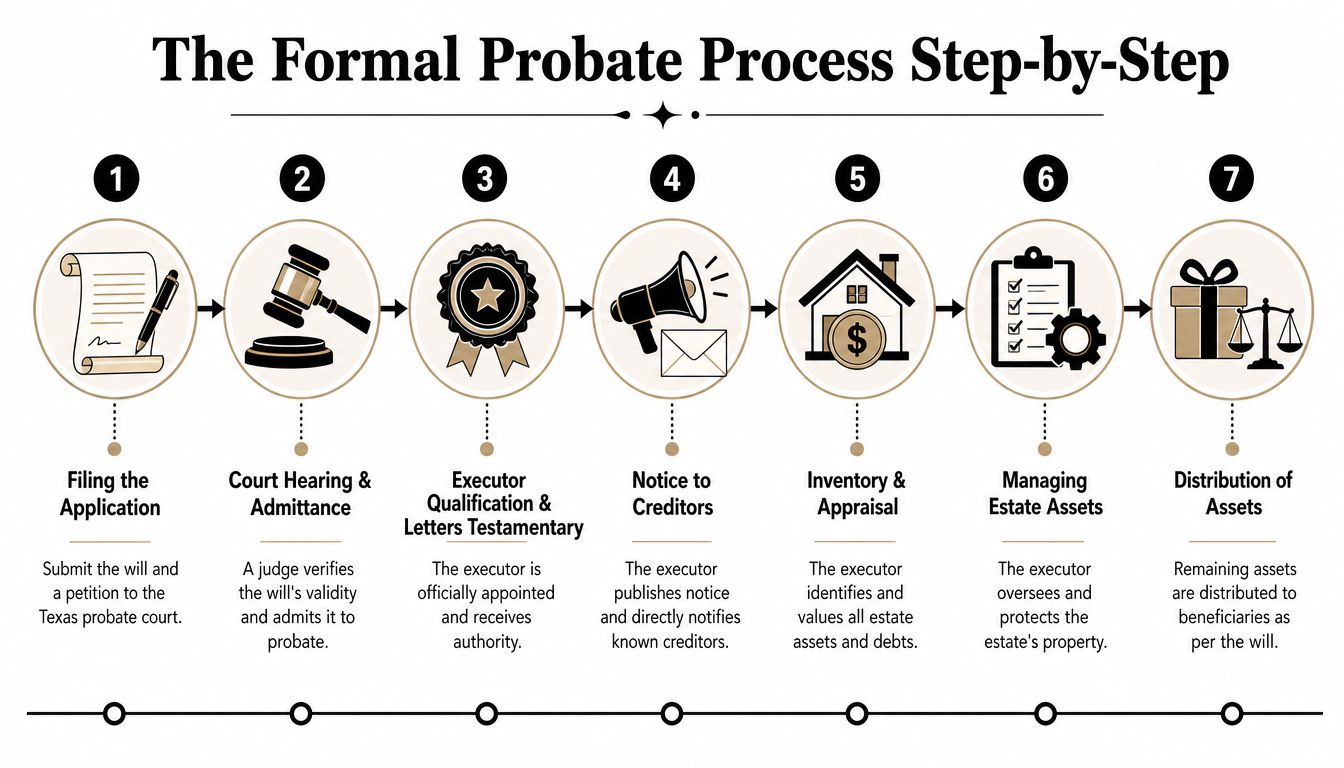
Formal probate often feels intimidating at first because families picture a maze of court dates, forms, and delays. In practice, it is closer to a structured handoff. The court confirms that the will is valid, names the person who has authority to act, and creates an orderly path for handling the estate.
To make that sequence easier to visualize, this timeline helps.
A family example
Take the Smith family. Mr. Smith dies owning a home, a car, and several financial accounts. His will names his wife as executor and leaves property to their children. The family is grieving, bills are still arriving, and institutions will not accept good intentions as legal authority. They need paperwork that proves who can act.
The process usually begins with filing an Application for Probate in the county where Mr. Smith lived. That filing asks the court to admit the will and appoint the executor named in it. A posted notice period follows, which gives others a chance to object if there is a legal reason to do so.
That waiting period can feel frustrating. It helps to know why it exists. Probate is designed to protect everyone involved, including beneficiaries, creditors, and the person offering the will.
What happens at the hearing
After the filing period passes, the court holds a hearing. In many uncontested cases, this hearing is brief and focused. The judge wants to know whether the will appears valid and whether the proposed executor is legally qualified to serve.
Texas allows many estates to proceed through independent administration. Texas Tech's Texas Probate Passport on independent administration explains that this approach often limits court involvement after the will is admitted. For families, that usually means one main court appearance at the front end instead of repeated hearings throughout the estate.
If the judge approves the application, the court issues Letters Testamentary. These letters work like proof of authority. Banks, title companies, and financial institutions often ask for them before they will release information, retitle accounts, or let the executor sign on behalf of the estate.
Families are often relieved at this point. The grief is still there, of course, but the uncertainty starts to shrink because someone now has recognized legal authority to take the next steps.
Later questions often come up about selling inherited real estate, especially when relatives own property in more than one state. For a comparison point, this discussion of Arizona law on inherited property sales shows how timing and title rules can differ outside Texas.
Here's a short overview that pairs well with the court timeline:
Independent versus dependent administration
The next part that confuses many families is the difference between independent and dependent administration. The labels sound technical, but the practical difference is simple. It is mainly about how much the court stays involved after the executor is appointed.
- Independent administration usually lets the executor handle many estate tasks without asking the court for permission each time.
- Dependent administration involves closer court supervision, which can require additional approvals before certain actions are taken.
- How that changes daily life is straightforward. More supervision often means more filings, more waiting, and more chances for conflict to slow progress.
Dependent administration tends to show up when there is no valid will, a dispute over the will, concern about the proposed representative, or other complications that call for tighter court oversight.
A helpful way to view formal probate is this. The court opens the door, confirms who holds the key, and decides how closely the process needs to be watched after that. Once families understand that sequence, the process usually feels less mysterious and more manageable.
Understanding the Executor's Role and Responsibilities
A lot of families expect the hardest part to be the court hearing. In practice, the harder part often starts after the hearing, when one person must carry out a long list of legal and practical duties while still grieving. An executor is often a spouse sorting through mail at the kitchen table, an adult child trying to secure a parent's home, or a sibling fielding calls from relatives who all want answers at once.
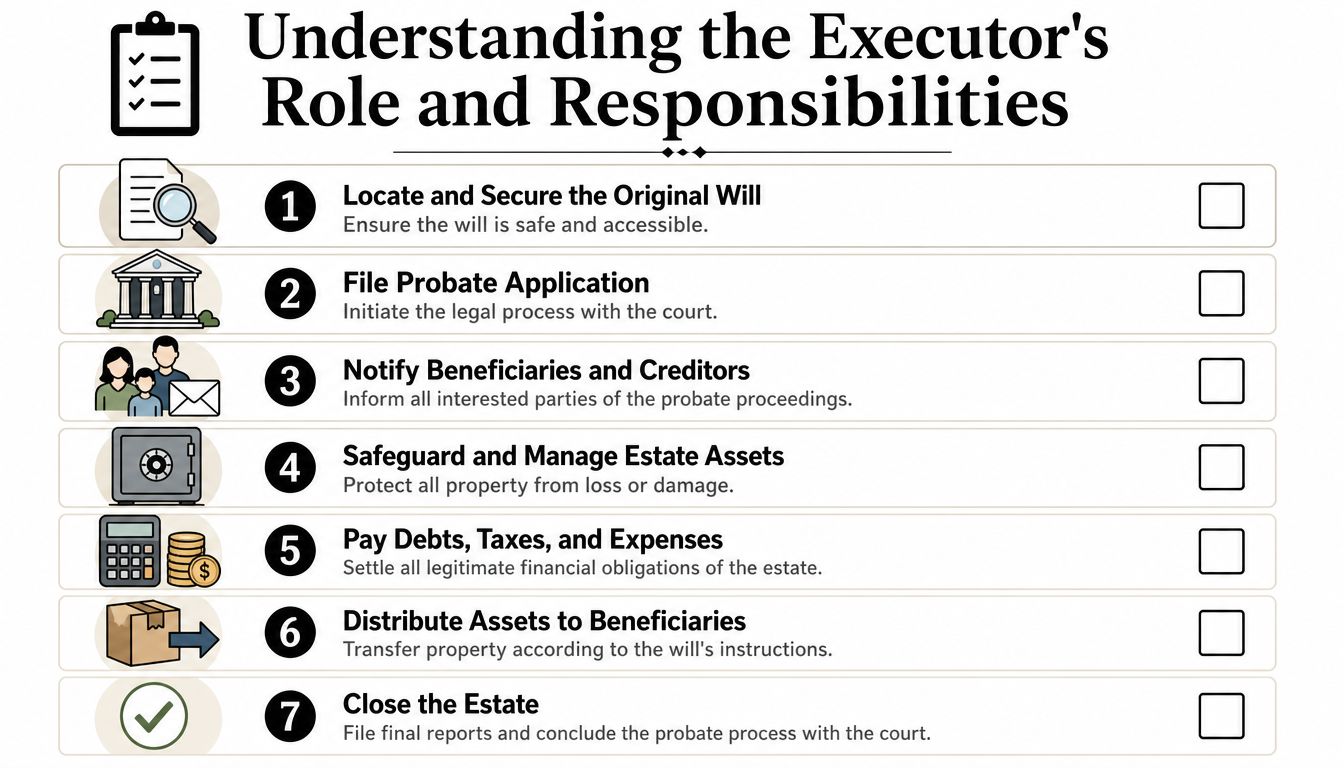
That is why it helps to understand the role for what it is. The executor is the person responsible for gathering the estate, protecting it, paying what the estate owes, and only then distributing what remains according to the will and Texas law.
The first duties after appointment
The executor's first job is usually not handing property to beneficiaries. It is getting the estate organized and protected so nothing is lost, overlooked, or paid out too soon.
Soon after appointment, the executor typically needs to publish notice to creditors, give required notice to beneficiaries, and prepare an Inventory, Appraisement, and List of Claims unless the court allows a different filing. Those tasks may sound formal, but each serves a simple purpose.
- Notice to creditors tells the outside world that the estate is open and gives creditors a path to present claims.
- Notice to beneficiaries makes sure the people named in the will know the probate case has been opened.
- Inventory, Appraisement, and List of Claims is the estate's master list of what existed at death, what it was worth, and what debts may need attention.
A good way to picture the inventory is as the estate's map. Before anyone can decide where property should go, the executor has to know what is there.
What the executor is really supposed to do
The executor is a fiduciary. That means the law expects care, honesty, and loyalty to the estate. The executor does not get to treat estate property like personal property, and does not get to change the will because a different outcome feels more fair to the family.
In day-to-day terms, that often includes:
- securing a home, vehicle, business interest, or other property
- maintaining insurance and handling urgent upkeep
- opening or using the proper estate account for estate money
- collecting account statements, tax records, deeds, and titles
- paying valid debts and expenses from estate funds
- keeping clear records of every deposit, payment, and distribution
Recordkeeping matters more than many executors expect. If a beneficiary later asks, "What happened to that refund check?" or "Why was that bill paid first?" the safest answer is a clean paper trail, not a memory.
Why this role feels heavier than it sounds
Many executors assume the family can agree on what to do and move property around informally. That instinct is understandable, especially in close families. Probate does not work that way.
The executor answers to the will, the court's orders, and the duties imposed by Texas law. Family harmony helps, but harmony does not replace procedure. Even in a peaceful estate, the executor still has to follow the right sequence, protect creditors' rights, and avoid early distributions that create problems later.
This is also why patience matters. Beneficiaries often see the executor as the person "holding" their inheritance. Legally, the executor is more like a temporary manager of a locked storeroom. The key purpose is safekeeping until the estate is ready to be settled correctly.
Why the will's wording matters
Clear wills make administration easier because they answer questions before conflict has room to grow. If the will plainly identifies beneficiaries, names an executor, and grants the powers needed to manage estate property, the executor has fewer gray areas to sort through.
Vague language creates the opposite experience. A short phrase that seemed harmless when the will was signed can lead to real confusion later about who receives a specific asset, whether something should be sold, or how expenses should be shared.
For that reason, the executor should read the will carefully, not casually. Small details often control big decisions. If the wording is unclear, getting legal guidance early can save the estate time, money, and family strain.
Common Probate Pitfalls and How to Avoid Them
A family can get through the hardest days with grace and still run into probate trouble. It often starts with one well-meaning decision made too soon. Someone cleans out a house before the inventory is clear. Someone hands over a vehicle because "Dad wanted her to have it." Someone assumes a signed will means every question is already answered.
That is how estates drift off course. Probate problems in Texas are often less about drama and more about timing, paperwork, and human emotion arriving at the same table.
Family conflict and contests
Grief can sharpen old tensions. A brother may believe the will reflects their mother's wishes. A sister may believe someone pressured her to sign it. What looked like a simple court filing can turn into a dispute about mental capacity, undue influence, or whether the document is even valid.
One point catches families off guard. A will can still be challenged after it has been admitted to probate in some circumstances. That means an early distribution can become a later headache if the court is asked to pull assets back or sort out who received what too soon. The practical lesson is simple. Do not treat the first court order as permission to relax your recordkeeping.
If conflict starts to build, slow the process down enough to document decisions carefully. Save emails. Keep receipts. Write down when property changed hands and why. Good records will not erase a dispute, but they often keep a painful disagreement from turning into a factual mess.
Out-of-state executors and practical barriers
Serving as executor from another state can feel like trying to manage a Texas house with a key that only works part of the time. You may be able to do the job, but distance makes every step less convenient.
Court procedures vary by county. Original documents may need to be filed in person or handled through local counsel. Hearings, notices, and estate banking can also create delays if the executor is not nearby. Families are often surprised to learn that being named in the will does not make the logistics easy.
Distance also creates smaller problems that add up. Checking on vacant property is harder. Meeting with a realtor, appraiser, or bank may require extra coordination. If no one is watching closely, missed mail, unpaid insurance, or unsecured property can create new risks for the estate.
Mistakes that create avoidable trouble
Some errors show up again and again because they come from understandable instincts.
- Distributing assets too early. Beneficiaries may be waiting, but the estate still has to clear debts, taxes, notices, and court requirements before property is handed out.
- Assuming everyone agrees on the facts. Families often use the same words but mean different things, especially when discussing verbal promises, loans, or personal property.
- Failing to keep a paper trail. An executor should be able to show where money came from, where it went, and why each decision was made.
- Overlooking warning signs. Missing account statements, sudden changes to estate planning documents, questionable signatures, and silence from a person controlling information all deserve a closer look.
- Treating probate like a one-time filing. It is a process with stages, deadlines, and follow-through, not a single courthouse visit.
The safest approach is usually the least dramatic one. Move in order. Verify before acting. Pause before distributing property that cannot be easily recovered.
If the estate feels tense, unusual, or harder than it should be, trust that signal. Probate rarely gets better when families push through confusion and hope it clears on its own.
Key Insights and When to Call a Probate Attorney
Key Insight
Probate in Texas is manageable when families break it into stages. The will has to be handled on time. The right probate path matters. The executor's authority comes from the court, not from family expectation alone. And once that authority is granted, the executor has specific duties that should be handled carefully and in order.
Texas Estates Code Titles 2 and 3 shape much of this process, but most families don't need a law school explanation. They need clarity, timing, and a plan. If you're still weighing whether to handle the matter with limited help or full representation, this article on probate without a lawyer in Texas and the risks involved is a useful next step.
You should strongly consider calling a probate attorney if the estate includes real estate, business interests, family conflict, creditor concerns, missing documents, an out-of-state executor, or any question about whether the will is valid. Getting help early isn't giving up control. It's often the best way to protect the estate and reduce stress for everyone involved.
If you're facing probate in Texas, our team can help guide you through every step, from filing to final distribution. Schedule your free consultation today.
For families who want practical, compassionate guidance, Law Office of Bryan Fagan, PLLC assists with probate, estate administration, and related matters across Texas.