Skip to content
A Texas probate dispute rarely starts with a dramatic courtroom moment. It usually starts at a kitchen table, in a group text, or during a tense phone call after someone says, “That's not what Mom wanted.”
Grief makes everything heavier. Old sibling dynamics come back fast. A vague will, a missing account statement, or a beneficiary form no one knew existed can turn a painful loss into a family fight. If you're dealing with that right now, or trying to prevent it for your own family, there is a practical way forward.
Family feuds in Texas probate are often preventable. When they aren't, they can still be managed with a clear plan, careful documentation, and the right legal strategy. Texas Estates Code Titles 2 and 3 govern much of the probate, administration, and claims process, but most families don't need more legal jargon. They need straight answers, a roadmap, and reassurance that this can be handled.
The Foundation of a Peaceful Probate
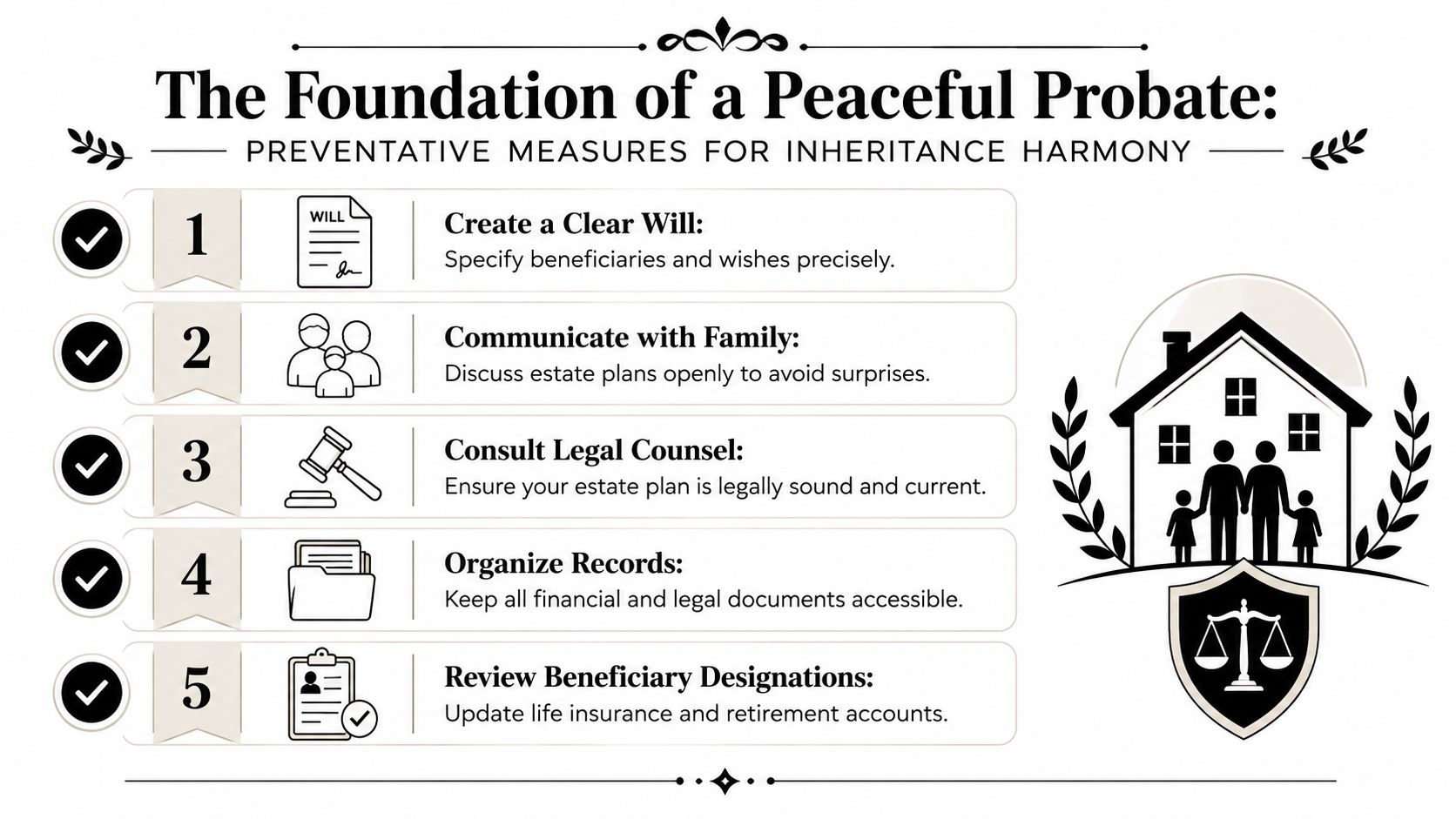
A peaceful probate usually begins years before probate ever opens. A parent signs a will, puts it in a drawer, remarries, sells a house, opens new accounts, and never updates the paperwork. After death, the family is left trying to sort out which document controls, what property belongs to whom, and whether the person "in charge" has valid legal authority. That is how grief turns into a dispute.
The strongest protection for an inheritance is clarity. In Texas, family conflict often grows out of unclear estate plans, missing originals, capacity questions, undue influence allegations, and gifts that feel unfair or unexplained. The Texas State Law Library also notes two points that catch families off guard. A surviving spouse generally keeps one-half of community property, and divorce can revoke a gift to a former spouse without invalidating the rest of the will (Texas State Law Library on will contests). Old documents create real problems.
The documents that do the heavy lifting
A Last Will and Testament directs who receives probate assets and names the executor. The executor gathers property, deals with debts, and carries the estate through the probate process.
A will should also be self-proving. In practical terms, that means the signing ceremony and affidavit meet Texas requirements so the witnesses usually do not have to come to court later just to confirm the will was signed properly. It does not prevent every contest, but it often removes one avoidable fight.
A revocable living trust serves a different purpose. If assets are transferred into the trust during life, those assets pass under the trust terms rather than through the usual probate process. That can mean more privacy, less delay, and fewer disputes over the assets the trust holds.
The same planning discipline should extend beyond the will itself. Beneficiary designations, payable-on-death accounts, transfer-on-death deeds, and trust funding often decide where substantial assets go. Families who want to prevent conflict should review how non-probate assets pass in Texas before assuming the will controls everything.
Practical rule: Replace vague phrases like “divide things fairly” with names, percentages, backup beneficiaries, and clear instructions for specific property.
Texas planning also has an incapacity component. Title 2 of the Texas Estates Code addresses decedents' estates, and Title 3 addresses guardianship. If a parent loses capacity before death and the family has no current powers of attorney, no updated plan, and no agreement about who should step in, that conflict often carries straight into probate.
What works and what fails
The families who avoid court fights usually do a few basic things well:
- Name people precisely: Use full legal names and relationships. "My children" can become a lawsuit in a blended family.
- Review after major life changes: Remarriage, divorce, a death in the family, a falling-out, or a major purchase should trigger an update.
- Match the paperwork to the plan: If a trust is supposed to own the house, the deed has to reflect that.
- Store originals where they can be found: Missing originals invite suspicion and delay.
- Be specific about personal items: Jewelry, firearms, furniture, and family keepsakes cause outsized conflict because the emotional value is high.
One common example. A father signs a will leaving everything equally to his children and naming his oldest child to "handle everything." Years later he remarries, buys a new home, and never signs updated documents. After his death, the children and surviving spouse disagree about community property, authority, reimbursements, and whether prior gifts should count against anyone's share. The argument feels personal, but the core problem is that the plan left too many unanswered questions.
A cleaner plan looks different. It names an executor and alternates, addresses the current marriage, identifies specific gifts, coordinates with any trust, and leaves a paper trail that matches the person's actual assets. That does not remove grief. It does remove much of the legal ambiguity that drives families into entrenched positions.
For families who are still gathering basic information, a plain-language resource with general help with probate can make the first attorney meeting more productive.
If conflict is already forming around validity, Contesting a Will in Texas explains the legal grounds and process for a will contest. That issue should be assessed early, while records are still available and before family members commit to a version of events that makes resolution harder.
A planning habit that saves families trouble
Estate planning is one of the clearest ways to spare your family unnecessary conflict.
A useful review routine includes:
- Review the will and trust after any major life change
- Confirm who has the original documents
- Reconsider whether the named executor is still the right choice
- Make sure incapacity planning is current
- Coordinate your plan with your attorney's drafting and review process
Beyond the Will Securing Your Non-Probate Assets
A common probate fight starts with a sentence I hear in consultations all the time: "Dad's will says everything is equal, so why did my brother get the account?" The answer is often uncomfortable but straightforward. The will does not control every asset.
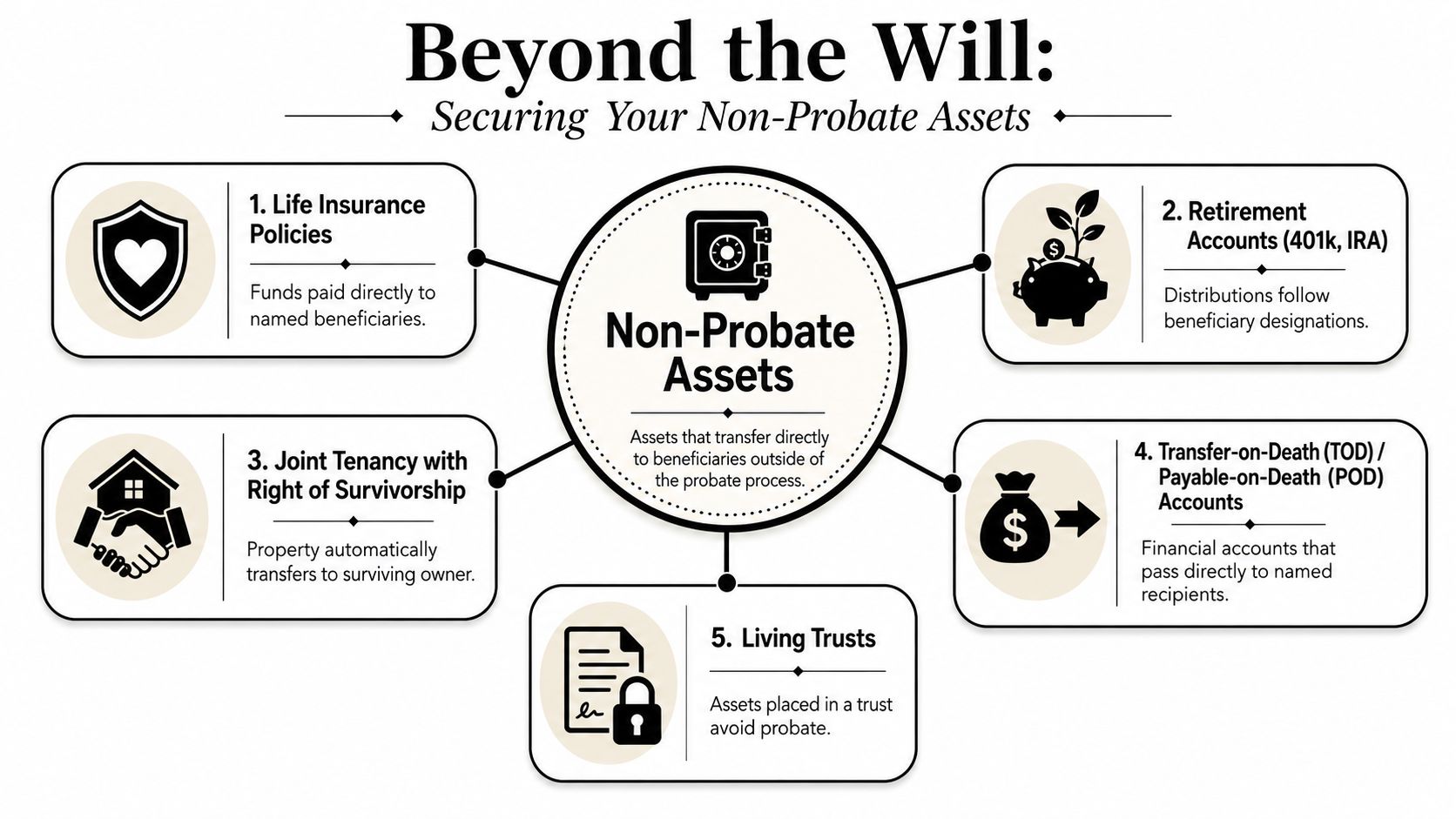
Some of the property with the highest dollar value passes outside probate altogether. That usually includes life insurance, retirement accounts, payable-on-death and transfer-on-death accounts, survivorship property, and assets already titled in a trust. Disputes over those assets can begin before anyone files a probate case, and they often shape the actual inheritance outcome even if no one challenges the will itself (hidden estate disputes involving non-probate assets).
Why the will may lose to a beneficiary form
If a life insurance policy names one beneficiary, the insurance company usually pays that person. If a retirement account names someone different from the will, the account custodian usually follows the beneficiary designation on file.
That result feels unfair to many families because it clashes with what they were told at the kitchen table. A parent may promise that everything will be divided evenly. The will may say the same thing. But if the beneficiary form was never updated after a divorce, remarriage, or death in the family, the largest asset may pass outside the executor's control.
Good planning does two things at once. It reduces the property that has to pass through court, and it makes the transfer instructions easier to verify. POD and TOD designations, survivorship arrangements, and properly funded revocable trusts can make transfers more efficient when they are set up carefully. They also create risk when they are outdated, incomplete, or inconsistent with the rest of the estate plan.
A focused review of beneficiary designations and other non-probate assets is often where families prevent the next dispute. In practice, this review matters because non-probate assets can hold more value than the probate estate.
Here's a useful overview before you dig into your own accounts:
A simple audit that prevents ugly surprises
Use this list after any major life event and during periodic reviews:
- Pull every beneficiary form: Life insurance, IRAs, 401(k)s, pensions, annuities, and brokerage accounts.
- Check POD and TOD designations: Banks and investment firms often have them on file even when the owner forgot about signing them.
- Review real estate ownership: Survivorship language can control who receives the property.
- Confirm trust funding: A trust only directs assets that were transferred into it.
- Save copies in one place: Missing paperwork creates delay, suspicion, and avoidable accusations.
I often tell families to treat this as prevention, not paperwork. Clear beneficiary designations can spare your loved ones from a court fight. Just as important, if a dispute still arises, the records usually give everyone a better chance to resolve it through early negotiation or mediation instead of spending months fighting over what the decedent "must have wanted."
The will may be valid and still not control the assets everyone is fighting about.
Choosing Your Executor a Decision of Trust
The wrong executor can turn a manageable administration into a family standoff. The right executor can lower the temperature from day one.
Texas law puts real duties on the personal representative. In everyday terms, that person must act for the estate and not for personal advantage. The executor needs to protect property, communicate with interested parties, keep records, address creditor and court requirements, and move the case toward distribution under the Texas Estates Code.

One family member can calm things down or inflame them
Consider two common outcomes.
In the first, a mother names her son as executor because he is the oldest. He lives nearby, but he has a strained relationship with his sisters and has never been organized. After the funeral, he changes the locks, stops answering messages, and treats every question like an accusation. Even if he means well, the others start assuming he is hiding something. The dispute becomes about trust before it becomes about law.
In the second, a father chooses a daughter who is calm under pressure, keeps meticulous records, and communicates in writing. She sends copies of the will, explains the next steps, avoids making promises she can't keep, and waits for legal authority before touching accounts. The same grief is present, but the estate doesn't become a battleground.
A national study reported that 58% of respondents had experienced family disputes and assets falling under court control when estate planning was lacking, and the same reporting emphasized that a carefully drafted trust can reduce opportunities for inheritance contests by specifying who receives what and potentially avoiding probate court altogether (national reporting on disputes caused by missing estate planning).
What to look for in an executor
The best executor is not always the closest child or the most successful relative. Look for practical traits:
- Steady judgment: This person shouldn't escalate every disagreement.
- Organization: Probate involves deadlines, notices, and records.
- Impartiality: A beneficiary who already feels entitled can be a poor choice.
- Willingness to serve: An unwilling executor often delays decisions.
- Communication: Silence creates conflict.
If your family has a history of tension, a neutral third party may make more sense than a relative. In some situations, families choose a professional fiduciary or another neutral person because the reduction in family friction is worth it.
Some testators also use a no-contest clause, sometimes called an in terrorem clause, to discourage challenges. Under Texas law, these clauses can matter, but they are not magic language that blocks every dispute. Their usefulness depends on the family dynamics, the strength of the documents, and the kind of challenge being threatened.
For families weighing that decision carefully, a practical guide on how to choose an executor can help frame the trade-offs before the will is signed.
A good executor doesn't just carry out instructions. That person manages expectations, timing, and emotions at the same time.
When Conflict Erupts First Steps in a Probate Dispute
Once a dispute surfaces, early decisions matter. The first week often shapes the next year.
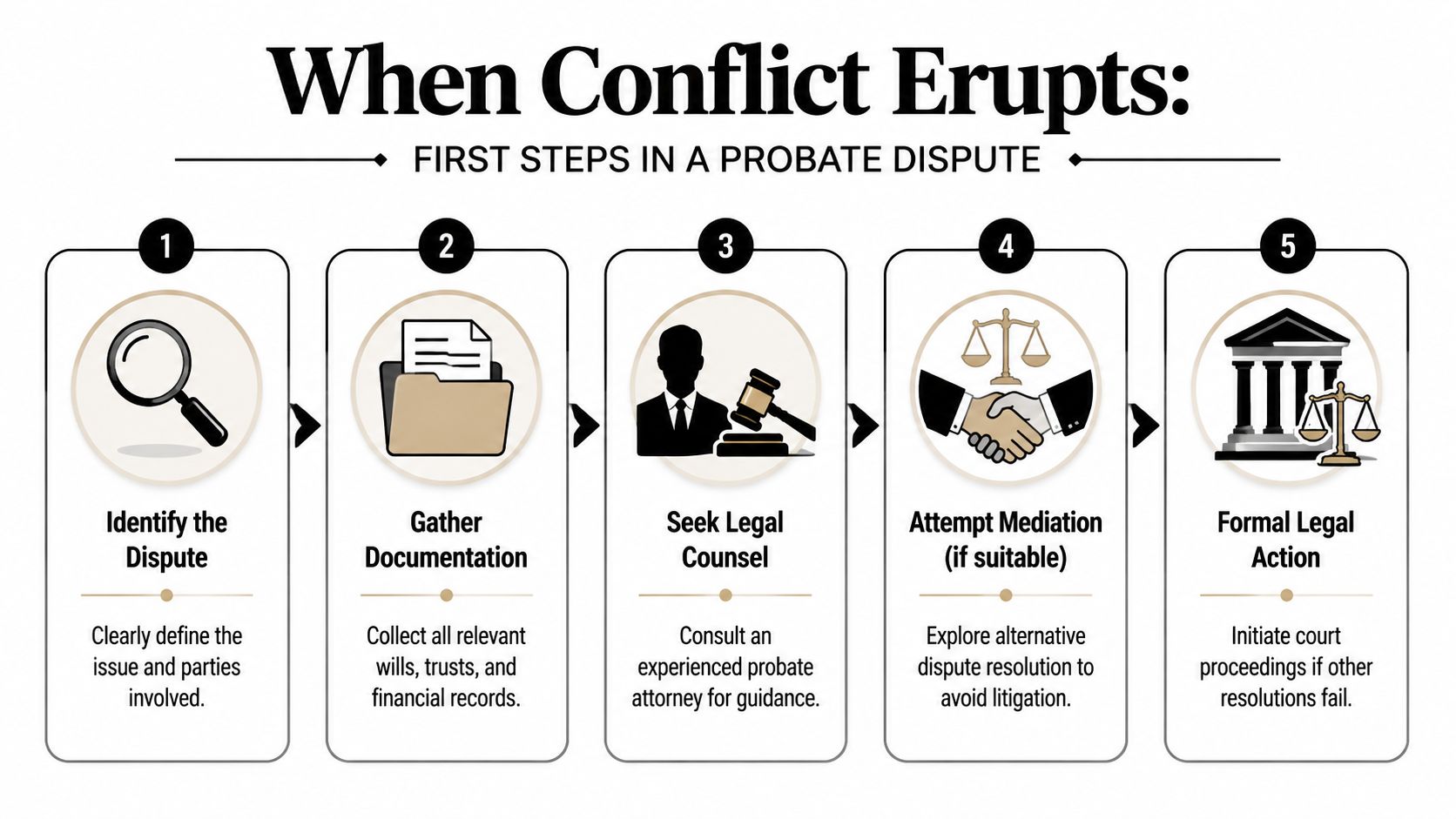
The first legal filter in a Texas will contest is standing. A person must have a legitimate financial interest in the outcome before the court will hear the challenge. If there is standing, the matter typically moves through consultation, pre-suit investigation, filing, discovery, mediation, and then trial or appeal if needed. If someone lacks standing or files in the wrong county, the case can fail before the court ever reaches the merits (Texas estate litigation process and standing requirements).
What an heir or executor should do immediately
If you're an executor, don't start distributing property to “keep the peace.” If you're an heir, don't assume a heated accusation should be answered with another accusation.
Start here instead:
Secure the documents
Gather the original will, any trusts, deeds, account statements, beneficiary forms, and prior estate planning documents. Save electronic records too.Freeze informal distributions
No one should take vehicles, jewelry, firearms, cash, or account access based on verbal understandings.Document communications
Save texts, emails, voicemails, and letters. Keep a timeline of who said what and when.Identify the actual dispute
Is this about validity, missing assets, undue influence, capacity, executor conduct, or beneficiary designations? Families often argue about everything because they haven't defined the core issue.Check venue and authority
The proper probate court and the right procedural posture matter under Texas Estates Code Title 2.
A realistic example
A daughter finds a later will naming her brother as sole beneficiary and executor. She believes their father lacked mental capacity near the end of life. She also suspects the brother moved money shortly before death.
Her first move shouldn't be a family confrontation in the funeral home parking lot. It should be preserving evidence. That means obtaining prior wills if they exist, medical records if available through proper channels, witness names, account statements, and messages that show the father's condition and who had access to him. It also means evaluating whether she has standing and which county has jurisdiction.
Important: Strong probate cases are usually built from documents, timelines, and witness evidence, not from family theories.
If litigation may be necessary, this is the point to involve counsel who handles contested estates. The firm's Probate Litigation services are one example of the kind of representation families use when they need help preserving evidence, filing correctly, and responding to will contests or fiduciary disputes.
What to expect next
After the initial review, a dispute usually moves into a more structured phase:
- Consultation and case assessment: Does the claim have legal footing?
- Pre-suit investigation: Records, witnesses, and procedural posture are evaluated.
- Filing: The contest or related pleading is filed in the correct court.
- Discovery: Each side can force disclosure of information and documents.
- Mediation: Courts often push parties toward settlement talks.
- Trial if needed: A judge or factfinder resolves the remaining issues.
That process can feel slow, but a methodical approach protects your position better than emotional speed does.
The Fork in the Road Mediation vs Litigation
Not every probate fight should go to trial. Not every probate fight should settle early either.
Families often hear that mediation is “faster and cheaper,” but that slogan doesn't answer the key questions. Texas judges frequently require mediation in probate disputes, yet many families still don't know when it is likely to work, what can be settled privately, or what happens if one heir refuses to participate in good faith (Texas probate mediation and conflict guidance).
The practical difference
Litigation asks a judge to decide. That can be necessary when someone is hiding assets, refusing to cooperate, or holding an extreme position that won't change without court pressure. Litigation also creates tools such as formal discovery, subpoenas, and court orders.
Mediation asks the parties to negotiate with the help of a neutral third party. It works best when the family needs a structured conversation, when the facts are disputed but not unknowable, or when everyone wants a solution but no one trusts the others enough to negotiate alone.
Here is the side-by-side view that most families need:
| Factor | Mediation | Litigation |
|---|---|---|
| Decision maker | The family controls the outcome if agreement is reached | The court decides unresolved issues |
| Privacy | Private setting | Public court process |
| Flexibility | Can include creative settlement terms | Limited to remedies the court can order |
| Speed | Often resolves earlier if parties are prepared | Usually slower because of formal procedure |
| Evidence pressure | Depends on what parties exchange and what the mediator can surface | Discovery tools can compel disclosure |
| Family relationships | Better chance of preserving workable relationships | Often hardens positions |
| Best use case | Misunderstandings, valuation issues, distribution logistics, negotiated compromises | Fraud concerns, hidden assets, capacity disputes needing proof, refusal to comply |
When mediation is a smart move
Mediation tends to work when the parties disagree about outcome but share at least some facts. It can also work when the executor has made mistakes that can be corrected without removing them, or when heirs want a private settlement over personal property, buyouts, sale timing, or accounting disputes.
It is less effective when one side needs emergency court action, when key records are missing and no one will produce them voluntarily, or when someone is using delay as a tactic.
One practical pattern appears often. A family starts with intense accusations, then calms down once discovery clarifies the estate inventory and the legal strengths of each side. Mediation is often most productive after enough information has been exchanged for people to evaluate risk realistically.
Settlement is not surrender. In the right case, it is a controlled way to protect inheritance value and avoid letting legal costs and delay consume the estate.
Families comparing these options in more detail can review mediation vs. litigation in Texas probate to understand how the strategic choice changes depending on the dispute.
If one heir won't cooperate
That doesn't always end the mediation path, but it alters the dynamic. Sometimes filing first is what creates enough pressure for meaningful talks. Other times the court's mediation order brings a resistant party to the table. If the person still refuses to engage productively, litigation may become the only route to protect the estate and force disclosure.
The key is to stop thinking of mediation and litigation as opposites. In Texas probate, they often work together. Litigation creates structure. Mediation creates options.
Your Path to a Peaceful Resolution
Probate conflict doesn't always mean your family has failed. It often means the law, the documents, and family history have collided at the worst possible moment. The right response is not panic. It is clarity.
The best protection is still prevention. Clear wills, current beneficiary designations, a thoughtful executor choice, and organized records remove many of the triggers that start inheritance battles. Texas Estates Code Titles 2 and 3 provide the legal framework, but families need more than statutes. They need a plan that makes those rules workable in real life.
If conflict has already started, there is still a path forward. Confirm who has standing. Preserve documents before they disappear. Avoid premature distributions. Get clear about whether the dispute is really about the will, the executor, or non-probate assets. Then choose your next step strategically, whether that means negotiation, mediation, or formal court action.
Takeaway
Protecting your inheritance is a two-part strategy. Build an unambiguous estate plan that reduces openings for conflict, and if a dispute still arises, use the right process to resolve it without wasting the estate on avoidable battles.
Families dealing with probate often need related support beyond one dispute. Depending on the situation, that may include guidance on the Texas Probate Process, planning through Guardianship, drafting with Wills & Trusts, or representation in Probate Litigation.
If you're facing probate in Texas, our team can help guide you through every step, from filing to final distribution. Schedule your free consultation today.
If your family is facing a contested estate, executor dispute, will challenge, or questions about inherited property, contact Law Office of Bryan Fagan, PLLC for a free consultation. We help Texas families understand their options, protect estate assets, and move through probate with a clear legal strategy and compassionate guidance.