Skip to content
A parent dies, and the family gathers around a dining room table with a will, a stack of bank papers, and years of old tension that no one ever fully resolved. One sibling thinks the will change made no sense. Another believes the executor is dragging things out. Someone wants to sell the house. Someone else wants to keep it. Grief is still fresh, but the legal questions arrive immediately.
That's where many Texas probate disputes begin. Not with strangers fighting over money, but with relatives trying to make sense of loss, responsibility, and a loved one's final wishes.
When families ask about mediation vs. litigation in Texas probate, they usually want more than a legal definition. They want to know which path will protect the estate, which one will reduce conflict, and whether there's any way to get through this without turning a painful season into a years-long court battle.
When Family Disagreements Cloud a Loved One's Wishes
Two sisters may agree on almost everything for years, then sharply disagree after their mother's death over one issue: whether the last will reflects what their mother wanted. A son serving as executor may believe he's doing his best, while other heirs see silence and delay as signs of favoritism. A family home can become more than property. It can represent fairness, memory, and old wounds all at once.

In Texas probate cases, these conflicts often involve will contests, heirship disputes, complaints about an executor's actions, or disagreements about how to value and divide estate assets. Under the Texas Estates Code, much of probate administration falls under Titles 2 and 3, which govern how estates are handled, who has authority to act, and how property passes after death. In plain English, probate is the legal process for wrapping up a person's affairs, paying valid debts, and transferring what remains to the right people.
Why this choice matters so much
Families usually have two main paths when a dispute develops:
- Mediation means the parties try to reach a negotiated resolution with help from a neutral mediator.
- Litigation means the dispute moves through the court system and a judge decides the outcome.
Neither path is automatically right for every case. The smarter move depends on what's broken. Is the problem poor communication, or serious misconduct? Is the disagreement emotional but workable, or has trust collapsed completely?
Practical rule: If the family still has enough trust to talk through options, mediation often deserves serious consideration before anyone commits the estate to a court fight.
A probate dispute doesn't mean your family is beyond repair. It usually means the conflict needs structure. The law provides that structure, but the form it takes can affect far more than the final ruling. It can affect how much of the estate is left, how long assets stay tied up, and whether family members can ever sit in the same room again.
Understanding the Two Paths in Texas Probate Law
Texas probate law gives families and courts tools for resolving estate disputes, but those tools work very differently.
What mediation means in plain English
Mediation is a guided settlement process. A neutral mediator helps the parties identify the core points of disagreement, test possible solutions, and work toward terms everyone can accept. The mediator doesn't act like a judge and doesn't decide who wins. The parties keep decision-making power.
Texas probate courts may encourage or order alternative dispute resolution in appropriate cases. In practical terms, that means a judge can push the parties toward a settlement process without forcing them to settle. That distinction matters. Families can be required to show up and participate, but they can't be forced to sign an agreement they don't accept.
For many probate disputes, mediation fits because estate problems are often part legal and part personal. A court can decide who gets what under a will. A mediation can also address things a court may not structure the same way, such as timing of a home sale, access to family heirlooms, or a practical plan for managing a family business interest during administration.
What litigation means in plain English
Litigation is formal court conflict. One side files a claim, the other responds, evidence is exchanged, hearings are held, and the judge ultimately issues rulings. If there is a trial, witnesses testify and legal rules control what the court can consider.
Under the Texas Estates Code, probate courts handle matters such as admitting a will to probate, appointing a personal representative, determining heirship, and resolving disputes tied to estate administration. Titles 2 and 3 are especially relevant because they deal with decedents' estates, administration procedures, personal representatives, creditor issues, and distribution of property.
The basic legal difference
Here is the simplest way to understand:
- Mediation asks: Can the family shape a solution together?
- Litigation asks: What will the court order after applying the law to the evidence?
A mediated resolution is built by the people who must live with it. A litigated result is imposed by the court.
That difference often defines the experience. Mediation tends to be more flexible, private, and relationship-conscious. Litigation tends to be more rigid, public, and final in a different way. Sometimes that finality is exactly what a family needs. Other times, it comes at a heavy emotional and financial cost.
If your dispute could have been prevented with clearer planning, it's also worth reviewing your family's documents and beneficiary designations through a solid Wills & Trusts strategy once the immediate probate issue is under control.
A Side-by-Side Comparison of Mediation and Litigation
A daughter wants to honor what she believes her father intended. Her brother thinks she is hiding information. Meanwhile, the house sits unsold, bills keep coming, and every lawyer email feels like one more drain on the estate. In that moment, the key question is not just who is legally right. It is how much money, time, and family trust will be spent getting to an answer.
That is why this comparison matters. In probate, the process can shape the damage almost as much as the dispute itself.
| Factor | Mediation (Collaborative Resolution) | Litigation (Court Adjudication) |
|---|---|---|
| Cost | Usually a more contained expense. The parties pay the mediator and their own counsel, but the process is often shorter and narrower in scope. | Often harder to predict. Fees can grow through pleadings, hearings, document requests, depositions, expert review, trial preparation, and multiple court appearances. |
| Timeline | Often resolved faster if both sides are prepared and willing to negotiate in good faith. | Commonly takes much longer because the court controls settings, deadlines, and contested hearings. |
| Privacy | Discussions are generally private, which helps keep family accusations and sensitive facts out of the public record. | Court filings and many hearings are part of the public record, which can make an already painful dispute feel more exposed. |
| Control over outcome | The parties decide whether to settle and what the terms will be. That flexibility can matter when families want practical solutions, not just legal rulings. | The judge decides the contested issues based on the evidence and the law. That can bring clarity, but it also means the family gives up control over the final call. |
| Emotional impact | Usually less adversarial. It gives people room to be heard without turning every disagreement into sworn testimony. | Often increases conflict because each side is building a case, attacking credibility, and putting family conduct under a microscope. |
Cost and timing guidance for Texas probate mediation can be found in this Texas probate mediation overview.
What families usually care about most
Grieving families tend to ask three practical questions:
- How much of the estate will this consume?
- How long will property and money stay tied up?
- What will this do to the family after the case ends?
Those are the right questions because probate conflict has a human price. A lawsuit can freeze a sale, delay distributions, keep an executor under constant attack, and turn holidays into silent standoffs. Mediation can reduce some of that strain, but only if both sides are willing to come to the table in good faith.
A practical way to read the table
Mediation often makes sense when the dispute is driven by mistrust, poor communication, hurt feelings, or different ideas about what would be fair. Litigation is often the better tool when the case involves serious misconduct, missing assets, incapacity claims, undue influence, a questionable will, or a fiduciary who refuses to account.
Families often need help deciding which path fits the facts. This guide on whether you should settle a probate dispute or go to court walks through that decision in more detail.
One legal point should not be missed. A probate mediation in Texas does not end with a handshake and good intentions. If the case settles, the agreement needs to be put in writing and documented correctly so it can be enforced.
What to Expect During Probate Mediation
A common mediation starts with family members arriving upset, tired, and convinced no one is listening. By the end of the day, they may still disagree about what was fair, but they often leave with a written plan for the house, the bank accounts, and the personal property, instead of another month of accusations.
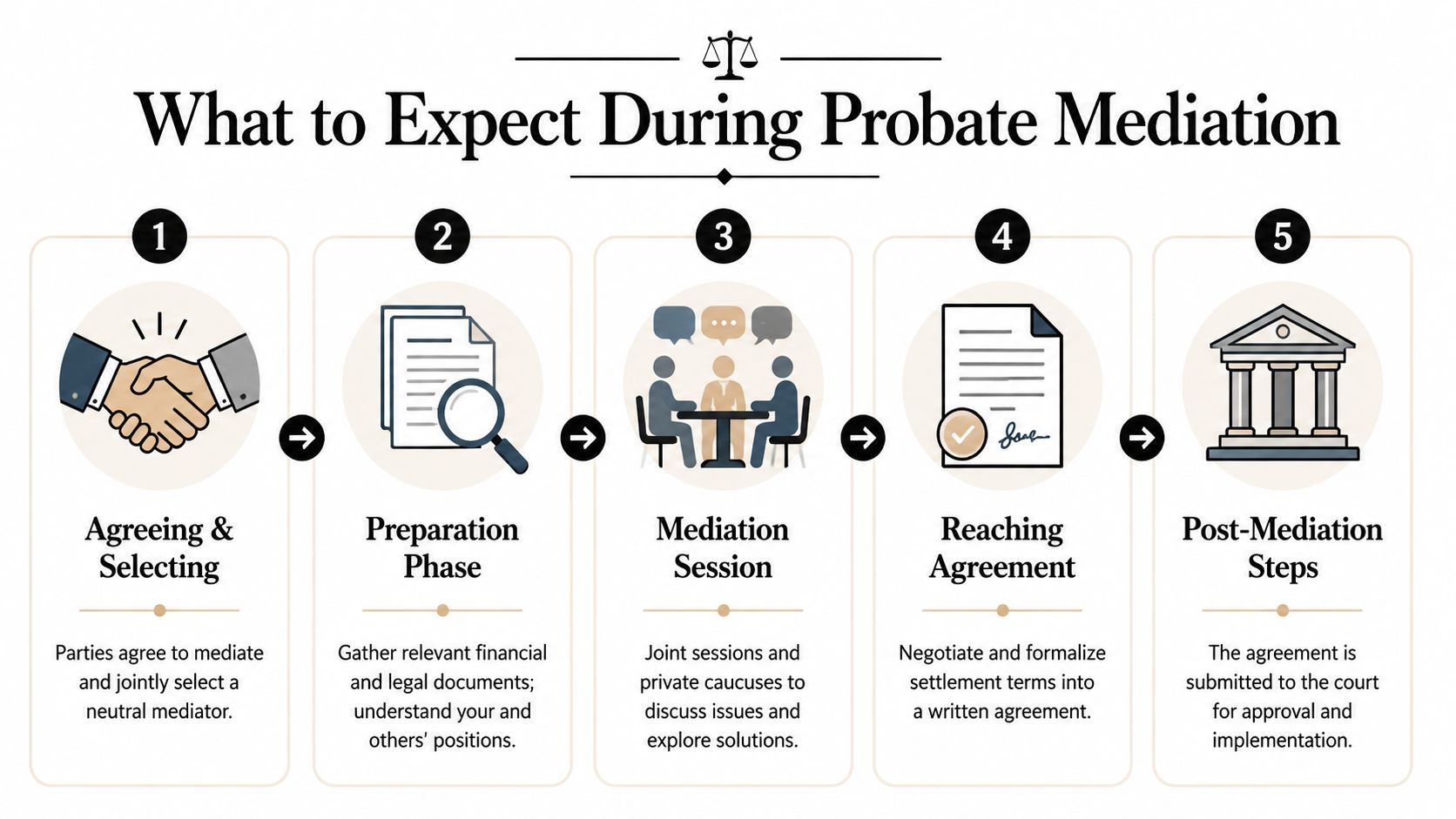
Mediation is a settlement conference led by a neutral third party. The mediator does not decide who wins. The mediator helps the parties test their assumptions, identify practical options, and measure the cost of continuing the fight, both in legal fees and in family damage.
It usually begins in one of two ways. The parties agree to mediate, or the court orders them to attend. After that, the lawyers choose a mediator. In probate cases, experience matters. A mediator who understands wills, executor duties, accountings, and family business disputes can spot problems faster and keep the discussion grounded in what a probate court will and will not approve.
Preparation often shapes the outcome. Lawyers gather the core records, such as the will, trust documents, inventories, appraisals, account statements, emails, medical records, and prior court filings. Each side usually sends the mediator a short statement explaining the dispute, the legal issues, and what resolution might be acceptable. Families who want a clearer overview of the process can review this page on Texas probate mediation for estate disputes.
The mediation session itself is usually less dramatic than people expect. Sometimes everyone meets together briefly. More often, the parties stay in separate rooms and the mediator moves back and forth, carrying offers, questions, and reality checks. That structure matters in probate cases because grief and old family roles can make direct conversation hard. A brother who will not sit calmly across from his sister may still make progress through a mediator.
Much of the day is spent narrowing the dispute. Maybe everyone agrees the independent executor should stay in place, but disagrees about reimbursement claims. Maybe no one contests the will anymore, but the family is stuck on the sale of the house or who gets sentimental items. Those smaller agreements have real value because they stop the estate from bleeding money on issues that do not need a judge.
If progress is made, the mediator and lawyers work on specific settlement terms. Those terms can address details a court judgment may not handle well, such as a timetable for selling real estate, a buyout of one heir's interest, a method for dividing personal property, a release of future claims, or a procedure for closing the estate without another round of conflict.
Later in the process, many families benefit from seeing the flow laid out clearly:
If a deal is reached, the written agreement matters as much as the handshake. In Texas probate disputes, a loose summary is not enough. Terms need to be clear, complete, and drafted so they can be enforced and, when required, presented to the probate court for approval.
Mediation works best when people arrive ready to solve the problem in front of them, even if they still disagree about the past.
A simple example shows why families choose this path. Three children inherit equal shares of an estate. One child lived with the parent and wants credit for years of caregiving. Another wants the home sold now. The third wants to wait six months and keep access to family belongings. Mediation can turn that emotional standoff into a practical plan with deadlines, reimbursement terms, access rules, and final releases. That does not erase hurt feelings, but it can keep the dispute from consuming the estate and hardening into permanent family fracture.
The Reality of Probate Litigation in Court
A daughter wants answers about missing bank transfers. A son insists their mother changed her will freely. An executor says he has done nothing wrong. Once a probate dispute reaches court, the conflict shifts from family conversations to formal accusations, deadlines, and evidence. That change carries a human cost as well as a legal one.
How a probate lawsuit typically unfolds
A probate case usually starts with a pleading filed in court. That may be a will contest, an application to determine heirship, a request to remove an executor, or a demand for an accounting. After that, each side must respond under court rules and on the court's timetable.
Then the case enters discovery. Discovery is the evidence-gathering phase. Lawyers request records, send written questions, issue subpoenas, and take depositions under oath. Sometimes that process is the only way to find out whether money was diverted, documents were hidden, or a vulnerable parent was pressured.
It is also expensive. It takes time away from work, pulls family members back into painful events, and often drains estate assets that would otherwise go to beneficiaries.
What families often underestimate
Trial gets the attention, but much of the wear and tear happens long before anyone takes the witness stand. There may be emergency hearings, fights over what records must be produced, motions about legal issues, and repeated rounds of preparation. In many cases, the lawsuit becomes part of the family's daily life for months or longer.
Under Texas Rule of Civil Procedure 167 and local court practice, a Texas court may refer parties to mediation, but the court does not force a settlement. The key difference is control. In mediation, the family decides whether to sign an agreement. In litigation, the judge decides disputed issues after applying the evidence and the law.
That shift matters more than many families expect. A court can decide who inherits, whether a fiduciary breached duties, or whether a will is valid. A court usually cannot create a solution that feels workable around Thanksgiving dinner, shared ranch land, a family business, or long-standing resentment in a blended family.
Families who have done planning before death often assume that paperwork alone will prevent conflict. Good planning helps, and resources on Modern investor estate planning strategies can reduce risk, but even a well-drafted plan can end up in court if people distrust each other or believe someone crossed a line.
When court becomes necessary
Some cases need a judge. Mediation cannot fix concealment, forgery, or refusal to turn over records without the pressure of formal court orders.
Litigation is often the right path when the dispute involves:
- Undue influence claims, where someone believes a vulnerable parent was pressured into changing a will
- Lack of capacity claims, where the decedent's mental ability at signing is in doubt
- Executor or administrator misconduct, including self-dealing, concealment, or refusal to account
- Heirship disputes, where legal rights must be determined before property can pass
For families facing that level of conflict, this guide to probate litigation in Texas when family disputes turn into lawsuits gives a fuller picture of the court process.
Court is sometimes necessary, but it rarely feels contained to the issue being decided.
A lawsuit can answer legal questions with finality. It can also leave siblings who once tolerated each other unwilling to speak, and it can reduce the estate through fees, delays, and forced sales. Families should go into probate litigation with open eyes. Sometimes court is the only sound choice. It is rarely the least costly one, financially or emotionally.
Making the Right Choice for Your Family's Situation
The smarter move is usually the one that solves the actual problem with the least avoidable damage.
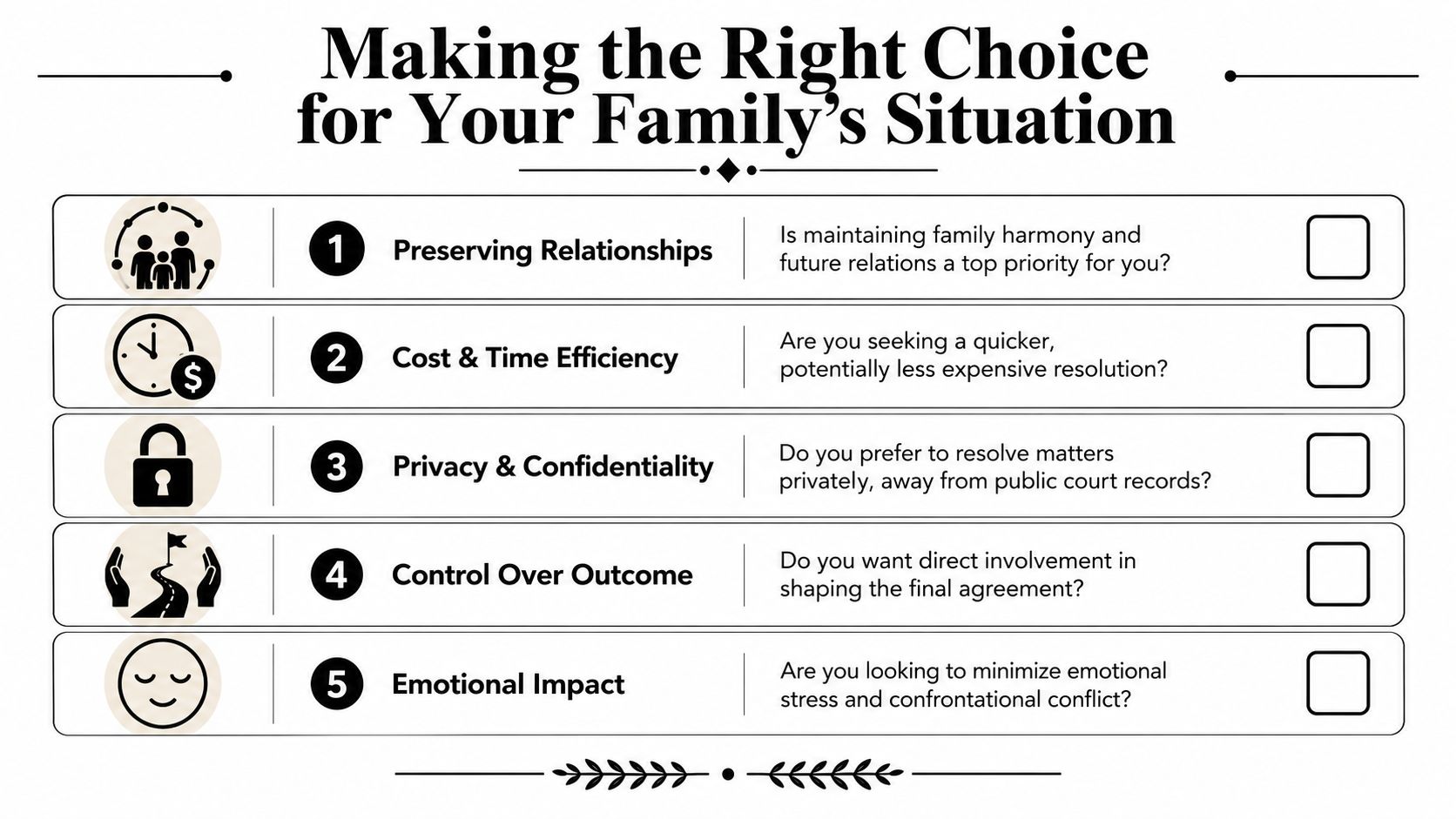
Questions worth asking before you choose
Start here:
- Can the parties still communicate? If people are angry but still willing to negotiate, mediation may work.
- Is speed important? If a delayed resolution will harm the estate or the family's finances, a negotiated path may preserve more value.
- Is anyone hiding information? If you need subpoena power and formal discovery, litigation may be the better fit.
- Do you need a legal ruling? Some disputes require the court to interpret a will, determine heirship, or remove a fiduciary.
- How important is future family peace? If grandchildren, shared property, or family businesses tie everyone together, the emotional aftermath matters.
Real-world judgment calls
Mediation is often the stronger first move when the dispute centers on interpretation, timing, valuation, or hurt feelings layered over a workable legal issue. It gives people room to speak, bargain, and preserve more of the estate for the people it was meant to support.
Litigation becomes more appropriate when one side refuses transparency, ignores duties, or appears to have manipulated a vulnerable person. In those cases, a judge's power is not a drawback. It's the point.
A good example is guardianship-related conflict. If an estate dispute overlaps with concerns about incapacity, exploitation, or who should make decisions for a vulnerable adult, the legal stakes rise quickly. Families in that position often need a more formal strategy and should understand how guardianship matters in Texas can intersect with probate issues.
Planning ahead also reduces the odds of families ever facing this choice. Clear beneficiary designations, updated estate documents, and coordinated financial planning can prevent many avoidable fights. For readers looking at the broader picture, this overview of Modern investor estate planning strategies is a useful starting point.
If you need help evaluating which path fits your dispute, the Law Office of Bryan Fagan, PLLC handles probate administration, estate disputes, guardianship matters, and contested proceedings in Texas. The important point isn't choosing a fight. It's choosing the right process for the facts you have.
Key Insights and Your Next Step
Takeaway: In most Texas probate disputes, mediation is the smarter first move when the parties still have room to negotiate and the goal is to protect both the estate's value and the family's relationships. It is often faster, more private, and more flexible than court. It also lets the people involved shape the outcome instead of surrendering that decision to a judge.
Litigation still matters. Some cases demand formal discovery, sworn testimony, and a court order. If there are serious allegations of undue influence, lack of capacity, hidden assets, or executor misconduct, court may be necessary to protect your rights.
The hard part is that grieving families often have to make this decision before they feel emotionally ready. That's normal. You don't need to have every answer on day one. You do need a clear assessment of the dispute, the estate, and the risks of each path under the Texas Estates Code.
The best next step is usually simple:
- Gather the core documents such as the will, court filings, and financial records.
- Identify the true dispute rather than every old family grievance.
- Get legal guidance early before delay makes the conflict more expensive or harder to resolve.
If you're facing probate in Texas, our team can help guide you through every step, from filing to final distribution. Schedule your free consultation today.
If you're facing probate in Texas, our team can help guide you through every step, from filing to final distribution. Schedule your free consultation today.
If you need help deciding between mediation and litigation, contact Law Office of Bryan Fagan, PLLC for a free consultation. We can help you evaluate the dispute, explain your options in plain English, and guide you through the Texas probate process with clarity and care.