The phone call comes, and everything changes. A parent, spouse, or sibling has died. Before the shock has even settled, someone asks who has the will, who can access the bank account, what happens to the house, and whether the family needs to go to court.
That's where many families in San Antonio feel stuck. They aren't just grieving. They're being asked to make legal and financial decisions at the same time.
Probate is the legal process of settling a person's estate after death. In plain English, it's the court-supervised method for recognizing a will when there is one, identifying the right person to handle affairs, paying valid debts, and transferring what remains to the people who should receive it. Under the Texas Estates Code, especially Titles 2 and 3, this process is structured. It may feel unfamiliar, but it isn't random.
A good Probate Lawyer in San Antonio helps turn that uncertainty into a checklist. Instead of guessing what to file, when to notify creditors, or how to transfer title to a home in Bexar County, families get a clear path forward. That matters even more when family members live in different states, when there's no will, or when the executor has never handled an estate before.
Navigating Probate in San Antonio After a Loss
Maria's father dies in San Antonio, and within days she's holding a folder with a death certificate request form, an unsigned list of bank accounts, and a will naming her as executor. Her brother lives in another state. Her aunt says the house can't be sold until “probate is done.” Everyone has advice, and none of it sounds the same.
That kind of confusion is common. Probate often begins at the exact moment a family has the least energy for paperwork. The legal terms can sound intimidating, but the core idea is simple. Probate is the process of carrying out a loved one's final affairs in an orderly way.
What probate means in plain language
If there's a valid will, the court may recognize it and appoint the person named to act for the estate. In Texas, that person is often called the executor. If there isn't a will, the court may appoint an administrator instead.
Either way, the person in charge has practical duties:
- Find assets: Bank accounts, vehicles, real estate, and other property need to be identified.
- Handle bills carefully: Valid debts and estate expenses must be reviewed and addressed.
- Transfer property correctly: Heirs and beneficiaries need legally proper transfers, not informal promises.
- Follow Texas law: The Texas Estates Code sets the rules, even when a family is in complete agreement.
Probate doesn't mean something has gone wrong. It often means the family is using the legal system the way Texas intended.
Why legal guidance helps early
Many people searching for a probate lawyer in San Antonio aren't looking for a courtroom fight. They want someone to explain what happens next, what documents matter, and what can wait until after the funeral.
That guidance can prevent avoidable mistakes, such as missing a filing deadline, using the wrong probate method, or trying to transfer a home without the right legal authority. Families usually feel better once they understand that probate is a process with defined steps, not a mystery.
Understanding Your Options for Texas Probate
Choosing the right probate path in Texas is a little like choosing the right key for a lock. If you use the wrong one, the process slows down, paperwork multiplies, and families get frustrated. If you use the right one from the start, the estate can be handled in a way that fits the property, the debts, and the court's requirements.
That matters even more for an executor who lives outside Texas. An out of state executor often wants to know one practical thing first. What is the least complicated legal path that still allows the house, bank account, or other property to be transferred correctly in Bexar County?
Texas offers several probate options, and they do not all involve the same level of court involvement.
Independent administration and dependent administration
The two main full probate routes are independent administration and dependent administration.
Independent administration works like giving the executor a clear set of instructions and the legal authority to carry them out. After the court appoints the executor, that person can usually handle many estate tasks without returning to the judge for approval each time. This is often the preferred option when there is a valid will and no serious dispute among the family.
Dependent administration involves much closer court supervision. The administrator may need court approval for actions that would be handled more directly in an independent administration. This route is more common when there is conflict, uncertainty, or a need for tighter oversight.
For many families, the difference comes down to control and court involvement. One path gives the personal representative more room to act. The other places more decisions under the court's direct review.
Comparing Texas Probate and Administration Options
| Method | Best For | Court Oversight | Typical Use |
|---|---|---|---|
| Independent Administration | A valid will or family agreement that supports less court involvement | Low | Full probate with more flexibility for the executor |
| Dependent Administration | Contested estates or situations where stronger court supervision is needed | High | Full probate with repeated court approval |
| Muniment of Title | A valid will where title needs to be cleared and full administration may not be necessary | Limited | Transfer of title without full estate administration |
| Small Estate Affidavit | An intestate estate with a qualifying probate estate not exceeding $75,000 | Limited court involvement | Transfer of certain assets when statutory requirements are met |
| Affidavit of Heirship | No will, limited debt issues, and real property questions | No full probate administration | Used to help establish title through deed records |
Options that may avoid full probate
Some estates do not need a full administration at all. That is often a welcome relief for families, especially when the estate is modest or the main concern is clearing title to a home.
A common starting question is whether a will has to be probated in Texas. The answer depends on what the person owned, whether debts must be addressed, and what legal authority the family needs.
Here are several tools that may fit better than full probate:
- Muniment of Title in Texas: Often used when there is a valid will, little or no unpaid debt, and the main goal is to transfer title, such as a San Antonio home.
- The Small Estate Affidavit in Texas: May work when the person died without a will and the estate meets Texas statutory requirements, including the probate estate value limit.
- Affidavit of Heirship: Commonly used to help document family history and support title questions involving real property, especially when no full probate was opened.
The best option depends on the facts, not on what sounds easiest. A house in Bexar County, a bank account in another state, or a last-minute creditor claim can change the correct approach.
A practical San Antonio example
Suppose a daughter in Colorado is named executor in her mother's Texas will. The estate includes a San Antonio house, one checking account, and no major disputes. She may not need the same type of probate that would be required for an estate with multiple creditors, business interests, or fighting heirs.
If the main legal task is clearing title to the home, Muniment of Title may be enough. If there is no will and the estate is small, The Small Estate Affidavit in Texas may be worth examining. If family members disagree or debts need formal handling, a full administration may be the safer route.
That early choice shapes everything that follows, especially for out of state executors who are trying to handle a Texas estate without making unnecessary trips back and forth to San Antonio.
The San Antonio Probate Timeline Step by Step
For most families, the hardest part isn't the legal standard. It's not knowing what happens first. A standard probate in Bexar County becomes easier to manage when you break it into stages.
The example below follows a fictional San Antonio family using a routine estate administration after a parent's death. The exact details can vary, but the sequence is familiar.
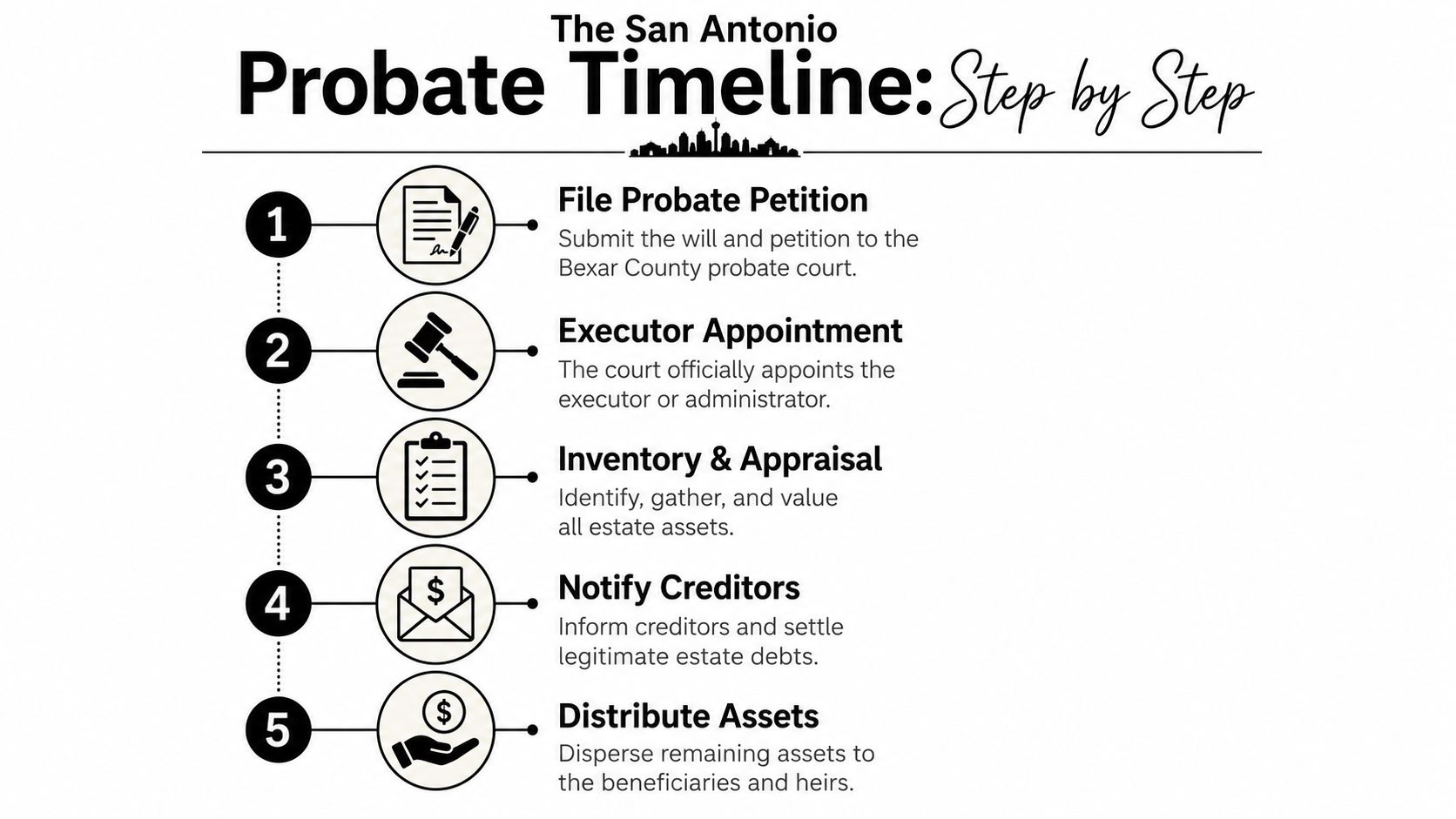
Step one through step three
File the probate application
The process usually starts by filing the will, if there is one, and an application with the probate court in Bexar County. This filing asks the court to recognize the will and appoint the executor, or to appoint an administrator if there is no will.Attend the court hearing
After the filing, the court schedules a hearing. If everything is in order, the judge can admit the will to probate and authorize the executor to act.Receive Letters Testamentary or other authority
These letters are the formal proof that the executor has legal authority to deal with banks, title companies, and others. Without them, many institutions won't release information or allow transfers.
A helpful way to understand the timing questions families ask most often is this guide on how long probate takes in Texas.
Step four through step six
Identify and value estate assets
The executor gathers account information, deeds, vehicle titles, insurance details, and personal property records. The estate then prepares the required inventory and related information under Texas procedure.Notify creditors and review claims
Creditors don't automatically get paid just because a bill appears in the mail. The executor has to sort valid claims from informal requests and follow the right process before paying estate debts.Distribute the remaining property
Once debts, expenses, and required steps are handled, the executor can distribute what remains to the beneficiaries or heirs.
Later in the process, many families find it useful to hear the full sequence explained visually:
The deadline families should not miss
Texas imposes one deadline that deserves immediate attention. Texas law imposes a strict four-year deadline from the date of death to file an Application for Probate. If the will is not filed within that window, it generally cannot be admitted to probate unless exceptional circumstances are proven, and the estate may be treated as intestate, according to Texas Law Help's probate court basics.
That deadline surprises families more often than it should. A will can sit in a drawer because everyone “meant to get to it later,” and by the time someone acts, the legal options are narrower.
Where most estates fit
Many estates follow Independent Administration in Texas, which explains why most Texas estates use this efficient, low-supervision path. In practical terms, that usually means less court involvement after the initial appointment and a smoother experience for the executor.
Key Documents and Costs in Bexar County Probate
Probate feels less intimidating when you know what paperwork matters. Most families don't need to memorize legal forms. They need to know what each document does and why someone is asking for it.
The documents that usually matter most
Several records tend to come up early in a Bexar County probate matter:
- Original will: If a valid will exists, the court usually needs the original.
- Death certificate: Banks, insurers, and the court often require certified copies.
- Probate application: This is the document that starts the court process.
- Letters Testamentary or Letters of Administration: These show who has legal authority to act for the estate.
- Asset information: Deeds, account statements, vehicle titles, and similar records help identify the estate.
- Heirship paperwork when needed: This can become important when there is no will.
If you want a local process overview, this guide to filing probate in Bexar County is a practical starting point.
When an Affidavit of Heirship may matter
Some families don't need full probate because the estate facts point in a different direction. For estates in Texas with no will, no outstanding debts, and only real property, an Affidavit of Heirship can serve as a statutory alternative. It requires two disinterested witnesses who knew the decedent to sign and swear to the affidavit under Section 203.002 of the Texas Estates Code, and it is filed in the county deed records, as explained by Bexar County probate guidance.
That tool is easy to misunderstand. It doesn't replace probate in every no-will case. It fits a narrow fact pattern, which is why lawyers often ask detailed questions about debt, real estate, and family history before recommending it.
If a family tries to use the wrong shortcut, the delay often shows up later when they try to sell property or prove title.
What about probate costs
Costs vary because estates vary. A simple, uncontested matter with clear documents is different from a disputed estate involving multiple heirs or title problems.
Families should expect to ask about:
- Court filing fees: Required to open the probate case.
- Attorney fees: Some firms use flat fees for certain uncontested matters. Others bill hourly.
- Certified copies and recording costs: Needed for court orders, deeds, or title work.
- Appraisal or valuation expenses: Useful when property values must be documented.
- Executor expenses: A personal representative may incur legitimate out-of-pocket costs while handling the estate.
The best approach is transparency. Ask early what type of fee structure applies, what work is included, and what additional expenses may arise if the facts become more complicated.
When You Need a Probate Lawyer in San Antonio
A lot of families call a lawyer only after something has already gone wrong. The executor paid a bill too soon. A sibling objects to the will. A bank refuses to release information. An out-of-state child is named executor and has no idea what Texas requires first.
That is usually the point where a simple probate stops feeling simple.
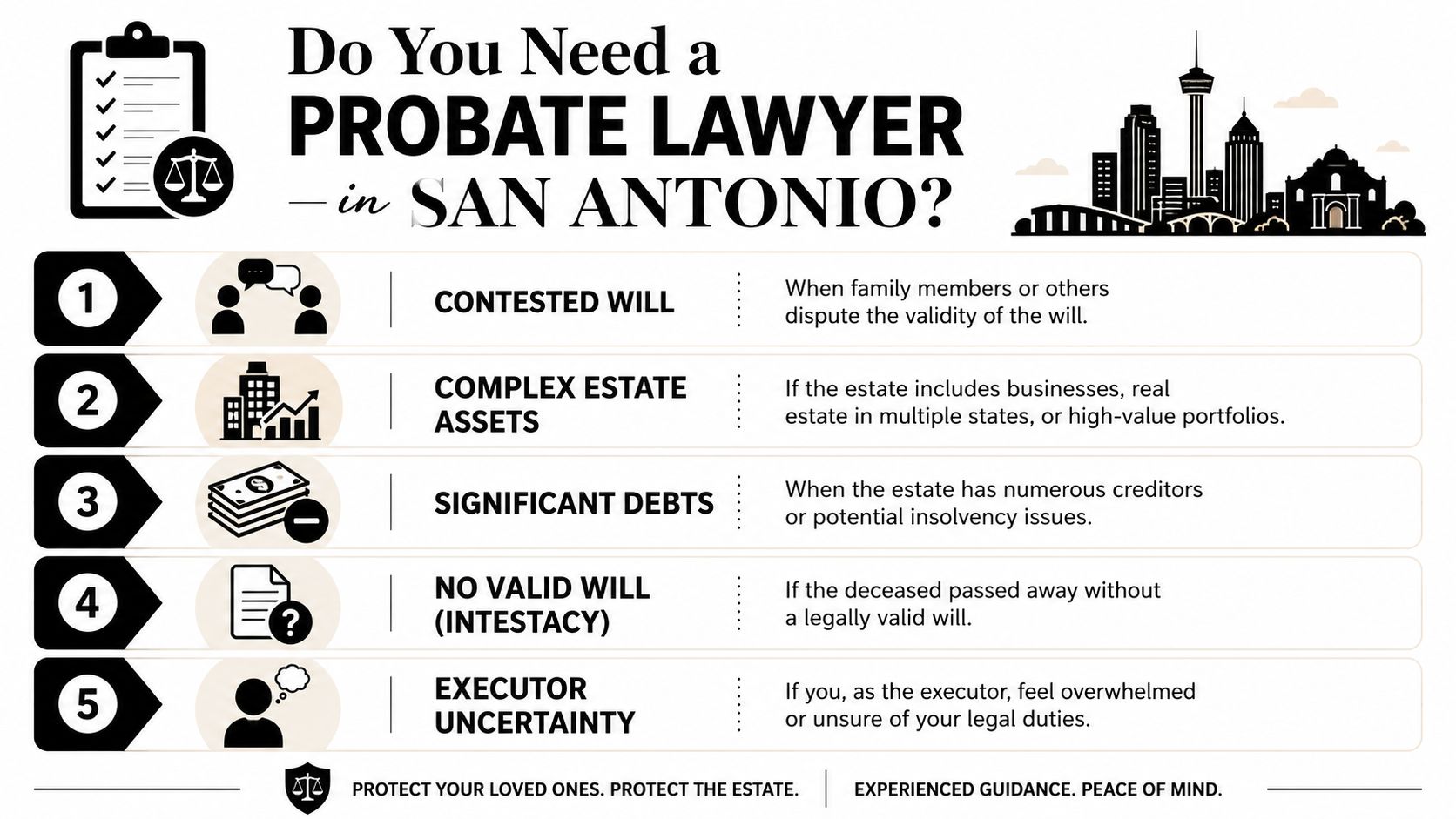
A probate lawyer helps you avoid those early mistakes and correct them if they have already happened. In practical terms, that means choosing the right probate procedure, preparing the court papers correctly, protecting the executor from missteps, and making sure title to property can be cleared later. For families handling a San Antonio estate from another state, that guidance often matters even more because routine tasks become harder when you are trying to manage them by phone, email, and overnight mail.
Situations that deserve immediate legal guidance
Some cases carry enough risk that guessing is expensive.
- A will is being challenged: If someone says the will was signed improperly, changed later, or created under pressure, legal help should start right away.
- The estate has significant debt or creditor pressure: Executors must follow the right order for handling claims. Paying one creditor too soon can create personal headaches for the person serving.
- There is no valid will: Texas intestacy rules decide who inherits, and families are often surprised by who has priority to serve as administrator.
- The estate includes complicated property: A family business, mineral interests, rental property, or real estate in more than one county can create issues that do not show up in a basic estate.
- The executor lives outside Texas: Remote administration can work, but the process usually needs tighter organization, clearer instructions, and careful attention to signatures, notices, and certified copies.
- The executor feels uncertain about next steps: That is reason enough to ask for help. Serving as executor is a legal job, not just a family favor.
Probate works a lot like handing off responsibility for someone else's financial life. If the handoff is clean, the process moves. If paperwork, authority, or communication breaks down, everything behind it starts to stall.
Why legal help can protect the family
A probate lawyer does more than fill out forms. The lawyer helps the family see the full picture before a small issue turns into a court problem, a title problem, or a dispute between relatives. That matters in San Antonio estates where the house is often the main asset and the family wants to sell, refinance, or transfer it without surprises later.
Legal help is especially useful when the executor is trying to act from out of state. A lawyer can explain what has to be signed in original form, what can be handled remotely, when the executor may need to appear, and how to keep the process moving without unnecessary trips back to Bexar County. That kind of step-by-step direction is often the difference between a manageable case and months of avoidable delay.
Some probate matters also expand into related issues. A will contest may require probate litigation. A family caring for an incapacitated adult may need to discuss guardianship. After going through probate once, many families also decide to update their own wills or trusts so their children have clearer instructions later.
Law Office of Bryan Fagan, PLLC is one Texas firm that handles probate administration, heirship matters, guardianship applications, wills and trusts, and probate litigation.
The best time to get probate advice is usually before the executor files anything, pays any claim, or makes promises about who will receive property. Early guidance is often simpler and less costly than repairing mistakes later.
Special Guidance for Out of State Executors
Serving as executor is hard enough when you live in San Antonio. It's a different challenge when you live in California, Florida, or another state and you're suddenly responsible for a Texas estate.
The good news is that distance doesn't automatically disqualify you from serving.
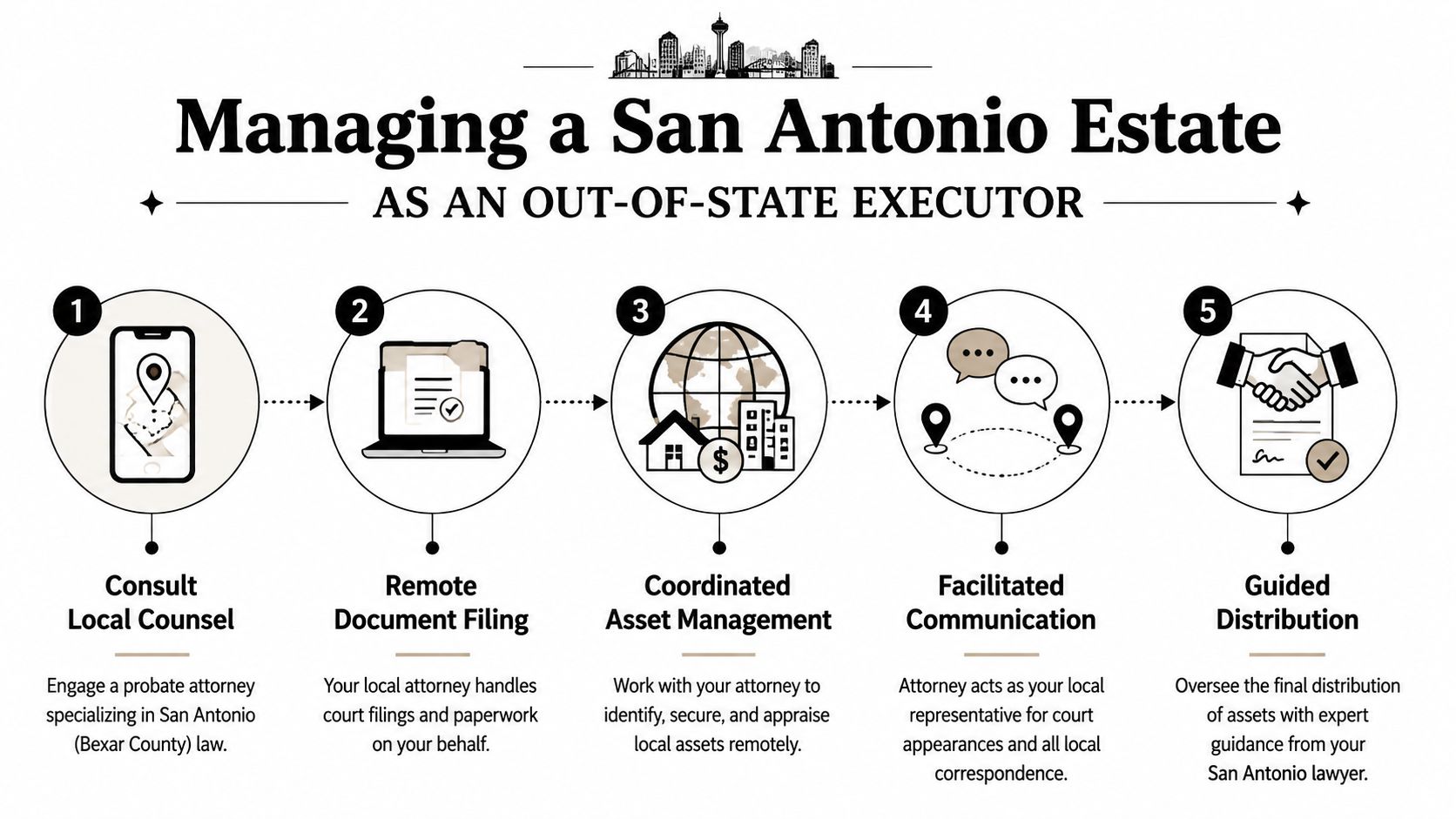
What Texas law allows
For out-of-state executors, one overlooked point can make the process much more manageable. Texas law allows independent administrators to be appointed without a local resident agent if the will waives that requirement, a detail often missed in the 15 to 20% of Texas probate cases involving non-resident heirs, as described in this San Antonio probate discussion.
That matters because many families assume an out-of-state child can't serve unless they move to Texas or hand everything off to someone local. In many cases, that assumption is wrong.
A practical remote protocol
If you're handling a Bexar County estate from another state, focus on order and documentation.
Confirm your authority first
Before calling banks or trying to list property, make sure the probate filing has been handled and your authority is recognized.Centralize documents digitally
Keep scans of the will, death certificate, court papers, property records, and account information in one secure place. Remote probate gets harder when papers are spread among siblings.Create an asset list by category
Separate real estate, financial accounts, vehicles, personal property, and possible debts. That keeps the inventory process cleaner and helps you identify what still needs verification.Use local help for local tasks
Someone may need to check a mailbox, secure a vacant home, meet an appraiser, or coordinate with a title company. Distance makes local logistics, not legal authority, the usual pain point.Keep beneficiaries informed
Silence creates suspicion. Clear updates reduce tension and help heirs understand that delay doesn't always mean inaction.
Where remote executors get tripped up
Out-of-state executors often struggle with practical details more than legal eligibility. They may not know how to access a locked property, how to coordinate signatures across state lines, or how to provide Texas-issued probate papers to institutions that have never seen them before.
A local probate lawyer can often handle filings, communicate with the court, help coordinate title or asset issues, and reduce the need for unnecessary travel. For many families, that turns a stressful long-distance estate into a manageable project with clear checkpoints.
Frequently Asked Questions About San Antonio Probate
What happens if there is no will
When someone dies without a valid will, Texas treats the estate as intestate. That means Texas inheritance law decides who receives property. The court may also need to appoint an administrator rather than an executor. The exact result depends on family relationships, such as whether there is a surviving spouse, children, or other relatives.
Can probate be avoided entirely
Sometimes, yes. Some assets pass outside probate by their own transfer method, and some estates may qualify for simpler alternatives instead of full administration. In other situations, estate planning tools can reduce or avoid future probate issues. The answer depends on how assets were owned and whether beneficiary designations or planning documents were in place.
What is probate litigation
Probate litigation is a court dispute connected to an estate. It can involve contests over a will, disagreements about who should serve, conflicts over property, or claims that an executor mishandled estate duties. Not every disagreement becomes litigation, but when the conflict affects legal rights, court involvement may be necessary.
What's the difference between an heir and a beneficiary
A beneficiary is someone named in a will to receive property. An heir is someone Texas law recognizes as entitled to inherit when there is no will. One person can be both, but the terms don't always mean the same thing.
What are Letters Testamentary
These are the court-issued documents that show an executor has authority to act for the estate. Banks, title companies, and other institutions often ask for them before releasing funds or recognizing the executor's authority.
Takeaway
Probate in San Antonio is usually less mysterious once the family identifies the right path. The key questions are straightforward. Is there a valid will? Does the estate qualify for a simpler alternative? Is the executor local or out of state? Are there disputes, debts, or title issues that require closer attention?
If you can answer those questions early, the next steps become much clearer. Titles 2 and 3 of the Texas Estates Code provide the framework. A careful probate strategy applies that framework to the facts of your family's situation.
If you're facing probate in Texas, our team can help guide you through every step, from filing to final distribution. Schedule your free consultation today. Contact Law Office of Bryan Fagan, PLLC to talk through your options with a Texas probate team that helps families, executors, and heirs move forward with clarity.