Skip to content
Losing a loved one is hard enough. Then someone hands you a will, mentions probate, and asks whether you're the executor. Many individuals in that moment aren't thinking about court filings or statutory deadlines. They're trying to plan a funeral, answer family questions, and figure out what their loved one would have wanted.
If you're searching for how to become executor of an estate in Texas, the first thing to know is simple. Being named in a will matters, but it doesn't give you immediate legal power. Texas requires a court process before you can collect assets, deal with banks, pay debts, or distribute property.
The good news is that probate in Texas is often more practical than families expect, especially when the will is clear and the executor acts promptly. The process has rules, but those rules become manageable once you understand the order of events and the deadlines that matter.
Understanding Your Role and Eligibility as an Executor
An executor is the person chosen to carry out the instructions in a will. In plain English, that means you're the one responsible for wrapping up your loved one's legal and financial affairs the right way. You gather information, protect property, handle required notices, work through debts and claims, and eventually help transfer what remains to the people entitled to receive it.
For many families, the executor is a spouse, adult child, sibling, or trusted friend. The role is practical, but it's also a fiduciary role. That means Texas law expects you to act carefully, ethically, and in the best interests of the estate, not for personal convenience.

What the job actually involves
Many people assume the executor “reads the will” and hands things out. Real life is slower and more structured than that.
Typical responsibilities include:
- Protecting estate property: Secure the home, preserve important papers, and make sure assets aren't lost or misused.
- Identifying what belongs to the estate: Some assets pass outside probate, while others require court authority before transfer.
- Handling paperwork and notices: Probate runs on deadlines, filings, and proof that you completed them.
- Working toward final distribution: After debts, claims, and administration issues are addressed, you distribute property according to the will.
If your family is also reviewing planning documents, our page on Wills & Trusts can help put the executor's role in the larger estate planning context.
Practical rule: An executor's job isn't to move fast. It's to move carefully, in the right order, with records that can be shown to the court and beneficiaries if questions come up.
Who can serve in Texas
Texas Estates Code provisions in Titles 2 and 3 govern probate, estate administration, and related proceedings. In everyday terms, the court is looking for someone who can responsibly manage the estate and follow the law.
A person named in the will is usually the starting point. But the court still has to decide whether that person is qualified to serve. Problems can arise if there are concerns about capacity, criminal history, residency-related filing requirements, or suitability to act fairly.
Here's the practical takeaway:
| Issue | Why it matters |
|---|---|
| Named in the will | Being nominated helps, but it isn't enough by itself |
| Court approval | No one has executor authority until the probate court appoints them |
| Fitness to serve | The court can refuse an appointment if the person isn't suitable |
| Fiduciary duty | The executor must protect the estate and treat beneficiaries fairly |
A common family concern
A realistic example helps. Suppose a mother's will names her oldest son as executor. He assumes that because the will names him, he can go to the bank and access her account the next day. He can't. Until the probate court appoints him and issues the proper authority, the bank is usually right to say no.
That answer often feels frustrating, especially during grief. But the rule protects everyone involved, including the executor. It creates a clear legal start date and a clear paper trail.
The Starting Line Filing the Probate Application
The first formal step is filing the probate case in the right court. In Texas, that usually means filing an Application to Probate Will and for Issuance of Letters Testamentary in the probate court for the county where the deceased person lived.
A visual overview can make the process easier to follow.

Texas law gives this step real urgency. To become an executor of an estate in Texas, an individual must file an Application to Probate Will and for Issuance of Letters Testamentary within a strict statutory deadline of four years from the date of the decedent's death, as mandated by Texas Estates Code § 256.003. Even if a will explicitly nominates a specific person as executor, that individual has no legal authority to act until the court formally appoints them. Once the court signs the Order Admitting the Will to Probate and Appointing the Executor, the individual receives Letters Testamentary, which serve as the official legal document authorizing them to manage the estate. That deadline and process are discussed in this explanation of Texas Estates Code § 256.003 and Letters Testamentary.
What you file and where you file it
The application starts the probate case. It tells the court that a person has died, that a will exists, and that the named executor is asking to be formally appointed.
The filing generally belongs in the county where the decedent resided. In larger counties, that may mean a statutory probate court. In other counties, it may be a county court handling probate matters.
For a closer look at the filing process itself, see this guide to filing a probate application in Texas.
Why the four-year deadline matters so much
The four-year deadline isn't a technicality. If the application isn't filed in time, the will generally can't be admitted to probate, and the estate may be treated as if there were no will. That can change who inherits and how property is handled.
If you're close to that deadline or unsure whether it has already passed, this overview of The Four-Year Deadline to Probate a Will in Texas explains why timing can reshape the case.
Missing the filing window can turn a will-based plan into an intestate estate. That shift often creates more conflict, not less.
What Letters Testamentary really are
Families often hear this phrase and don't know what it means. Letters Testamentary are the court-issued papers that prove you have authority to act for the estate. Think of them as your official permission slip.
Banks, title companies, and other institutions usually want to see certified copies before they'll recognize you as the executor. Without them, even a named executor usually can't complete basic estate tasks.
This short video offers a useful overview of the opening phase of probate:
What usually works best at this stage
The families who move through this part most smoothly usually do three things early:
- Locate the original will if one exists.
- Confirm the correct county for filing.
- Prepare for the hearing and qualification steps instead of assuming the application alone is enough.
What doesn't work is waiting because the family “isn't ready yet.” Emotional readiness and legal deadlines don't always move together.
Navigating Different Types of Texas Probate
Not every Texas probate case follows the same path. That matters because the kind of probate you open affects how much court supervision you'll have, how much flexibility you'll have as executor, and how much paperwork you'll manage during the estate.
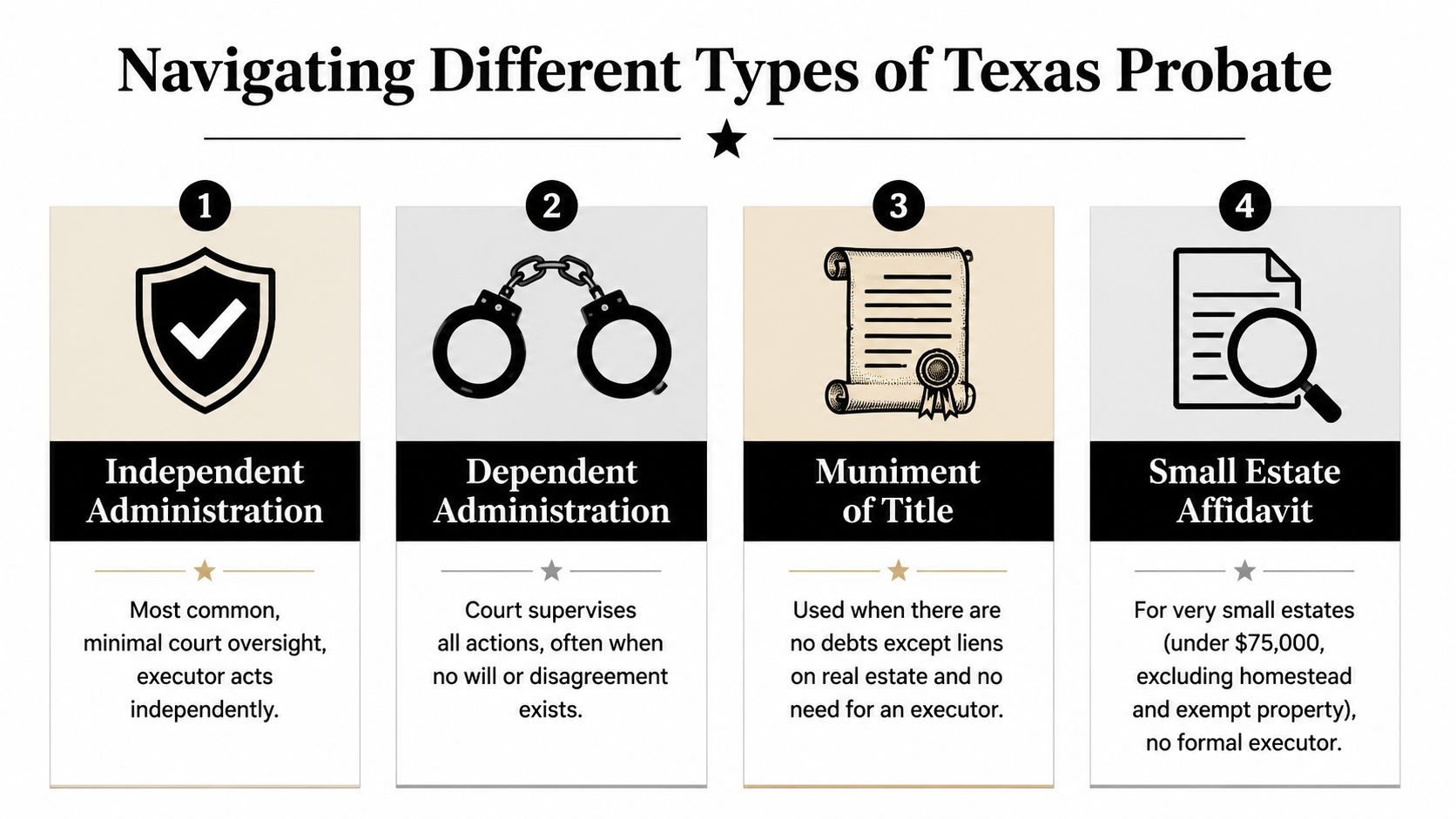
This side-by-side view helps illustrate the main options.
Independent administration and dependent administration
In Texas, the major fork in the road is often independent administration versus dependent administration.
Texas probate law uniquely facilitates independent administration, a process that allows an executor to manage the estate without needing court approval for every action. For an estate to qualify, the will must name an independent executor, or all legal heirs must give unanimous consent. Once appointed, an independent executor must file an Oath and a Bond (unless waived) within 20 days and a sworn Inventory, Appraisement, and List of Claims within 90 days of the order admitting the will to probate, as explained in this overview of independent administration in Texas.
That's one reason independent administration is often the preferred route. It reduces repeated court involvement and lets the executor administer the estate, rather than asking permission at every turn.
Here is the practical difference:
| Probate path | What it feels like in practice |
|---|---|
| Independent administration | Executor has room to act, with fewer court approvals after appointment |
| Dependent administration | The court stays involved throughout, often requiring approval for major acts |
A real-world comparison
Suppose an estate includes a house that needs to be sold so debts can be paid and the remaining funds distributed. Under independent administration, the executor may be able to move forward without returning to court for approval of each step. Under dependent administration, that same decision may require added court supervision.
For grieving families, that difference is more than procedural. It affects stress, delay, and the number of points where conflict can grow.
Independent administration usually works better when the will is clear and the family can cooperate. Dependent administration may be necessary when the estate needs tighter court oversight.
When simpler probate options may apply
Full estate administration isn't always necessary. In some situations, a more limited probate procedure may fit the facts better.
Examples include:
- Muniment of Title: Often considered when there's a valid will, no need for ongoing administration, and no debts other than debt secured by real estate.
- Small Estate Affidavit: The infographic notes this may be available for qualifying smaller estates.
- Heirship-related alternatives: In some no-will situations, the legal issue may focus more on identifying heirs than appointing an executor.
These options can be efficient in the right case, but they aren't interchangeable. The presence of debt, family disagreement, or complicated assets can quickly push a case toward more formal administration.
What works and what doesn't
What works is matching the procedure to the estate's actual needs. A simple title-transfer problem may not need full administration. A contested estate with debts and multiple beneficiaries usually does.
What doesn't work is choosing a shortcut because it sounds easier. In probate, the “faster” path only helps if it legally fits the case.
If disputes begin to build around the will, the executor, or the handling of property, those issues can move beyond administration and into Probate Litigation.
Making It Official The Oath and Bond Requirement
The court's order admitting the will is a major milestone, but it usually isn't the final step in qualifying as executor. Texas requires the executor to complete the formal qualification process before acting under that authority.
The oath is your formal promise
The Executor's Oath is exactly what it sounds like. You swear that you'll faithfully perform the duties of the office. This isn't ceremonial language. It's the legal statement that you accept the responsibility and intend to carry it out properly.
In practical terms, the oath matters because probate law treats an executor as a fiduciary. That is the same broad idea families encounter in other court-supervised contexts involving responsibility for another person's interests, including some matters discussed on our Guardianship page.
The bond protects the estate
An executor's bond is a financial protection mechanism for the estate. If the executor mishandles funds or fails in duties in a way that causes loss, the bond may provide a source of protection.
Some wills waive bond. Courts may also waive it in appropriate cases. When the will doesn't waive bond, or the court requires one, the executor must satisfy that requirement before fully qualifying.
This guide to Texas probate bond requirements gives a useful overview of when bond issues matter.
Why these steps trip people up
The problem isn't usually complexity. It's timing. Families often think the hearing ends the process, then they're surprised to learn there's still a short qualification window for filing what the court requires.
A few practical points help:
- Read the order carefully: The order and clerk's instructions often tell you what must be filed next.
- Don't assume bond is waived: Check the will and the court's ruling.
- Get proof of qualification: Institutions may ask for current certified letters before recognizing your authority.
A probate case can stall after a successful hearing if the executor doesn't complete qualification requirements on time.
Common Pitfalls and Issues for Out-of-State Executors
A lot of probate trouble starts the same way. Someone lives in another state, wants to do right by a parent or sibling, and assumes the hardest part was getting named in the will. Then Texas procedure starts imposing deadlines, filing requirements, and notice rules that do not wait for grief, travel schedules, or family consensus.

For out-of-state executors, the risk usually is not dishonesty. It is missing a procedural step that feels minor until the court, a creditor, or a beneficiary asks for proof.
The paperwork problem out-of-state executors overlook
Texas often requires a nonresident executor to file an Appointment of Resident Agent so someone in Texas can accept service of process. Families are often surprised by that requirement, especially if the executor has already appeared at the hearing and assumed the appointment was complete.
That is only part of the problem. Notice deadlines begin running quickly. Beneficiaries may need formal notice. Creditors may need publication and, in some cases, direct notice. If those steps are late or poorly documented, the administration can slow down fast, and the executor may have to spend time and money fixing avoidable mistakes.
I have seen this happen in otherwise calm estates. No dispute over the will. No fight among siblings. Just a nonresident executor who did not realize Texas expected one more filing and careful proof that notices were sent.
If you are serving from outside Texas, this guide to foreign executor issues in Texas probate explains the state-specific requirements that tend to cause delays.
Serving from another state can work well. It works poorly when the executor assumes Texas uses the same rules as home.
A common real-world pattern
A daughter in Colorado is named executor in her father's Texas will. She hires counsel, attends the hearing remotely, and believes the estate is finally in motion. Then she learns she still has to address Texas resident-agent requirements, track notice deadlines, gather certified mail proof, and respond to local institutions that want current letters and precise documentation before they will release information.
That kind of case feels simple at the start. It becomes stressful because the friction is procedural, not personal.
The emotional side matters here. Out-of-state executors often feel they are already behind because they cannot easily drive to the courthouse, inspect property on short notice, or meet with beneficiaries face to face. Good systems matter more in those cases. A written deadline calendar, scanned copies of every filing, and one local point of contact can prevent many of the problems that make families think probate is going off the rails.
The compensation misunderstanding
Money creates tension even in cooperative families. Executor compensation is a common source of confusion because relatives often assume the fee is based on the gross estate value or that payment is automatic.
Texas compensation rules are narrower than that. As noted earlier in this article, the fee is tied to qualifying receipts and disbursements, not merely to the total value of everything the decedent owned. Courts also expect the executor to meet filing and notice obligations. If the executor falls badly out of compliance or is removed, compensation can be reduced or lost.
That is why I tell families to discuss compensation early, document time and transactions carefully, and avoid casual statements like “just take your five percent.” That phrase causes problems.
What helps in practice
Out-of-state executors usually do best when they treat the role like a file that needs active management, not occasional attention.
A practical approach looks like this:
- Confirm every nonresident filing requirement immediately after appointment.
- Put all court, notice, and inventory deadlines on one calendar with reminders.
- Keep proof of mailing, publication, and delivery in one organized file.
- Use local help for Texas real property, court appearances, and urgent document requests.
- Communicate with beneficiaries in plain language, but do not confuse updates with formal legal notice.
In some estates, families also benefit from outside professionals who already understand compliance systems and documentation standards in regulated settings. The discipline behind mastering fair housing compliance reflects the same basic lesson. Clear procedures and written records prevent avoidable disputes.
If the estate has Texas real estate, creditor pressure, business interests, or growing tension among family members, local probate support becomes more than a convenience. Law Office of Bryan Fagan, PLLC is one example of a Texas probate firm that handles administration and related disputes across the state.
Key Insight Your Responsibilities as Executor
A week or two after the funeral, the paperwork usually starts to feel heavier than the grief. A bank wants letters testamentary. A family member asks when belongings will be divided. Utilities, insurance, and mortgage payments keep coming. That is the point where many executors realize the job is not one big legal event. It is a series of small decisions that need to be handled in the right order.
Your role is to protect the estate while the court process runs its course. In practice, that means finding and securing assets, identifying what the estate owes, keeping beneficiaries reasonably informed, and waiting to distribute property until debts, taxes, and probate requirements are addressed.
The waiting is hard. It also prevents expensive mistakes.
Executors often get into trouble by treating informal family agreements as if they replace probate procedure. They do not. If a car is handed over too early, if a house is sold before title issues are cleared, or if one beneficiary gets more information than the others, tension grows fast. Good administration is usually quiet, methodical, and well documented.
A practical way to handle the work is to focus on four questions:
- What does the estate own, and is it protected right now? Secure real property, redirect mail, review insurance, and locate account statements, deeds, vehicle titles, and business records.
- What bills and claims need attention? Separate valid debts from noise, keep estate funds separate, and do not pay heirs before the estate's obligations are clear.
- Who needs updates, and what kind of update is appropriate? Beneficiaries usually need clear timelines and plain-English status reports, even when there is little progress to report.
- Is the estate ready to distribute? Waiting for the inventory, creditor issues, tax questions, and court requirements to be resolved usually protects both the estate and the executor.
If the estate includes a rental home or occupied property, communication becomes even more sensitive. Executors may need to deal with tenants, showings, repairs, or lease questions while still honoring legal boundaries. In that setting, outside reading on mastering fair housing compliance can help you avoid avoidable missteps when estate administration overlaps with property management decisions.
You do not have to carry the entire burden alone. Many executors need help from a probate lawyer, CPA, realtor, or appraiser at different points. Law Office of Bryan Fagan, PLLC is one example of a Texas probate firm that assists with administration issues and disputes. The right support often makes the difference between a manageable process and one that turns into family conflict.