Some very simple Texas estates can be handled without a lawyer, especially when the estate qualifies for a shortcut like a small-estate process at $75,000 or less and meets the legal requirements. But if the estate needs formal administration, Texas requires an attorney, and hiring one is usually worth it when there's real estate, debt, or conflict in the family.
You may be reading this while sorting through mail, looking for a will, answering questions from relatives, and trying to grieve at the same time. That's a hard place to be. Probate often lands on one person's shoulders fast, and that person is expected to make legal decisions before they've had time to breathe.
The honest answer to “Do you really need a probate lawyer in Texas?” is that it depends on the kind of estate you're dealing with, the county where the case will be filed, and whether the property can pass through a simplified process. Texas gives families more than one path, but those paths have rules, and the wrong choice can create delays, title problems, and personal stress for the executor.
Texas probate law lives mainly in the Texas Estates Code, especially Titles 2 and 3, which govern estates, wills, administration, and related court procedures. You don't need to memorize those statutes. You do need to understand where your family's situation falls on the spectrum from “simple paperwork” to “court-supervised administration.”
Navigating a Loved One's Estate in Texas
A common Texas probate story starts like this. A parent passes away. One adult child has the house key, another has the checkbook, and everyone assumes the will makes the next steps simple. Then the bank asks for court papers, the county clerk has filing requirements, and someone realizes there are unpaid bills and a deed that still needs to be transferred.
That's when families learn probate isn't one single process. It's a set of legal tools. Some are straightforward. Some are not.
The word probate means the legal process for dealing with a person's property after death. In plain English, it's the system for confirming who has authority, identifying what the person owned, paying valid debts, and transferring what's left to the right people. If there's a will, the court may need to recognize it. If there's no will, Texas intestacy rules decide who inherits.
Probate gets easier when the estate is simple, the family agrees, and the assets don't need much court involvement. It gets harder when title has to change, debts must be handled, or local court rules leave little room for mistakes.
Start with three practical questions
Before deciding whether to hire counsel, answer these:
What property was owned only in the decedent's name?
Joint accounts, beneficiary designations, and some insurance proceeds may pass outside probate. Solely owned assets often create the primary probate issue.Is there a shortcut available?
Some estates fit a simpler option. Others don't.Which county will handle the case?
Local probate practice matters more than most families expect.
A quick decision snapshot
| Situation | Likely path | Is a lawyer often worth it? |
|---|---|---|
| Small estate, no will, limited assets, heirs agree | Simplified procedure may be possible | Sometimes not |
| Estate with a will but little debt and limited transfer issues | Depends on filing type and county | Often yes |
| Real estate, creditors, disputes, or formal administration | Probate administration | Usually yes |
| Out-of-state executor handling a Texas estate | County-specific process | Very often yes |
If you're asking whether a probate lawyer in Texas is worth it, the question isn't “Do I have a will?” It's “What kind of estate am I responsible for?”
The Two Paths for Settling a Texas Estate
Texas families usually face two broad routes. One is formal probate administration. The other is a simplified alternative, if the facts line up.

Formal probate administration
Under the Texas Estates Code, administration is the full court process for handling an estate. The court appoints a person, usually an executor if there is a will or an administrator if there isn't, to act for the estate.
That authority is important. Banks, title companies, and buyers often want proof that the person signing documents has legal power to do so. In many estates, that proof comes from Letters Testamentary or Letters of Administration issued by the probate court.
Formal administration is where legal duties become serious. The personal representative may need to file pleadings, give notice, manage deadlines, prepare an inventory, address debts, and distribute property correctly.
Simplified alternatives
Texas also allows less formal options in the right cases. These are not shortcuts for every family. They are narrow tools for specific facts.
- Small Estate Affidavit. Think of this as a limited paper route for smaller estates. It may help when someone died without a will and the estate fits the legal requirements.
- Affidavit of Heirship. This document is often used to help establish family history and ownership, especially when there's no will and real property title needs attention.
- Muniment of Title. This is often the closest thing Texas has to using a will like a title document. In the right estate, the court admits the will and the order serves as evidence of ownership transfer, without a full administration.
Practical rule: The easier route only works when the facts are clean. If the estate has unresolved debts, title problems, or disagreement among heirs, the “simple” option often stops being simple.
Why the distinction matters
Many families often misunderstand this point. They assume “probate” means a single courthouse process. It doesn't. Texas Estates Code Title 2 covers decedents' estates and administration, while Title 3 covers guardianship matters that can become relevant if an heir or interested person lacks legal capacity. That statutory framework matters because the path you choose affects filing requirements, court involvement, and the amount of risk you take on personally.
A will doesn't automatically eliminate probate. And the absence of a will doesn't automatically mean disaster. The key is matching the legal tool to the estate you have.
When You Might Not Need a Probate Lawyer
Some Texas families can handle matters without hiring probate counsel. That's most realistic when the estate qualifies for a simplified procedure, the heirs agree, and the assets are limited and easy to identify.
The most important line isn't only whether a will exists. It's whether the estate includes assets held solely in the decedent's name and whether it fits Texas's simplified cutoff. One Texas probate resource explains that full probate is typically required when the estate is greater than $75,000, while estates at or below that level may qualify for a Small Estate Affidavit only if there is no will and no non-homestead real estate. You can review that discussion in this Texas probate overview of when probate is necessary.
A true DIY lane exists, but it's narrow
A do-it-yourself approach may be realistic when all of these are true:
- The estate is modest: It falls within the simplified range allowed for the shortcut process.
- There is no will: A Small Estate Affidavit is generally tied to intestate estates, meaning the person died without a valid will.
- There is no non-homestead real estate: Land and title issues often push an estate out of the easy lane.
- The family agrees: No fighting over who inherits what.
- The debts are limited and understandable: The estate isn't tangled up with creditor problems.
Texas Estates Code Chapter 205 is the part families often hear about in connection with Small Estate Affidavits. In practice, this chapter can be helpful, but only when the estate qualifies. Filing the wrong tool for the wrong estate can waste time and create more work later.
A realistic example
Take a simple scenario. A widowed father dies without a will. He leaves a homestead, one small bank account, household items, and no dispute among his adult children. There's no rental property, no business, and no one is contesting who the heirs are. In a case like that, a simplified process may work.
Now change one fact. Add a second parcel of real estate, or a sibling who disagrees about ownership, or a creditor claim that no one understands. The case can move out of the DIY category quickly.
For families weighing that choice, this guide on DIY probate in Texas can help frame the risks and limits of handling it yourself.
What usually works without counsel
- Collecting basic information early: Death certificate, property list, bank statements, and the original will if one exists.
- Using a simplified procedure only when the facts clearly fit: Not when you're hoping the court will “let it slide.”
- Keeping expectations realistic: Even a simple filing still has formal requirements.
What does not work is guessing. Probate forms can look deceptively simple. The legal effect of signing them is not.
Comparing DIY Probate vs Hiring a Lawyer
The decision often comes down to trade-offs. Cost matters. So does risk. So does the amount of time the executor can realistically spend learning court procedure while also dealing with family logistics.

DIY Probate vs. Hiring a Texas Probate Lawyer
| Factor | DIY Approach (e.g., Small Estate Affidavit) | Hiring a Probate Lawyer |
|---|---|---|
| Cost | Lower up front, but mistakes can create added filing and correction costs | Attorney fees add cost, but often reduce avoidable errors |
| Complexity | You must learn forms, deadlines, court expectations, and title issues yourself | The lawyer handles procedure, filings, and compliance |
| Time | More personal time spent on research, drafting, and follow-up | Less time spent navigating process alone |
| Risk | Higher chance of rejected filings, delay, or incomplete transfer | Lower procedural risk when the estate is handled correctly |
| Family dynamics | Harder to stay neutral during disagreements | Counsel can create structure and reduce friction |
| Creditor issues | Easy to mishandle if you don't know required steps | Attorney can guide notices and claims handling |
| Real estate | Deeds and title problems can become stumbling blocks | Counsel helps align probate orders with transfer needs |
What the cost question really means
Texas families understandably focus on fees first. One Texas probate resource describes a common threshold of $75,000 for simplified processes and notes that, for larger estates requiring an attorney, probate lawyer pricing is often described as 3% to 7% of the estate value, with flat fees for simpler matters commonly ranging from $3,000 to $7,000, and hourly rates in major metros like Houston or Dallas often running roughly $200 to $500 per hour. That discussion appears in this explanation of Texas probate attorney costs and when one is needed.
Those numbers matter for one reason. They help families compare the fee against the value of getting the estate transferred correctly.
If the estate is small and plainly qualifies for a shortcut, paying for full legal representation may not always be necessary. If the estate includes a house, investment accounts, unresolved debts, or title concerns, the cost of a mistake can outweigh the attorney's fee quickly.
For a closer look at fee structures, this Texas probate cost guide gives a practical starting point.
When this happens, legal help usually earns its keep
- A bank refuses to release funds: The issue is often authority, not paperwork volume.
- A house must be sold or transferred: Title companies want clean probate authority.
- The executor is nervous about personal liability: That concern is justified when debts and distributions overlap.
- Heirs don't communicate well: Probate procedure can become a buffer.
Hiring a probate lawyer isn't just paying for forms. You're paying for correct sequencing, local court compliance, and fewer chances to create a problem that follows the family long after the funeral.
The practical value of counsel is highest when the estate is large enough, complex enough, or tense enough that “figuring it out as you go” becomes expensive.
What a Probate Lawyer Actually Does for You
A good probate lawyer brings order to a process that often feels scattered and urgent. Families are grieving, bills are still arriving, a house may need attention, and someone has to answer the court, the bank, and the beneficiaries without making a costly mistake.
In Texas, the lawyer's role is practical. The Texas State Law Library's probate guide explains that a personal representative generally cannot represent an estate in court without an attorney, and local court practice can affect what is required. That point matters because probate is not handled the same way in every county, and an out-of-state executor usually feels those differences first.

The work follows a sequence
Initial assessment
The lawyer reviews the will, the asset mix, the debts, the family dynamics, and the likely probate procedure. This first review often changes the family's assumptions. A file that looked simple may involve title problems, a missing beneficiary, or property that does not fit the shortcut the family had in mind.Preparing and filing the right probate application
The first filing sets the tone for the case. The court needs the correct petition, the proper supporting documents, and a filing in the right county. If the decedent owned property in more than one place, or if the named executor lives outside Texas, those details can shape the strategy early.Court hearing and appointment
If the estate requires administration, the lawyer prepares the executor or administrator for the hearing and obtains the documents that give legal authority to act. Without that authority, banks, title companies, and other institutions often will not cooperate.
The executor usually feels the value of counsel most after the appointment.
After appointment, the lawyer keeps the estate moving in the right order
- Creditor notices and debt handling: Texas law imposes deadlines and priority rules. Paying the wrong claim first can expose an executor to personal liability.
- Inventory and asset identification: The estate has to be identified with care. That may include real estate, mineral interests, business interests, personal property, accounts, and claims the family did not know existed.
- Title and transfer issues: A home cannot be “given to the heirs” because everyone agrees. The transfer has to match the probate authority and satisfy the title company or county records office.
- Distribution timing: Beneficiaries often expect quick distributions. A lawyer helps the executor explain why notice requirements, debt review, tax questions, and court procedure usually come first.
Independent administration is often more efficient, but it still requires correct filings, notice procedures, inventories, and distributions. Efficiency does not excuse mistakes.
What you are paying for
You are paying for judgment, sequencing, and risk control. A probate lawyer applies the Texas Estates Code to the facts in front of your family, then handles the court process in a way that fits that county's expectations.
That work can expand if the estate reveals a larger legal problem. A will may need interpretation. An heir may lack capacity. A disagreement about conduct or inheritance may turn into a contested matter. In those situations, the legal job is no longer limited to filing forms and waiting for letters.
Some families also decide they want one lawyer to manage the filings, notices, court settings, and distribution steps from start to finish. The Law Office of Bryan Fagan, PLLC is one Texas option for that kind of representation.
Red Flags That Make a Lawyer Essential
Some estates aren't good candidates for self-help, even if they look manageable at first glance. The danger signs usually show up in the facts, not in the family's confidence level.
County rules can decide the issue for you
A major point that generic probate articles often miss is local court policy. One Texas probate article notes that several counties, including Harris, Travis, Dallas, and Denton, require attorney representation for many probate filings. You can read that discussion in this article on whether Texas requires a lawyer to probate a will.
That means the answer may change depending on where the decedent lived or where the estate must be filed. For out-of-state executors, this issue is even more important because they're trying to comply with Texas procedure from a distance.
If you live in another state, don't assume you can manage a Texas probate matter the same way you handled a local estate before. County practice can change the whole strategy.
The most common red flags
Family conflict
If one heir questions the will, accuses another relative of misconduct, or disagrees about property, the estate can move toward litigation fast. What started as a paperwork matter becomes a legal dispute.
Real estate complications
A house in one county is one thing. Property in multiple counties, inherited land, unclear deeds, or mineral interests create a different level of probate work. Title problems don't fix themselves.
Significant debts or unclear claims
An executor has duties to both beneficiaries and creditors. If there are notices to send, claims to evaluate, or questions about what gets paid first, legal guidance is often the safest course.
Poorly drafted documents
A will can be valid and still be confusing. Ambiguous language, missing signatures, inconsistent gift terms, or handwritten changes can trigger real court issues.
Out-of-state executor
Remote administration sounds manageable until original documents, hearing settings, local rules, and real property transfers enter the picture. Distance magnifies every small mistake.
For families dealing with a dispute, this probate litigation resource is a practical place to start.
A realistic scenario
Suppose a daughter in Colorado is named executor of her mother's Texas will. The estate includes a home in Dallas County, a checking account, and unpaid credit card balances. One sibling wants the house sold. Another wants to keep it. Even before the family disagreement is resolved, the executor has county-specific filing issues, creditor questions, and title transfer concerns.
That is not a DIY estate.
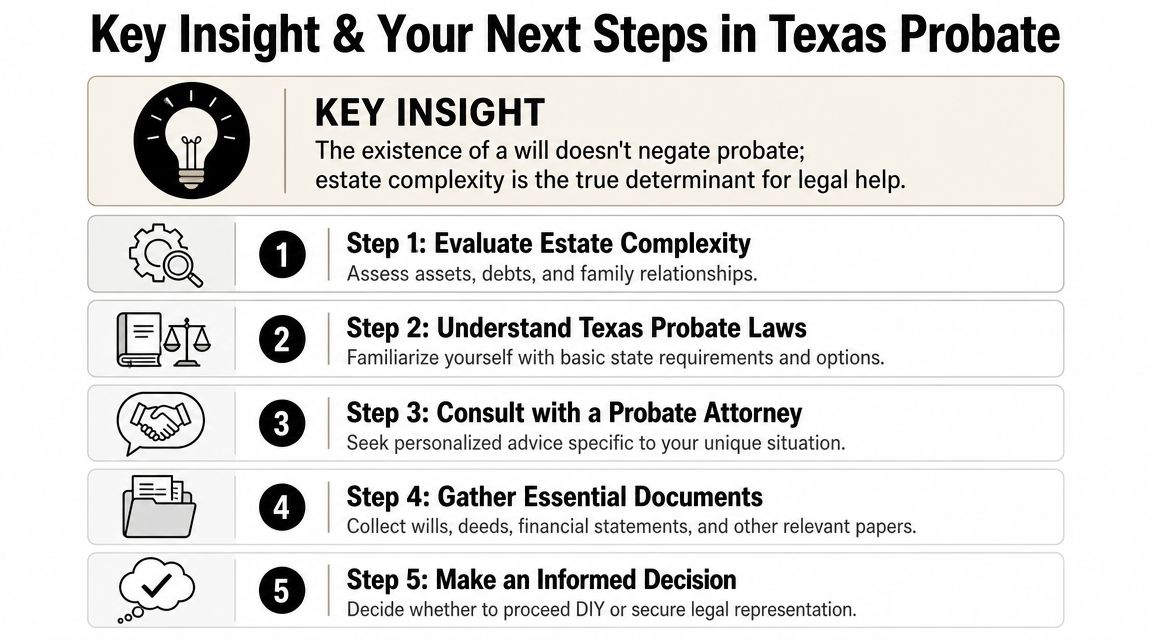
Key Insight and Your Next Steps
The key insight is simple. The decision to hire a probate lawyer in Texas usually turns on complexity, not on whether a will exists. A will may help. It doesn't automatically remove the need for probate, and it doesn't override local court practice.
When to Call a Probate Lawyer Checklist
| Checklist Item |
|---|
| The estate includes solely owned real estate |
| There are debts, creditor notices, or uncertainty about claims |
| The heirs disagree or communication has broken down |
| The executor lives outside Texas |
| The will is missing, unclear, or may be contested |
| The estate appears too large or complex for a shortcut process |
| The county court's local policy may require counsel |
| You aren't sure which probate method applies |
A practical next-step sequence
- Gather the basics first: Find the original will, death certificate, deeds, account statements, and any list of debts.
- Identify probate assets: Focus on property titled only in the decedent's name.
- Check whether a shortcut applies: Don't assume a simplified process applies because the estate “seems easy.”
- Confirm the county's filing practice: This is especially important if you live elsewhere.
- Get legal advice before filing anything irreversible: One early consultation can prevent a long detour.
Texas Estates Code Titles 2 and 3 give the legal framework, but most families don't need a lecture on code sections. They need a clear answer about which path fits their facts, what the court will expect, and how to avoid creating new problems while trying to solve old ones.
If you're still weighing your options, this guide on choosing the right probate attorney in Texas can help you ask the right questions before you commit.
Takeaway: If the estate is truly small, uncontested, and eligible for a narrow shortcut, you may not need full legal representation. If there's administration, real estate, debt, distance, or conflict, a probate lawyer is often not just helpful. It's the safer and sometimes required choice.
If you're facing probate in Texas, our team can help guide you through every step, from filing to final distribution. Schedule your free consultation today with Law Office of Bryan Fagan, PLLC.