Skip to content
Yes, you can remove an executor for misconduct in Texas, but only when you can prove specific wrongdoing under Texas law. A missed 90-day inventory deadline, misusing estate property, incapacity, serious neglect of duty, or other statutory misconduct can justify removal, while family tension alone usually won't.
A lot of families reach this question at a painful moment. Someone has died. People are grieving. Then the person appointed to handle the estate stops answering questions, won't share records, delays distributions, or starts making decisions that don't look right. At that point, the concern is no longer just emotional. It becomes practical. Is the estate being protected, or is it being mishandled?
Texas probate law gives executors real authority. It also imposes a fiduciary duty, which is a legal duty to act in the estate's best interest, not their own. That means an executor must protect assets, follow court rules, keep proper records, and carry out the decedent's wishes. When that duty is broken, the probate court can step in.
The hard part is that probate judges do not remove executors because heirs are upset. Courts look for evidence, paper trails, missed legal duties, and conduct that harms the estate. That difference matters. It can save a family from wasting time on a weak claim, and it can also help a beneficiary act quickly when the problem is real.
When Trust Is Broken During the Probate Process
The most common version of this problem begins subtly. A daughter asks for an update about her father's estate and gets vague answers. A son notices the executor has changed the locks on a home but hasn't listed it for sale or explained what's happening with the contents. A beneficiary hears that estate funds were used for expenses that don't seem related to the estate at all.

That doesn't automatically mean misconduct has occurred. Probate often moves slower than families expect, especially when there are debts, real estate issues, tax questions, or disputes over personal property. But some warning signs deserve attention.
Red flags that often justify a closer look
- Secrecy about finances: The executor refuses to explain what accounts exist, what bills have been paid, or what assets remain.
- Missed legal duties: Required probate filings aren't completed, or deadlines pass without explanation.
- Self-interested decisions: The executor appears to be benefiting personally from estate property or estate money.
- Long silence: Heirs and beneficiaries receive no meaningful updates even when major decisions are being made.
A realistic example helps. Suppose your brother is serving as executor of your mother's estate. He tells everyone he is “working on probate,” but months pass. The family home sits empty. Utility bills are still being paid from estate funds. No inventory is filed. When you ask for records, he says you don't need to know. At that point, the issue may no longer be communication style. It may be a breach of duty.
Probate courts expect executors to do more than mean well. They expect them to perform the job lawfully and transparently.
Texas law provides a path forward, but it's a formal one. In many cases, the right first move isn't immediate removal. It's figuring out whether the executor is acting poorly, acting slowly, or violating the Estates Code.
Statutory Grounds for Removing a Texas Executor
Texas doesn't remove executors based on frustration alone. The legal framework for removing an independent executor appears in Texas Estates Code Section 404.0035, and one of the clearest grounds is failure to file the required Inventory, Appraisement, and List of Claims within 90 days of appointment according to Texas guidance on removing an executor.
That deadline matters because it gives the court an objective checkpoint. If an executor misses it without a valid legal reason, beneficiaries often have something concrete to point to.
What the court will consider
Under Texas law, the actionable categories include:
- Failure to return required inventory or accounting
- Misapplication or embezzlement of estate property
- Incapacity
- Neglect of required duties
- Gross misconduct or gross mismanagement
- Unsuitability to serve
Those phrases sound technical, so it helps to translate them into plain English.
Misapplication or embezzlement means estate assets are being used improperly. That could include taking estate money, transferring property without authority, or using the estate for personal benefit.
Gross misconduct or gross mismanagement is more than being disorganized. It points to serious wrongdoing or serious handling failures that harm the estate.
Unsuitability can apply when the executor has a conflict so serious that fair administration is no longer realistic.
Grounds for Removal vs. Common Frustrations
| Actionable Grounds for Removal (Under Texas Law) | Common Issues Not Typically Sufficient for Removal |
|---|---|
| Failing to file the inventory within 90 days | Being rude or difficult to deal with |
| Embezzling or misapplying estate property | Slow responses to emails |
| Gross misconduct that harms the estate | Family members disliking the executor |
| Serious neglect of required duties | General suspicion without proof |
| Incapacity that prevents proper service | Different opinions about minor decisions |
| Material conflict of interest or unsuitability | Personality conflicts among siblings |
Texas courts have consistently treated family disagreement alone as insufficient. That can be frustrating for heirs who feel shut out, but it reflects a basic probate principle. The court is protecting the decedent's chosen executor unless there is a legally recognized reason to intervene.
A practical example of a strong claim
Suppose an executor never files the inventory, won't account for estate property, and tries to buy a business asset from the estate at an unfair price. That combination can move a case from “family dispute” to statutory removal territory.
If you're trying to understand whether the conduct rises to the level of a fiduciary breach, this explanation of executor breach of fiduciary duty in Texas is a useful starting point. Families dealing with trust disputes in another state may also find it helpful to compare how courts approach fiduciary wrongdoing in articles about suing a trust in California, because the same practical lesson applies: courts want proof, not just suspicion.
For broader estate planning context, it also helps to understand how the executor got that authority in the first place through a will, trust, or probate appointment. That's where a family's planning documents and the overall Texas Probate Process and Wills & Trusts strategy often shape the dispute.
How to File a Petition for Executor Removal
A removal case usually starts after smaller efforts have failed. A beneficiary asks for basic estate records. The executor ignores the request, misses probate deadlines, and keeps saying everything is “under control.” At that point, the question is no longer whether the family is frustrated. The question is whether the court has a basis to step in.
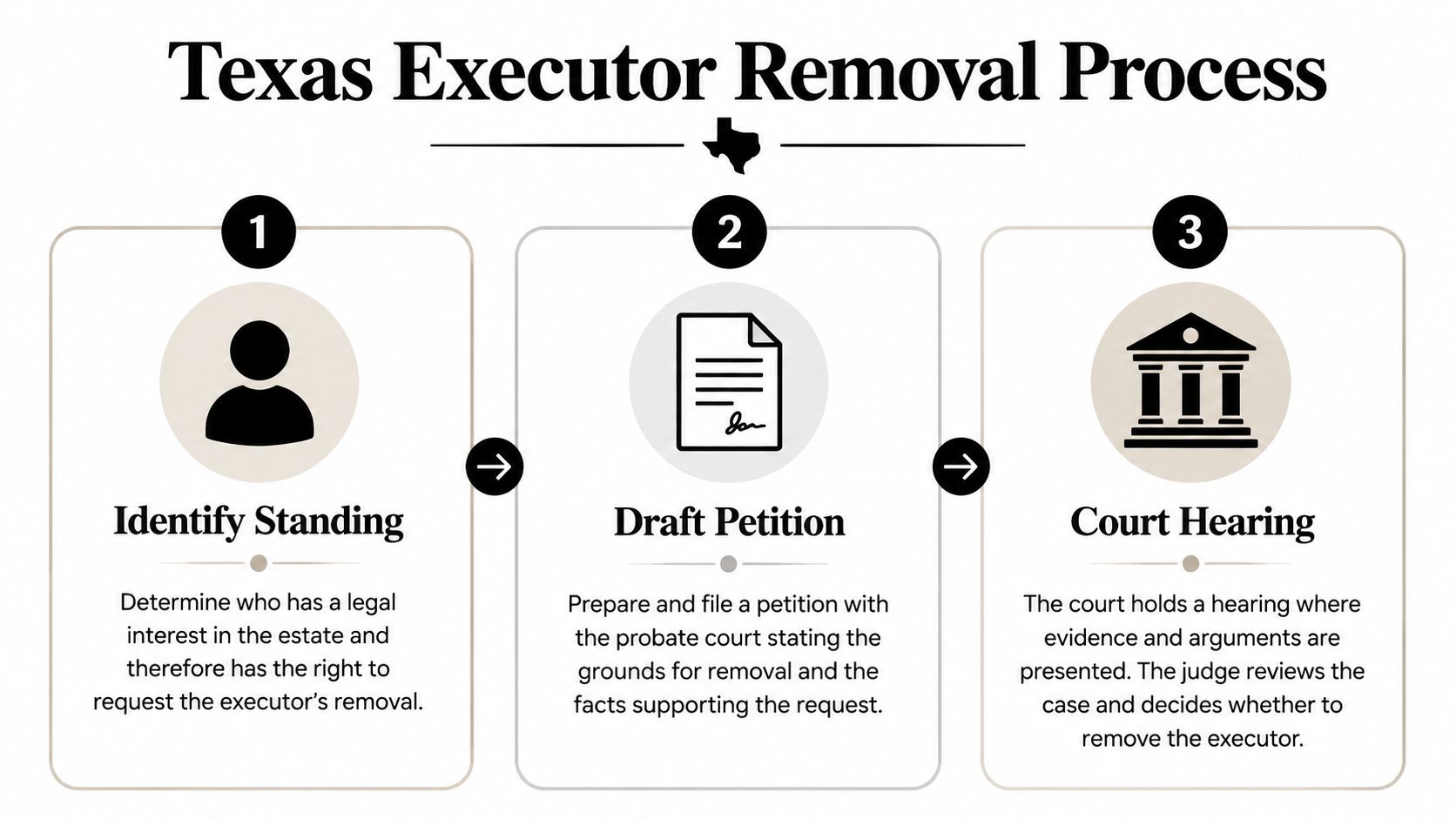
Who can file and when
In Texas, the person asking for removal must be an interested person. That usually means an heir, beneficiary, creditor, or someone else with a financial stake in the estate.
Timing matters. If the executor has not been appointed yet, the fight is often about whether that person is qualified to serve at all. Once the court has issued Letters Testamentary, the focus shifts to conduct. Judges want specific facts tied to what the executor did, failed to do, or did with estate property.
That difference affects strategy. A pre-appointment objection may rely heavily on legal disqualification or unsuitability. A post-appointment removal case usually rises or falls on records, missed duties, and proof that the estate is being harmed.
What filing the petition actually involves
The process is more formal than many families expect. You file a written petition in the probate court handling the estate, identify your interest in the case, state the legal grounds for removal, and request the relief you want. If the facts support it, that relief may include temporary restrictions to protect estate assets while the case is pending.
The executor then has to be served and given a chance to respond. After that, the court may set a hearing, require briefing, or address temporary issues first if there is concern about money, property, or business operations.
A well-prepared petition usually does four things:
- Establishes standing: It explains why you have the right to ask the court for action.
- States the legal basis for removal: It connects the facts to recognized Texas grounds, not just family complaints.
- Requests targeted relief: It asks for removal, suspension, an accounting, turnover of records, or other appropriate orders.
- Puts the proof in order: It identifies the documents, transactions, and witnesses that will matter at the hearing.
Families often assume filing the petition is the hard part. In practice, drafting is only the beginning. The essential work is presenting a clean, provable story to the judge. For a broader procedural overview, see this Texas guidance on removing an executor.
What to ask for besides removal
One of the biggest tactical mistakes is asking for removal when the immediate problem is lack of information. If the executor is disorganized but not stealing, the smarter first move may be to demand an accounting or ask the court to compel production of records. That can solve the problem. It can also expose whether there is a deeper one.
I often look at removal petitions through a practical lens. Will this filing protect the estate, or will it just make the family spend more money fighting? A judge may be more receptive when the petition asks for measured relief based on the facts rather than the maximum remedy from the start.
What happens at the hearing
Hearings are usually less dramatic than families expect and more exacting. The judge will want dates, documents, transactions, and testimony that fits the legal standard. General statements like “he shut us out” or “she has always been dishonest” rarely carry much weight without records to back them up.
The court may remove the executor, deny the request, or order something in between. In the right case, the judge can require an accounting, impose conditions, or closely supervise the administration instead of replacing the executor outright. That is one reason a careful filing strategy matters. The goal is not to punish an executor. The goal is to protect the estate.
Gathering Evidence to Prove Executor Misconduct
Most removal cases turn on one issue. Proof.

Texas courts require more than carelessness or suspicion. The petitioner must prove gross misconduct or gross mismanagement that resulted in harm to the estate, and the strength of the case is closely tied to the quality of documentary evidence such as financial records and dated communications, as explained in this review of the Texas executor removal probate process.
What evidence persuades a judge
The best evidence usually comes from records created at the time events happened, not from later family recollections.
- Bank statements and transaction histories: These can show unexplained withdrawals, transfers, or personal use of estate funds.
- Emails, letters, and text messages: Dated communications can show refusals to provide information, admissions, or a pattern of neglect.
- Probate filings and docket history: Missed deadlines and missing required filings often matter.
- Property records and sale documents: These can reveal self-dealing or suspicious transfers.
- Witness testimony: Beneficiaries, creditors, accountants, and other third parties may help explain what happened.
A useful way to think about it is this: the court wants the story told through documents first, witnesses second.
What usually doesn't carry enough weight
A lot of concerns are real but still not court-ready. These examples often need more support:
- “I think she stole something.”
- “He never tells us anything.”
- “She's always been irresponsible with money.”
- “I'm sure the house could have sold for more.”
Those may be starting points for investigation. They are not usually enough by themselves to remove an executor.
This short video gives a practical look at the kinds of probate disputes that often require a stronger evidentiary showing before the court will act.
Building a usable paper trail
If you suspect misconduct, start preserving information in an organized way.
- Save every communication: Don't rely on memory.
- Request records in writing: Written requests often become evidence later.
- Track dates carefully: Probate deadlines and response delays can matter.
- Avoid confrontational accusations too early: You don't want to invite document destruction or make settlement harder without gaining useful proof.
Families often discover that a strong removal case starts with something smaller, such as a written demand for information or an accounting. If the executor responds poorly, that response may become part of the proof. For readers dealing with more serious fiduciary breaches, this overview of executor misconduct in probate cases gives additional context.
Alternatives to Removal and Likely Outcomes
Full removal is the most aggressive remedy, and it isn't always the smartest first move. Texas probate courts often try to preserve estate administration if the problem can be corrected without replacing the executor.

Remedies short of removal
Courts often consider options like these before ordering the executor out:
- Formal accounting: The executor must provide a detailed report of estate assets, expenses, and transactions.
- Restricted powers: The court can limit the executor's authority over particular assets or decisions.
- Court supervision of specific acts: A judge may require oversight for sales, transfers, or other sensitive transactions.
Those remedies can be powerful. If the problem is secrecy, an accounting may solve it. If the concern is a proposed sale at an unfair value, restricting authority or requiring court supervision may protect the estate without resetting the entire probate process.
Sometimes the most effective result is not removal. It's forcing transparency quickly enough to stop damage.
When removal makes more sense
Removal becomes more likely when the executor has taken estate funds, ignored core duties, has a disabling conflict, is incapacitated, or refuses to correct the problem. If the issue is incompetence caused by declining mental ability, related planning around Guardianship may also become relevant in the family's broader legal picture.
A realistic example is an executor trying to sell a family business asset to themselves or to someone close to them on unfair terms. In that situation, a temporary court order might stop the sale first. If the evidence confirms a material conflict and harm to the estate, removal may follow.
What happens after a successful removal
The estate does not vanish into limbo. The court must issue a written order stating the reasons for removal and then appoint a successor or direct what happens next with administration and distribution. That continuity matters because heirs often worry that removing the executor will only create more delay.
Sometimes it does create delay. But leaving the wrong person in control can cost the estate more. That is the trade-off families need to evaluate carefully.
For people weighing options, legal counsel can compare whether a petition for accounting, targeted injunctive relief, or full removal is the better fit. Firms such as Law Office of Bryan Fagan, PLLC handle probate administration disputes and litigation when that kind of assessment is needed.
Key Insights and When to Hire a Probate Attorney
Families usually ask the same practical question: is this bad enough to take to court? The answer depends less on how upsetting the conduct feels and more on whether you can tie it to a legal duty, a document, and actual harm to the estate.
Key Insight: In Texas, you can remove an executor for misconduct, but the winning cases usually involve documented statutory violations, estate financial harm, or both. Courts do not remove executors just because the family relationship has broken down.
Signs it's time to get legal help
You should strongly consider talking with a probate attorney if any of these are happening:
- Estate money appears to be missing
- The executor refuses to provide records or accountings
- Required probate duties are being ignored
- Assets are being sold under suspicious circumstances
- Distributions are withheld without a valid estate reason
- The executor may be incapacitated or unable to serve
It also makes sense to get advice when you are not sure whether the conduct justifies removal. A short consultation can save months of expensive litigation over a complaint that won't meet the legal standard.
Why early advice matters
Early legal guidance can help you choose the right remedy. Sometimes the best move is a removal petition. Sometimes it's a demand for an accounting, a request for temporary protection of assets, or a focused probate court motion that solves the immediate problem without a full fight.
That matters because probate cases are rarely just legal disputes. They involve grief, family history, old resentments, and a deceased loved one's final wishes. The court only handles the legal piece. A lawyer helps you sort out which part of the conflict belongs in court and which part doesn't.
If you're facing concerns about an executor, keep your records, stay calm, and act sooner rather than later. Waiting often helps the executor who controls the documents and the money.
If you're facing probate in Texas, our team can help guide you through every step, from filing to final distribution. The Law Office of Bryan Fagan, PLLC works with Texas families on probate administration, Texas Probate Process, Wills & Trusts, Guardianship, and Probate Litigation issues, including executor disputes and removal cases. Schedule your free consultation today.