Skip to content
The funeral has ended. The casseroles are gone. Then someone opens a dresser drawer or the garage cabinet, picks up a ring, a watch, a set of tools, or a stack of old photographs, and the first real argument begins.
I see this pattern often in Texas probate matters. Families who agree about bank accounts and bills can still reach a hard stop over personal belongings because those items carry history. A kitchen table may have modest resale value and enormous emotional weight.
These disputes do not have to turn into a court fight on day one. The better approach is usually staged and deliberate. Start with practical steps that lower the temperature, sort out what belongs to the estate, and document any points of agreement. Court tools are available, but they work best after the family has tried the less expensive options first.
A few early questions usually shape the whole dispute. Did the person leave a will that specifically gives away certain items? Was there a written list, a label, or a clear record of a gift made during life? Is the item part of the probate estate, or does it pass outside probate? If an older keepsake is already causing disagreement about identity or value, a practical reference such as this antique wood jewelry box guide can sometimes help the conversation shift from accusation to facts.
Texas law provides a structure for these conflicts, and structure helps. The goal is not limited to deciding who gets what. The goal is to preserve evidence, reduce family damage where possible, and use formal probate remedies only when informal agreement has failed.
The Unspoken Grief of Dividing Personal Belongings
Two siblings may agree on nearly everything until they stand in their mother's bedroom holding the same necklace. Another family may work peacefully through bank paperwork, then stop cold when one brother says their father promised him the tool chest in the garage. These moments are common because personal belongings often mean more than money.

A jewelry box is a good example. To one heir, it may be a decorative object. To another, it may represent years of watching a parent get ready for church, holidays, and family weddings. If you're trying to identify or value an older piece before discussing division, a practical design reference like this antique wood jewelry box guide can help families talk about the item more concretely and less emotionally.
Why these disputes hurt so much
Personal property disputes tend to expose three things at once:
- Grief: People are mourning and don't always recognize how grief changes communication.
- Memory conflicts: Family members often remember different promises, conversations, or intentions.
- Fairness concerns: An item may have modest market value but major emotional value, which makes “equal division” hard.
Personal effects often create the sharpest conflict because they feel personal in a way financial accounts do not.
That doesn't mean every disagreement becomes a lawsuit. Many don't. But families usually do better when they stop treating the dispute as a character problem and start treating it as an estate administration problem.
What Texas probate does for a family
Probate can sound intimidating, but at its core it creates an orderly way to validate a will, address debts, identify estate property, and distribute what remains. That structure matters when family members disagree, because it replaces hallway arguments and text-message battles with clearer rules.
In plain English, probate answers practical questions. Who is in charge? What property is subject to probate? Has anyone documented the items? Is there a will? Are there creditor issues? Can the family settle this by agreement?
When families understand that the system is meant to create fairness, not punishment, the conflict often becomes easier to manage. The emotional pain may still be there. The chaos doesn't have to be.
Your First Moves Before Calling a Lawyer
A common pattern starts fast. One sibling takes the jewelry box for “safekeeping,” another changes the locks, and by that evening everyone is arguing about what Mom said she wanted. Those first 48 hours often decide whether a family can work this out informally or whether the dispute hardens into a court fight.
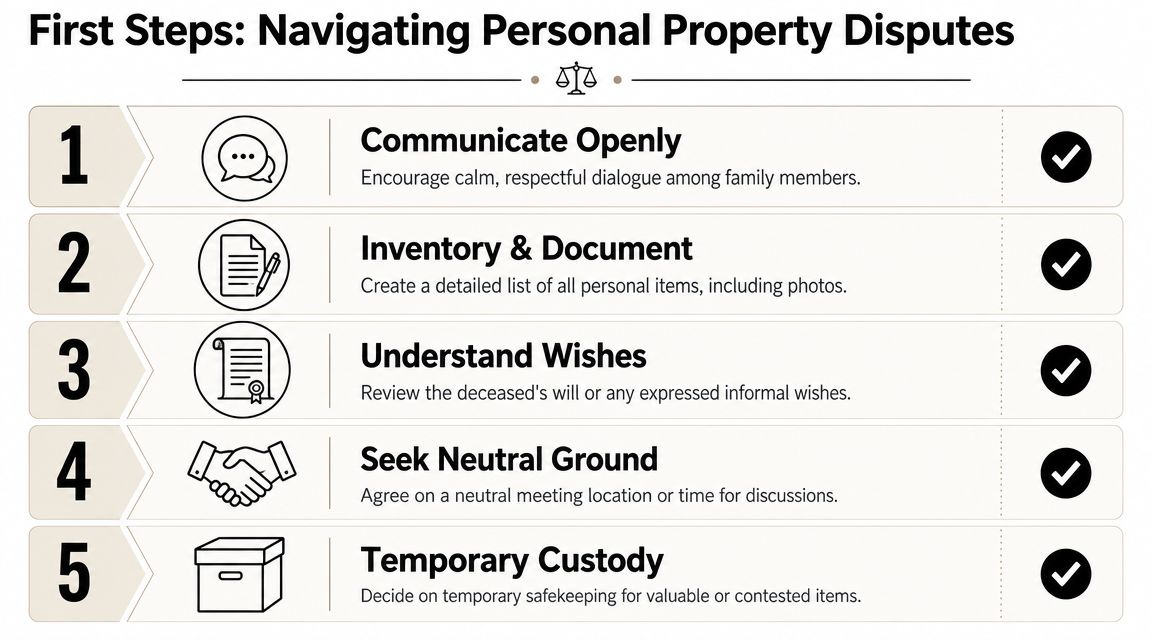
The goal at this stage is simple: lower the temperature, preserve the facts, and avoid decisions that are hard to reverse. In many estates, that alone prevents a manageable disagreement from becoming expensive litigation.
Start with control, not confrontation
Before anyone debates who should receive a ring, gun safe, truck, or set of tools, freeze the situation as it stands.
Stop property from being moved.
Ask everyone to leave items where they are until there is a list and a clear plan. Possession creates suspicion quickly, even when the person who took the item meant well.Make a written inventory right away.
Record the item, its location, its condition, and who currently has access to it. Photos and short videos help. If you need a practical format, use this guide on how to make an itemized inventory for probate in Texas.Gather documents that can verify ownership or value.
Receipts, old appraisals, insurance schedules, repair records, title papers, and account statements usually carry more weight than competing memories.Pick one person to coordinate information.
That person is not deciding ownership. The job is only to collect photos, documents, and questions in one place so the family is not fighting across five text threads.Use temporary storage or temporary possession rules if needed.
For firearms, collectibles, cash, coins, or items likely to disappear, agree on a neutral holding arrangement until authority is sorted out.
This approach protects both relationships and evidence.
Use a short script that keeps everyone out of a corner
Families often do better when someone uses calm, neutral language early. Here is wording that works:
“Let's list everything first, photograph it, and hold off on taking anything home until we know what belongs to the estate and what documents exist.”
That statement does three jobs. It slows the rush for possession. It shifts the conversation from accusation to process. It gives grieving relatives a face-saving way to pause without feeling accused of theft or bad motives.
Sort the easy agreements from the hard ones
Not every item needs a fight. Some issues can be resolved informally if the family separates them into categories:
- No-dispute items: Everyone agrees who should receive them.
- Information-gap items: No one has enough paperwork yet.
- High-conflict items: Sentimental or valuable property that needs a slower process.
This triage method saves money. It also helps families reach partial agreements instead of treating the whole estate as one all-or-nothing argument.
A few practical trade-offs often work well:
- One heir keeps the piano, and another receives jewelry of similar agreed value.
- A tool collection stays together, with one beneficiary buying out the others.
- Family photos are scanned, then divided by album, branch of the family, or mutual selection.
If a vehicle is part of the disagreement and the title is missing, gather that information early too. Problems with title paperwork can delay resolution even when the family agrees on who should receive the car. Resources like NCT vehicle title assistance can help clarify the practical steps.
Know what not to do
Several mistakes make probate property disputes harder than they need to be.
Do not distribute items based on verbal promises alone. Do not let relatives “borrow” disputed property. Do not post accusations in a family group chat. Do not clean out a house before someone has documented what was there.
I tell families this often: a rushed cleanout creates more legal work than almost anything else.
Informal agreements can work, if they are specific
Texas families often resolve personal property disputes without a hearing, but the agreement needs to be clear enough that everyone knows what happens next. Put the terms in writing. Identify each item. State who receives it, whether anyone is making an equalizing payment, and when the exchange will happen.
The best early agreements are modest. They preserve peace, protect property, and buy time. If that works, the family may never need formal court intervention.
Is It Part of the Estate? The Probate vs Non-Probate Asset Test
The most important legal question is often not who wants the item. It is whether the item is even part of the probate estate.
Texas probate disputes often turn on that threshold issue. Property owned solely by the decedent may need to pass through probate. Property with a built-in transfer method may pass outside probate. That distinction can decide who has authority over the item and whether the probate court is involved at all. For a plain-English overview, see this explanation of what is a non-probate asset.
The practical test
Ask these questions:
- Was the item owned only by the person who died?
- Was there a named beneficiary or transfer-on-death designation?
- Was it jointly owned with right of survivorship?
- Is there a title document that controls transfer?
Texas guidance explains that assets with named beneficiaries, right-of-survivorship ownership, or transfer-on-death designations can bypass probate, and that a Small Estate Affidavit may be available when the estate is valued at $75,000 or less, excluding homestead and exempt property in qualifying situations, as summarized in this discussion of the Texas probate process.
Probate vs non-probate personal property
| Characteristic | Probate Property | Non-Probate Property |
|---|---|---|
| How it transfers | Through the estate administration process | By contract, designation, or survivorship feature |
| Who usually controls it first | Executor or administrator, subject to legal authority | The named beneficiary or surviving co-owner |
| Common examples | Solely owned household goods, jewelry, tools, collectibles | POD or TOD assets, survivorship property |
| Role of the will | Often central | Often limited or irrelevant to transfer |
| Dispute focus | Estate ownership, valuation, distribution | Validity of designation, title, or survivorship rights |
A common vehicle problem
Cars create confusion. Families assume the executor can hand over the vehicle to whoever “needs it most.” That's not always true. Title controls a lot. If the vehicle has a survivorship feature or another non-probate transfer mechanism, the probate estate may not control it in the way family members expect.
If the title is missing and a family is trying to determine next steps before transfer, a practical logistics reference like NCT vehicle title assistance can help clarify title-related issues that often accompany probate vehicle disputes.
Texas Estates Code Titles 2 and 3 govern much of the administration framework families encounter in probate, including the authority of personal representatives and procedures for estate administration. Non-probate transfer questions also require careful review of the governing document or title record, not just the will.
Using Formal Probate Tools to Resolve a Stalemate
A stalemate usually looks familiar. One sibling has the item. Another says the will requires it to be shared. The executor is stuck in the middle, and every text message makes the dispute worse.
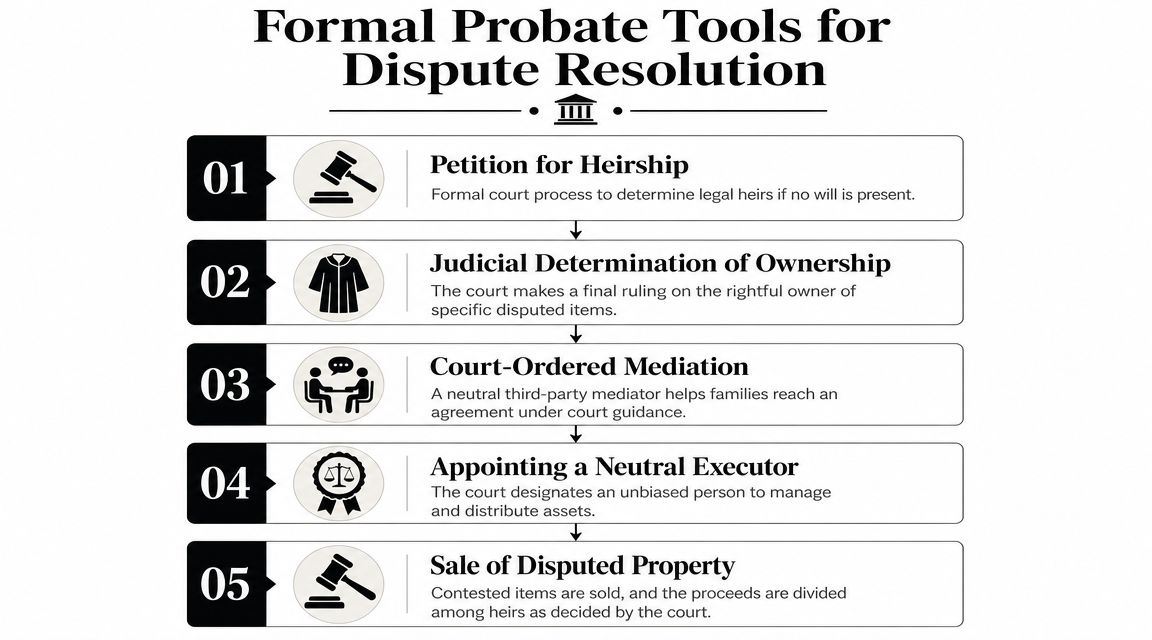
At that point, formal probate tools can lower the temperature because they replace argument with process. The goal is not to rush into a hearing. The goal is to create a controlled sequence. Preserve the property, clarify who has legal authority, put positions in writing, and ask the court for help only when the family cannot reach a workable agreement.
The type of administration matters. In an independent administration, the personal representative usually has more room to gather property, communicate with heirs, and propose a practical solution without asking the court to approve each step. In a dependent administration, court approval is required for many major actions. That extra supervision can protect the estate, but families should expect more procedure, more delay, and higher cost.
A common example is a valuable painting hanging in one child's home. The will leaves the residuary estate equally to three children but does not specifically give away the painting. The child in possession says their parent promised it to them. The others disagree.
The executor should slow the situation down. Start by documenting the painting's location, condition, and apparent ownership. Gather photos, receipts, insurance records, appraisals, emails, and any writing that may show intent. Then make a written proposal for temporary handling of the item while the ownership issue is sorted out. That step often prevents damage, disappearance, or a rushed sale.
If agreement still fails, Texas probate procedure gives the estate several tools:
- Turnover request if someone is keeping property that appears to belong to the estate
- Court instructions or a declaratory ruling on ownership if the dispute is really about title or estate status
- Partition or sale procedures if multiple beneficiaries have rights in the same item but cannot agree who should keep it
- Mediation ordered by the court or agreed by the parties if communication is strained but still salvageable
Each option has trade-offs. A turnover action can force the issue, but it also hardens positions fast. A request for instructions may be narrower and more efficient when the executor needs guidance. A sale can end the possession fight, but it may feel harsh when sentimental items are involved. Mediation often gives families more control over the outcome, especially if they want creative solutions such as rotations, buyouts, or grouped distributions. For a closer look at that process, see probate mediation in Texas as an alternative to court.
Good records matter. Judges tend to respond better to a representative who brings a clean timeline, an inventory, photographs, written demands, and supporting documents than to a representative who arrives with only accusations and family history.
Formal procedure can protect everyone involved. It creates deadlines, preserves evidence, and gives the executor a lawful path to follow when private negotiations have stopped working.
The Law Office of Bryan Fagan, PLLC handles probate administration and probate litigation matters in Texas, including disputes over estate property where heirs or representatives need court guidance on possession, inventory, and distribution.
Knowing When to Call for Legal Reinforcements
A daughter has the house key. A son has already loaded boxes into his truck. The executor is asking everyone to wait, but no one trusts anyone else. That is usually the point where a family meeting stops being enough.

The goal is not to rush into court. The goal is to protect the property, preserve options, and keep a painful dispute from getting worse. In many estates, counsel helps families stay on the least combative path that still works. That may mean a lawyer sends a written demand, sets terms for a temporary standstill, or prepares a settlement that can be enforced.
Signs the dispute has outgrown informal handling
Bring in a probate attorney promptly when delay creates real legal or practical risk, especially if:
- Someone took possession of items before authority was clear
- The executor or another family member will not provide basic information about what exists and where it is
- A person is threatening to sell, gift, transfer, or destroy property
- There are concerns about theft, undue influence, forgery, or altered records
- Written requests to return estate property are being ignored
- Someone is relying on an alleged verbal promise that conflicts with the will, title, or other estate documents
Those facts change the job. The issue is no longer just fairness between relatives. It becomes evidence, authority, and risk management.
Mediation can still help in the right case. Texas Law Help explains that probate mediation can save time and cost, but any settlement needs to be properly documented and enforceable under Rule 11. That is especially important in disputes over personal belongings, where sentimental value often drives the conflict more than resale value. See mediation and probate.
What legal counsel adds
A lawyer does more than argue. Counsel can identify what kind of dispute you have, preserve evidence before it disappears, and ask for court intervention if property is at risk.
That early framing matters. A conflict over a ring may be an inventory problem. A locked storage unit may raise access and possession issues. A family member refusing to disclose what was removed from the home may create fiduciary questions or support a turnover request. Families often save money when they sort that out early instead of fighting for months under the wrong theory.
“Before you argue about who should keep the item, make sure the estate still has legal control over it.”
Mediation also has limits. If one side is hiding information, refusing access, or using delay to gain an advantage, a mediator cannot force honest disclosure. At that stage, legal counsel helps move the matter from informal pressure to enforceable action.
Later in the process, some families benefit from seeing how probate disputes are addressed in a courtroom setting. This short video offers additional context:
A practical rule works well here. Call for legal help when the disagreement starts threatening the estate itself, the evidence, or the executor's ability to do the job. That step does not mean the family has failed. It often gives the family its best chance to contain the damage and resolve the dispute on terms everyone can live with.
Key Insight Timelines and Takeaways
The safest path is usually a de-escalation path. Document first. Talk second. Classify the asset correctly. Use formal probate tools only when agreement fails. Bring in counsel as soon as there is a real risk to the property or the estate.
The timelines that matter
Two timing issues often shape the outcome.
First, independent administration generally requires an inventory, appraisement, and list of claims, or an affidavit in lieu, within 90 days. Texas Estates Code § 309.051 is part of that practical framework. When disputed personal property hasn't been identified and documented early, that deadline can become a problem.
Second, probate timing affects a party's advantage. Texas probate guidance notes that simple uncontested cases commonly finish in about 6 to 9 months, while contested estates can take 12 to 24+ months. By contrast, a Small Estate Affidavit can often be completed in about 30 to 60 days when available, as reflected in the Texas State Law Library's probate guidance.
Takeaway
- Document the item before debating it
- Don't assume every possession dispute is a probate dispute
- Use written family agreements when the facts are clear
- Move quickly when deadlines or missing property are involved
- Treat court as a tool, not a failure
When families follow that order, they usually preserve more than property. They preserve options.
Frequently Asked Questions About Property Disputes
Common questions families ask
| Question | Answer |
|---|---|
| What if a relative took property before probate was opened? | Start by documenting what is missing, when it was removed, and any proof of ownership or possession. Don't respond with self-help. The personal representative may need to demand return of the item or seek court relief if the property belongs to the estate. |
| Do verbal promises control who gets an item? | Usually, a verbal promise is much harder to enforce than a will, title record, beneficiary designation, or other written evidence. Families often feel strongly about these promises, but courts focus on legal ownership and reliable proof. |
| Can the executor just split everything informally? | Not safely in every case. An executor has duties to the estate and all interested parties. If an item may need appraisal, may be needed to satisfy debts, or may not belong to the probate estate at all, informal division can create personal liability and more conflict. |
A few additional points help.
If the item is modest in value but emotionally loaded, a written swap agreement may solve the problem better than a fight over legal entitlement. If the item is uniquely valuable, titled, insured, or connected to debt payment, more formal handling is usually necessary.
If you're the executor, don't let pressure from one beneficiary push you into quick side deals. Your role is to administer the estate according to Texas law, the will if there is one, and any valid court orders. Titles 2 and 3 of the Texas Estates Code provide much of the governing framework for that job.
If you're an heir, don't assume silence means you have no rights. Ask for information early, keep your records organized, and get legal advice if possession, transparency, or fairness becomes a serious issue.
If you're facing probate in Texas, our team can help guide you through every step, from filing to final distribution. The attorneys at Law Office of Bryan Fagan, PLLC help Texas families with probate administration, estate disputes, Texas Probate Process, Guardianship, Wills & Trusts, and Probate Litigation. Schedule your free consultation today.