Skip to content
Dealing with a difficult executor while you're also grieving is an incredibly stressful and frustrating position to be in. It's natural to feel powerless. But it’s important to know that Texas law gives heirs and beneficiaries real protections, including the power to seek the removal of an executor for specific, legally defined reasons like mismanagement or a serious conflict of interest. This guide provides a compassionate, step-by-step look at how Texas families can protect their inheritance.
When Can You Legally Remove a Texas Executor?

When a loved one names an executor in their will, they are placing an immense amount of trust in that person. The law formalizes this trust by assigning the executor a strict legal obligation, known as a fiduciary duty. In plain English, this means they must always act in the best interests of the estate and its beneficiaries. This isn't just a suggestion; it's a legal mandate with serious consequences if ignored.
But what happens when that trust is broken? You might find yourself wondering if you have any real recourse. The good news is, you absolutely do. The Texas Estates Code, particularly Titles 2 and 3, provides the legal foundation to remove an executor who fails to perform their duties properly.
Understanding the Legal Standard for Removal
First, it's important to understand that a Texas probate court won't remove an executor just because of family squabbles or minor disagreements. Hurt feelings and personality clashes, while difficult, are not legal grounds for removal. The court needs to see clear evidence of specific actions—or failures to act—that are actively harming the estate or violating Texas law.
The legal process for removing an executor in Texas is laid out in the Texas Estates Code. Section 404.003, for example, lists the grounds for removing an executor or administrator. For an independent executor, the most common type in Texas, Section 404.0035 provides similar grounds.
To help you understand what qualifies, here’s a plain-English summary of the most common reasons a court will consider removing an executor.
Common Grounds for Removing a Texas Executor
The law provides several valid reasons for an executor's removal, all centered on protecting the estate's assets and the beneficiaries' inheritance.
| Reason for Removal | Simple Explanation | Example |
|---|---|---|
| Gross Misconduct or Mismanagement | The executor is acting recklessly or incompetently, causing financial harm to the estate. | Using estate funds for personal expenses, or letting valuable property fall into disrepair. |
| Misapplication or Embezzlement | The executor is stealing or wrongfully using estate property for their own benefit. | Selling an estate vehicle and pocketing the cash instead of depositing it into the estate's bank account. |
| Failure to File Inventory | The executor misses the 90-day deadline to file a complete Inventory, Appraisement, and List of Claims with the court. | Months go by, and the beneficiaries have no official record of the estate’s assets or their value. |
| Material Conflict of Interest | The executor's personal interests are at odds with the estate's interests, creating a risk of harm. | The executor is also a business partner of the deceased and tries to buy out the estate's share of the business for a below-market price. |
| Incapacity or Incarceration | The executor becomes legally unable to perform their duties due to a new circumstance. | The executor is diagnosed with advanced dementia or is sentenced to prison. |
This isn't an exhaustive list, but it illustrates the kinds of serious issues that catch a judge's attention. A simple delay in communication might not be enough, but a pattern of ignoring deadlines and failing to account for assets certainly is.
The Role of Fiduciary Duty
At the heart of every removal case is the concept of fiduciary duty. Think of it as the highest standard of care our legal system recognizes. An executor must be loyal, honest, transparent, and prudent with the estate's assets.
When an executor violates this duty—perhaps by selling estate property to a friend for a suspiciously low price or by failing to pay the estate's taxes on time, racking up penalties—they can be held personally accountable. This breach of duty is often the core argument in a petition to have them removed.
Key Insight: An executor’s role is one of service, not personal gain. They are legally bound to protect the estate's assets and follow the will. Any deviation from that path that harms the estate can be grounds for removal by a probate court.
This area of law is tightly regulated. For instance, the law on conflicts of interest evolved after the Texas Supreme Court case Kappus v. Kappus, which ruled a conflict of interest wasn't an automatic reason for removal. In response, the Texas Legislature amended the Estates Code to explicitly add "material conflict of interest" as a statutory ground. This change clarified that an executor can be removed if their personal interests clash with the estate's in a way that could cause harm—you don't even have to wait for the damage to be done. You can read more on this legal history and what it means for Texas probate.
Understanding these legal grounds is the crucial first step in protecting your inheritance. If you believe the executor of a loved one's estate is failing in their duties, your next move should be to document their actions and speak with a probate litigation attorney.
What Gross Mismanagement and Misconduct Actually Look Like
When you’re grieving, the last thing you want is to police the person handling your loved one’s estate. But what happens when their actions just don’t feel right? Legal terms like “gross mismanagement” and “gross misconduct” are often used, but they can feel abstract.
It’s one thing to hear the legal definition; it’s another to see if the executor’s behavior actually crosses the line. Let's move past the jargon and look at what this really means for families in Texas probate courts.
An executor has one core job: to be a faithful steward of the estate's assets. When they fail—either through blatant bad acts or just sheer neglect—that’s when we start talking about mismanagement and misconduct. This isn't about small, forgivable slip-ups. It's about a pattern of behavior that shows incompetence, bad faith, or a complete disregard for their duties.
Honest Mistakes vs. Harmful Actions
Everyone makes mistakes. It’s important to know the difference between a simple error and a genuine breach of duty that can get an executor removed.
- An honest mistake is forgetting to pay a small utility bill for a month and quickly catching up. It’s frustrating, but it causes no real harm to the estate.
- Gross mismanagement is letting the estate’s property taxes go unpaid for a year, racking up thousands in penalties and putting the home at risk of foreclosure.
The real test is the damage. An honest mistake might be an annoyance. Gross mismanagement costs the estate real money and chips away at the beneficiaries' inheritance. It shows a fundamental lack of respect for the job the executor swore to do.
Takeaway: A Texas probate judge is looking for a pattern. One unreturned phone call won't get an executor fired. But a consistent failure to communicate, combined with missed deadlines and questionable accounting, paints a very different picture of misconduct.
Concrete Examples of Executor Misconduct
To make this crystal clear, here are real-world scenarios our firm has handled—actions that Texas courts have deemed serious enough for removal.
- Self-Dealing: The executor sells Dad’s prized classic car to his own son for a fraction of its Blue Book value. He’s enriching his own family at the direct expense of the other heirs.
- Negligent Property Management: The executor is in charge of the family home, but a leaky roof is ignored for months. Now there’s major water damage, and the property's value has plummeted. This is neglect, plain and simple.
- Commingling Funds: The executor starts depositing checks made out to the estate into his personal checking account. This makes a clean accounting impossible and is a massive red flag for fraud.
- Failure to Act: The executor does… nothing. Bills are piling up, bank accounts aren't being consolidated, and the estate is just sitting there, losing value. This “do-nothing” approach can be just as destructive as an outright wrongful act.
One case out of a Dallas probate court is a perfect example of gross mismanagement. An administrator was removed after seven years of inaction. By the time the court stepped in, the estate was left with a foreclosed house, an uncashed check, and a bank account that had been stagnant for years. This happened despite multiple court orders demanding action and illustrates that failing to settle an estate in a timely manner is a serious breach of duty.
When you see these behaviors, it’s a sign that you need to protect your loved one’s legacy. Recognizing the warning signs of executor misconduct in probate cases is the first step. If these red flags are popping up, it’s time to start thinking about your legal options.
Your Roadmap for Filing a Removal Action in Court
Deciding it’s time to remove an executor is a major decision, but it doesn't have to be overwhelming. While every family's situation is different, the legal path to holding a bad executor accountable follows a clear, structured process in Texas. Let's walk through what that looks like, from gathering proof to your day in court.
The first step, always, is building your case. This isn't about airing grievances; it's about collecting cold, hard facts. A probate judge won't act on suspicion alone. You need proof.
This means digging up the documents that tell the story of the executor's misconduct. Bank statements showing strange withdrawals, unanswered emails proving they've gone dark, or property records revealing a sale you never approved—this is the kind of evidence that gets a judge’s attention.
Kicking Off the Removal Process
Once you and your attorney have a solid file of evidence, the next step is to file a formal document with the probate court. In Texas, this is usually called a Verified Motion to Remove Executor.
Think of this motion as the opening bell in a legal fight. It officially tells the court three critical things:
- Who you are (an "interested person," like a beneficiary with a financial stake in the estate).
- Why you're filing (the specific grounds for removal, like self-dealing or gross mismanagement, citing the Texas Estates Code).
- What you want the court to do (fire the current executor and appoint a new, trustworthy one).
This isn't just a simple letter. It’s a sworn statement where you attest, under penalty of perjury, that everything in it is true. It’s a serious move that signals to the court just how bad the situation has become.
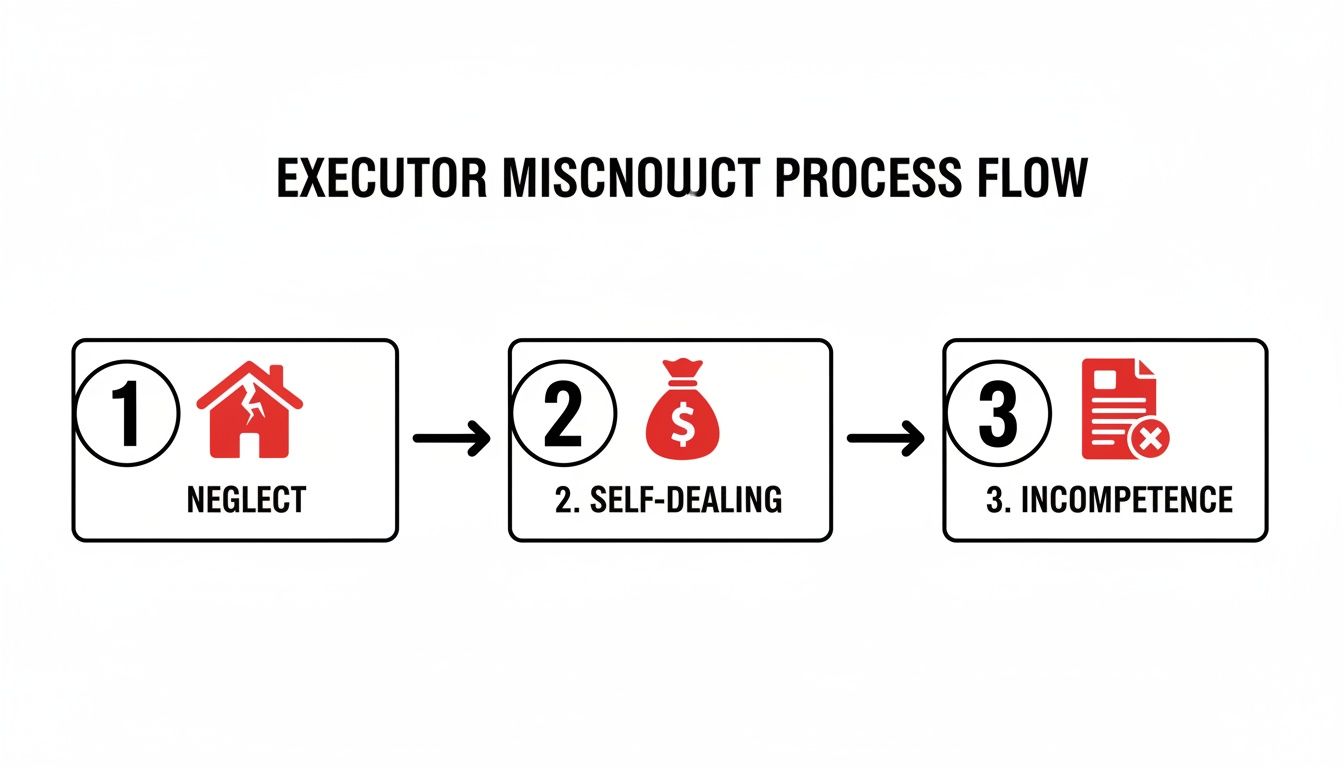
These are the heavy hitters when it comes to executor misconduct. Whether it's blatant self-dealing, careless neglect, or just plain incompetence, these are the core reasons a Texas judge will step in and remove someone.
The Court Hearing and What to Expect
After your motion is filed, the executor must be officially notified through a legal process called "service." They can't just be ignored. They’ll have a chance to hire their own lawyer and file a formal answer to your allegations. Once that's done, the court sets a date for a hearing.
This is your day in court. It’s a formal proceeding where both sides make their case to the judge. Your attorney will present the evidence you’ve gathered, and you might even have to testify. The executor, in turn, gets to defend their actions.
Key Insight: A probate judge's number one job is to protect the estate. They aren't there to pick sides in a family feud. They will listen to the arguments, look at the evidence, and make a ruling based on the law and what’s best for the estate and its beneficiaries.
At the end of the hearing, the judge has a few options. They can:
- Grant the Removal: If your evidence is strong and the executor's defense is weak, the judge will sign an order removing them on the spot.
- Deny the Removal: If the proof isn't there or the executor has a good explanation, the judge might leave them in place.
- Order a Lesser Remedy: Sometimes, a judge looks for a middle ground. Instead of a full removal, they might order the executor to produce a detailed accounting or post a bond to protect the estate’s assets.
Filing in the right court is the first hurdle; knowing which court has jurisdiction over probate in Texas is non-negotiable. Trying to navigate this alone is a recipe for disaster. This is exactly why you need an experienced probate litigation attorney who knows the judges, the procedures, and how to build a winning case.
Exploring Alternatives to Full Executor Removal

Trying to remove an executor is the "nuclear option" in probate litigation. It’s a huge step, and while it's sometimes the only way forward, it isn't always the first or best move. A full-blown court battle is expensive, emotionally draining, and can drag on for months.
Fortunately, Texas law gives us several other powerful tools. Before escalating to a removal hearing, a good probate litigator will explore less confrontational options that can force an executor to do their job correctly. Think of these as surgical strikes rather than an all-out war—precise legal maneuvers designed to solve specific problems.
Force Financial Transparency with a Demand for Accounting
One of the biggest red flags for beneficiaries is radio silence. When you have no idea what’s happening with the estate’s money and the executor isn't returning your calls, you have the right to demand answers.
Under Texas Estates Code § 404.001, any "interested person" can file a demand for a formal accounting. This isn’t a friendly request for an update; it's a legal demand for a detailed, sworn financial report that must show:
- All estate property that has come into the executor’s possession.
- A complete list of all payments and disbursements made.
- All property currently left in the estate.
- The necessary facts to prove the estate is being properly managed.
Putting an executor on the spot like this often works wonders. It forces them to get organized and justify their actions to a judge. If they can’t or won’t, you’ve just built a fantastic piece of evidence for a future removal action.
Takeaway: Often, the simple act of demanding a formal accounting is enough to make a disorganized or secretive executor get their act together. Faced with legal pressure and the need to justify their actions to a judge, many will either correct their course or choose to resign voluntarily.
Protect the Assets with a Court-Ordered Bond
Many Texas wills include a provision allowing the executor to serve "independent and without bond." This is common, and it just means they can manage the estate without having to buy a special insurance policy—a bond—that protects the estate from their negligence or theft.
But that privilege can be revoked. If you have evidence that the executor is mismanaging money, selling assets for less than they're worth, or putting the estate at risk, you can petition the court to force them to post a bond.
This action doesn’t remove the executor, but it creates a critical financial safety net. If the executor later causes a financial loss to the estate, the bonding company has to cover the damages. It’s a way to protect your inheritance while you figure out the next steps.
Hold an Executor Personally Liable Through a Surcharge
What happens if the damage is already done? Maybe the executor let a valuable property fall into disrepair, sold a classic car for pennies on the dollar, or used estate funds for personal expenses. In these cases, you can ask the court to surcharge the executor.
A surcharge is a court order that makes the executor personally responsible for the financial harm they caused. For example, if an executor’s negligence caused an estate property’s value to drop by $50,000, a surcharge order would require them to pay that money back to the estate from their own pocket.
This is an incredibly powerful tool for clawing back losses and sending a clear message to a rogue executor that they will be held accountable.
These alternatives aren’t just preliminary steps; they are powerful legal actions in their own right. They apply targeted pressure and often resolve the problem faster and with far less conflict than a full removal proceeding. Best of all, using these tools doesn't stop you from seeking removal later if the executor’s behavior doesn’t change. Sometimes, exploring options like probate mediation can also provide a structured path to resolving disputes before things escalate even further.
A Real-World Scenario: Removing a Negligent Executor

Sometimes the best way to understand a legal process is to see how it plays out for a real family. Let’s look at a situation we handled that shows just how the process of removing an executor in Texas works, step by step, from a family’s perspective.
The Problem: A Grieving Family and a Silent Executor
The family consisted of three adult children—siblings Maria, Carlos, and their older brother, David. When their father passed, his will named David as the independent executor. At first, everyone was relieved a family member would be handling things during such a difficult time.
David filed the will for probate and received his Letters Testamentary from the court, which gave him the legal authority to manage the estate. But after that, things went silent. As weeks turned into months, Maria and Carlos started getting calls about overdue utility bills for their dad's house. Then, a property tax delinquency notice showed up.
The Breaking Point: From Concern to Action
The final straw came when Carlos drove by their father's house. The classic 1967 Mustang their dad had spent years restoring—his pride and joy—was gone from the garage.
When they finally got David on the phone, his story kept changing. First, he claimed the car was "in storage." A week later, he said he "loaned it to a friend." His excuses didn't add up, and soon he stopped returning their calls entirely. Worried their inheritance was being squandered, Maria and Carlos scheduled a consultation.
The Legal Strategy: Applying Pressure and Taking it to Court
It was clear that David’s behavior was a textbook case of gross mismanagement and a breach of his fiduciary duty. Our first move was to send David a formal demand letter by certified mail. The letter laid out their concerns in no uncertain terms: the unpaid bills, the missing car, and his total failure to communicate. We demanded a full accounting of the estate within 15 days and the immediate return of the Mustang, making it clear that a lawsuit to have him removed would be the next step.
As we expected, David never responded. We filed a Verified Motion to Remove Executor with the probate court, detailing David's failures and citing the specific sections of the Texas Estates Code he violated. We backed it up with proof: copies of past-due notices, screenshots of contradictory text messages, and a sworn affidavit from Carlos about the missing car.
The Outcome: A New Administrator and Peace of Mind
At the court hearing, David crumbled under questioning. He couldn't produce a single receipt or offer a credible explanation. The judge agreed he had failed in his duties and signed an order immediately removing David as executor. On our recommendation, the court appointed a neutral, third-party professional to step in as the successor administrator.
The new administrator's first job was to secure all the estate's assets, launch an investigation into the car's disappearance, and get the administration back on solid footing. For the first time in months, Maria and Carlos had peace of mind, knowing the Texas Probate Process was finally back on track.
If you’re facing probate in Texas, our team can help guide you through every step — from filing to final distribution. Schedule your free consultation today.
Common Questions About Removing a Texas Executor
Even after you've decided to move forward with removing an executor, a lot of practical questions start to surface. It’s one thing to know the law, but it's another to understand what this process will actually look like for your family.
Let's cut through the legal jargon and tackle the real-world concerns we hear from families every day. Here are the straight answers to the most common questions you probably have right now.
How Long Does It Take to Remove an Executor?
This is the million-dollar question, and the honest answer is: it depends. The timeline hinges almost entirely on whether the executor fights back.
If the removal is uncontested—meaning the executor sees the writing on the wall and agrees to step down—it can be surprisingly quick. We're talking a matter of weeks to get the paperwork filed and signed by a judge.
But a contested removal is a different story. When an executor decides to dig in their heels, the process can stretch from a few months to over a year. You have to file the motion, serve them, wait for their response, go through discovery (where both sides gather evidence), and then wait for your day in court. A congested court docket can add even more delays.
Can the Executor Pay My Legal Fees If I Win?
Yes, and this is a critical piece of leverage. Under Texas Estates Code § 362.005, the court has the power to order a misbehaving executor to pay for their own legal defense out of their own pocket, not from the estate's funds.
Even better, if the judge finds the executor breached their duties, they can be ordered to reimburse the estate for the attorney's fees you spent to get them removed.
This isn’t a slam dunk, though. The judge has discretion and will look at the specifics of the misconduct and whether your lawsuit truly benefited the estate. But it's a powerful tool to hold a bad actor accountable without draining the inheritance you’re trying to protect.
What Happens to Estate Assets After Removal?
The moment a judge signs that removal order, the executor is stripped of all authority. They are legally powerless. They can't write another check, sell a piece of property, or access a single estate account.
The court will immediately appoint a successor administrator or successor executor to take their place.
This new representative's first and most urgent job is to secure the estate's assets. They will formally demand that the removed executor turn over every last bank statement, property key, and financial record. If the old executor drags their feet or refuses, the new administrator can get another court order to force their compliance. It’s a clean, immediate transfer of power designed to stop the bleeding and protect what's left.
Navigating these issues often brings up other complex topics. Understanding how to handle a loved one's estate might also involve learning about Guardianship for dependents or untangling complicated Wills & Trusts. The more you understand the Texas Probate Process, the more empowered you'll be to make the right moves with confidence.
If you’re facing probate in Texas, our team can help guide you through every step — from filing to final distribution. Schedule your free consultation today.