Skip to content
A parent dies. The family is still arranging the funeral, answering calls, and trying to locate account statements. Then a new worry appears. The executor says the estate had to stay invested, the market moved against everyone, and there's less money than expected.
Sometimes that's true. Sometimes it isn't.
When an inheritance starts shrinking and the explanations stay vague, beneficiaries often feel trapped. You may not have online access to the accounts. You may not know what the executor was allowed to do. You may also worry that asking questions will make family conflict worse. Those concerns are common, and they're valid.
Texas probate law gives executors real authority, but it also places real limits on how they use it. If an executor mismanages estate investments, the problem isn't just emotional. It can become a legal claim with consequences inside the probate court. That includes forcing an accounting, asking the court to remove the executor, and in the right case seeking repayment for losses.
An Inheritance in Peril A Common Story
Maria and her brother expected probate to be slow. They didn't expect silence.
Their father left a house, a brokerage account, and cash in the bank. Their uncle was named executor. At first, the family trusted him. He said he was “handling everything.” Months later, the house still hadn't been sold, statements weren't being shared, and the brokerage balance seemed lower every time Maria heard a new number. When she asked what changed, the answer was always the same. “The market's been rough.”
That kind of answer can leave an heir feeling helpless. You don't want to accuse someone unfairly. But you also don't want to watch a loved one's life savings disappear while everyone pretends nothing is wrong.

What families usually notice first
Most heirs don't spot investment mismanagement through a detailed financial analysis. They notice practical warning signs:
- Numbers that keep changing: The estate value seems to drift downward without a clear explanation.
- No paperwork: The executor gives verbal updates but avoids sharing statements, trade confirmations, or account ledgers.
- Long delays: Distributions don't happen, and no one can explain why the estate still lacks enough liquid cash.
- Defensive answers: Ordinary questions get treated like personal attacks.
Those signs don't automatically prove wrongdoing. Markets do fall. Assets do fluctuate. Some estates are complicated.
When an executor is doing the job properly, questions usually lead to records. When questions lead to excuses, it's time to look closer.
Why this issue matters so much
An executor controls property that belongs to the estate, not to the executor personally. That includes cash, securities, and sale proceeds. The executor's role is to preserve value, handle debts and taxes, and distribute what remains according to the will and Texas law.
That's why the question, what happens if an executor mismanages estate investments, matters so much. If the loss came from reckless choices, the family may not have to absorb it without recourse. Texas probate courts can intervene, and heirs can take practical steps before more damage occurs.
The Executor's Fiduciary Duty A Sacred Trust
An executor is a fiduciary. In plain English, that means the law expects the executor to put the estate first.
A simple way to think about it is this. If someone asked you to manage a child's college fund for a short period, you wouldn't treat that money like your own trading account. You wouldn't chase risky bets because you felt optimistic. You'd protect it, keep records, and make decisions you could explain line by line later.
That's the basic standard here too.
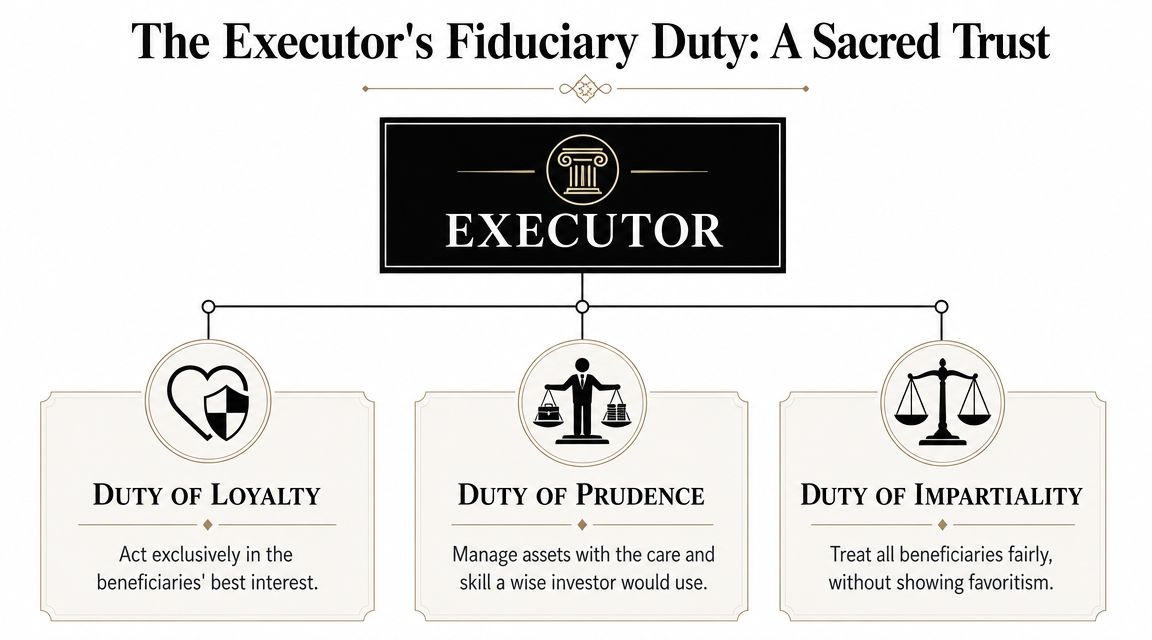
The three duties families should know
Texas probate practice often comes back to three core duties.
- Duty of loyalty: The executor must act for the benefit of the estate and its beneficiaries, not for personal convenience or gain.
- Duty of prudence: The executor must handle property with care, attention, and sound judgment.
- Duty of impartiality: The executor can't favor one beneficiary at the expense of another without legal authority to do so.
For a plain-language discussion of fiduciary breaches generally, Brillant Law on fiduciary responsibilities is a useful background read.
How that shows up under Texas probate law
Under Texas Estates Code Titles 2 and 3, an executor's work includes gathering estate property, protecting it, dealing with claims and expenses, and eventually distributing assets. The exact procedure depends on whether the estate is under independent administration or dependent administration, but the obligation to act carefully doesn't disappear.
Practical examples matter more than abstract rules:
- Loyalty means the executor shouldn't move estate funds into accounts that blur the line between personal money and estate money.
- Prudence means the executor shouldn't make speculative investment moves just because they personally like the risk.
- Impartiality means the executor shouldn't preserve one heir's preferred asset while exposing another heir's share to unnecessary loss.
Texas families dealing with these issues often benefit from learning how courts view an executor breach of fiduciary duty in Texas.
Practical rule: An executor doesn't need to be a professional investor. The executor does need to be careful, transparent, and able to justify each major decision.
Accountability is part of the job
Being fiduciary also means being ready to explain what happened. Records matter. Timing matters. If the executor can't show where the money went, why assets were sold, or why concentrated positions were left untouched, the legal problem grows quickly.
That's where many cases turn. Not on one bad day in the market, but on a pattern of choices no careful fiduciary should have made.
Identifying Investment Mismanagement vs Market Loss
Not every estate loss is executor misconduct. Some losses happen because markets move after death. The law doesn't require perfect outcomes. It requires prudent conduct.
That distinction matters. Beneficiaries often arrive in a lawyer's office convinced the executor “lost money,” but the actual question is narrower. Did the executor act reasonably under the circumstances, or did the executor create avoidable risk?
What a prudent executor usually does
A prudent executor starts by figuring out what the estate owns, what bills are coming due, and how much cash will be needed during administration. That often means reviewing the date-of-death values, understanding whether the will contains special instructions, and deciding whether certain assets should be held, sold, or diversified.
A careful executor also keeps a paper trail. If a financial advisor was consulted, there should be notes or emails. If an asset was retained for a reason, that reason should make sense in hindsight.
What tends to cross the line
Mismanagement usually looks less like a single typo and more like a pattern. Examples include putting too much of the estate into one volatile stock, leaving an obvious concentration risk untouched without a reason, using estate funds in a business venture tied to the executor, or failing to preserve enough liquidity to pay ordinary estate obligations.
Texas-focused guidance notes that executors are expected to file an inventory and appraisal within 90 days of appointment unless extended, and beneficiaries may petition the court if the executor fails to distribute assets within roughly 15 months absent exceptional circumstances. Those deadlines often expose shrinking estate value because losses show up when inventory, accounting, or delay finally forces disclosure, as discussed in guidance on common executor misconduct examples.
| Action | Prudent Executor ✔️ | Potential Mismanagement ❌ |
|---|---|---|
| Holding securities after death | Reviews risk, liquidity needs, and estate instructions before deciding | Ignores concentration risk and leaves everything in one volatile position |
| Responding to market declines | Documents reasoning and adjusts if needed | Blames “the market” while taking no protective steps |
| Using estate cash | Preserves enough liquidity for debts, taxes, and expenses | Ties up cash in illiquid or speculative assets |
| Working with advisors | Gets advice when issues are outside the executor's skill set | Makes aggressive investment calls without analysis |
| Following the will | Uses investment authority consistent with estate instructions | Ignores specific directions in the will |
| Communicating with heirs | Shares records and explains major moves | Gives vague updates and refuses documents |
A realistic Texas example
Suppose an executor inherits control over an estate that is mostly one energy stock, plus some cash. A lawful approach might be to review the will, determine upcoming expenses, consult a qualified advisor if needed, and consider whether some portion should be sold to reduce risk and create liquidity.
A problematic approach would be very different. The executor leaves the entire position untouched for personal reasons, starts active trading, or shifts estate funds into a risky private deal. If the estate then can't cover taxes, expenses, or timely distributions, the issue is no longer “bad luck.” It may be a breach of duty.
Legal Remedies for Executor Misconduct in Probate Court
Texas probate courts can do more than scold an executor. If the evidence shows investment mismanagement, the court has tools to protect the estate and repair the damage.
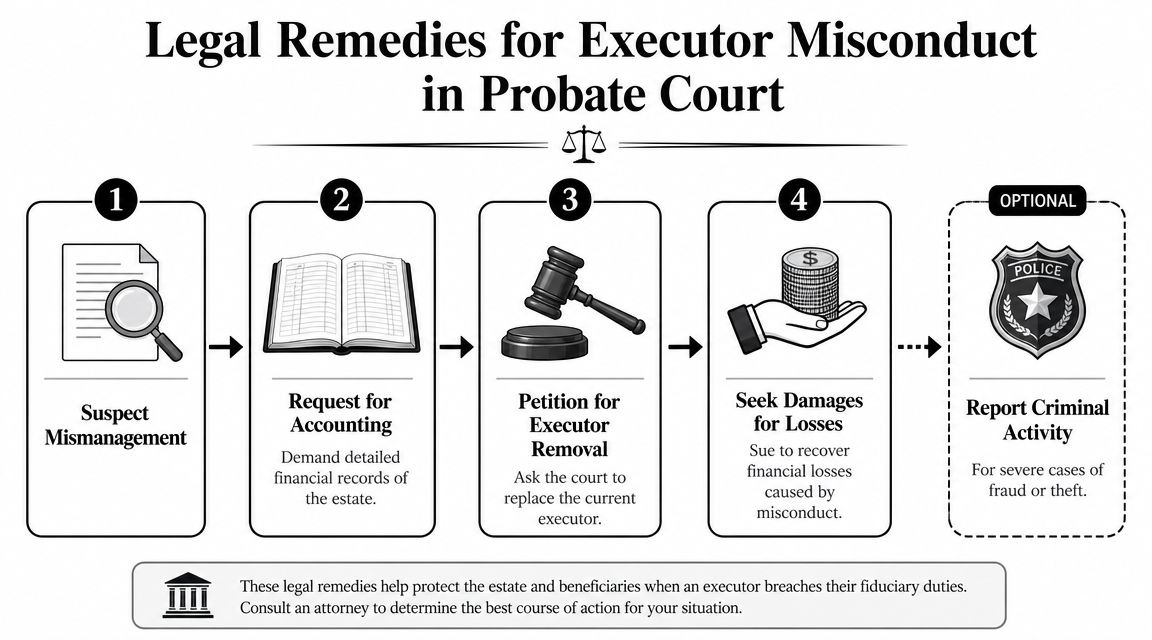
The main remedies heirs should understand
In probate law, an executor who mishandles estate investments can face personal financial liability. Courts commonly treat reckless or imprudent investing as a breach of fiduciary duty, and available remedies can include removal of the executor, a surcharge, and an order requiring the executor to repay losses to the estate, which shifts the loss from the estate to the executor personally, as described in this discussion of executor misconduct remedies.
That usually translates into a few concrete court requests:
A formal accounting
This asks the executor to produce a detailed financial picture of the estate.Removal of the executor
Under Texas Estates Code § 404.003, a court may remove an independent executor in certain circumstances, including misconduct or failure to properly perform duties.A surcharge claim
This is the practical remedy families care about most. If the executor caused a loss, the court can require repayment.Emergency relief
In urgent cases, courts can issue temporary restraining orders to stop ongoing harm.
A beneficiary considering litigation can also review the mechanics of how to sue an executor in Texas probate court.
Later in the process, many families also benefit from seeing how other Texas firms describe legal help for probate in San Antonio, especially when they're comparing litigation and administration options across counties.
After a court filing, it often helps to hear the process explained in a different format:
What works and what usually doesn't
What works is focused evidence. Statements. Ledgers. Trade history. Dates. Written requests that were ignored.
What usually doesn't work is walking into court with only suspicion and anger. Judges need a record. If the complaint is that the estate is worth less than expected, the court will want to know why, when, and how that connects to the executor's decisions.
Probate judges care about provable conduct. The stronger your paper trail, the stronger your position.
Documenting Suspected Mismanagement The Heir's Toolkit
If you believe the executor mishandled estate investments, start building a clean file. Don't rely on memory. Don't keep everything in your email inbox and hope you can sort it out later.
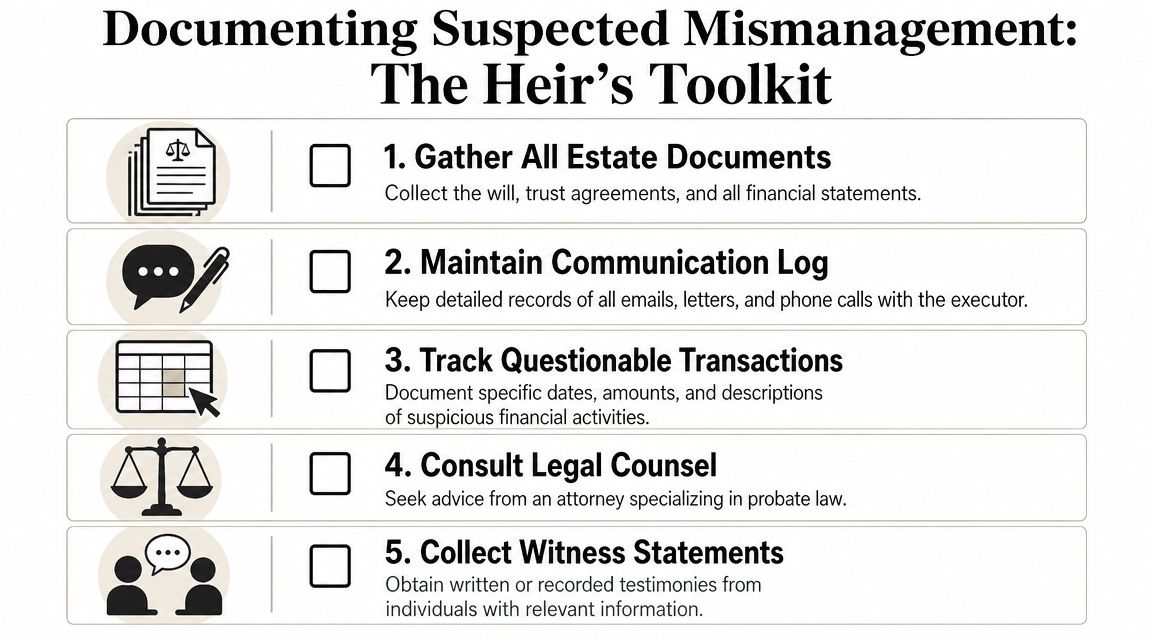
The documents to gather first
Start with core probate records and account evidence.
- Court filings: Get the will, application for probate, order appointing executor, and letters testamentary if issued.
- Inventory materials: Ask for the Inventory, Appraisement, and List of Claims, or determine whether an affidavit in lieu of inventory was filed.
- Financial statements: Collect bank and brokerage statements from the date of death forward.
- Written communications: Save texts, emails, letters, and voicemail summaries.
- Transaction records: Look for trade confirmations, wire records, transfer requests, and closing statements from any sales.
Texas heirs who want a clearer view of disclosure obligations often begin with this overview of executor accounting requirements in Texas.
How to organize the evidence
Create a timeline. One page is enough to begin.
List the date of death, the date the executor was appointed, the date any major asset was sold, and every time you asked for information. Add the estate values you were told at each stage. If an account dropped sharply after unusual transactions, note the date and what happened around it.
Investment mismanagement can also trigger liquidity and tax problems. Beneficiaries should request a formal accounting, inventory the investment ledger, and compare transactions against the date-of-death valuation and market prices to detect unauthorized dispositions, fee leakage, or concentration risk. If discrepancies appear, probate courts can compel accounting and freeze or unwind suspect transfers, as explained in this practical guide to executor misconduct indicators.
Evidence that tends to matter most
Some proof is more persuasive than others.
- A mismatch between records and explanations: The executor says no trades occurred, but the statements show multiple trades.
- Large unexplained movements: Money leaves an account without documentation tied to legitimate estate expenses.
- Concentration with no rationale: A large position stays exposed while the executor ignores obvious risk and cash needs.
- Missing paperwork: Repeated requests for statements and accountings go unanswered.
Save records in the form you received them. Don't alter PDFs, crop screenshots, or write on originals. A clean document trail is easier for a lawyer and a court to trust.
Your Step-by-Step Guide to Taking Action
A lot of families reach this point after months of polite requests, uneasy phone calls, and a growing sense that something is off. By then, the question is no longer whether the executor is being difficult. The question is how to protect the estate before more money moves or more records disappear.
Start with a written request that is specific enough to test the executor's honesty and organization. Ask for the account statements, the estate inventory, trade confirmations, a transaction ledger, and a written explanation for any sale, transfer, or change in investment strategy that concerns you. In Texas, details matter. A vague request for “updates” is easy to brush aside. A request tied to dates, accounts, and transactions is harder to evade.
Then give a reasonable deadline. Ten to fourteen days is often enough to show whether the executor intends to cooperate. Keep the request professional. Angry messages may feel justified, but they often make the response worse and give the executor an excuse to frame the dispute as family conflict instead of a record-keeping problem.
Save everything.
That includes partial responses, missing attachments, text messages, voicemail summaries, and envelopes showing when documents were mailed. If the executor answers one question but ignores three others, that pattern can matter. If statements arrive with unexplained gaps, note which months are missing. In these cases, heirs usually help themselves most by building a timeline that another person can follow without guesswork.
If the executor still will not provide basic information, bring in counsel. A probate attorney can compare what you have against what Texas probate procedure allows you to request, and can assess whether the problem is delay, incompetence, self-dealing, or a breach serious enough to justify court intervention. Sometimes a formal demand letter gets the records produced. Sometimes it becomes clear that waiting is riskier than filing.
Law Office of Bryan Fagan, PLLC handles probate administration and probate litigation matters involving requests for accountings, disputes over estate management, and court oversight in Texas estates.
Executors often respond with the same set of explanations, and some are legitimate. Market volatility may explain a loss, but it does not explain undocumented transfers, ignored cash needs, or trades that make no sense for an estate administration. Broad authority under a will may give the executor room to act, but it does not erase fiduciary duties. Good intentions may matter to the family, but courts usually focus on conduct, records, and whether the estate was harmed.
Timing also matters. Texas claims can be affected by filing deadlines, the status of the probate case, and when the heir knew or reasonably should have known about the problem. Waiting too long can limit your options, especially if assets have already been sold, distributed, or mixed with other funds. If you are seeing missing statements, inconsistent explanations, or unusual investment activity, treat that as a sign to act promptly, not a reason to wait for one more promise.
Key Insights and When to Contact a Probate Attorney
Takeaway: If an executor mishandles estate investments, the issue is rarely just “a family misunderstanding.” It can be a probate dispute with recoverable losses and court-enforced remedies.
Three points matter most.
The short version
Fiduciary duty is a legal obligation
An executor must act carefully, loyally, and fairly while administering estate property under Texas probate law.Documents decide these cases
Suspicion starts the process. Statements, ledgers, inventories, and written communications move it forward.Texas courts can act
Depending on the facts, a court may compel an accounting, remove the executor, freeze harmful transfers, or order repayment.
Families often delay calling a lawyer because they hope things will smooth out on their own. Sometimes they do. But when estate values are falling and records aren't being shared, delay can make the case harder and the damage larger.
For readers trying to understand the broader process, these service pages may help: Texas Probate Process, Guardianship, Wills & Trusts, and Probate Litigation.
Early legal advice doesn't commit you to a lawsuit. It tells you whether you have a paperwork problem, a communication problem, or a real fiduciary-breach case.
Frequently Asked Questions About Executor Mismanagement
Can an executor in Texas sell stocks or real estate without asking beneficiaries first
Often, yes. An executor, especially an independent executor, may have authority to manage and sell estate assets without getting each beneficiary's permission first. But authority to act isn't authority to act carelessly. The sale or investment decision still has to fit the executor's fiduciary duties and the terms of the will.
What if the will says the executor has broad discretion
Broad discretion helps an executor make ordinary administrative decisions. It doesn't give a free pass for self-dealing, concealment, reckless investing, or other conduct a probate court would treat as a breach of duty. Clauses that try to protect an executor have limits, particularly when the facts suggest serious misconduct.
Do I need proof before talking to a probate lawyer
No. You need enough information for a lawyer to assess the concern. Bring the will, court papers, account statements you have, and a short timeline. A lawyer can then tell you what's missing and whether formal discovery or a court-ordered accounting may be needed.
How much does it cost to challenge an executor
That depends on the facts, the county, the complexity of the estate, and the fee arrangement. Some matters are handled on an hourly basis. Others may involve alternative structures depending on the claim. The first priority is usually getting a clear case assessment before worrying about a final litigation budget.
What should I do today if I'm worried money is disappearing
Start preserving records. Send a focused written request. Don't accuse the executor of theft unless you already have evidence to support it. Then speak with a Texas probate attorney promptly, especially if assets are still being traded, sold, or transferred.
If you're facing probate in Texas, our team can help guide you through every step from filing to final distribution. If you're concerned that an executor's investment decisions have put an inheritance at risk, contact Law Office of Bryan Fagan, PLLC to schedule your free consultation today.