When a loved one dies and the will suddenly becomes the center of a family conflict, the probate court can feel intimidating fast. Individuals often don't start by asking, “What is a will contest hearing like in Texas probate court?” Instead, their thoughts turn to something more personal. “Was Mom pressured?” “Did Dad really mean this?” “Why was that last-minute change made?”
Those questions are emotional, but Texas probate courts don't decide them based on suspicion alone. A will contest hearing is a formal legal process. It has deadlines, evidence rules, witness testimony, and very real financial consequences for everyone involved. It also unfolds while people are grieving, which is one reason these cases can feel so heavy.
Texas law does allow a will to be challenged. But not every family concern turns into a viable case. Historical data from Texas probate records indicates that only about 3 to 5 percent of wills filed for probate face formal contests, which reflects how much proof courts require before they set aside a signed will under the Texas State Law Library probate guide.
What follows is a practical look at what families can expect. Not the television version. The actual one.
Understanding the Grounds for a Texas Will Contest
A will contest starts with a legal reason, not just a painful surprise. Texas courts generally want to know whether something was wrong with the making of the will itself. That usually means a problem with the testator's mental capacity, outside pressure, fraud, forgery, or the way the will was signed and witnessed.
Grief often makes families second-guess a will. Sometimes they should. Sometimes the will is valid even though it feels unfair.
What the court is actually looking for
Under the Texas Estates Code, a contest usually focuses on whether the will was validly executed and whether the person signing it understood what they were doing at that time. In plain English, the court asks questions like these:
- Did the person understand they were signing a will?
- Did they understand what property they owned and who their family members were?
- Did someone pressure them into changing their plan?
- Was the document signed the way Texas law requires?
- Is the signature genuine?
A will can be upsetting and still be valid. Texas courts don't throw out wills because one child expected more or because siblings dislike each other. They look for proof tied to recognized legal grounds.
Common grounds for contesting a will in Texas
| Grounds for Contest | Plain-English Explanation | Example Scenario |
|---|---|---|
| Lack of testamentary capacity | The person wasn't mentally able to understand the will when they signed it | A parent signs a new will during a period of severe confusion and doesn't recognize close family members |
| Undue influence | Someone pressured or manipulated the person into making changes they wouldn't have made freely | A caregiver isolates an elderly person and appears shortly afterward as the main beneficiary |
| Improper execution | The will wasn't signed or witnessed the way Texas law requires | A typed will is found, but the required signing formalities were not followed |
| Fraud | The person was deceived about what they were signing | Someone tells the testator a document is routine paperwork when it is actually a new will |
| Forgery | The signature or document isn't authentic | A family member suspects the signature was not made by the deceased |
Practical rule: A strong will contest usually starts with documents and witnesses, not family rumors.
If the estate includes a house, land, or other real property, it's often helpful to understand the larger probate picture before focusing only on the dispute. This plain-language Buys Houses probate explanation can help families understand how probate affects real estate transfers and why title issues often become part of a contest.
Red flags that deserve a closer look
Families often notice patterns before they know the legal terms. Red flags may include:
- Sudden changes late in life that break sharply from long-standing estate plans
- Isolation from family before a new will appears
- Confusion around appointments or paperwork
- A missing prior will that used to be discussed openly
- A new beneficiary who controlled access to the deceased
Those facts don't automatically prove a case. They do tell you whether it's worth asking a probate attorney to review the file, the timeline, and the medical background before anyone commits to litigation.
The Path to the Hearing Pre-Trial Procedures
A will contest hearing doesn't happen right after someone objects. There is usually a long stretch of procedural work before anyone testifies in court. That part often feels slow, but it matters because probate judges decide these disputes based on evidence gathered well before the hearing date.
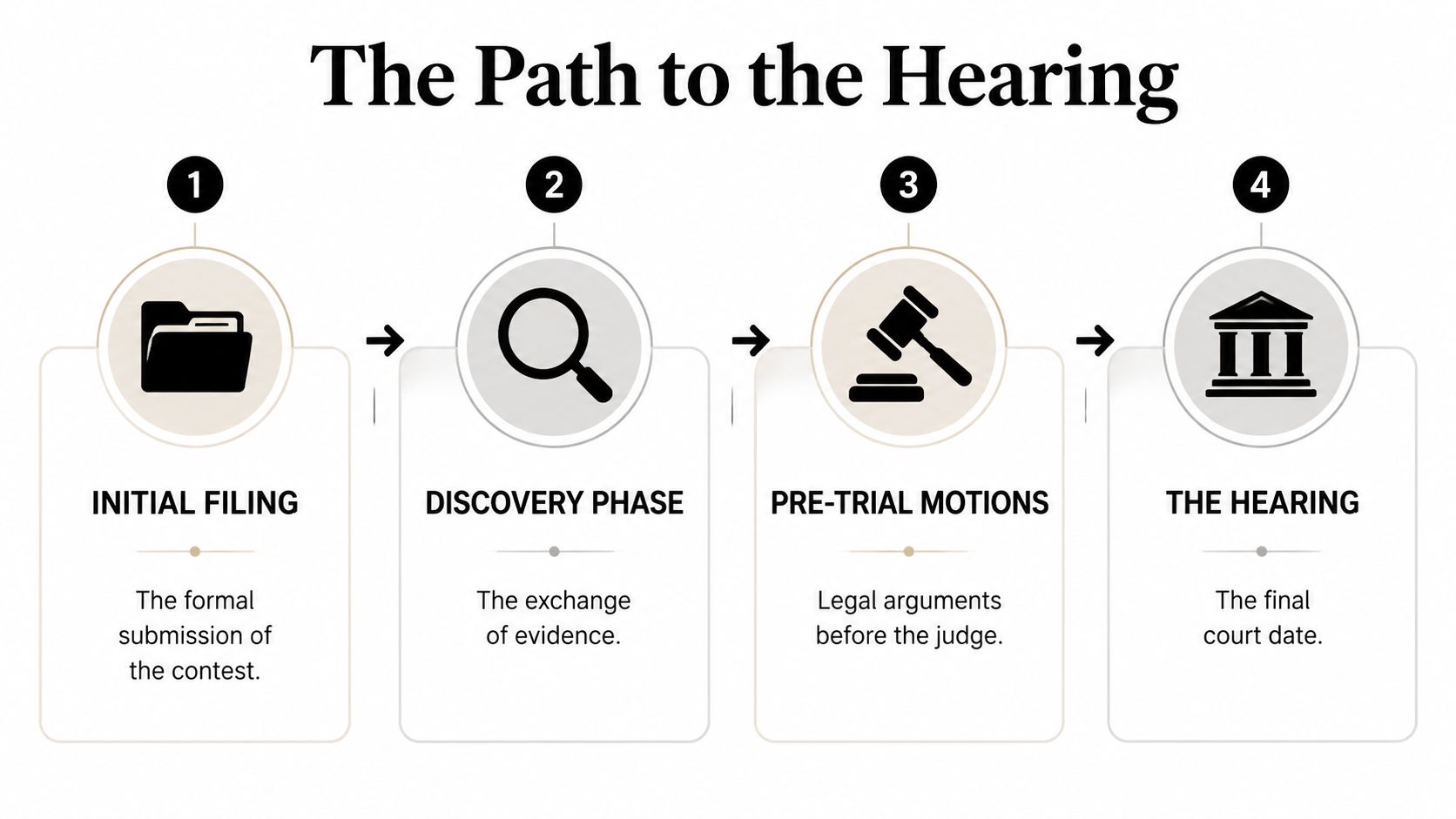
Texas will contests often move on a litigation timeline rather than a simple probate timeline. According to this overview of contested probate cases in Texas, the full process from filing to final hearing averages 12 to 18 months, largely because discovery takes time.
How the case gets started
The first step is a formal filing with the probate court. That filing tells the court what the challenger is claiming and why the will should not be admitted, or why an admitted will should be set aside. The filing also identifies the interested parties, which may include heirs, beneficiaries, and the named executor.
Deadlines matter here. Texas law includes a strict window for many post-admission contests, and missing it can end the case before it begins. Families dealing with timing questions should review the Texas will contest deadline guide as early as possible.
What happens before the hearing
The pre-trial process usually includes several moving parts:
Notice to interested parties
Everyone with a legal interest in the estate has to be told about the contest. Probate courts want all affected people brought into the case.Discovery
This is the evidence-gathering phase. Lawyers request medical records, financial documents, prior wills, text messages, emails, and other records that might show capacity, influence, or authenticity.Depositions and written questions
Witnesses may give sworn testimony outside the courtroom. Doctors, caregivers, family members, and drafting witnesses often become central figures here.Pre-trial motions
Lawyers may ask the judge to rule on legal issues before the hearing, such as whether certain evidence should be allowed.
A contested probate case is usually won or lost in preparation. The hearing is where the record gets presented, not where the facts first get discovered.
Why this stage feels expensive and frustrating
Families often expect a single court date. Instead, they get months of records requests, scheduling fights, and hard conversations. That can feel invasive. Medical privacy, family finances, and old grievances all come into the open.
Still, this phase serves a purpose. If one side doesn't have enough proof, that weakness often shows up before trial. If both sides see risk, this is also the stage where serious settlement discussions usually begin.
Inside the Courtroom A Step-by-Step Walkthrough
Most will contest hearings are quieter than people expect. Probate court isn't usually dramatic. It's controlled, orderly, and focused on the judge's questions, the witnesses' answers, and the documents admitted into evidence.
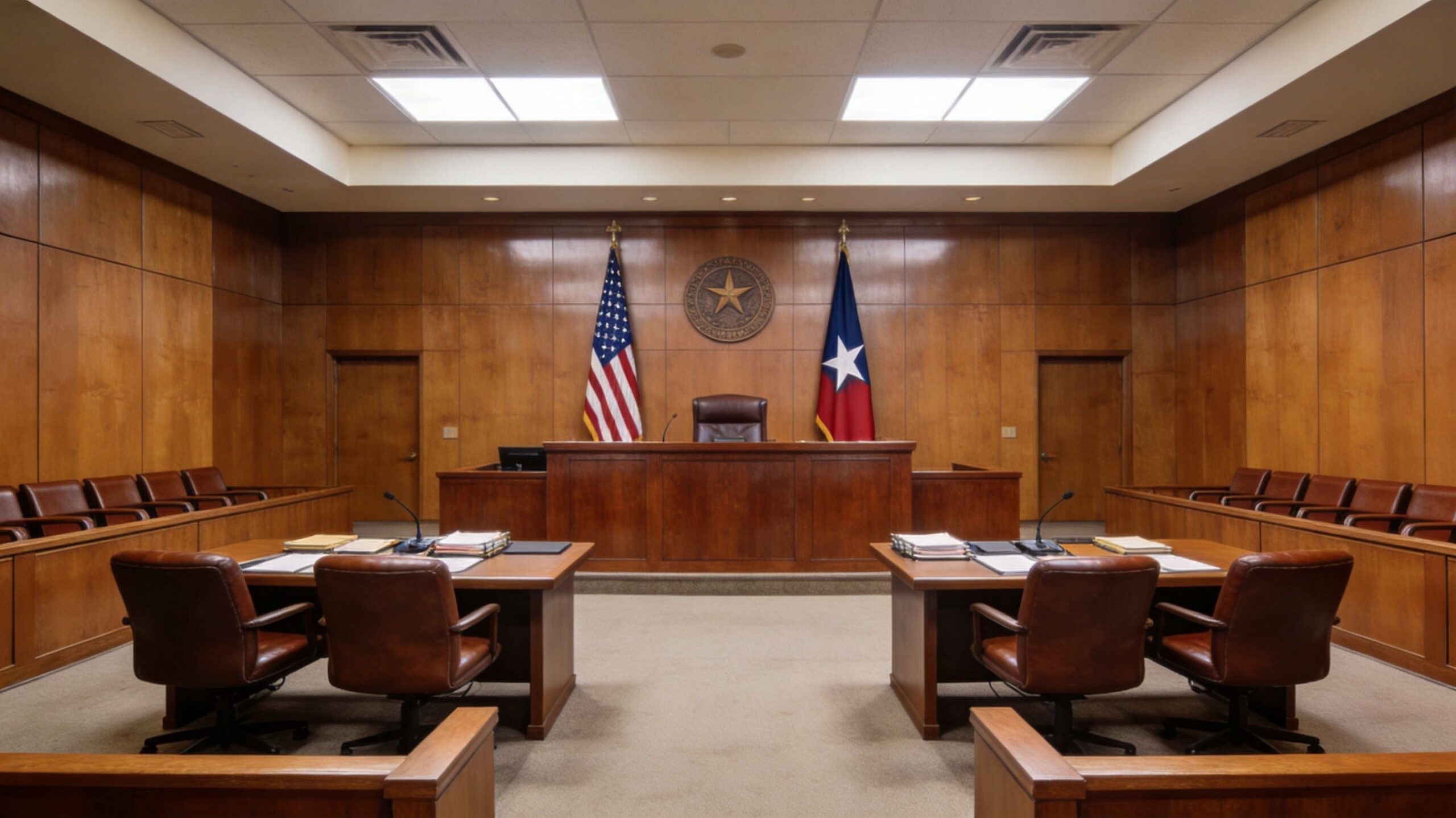
If you want a county-specific look at the courtroom side of these disputes, this Texas contested probate hearing resource helps explain how the hearing stage works in practice.
What the hearing day usually looks like
A typical hearing moves in a familiar sequence.
First, the judge calls the case and confirms who is present. The court may address housekeeping matters, identify pending issues, and clarify whether the matter is a bench trial or another evidentiary setting.
Then each side gives an opening statement. This isn't evidence. It's a roadmap. One side tells the judge why the will should stand. The other explains why it should not.
After that, the main work begins:
- Witness testimony from family members, attorneys, caregivers, or subscribing witnesses
- Expert testimony if a doctor, handwriting expert, or other specialist is needed
- Documents introduced into evidence, such as prior wills, records, notes, or correspondence
- Cross-examination, where the other side tests whether a witness is credible or mistaken
- Closing argument, where each lawyer ties the facts back to the legal standard
A realistic courtroom example
Suppose a father signed a new will shortly after a hospitalization. His earlier will treated his children equally. The newer document leaves nearly everything to one adult child who had recently moved in and was managing appointments.
At the hearing, the child defending the will may call the lawyer who prepared it and the witnesses who saw it signed. They may testify that the father appeared alert and understood what he wanted.
The children challenging the will may call treating medical providers, introduce records showing confusion during the same period, and point to messages showing restricted family access. The judge then weighs whether the evidence shows free decision-making or improper influence.
Courtrooms are built for proof, not family history. The judge won't decide who was the better son or daughter. The judge decides whether the legal requirements for a valid will were met.
A short explainer can also help readers visualize the hearing process before they ever walk into the courthouse:
What surprises families most
The pace surprises people. So does the emotional restraint the process requires. A witness may be talking about a parent's final months, but the court still expects direct answers to narrow questions.
That can feel cold. It isn't meant to be. Probate judges are trying to separate sympathy from admissible evidence so they can make a legally defensible ruling.
The Legal Hurdles Proving Your Case in Court
Many families enter a contest believing the truth will be obvious once the judge hears the story. That's rarely how it works. Probate litigation turns on standards of proof, burdens of proof, and the quality of the evidence presented.
One of the biggest strategic issues is timing. Before a will is admitted to probate, the proponent must prove it is valid. After admission, the challenger bears the burden, and success rates drop to approximately 20 to 30 percent. That shift changes how lawyers evaluate risk from the start.
What burden of proof means in plain English
Think of the burden of proof as the obligation to convince the court. The side carrying that burden has to bring enough evidence to satisfy the judge under the legal standard that applies.
In practical terms:
- Before probate admission, the person offering the will has more work to do up front.
- After probate admission, the challenger usually has the harder road.
Families often underestimate how much that matters. A case that looks promising emotionally can become much harder once the burden shifts.
What kinds of proof tend to matter most
Texas probate judges want evidence tied closely to the moment the will was executed. Helpful proof may include:
- Medical records showing cognitive condition near the signing date
- Testimony from the drafting attorney about the testator's understanding
- Witness testimony from people who were present
- Prior estate planning documents that show a pattern or sudden departure
- Financial records or communications suggesting control, secrecy, or manipulation
For readers who want a practical list of supporting proof, this guide to evidence needed to contest a will is a useful starting point.
Key insight: Feeling certain isn't the same as proving a claim. Probate judges need admissible evidence that lines up with the legal ground being asserted.
The no-contest clause problem
Some wills contain a no-contest clause. This is sometimes called an in terrorem clause. In plain language, it says a beneficiary could lose an inheritance if they challenge the will and lose.
That sounds final, but it isn't always. Texas law does not enforce these clauses when a contest is brought in good faith and with just cause. The hard part is that families often don't know whether they meet that standard until a lawyer reviews the facts carefully.
This creates a real trade-off. A beneficiary may have legitimate concerns but also real financial exposure if the case is weak. That's one reason a sober case assessment matters more than anger in the early days of a dispute.
After the Verdict Possible Outcomes Costs and Appeals
The hearing ends with a ruling, but the consequences ripple through the estate long after the judge speaks. Sometimes the court rules immediately from the bench. Sometimes the judge takes the matter under advisement and issues a written decision later.
The outcome can affect not only who inherits, but also whether the estate administration has to restart, whether a prior will controls, and whether estate property can be transferred without more delay.
If the court upholds the will
If the will is upheld, the estate usually continues under that document. The executor or administrator moves forward with the remaining probate steps under Texas Estates Code procedures in Titles 2 and 3, including marshaling assets, addressing debts, and making distributions according to the will.
That result may still leave emotional damage behind. A legal loss doesn't automatically resolve family distrust. It only resolves which document controls.
If the court invalidates the will
If the court invalidates the contested will, the next question is whether an earlier valid will exists. If there is one, the estate may proceed under that prior document.
If there isn't a valid earlier will, the estate may pass by intestacy. That means Texas law, not the deceased person's last disputed document, determines who inherits. For many families, that's the most surprising part of the case. Winning a contest doesn't always produce the inheritance pattern the challenger hoped for.
A few practical consequences often follow:
- Asset distribution may pause while the court sorts out the next controlling document or heirship path
- Real estate transfers can be delayed because title companies want clarity
- Estate expenses continue while the case remains open
- Family relationships often worsen even after the ruling
The cost and appeal reality
Contested probate is expensive because it requires document review, witness preparation, court appearances, and often expert input. Costs don't just come from legal fees. Delays can affect property sales, access to funds, and the executor's ability to wrap up administration.
Appeals are possible, but they aren't a do-over. An appeal usually focuses on whether the trial court made a legal error. It doesn't ask a higher court to rethink every factual dispute from scratch.
A family thinking about appeal should ask three questions early:
- Was there a genuine legal error?
- Will the likely benefit outweigh the added delay and cost?
- Can the estate function while the appeal is pending?
Those are strategic questions, not emotional ones. They deserve a careful answer before more money is spent.
The Alternative to a Hearing Settlement and Mediation
Many probate fights should never reach a final hearing. That isn't weakness. It's judgment.
A courtroom gives you a ruling. Mediation gives you options. In the right case, that difference matters more than people expect because the dispute isn't only about legal rights. It's also about preserving estate value and limiting damage between relatives who may still have to deal with one another after probate ends.
Texas probate courts regularly use mediation, and it works often enough that no family should dismiss it casually. In Texas probate disputes, an estimated 65 percent of contested will cases resolve through a binding settlement agreement, which helps families avoid the cost and strain of a full trial.
Why mediation often works better than trial
Mediation places the conversation in a structured setting with a neutral third party. The mediator doesn't decide who wins. The mediator helps the sides test risk, narrow issues, and find terms they can live with.
That can produce results a judge usually can't craft on the bench, such as:
- A phased property sale plan that gives family members time to coordinate
- Adjusted distributions that address a disputed asset without voiding the entire will
- Agreements over personal items with sentimental value
- A quiet resolution that avoids witness testimony about painful family history
Settlement can protect more than money. It can protect privacy, reduce delay, and keep one legal fight from becoming a permanent family fracture.
When mediation makes the most sense
Mediation is especially useful when both sides face uncertainty. That might happen when the evidence is mixed, when a no-contest clause creates risk, or when the estate holds property that shouldn't sit in limbo for months.
It also helps when the family wants control. In trial, the judge chooses from the legal remedies available. In mediation, the parties can shape practical terms around timing, possession, and administration.
That said, mediation isn't magic. It usually fails when one side wants punishment more than resolution, or when someone refuses to produce basic records. But in many cases, it is the smartest off-ramp available.
Key Insights and Next Steps for Your Family
If you're dealing with a possible will contest, the most helpful next step is usually not confrontation. It's getting organized. Probate disputes get better when families move from suspicion to evidence, from panic to deadlines, and from argument to strategy.
Texas law gives people rights, but those rights can be lost through delay, weak proof, or avoidable mistakes. A calm review early on often makes the difference between a focused case and a painful, expensive one.
A practical checklist for heirs and beneficiaries
Collect documents quickly
Keep copies of the will, prior wills, letters from the court, medical records you lawfully have, and any relevant messages or notes.Write down the timeline
Dates matter. Note when the will was signed, when major health changes occurred, and when family access changed.Don't rely on verbal family history alone
Probate courts need records and testimony tied to specific events.Assess the risk before filing
If the will has a no-contest clause, the cost of a failed challenge may be higher than you think.
A practical checklist for executors and will proponents
Preserve the file
Don't discard emails, drafts, witness information, or estate planning records.Follow the probate process carefully
Courts expect compliance with filing, notice, and administration duties under the Texas Estates Code.Separate emotion from administration
An executor's job isn't to win family arguments. It's to protect the estate and carry out lawful duties.Consider settlement early if appropriate
A defensible will can still be expensive to defend through final hearing.
Helpful resources for the broader probate picture
Families often need more than litigation guidance. Depending on the issue, these resources may help:
- Texas Probate Process
- Probate Litigation
- Wills & Trusts
- Guardianship
Takeaway
A will contest hearing in Texas probate court is not a quick family meeting in front of a judge. It's a formal evidentiary dispute with deadlines, costs, and consequences. The strongest cases are built on records, witnesses, and timing. The wisest outcomes often come from clear-eyed negotiation before trial becomes the only option.
If your family is at this point, don't assume you have to figure it out alone or argue your way through it. The law is technical, but the decisions are personal. Good guidance should respect both.
If you're facing probate in Texas, our team can help guide you through every step, from filing to final distribution. Schedule your free consultation with Law Office of Bryan Fagan, PLLC today.