Skip to content
Losing a loved one is one of life’s most difficult experiences. The last thing you should have to worry about is whether the person in charge of their estate is acting honestly and protecting their final wishes. In Texas, when an executor—the person named in a will to manage the estate—puts their own interests first, it’s a serious betrayal known as an executor breach of fiduciary duty.
This isn't just a minor misstep; it's a violation of the deepest trust placed in them to protect a family's legacy. We understand how painful and confusing this situation can be. This guide is designed to provide Texas families with clear, compassionate, and step-by-step guidance on how to identify misconduct and protect their inheritance.
Understanding Executor Breach of Fiduciary Duty in Texas

When someone passes away, the executor they named in their will steps into a special role defined by Texas law. This role comes with what’s called a fiduciary duty, which is the highest standard of care our legal system recognizes. It legally binds the executor to act with absolute loyalty and good faith, always putting the interests of the estate and its beneficiaries above their own.
Think of an executor as the captain of a ship, entrusted with safely guiding a family’s legacy to its final port. The will is their map, and the beneficiaries are the passengers who have put their complete faith in the captain's ability to navigate. A breach of fiduciary duty happens when that captain deliberately steers the ship off course for personal gain.
This can range from something as blatant as theft to more subtle forms of financial mismanagement. To get a better sense of the core legal ideas at play, it's helpful to understand what a breach of fiduciary duty entails in a broader context. To make these duties crystal clear, here’s a quick rundown of what Texas law expects from every executor.
Executor's Core Fiduciary Duties at a Glance
This table breaks down the main legal responsibilities an executor owes to the estate and its beneficiaries under the Texas Estates Code.
| Duty | What It Means in Plain English | Relevant Texas Estates Code Section (Example) |
|---|---|---|
| Duty of Loyalty | You must act solely in the best interest of the estate and its beneficiaries, never for your own personal benefit or gain. | § 351.151 (Duty of Care) |
| Duty of Impartiality | You cannot play favorites. You must treat all beneficiaries equally and fairly, without bias. | § 351.151 (Duty of Care) |
| Duty to Account | You must keep meticulous records of all money coming in and going out of the estate and be ready to show them to beneficiaries. | § 404.001 (Accounting) |
| Duty of Prudence | You must manage the estate's assets responsibly, as a "prudent person" would manage their own property. | § 351.151 (Duty of Care) |
These aren't just suggestions; they are legally enforceable commands. When an executor fails to live up to them, Texas law gives beneficiaries powerful tools to fight back.
What This Guide Will Cover
We know how gut-wrenching it is to suspect a loved one's final wishes are being ignored. The good news is you are not powerless. Texas law gives beneficiaries strong protections, and you don’t have to face this alone.
This guide is built to give you knowledge and a clear path forward. We will walk you through:
- An executor’s specific legal duties: We’ll break down what the Texas Estates Code actually demands, moving past the legal jargon to give you plain-English explanations.
- Spotting the red flags of misconduct: You’ll learn to identify the common warning signs, from secrecy and poor communication to obvious self-dealing.
- The steps to protect your inheritance: We lay out a step-by-step roadmap for holding a bad executor accountable, from gathering evidence to filing a petition in court.
Navigating this process feels overwhelming, especially while grieving. Our goal is to bring clarity and reassurance, showing you that the law is on your side when an executor breaks their sacred trust. This guide will help you understand your rights and the actions you can take to make things right.
Understanding an Executor's Legal Obligations in Texas
When someone is named an executor in a will, they aren’t just being handed a title; they’re being given a profound and legally binding responsibility. This role is built on a foundation of trust, and in Texas, it’s governed by a strict set of rules known as fiduciary duties. These duties aren't just suggestions—they are legal commands that carry the full weight of the Texas Estates Code.
Think of a fiduciary as someone holding the keys to a kingdom that isn't theirs. They must protect it, manage it wisely, and act only in the best interests of the kingdom's true heirs. In legal terms, this is the highest standard of care the law recognizes. It means the executor must act with complete loyalty and honesty, putting the interests of the estate and its beneficiaries above their own at all times. This is not a role to be taken lightly, and for beneficiaries, understanding these obligations is the first step toward protecting their inheritance.
The Core Duties Every Texas Executor Must Uphold
An executor’s job has many moving parts, but everything boils down to a few fundamental duties. These duties form the legal benchmark against which an executor's actions are measured. If an executor drops the ball in any of these areas, they may be committing an executor breach of fiduciary duty in Texas.
- The Duty of Loyalty: This is the absolute cornerstone of an executor’s role. They must act solely for the benefit of the estate. They cannot use their position for personal gain, a practice known as "self-dealing." This means no selling estate property to themselves at a discount, no using estate funds for personal bills, and no making decisions that line their own pockets at the estate's expense.
- The Duty of Care: The executor has to manage the estate’s assets with the same caution and skill a "prudent person" would use for their own affairs. This isn't just a nice idea; it's explicitly required by Texas Estates Code § 351.101. It means protecting assets from damage, loss, or waste. For example, they must keep real estate maintained, secure valuable items, and manage investments without taking reckless risks.
- The Duty to Account: Transparency is completely non-negotiable. An executor has a duty to keep meticulous and accurate records of every single transaction—all money that comes in and all money that goes out. Under Texas Estates Code § 404.001, they must provide a detailed accounting to the beneficiaries if requested, showing exactly how every dollar has been handled.
A Realistic Scenario: Managing Estate Assets
Let's make this more concrete. Imagine an executor is managing their late father's estate, which includes a vintage car valued at $50,000. The will specifies all assets are to be divided equally between two children.
A Clear Breach of Duty: The executor, who always wanted the car, decides to "sell" it to himself for $10,000. He pockets a massive discount, and the other beneficiary is shorted their fair share of the car's true value. This is a textbook violation of the Duty of Loyalty.
Acting Properly as a Fiduciary: A responsible executor would get the car professionally appraised, list it for sale on the open market, and sell it to the highest bidder for a fair price. They would then deposit the full proceeds into the estate's bank account, where it will be distributed to both beneficiaries according to the will. This action upholds both the Duty of Loyalty and the Duty of Care.
A solid grasp of an executor's responsibilities is the best defense against misconduct. This includes following precise financial principles, as detailed in this helpful fiduciary accounting and trust administration guide.
These legal duties are the very framework that protects a family’s legacy. When an executor honors them, the Texas Probate Process moves forward smoothly. When they don't, Texas law gives beneficiaries a clear path to seek justice and hold them accountable. To dive deeper into what an executor should be doing, check out our guide on the primary responsibilities of an executor of a will.
Key Insight
A simple mistake made in good faith isn't always a breach of duty. But a pattern of secrecy, a refusal to share financial information, or actions that personally benefit the executor are huge red flags. The law focuses on whether the executor fulfilled their duties with loyalty and prudence, not just whether they intended to cause harm.
If you’re facing probate in Texas, our team can help guide you through every step — from filing to final distribution. Schedule your free consultation today.
Recognizing the Warning Signs of Executor Misconduct
Grief is disorienting enough on its own. When you add the complexities of probate, it’s easy to feel lost. It can be incredibly difficult to tell if an estate administration is just moving slowly or if something is genuinely wrong.
While every probate case is different, an executor who is breaking the rules often leaves a trail of red flags. Recognizing these warning signs is the first step toward protecting your inheritance and holding a bad actor accountable. It's crucial to know the difference between an honest mistake—like a typo on a form that gets quickly fixed—and a true executor breach of fiduciary duty in Texas. One is a minor hiccup; the other is a serious betrayal of trust.
From Secrecy to Self-Dealing
Some of the most damaging breaches happen when an executor uses their position for personal gain or deliberately keeps beneficiaries in the dark. These aren't just small missteps. They are direct violations of the duties of loyalty and care required by Texas law and the trust your loved one placed in them.
Here are some of the most common forms of misconduct to watch for:
- Going Silent: The executor ignores your calls, emails, and letters. They flat-out refuse to give you updates on the probate process or answer reasonable questions about where things stand.
- Hiding the Books: You ask for a list of the estate's assets and debts (the inventory) or a report of its financial transactions (an accounting), and the executor either refuses or hands over vague, incomplete documents. Transparency isn't optional; it's a core duty.
- Letting Assets Rot: The executor allows estate property to fall into disrepair, causing its value to plummet. This could be anything from failing to make mortgage payments on a house, letting it slide into foreclosure, to neglecting to pay insurance premiums.
- Self-Dealing: This is when the executor uses estate assets for their own benefit. Maybe they "buy" the deceased's classic car for a fraction of its real value or decide to live in the estate's house rent-free for months on end.
These actions are clear violations of an executor's responsibilities. For a deeper look into specific cases and examples, you can explore more about executor misconduct in probate cases.
A Real-World Example of Executor Misconduct
Imagine an executor is handling their late father’s estate, which includes a sizable stock portfolio. The will clearly states that all assets are to be distributed equally among three siblings.
The stock market is shaky, and a prudent executor would likely liquidate the stocks to lock in their value and distribute the cash. Instead, this executor decides to hold on, convinced they can time the market and get a bigger payout for everyone. But their gamble fails. The market takes a nosedive, and the portfolio loses 30% of its value before the executor finally sells.
This is a classic example of a breach of the Duty of Prudence. The executor gambled with estate assets instead of acting cautiously to preserve their value for the beneficiaries. They put their own judgment ahead of their legal duty to protect the estate.
The High Cost of Hidden Deals
Sometimes, an executor's misconduct goes beyond simple mismanagement into deliberate, calculated fraud. A Texas case shows just how seriously our courts treat this kind of behavior.
Key Insight
In the Texas case In re Estate of Stewart, an executor breached his duty by failing to disclose critical information to a fellow beneficiary—his sister. He deeded a valuable piece of property to himself and his brothers while cutting his sister out. What he didn't tell her was that he had secretly negotiated a lucrative deal for an easement on that land worth $11,250 per acre. He pocketed the proceeds himself, a blatant act of self-dealing. The court came down hard, ordering him to pay $150,000 in attorney's fees to his sister and sending a clear message: secrecy and self-enrichment will not be tolerated. This case drives home the point that an executor's duty to be open and honest is not a suggestion—it's a requirement. If you feel that the executor of your loved one's estate is being secretive or their actions just don’t add up, trust your instincts. That feeling is often the first sign that it's time to get legal advice.
Your Step-by-Step Guide to Taking Action
Finding out that an executor might be mishandling a loved one’s estate is a deeply painful experience. You’re already dealing with grief, and now you’re faced with suspicion and the fear that your family’s legacy is at risk. It's enough to make anyone feel powerless.
But you’re not powerless. Texas law gives beneficiaries a clear, structured path to hold a rogue executor accountable. This isn't about starting a family war; it's about protecting what's rightfully yours. Let's walk through how you can move from suspicion to decisive action.
This diagram shows how different types of executor misconduct—like secrecy, mismanagement, and self-dealing—often feed into one another.
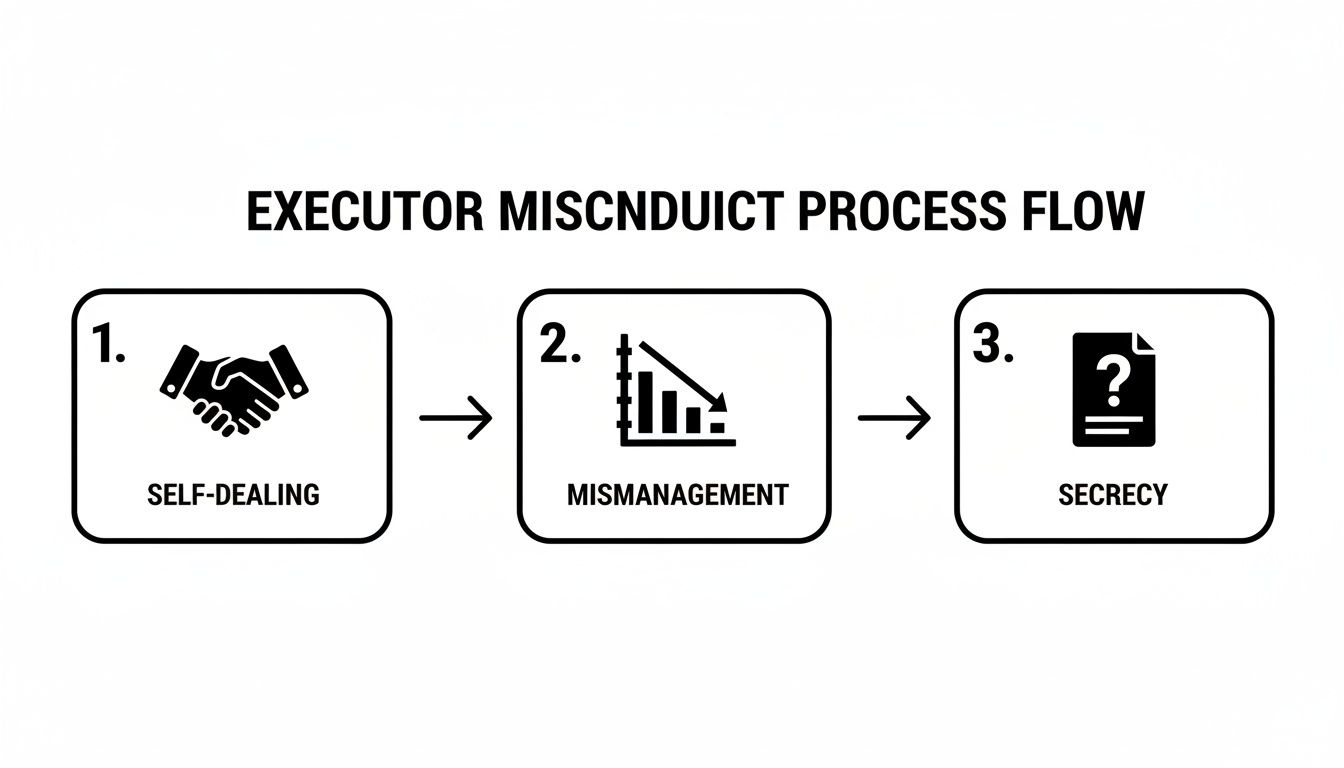
As you can see, an executor who operates in secret has a much easier time mismanaging assets or even helping themselves to estate property. Breaking that cycle starts with demanding transparency.
Step 1: Gather Your Evidence
Before you make any formal accusations, the first step is always to gather concrete proof. Suspicions and gut feelings won't hold up in a Texas probate court—you need documents. The best way to get them is to make a formal request to the executor.
You have a legal right to this information. Send a written request via certified mail, so you have a paper trail proving you asked. You're primarily looking for two key documents:
- An Inventory, Appraisement, and List of Claims: This is the official, detailed list of every asset the deceased owned at the time of death, complete with its estimated value. It also includes any debts the estate has to pay.
- An Accounting: Think of this as the estate’s checkbook register. It must show every single dollar that has come into the estate and every dollar that has gone out.
How the executor responds is your first critical piece of evidence. If they ignore you, drag their feet, or hand over an incomplete or nonsensical report, that’s a massive red flag. It often confirms your fears are justified.
Step 2: Escalate With a Formal Demand Letter
If your initial requests are ignored or you get an unsatisfactory response, it’s time to escalate. This is the point where teaming up with an experienced probate litigation attorney becomes crucial.
Your attorney will draft and send a demand letter to the executor and their attorney, if they have one. This isn't just another strongly worded email. It's a formal legal document that puts the executor on notice. A proper demand letter will:
- Clearly outline the executor's specific fiduciary duties under the Texas Estates Code.
- Detail the suspected breaches, whether it's the failure to provide an accounting, signs of self-dealing, or other forms of mismanagement.
- Demand specific actions to fix the problem, like producing a full accounting or returning assets to the estate.
- Set a firm deadline for compliance before you take the next step—filing a lawsuit.
More often than not, a demand letter from a reputable law firm is the wake-up call a negligent executor needs. It signals that you're serious and have legal muscle on your side.
Step 3: File a Petition in Probate Court
If the demand letter doesn't work, your attorney will help you take the most powerful step: filing a formal petition with the probate court. This officially starts the legal process to hold the executor accountable for an executor breach of fiduciary duty in Texas.
This petition asks a judge to intervene and can request several different remedies, including:
- Compelling an Accounting: A court order that forces the executor to produce a complete and accurate financial report for the estate.
- Removing the Executor: Asking the judge to strip the current executor of their authority and appoint someone new. You can learn more in our guide on removing an executor in Texas.
- Seeking a Surcharge and Damages: Requesting a court order that forces the executor to personally repay the estate for any money they lost, mismanaged, or stole.
Understanding Critical Timelines
It is absolutely vital to act quickly. While Texas generally has a four-year statute of limitations for breach of fiduciary duty claims, you should not wait. From our experience, estate assets can disappear frighteningly fast when an executor is acting in bad faith. Delaying action only makes it harder to recover what’s been lost.
Navigating the probate court system is not a DIY project. It requires a deep understanding of the Texas Estates Code, court procedures, and evidence rules. An experienced probate litigator will handle the court filings, build a compelling case based on the evidence, and represent your interests at every hearing to protect the inheritance your loved one left for you.
Legal Remedies for Beneficiaries in Texas

So, you were right. A probate court has confirmed your suspicions and found that the executor breached their fiduciary duty. That validation is a huge step, but what happens next? This isn't just about winning an argument; it's about making the estate—and the beneficiaries—whole again.
Thankfully, Texas law doesn't just wag a finger at a misbehaving executor. It gives probate judges a powerful set of tools to step in, stop the misconduct, and repair the damage. These legal remedies are the system’s way of ensuring your loved one's final wishes are actually honored and your inheritance is protected.
Common Remedies for an Executor Breach of Duty
When a judge determines a breach has occurred, they aren't limited to a single course of action. They can mix and match remedies to fit the situation, with the primary goal of restoring the estate's integrity.
Here are the most common remedies a Texas court can put into play:
- Executor Removal: This is often the first and most critical step. The court can immediately strip the executor of all power and authority, stopping any further harm in its tracks. A new, impartial administrator will then be appointed to take over and manage the estate correctly.
- Surcharge: Think of a surcharge as the court telling the executor, "You broke it, you bought it." It’s a powerful court order that forces the executor to personally repay the estate for any financial losses caused by their actions. They have to use their own money to replace what was mismanaged, lost, or stolen.
- Lawsuit for Damages: Beyond a simple surcharge, beneficiaries can also sue the executor for damages. This can recover not just the money that was lost, but also things like lost investment gains or other financial harm that wouldn't have happened if the executor had done their job properly.
- Disgorgement of Profits: If the executor used their position to personally profit—say, by selling an estate property to themselves for a ridiculously low price—the court can force them to "disgorge" those profits. They have to give back every single penny of their ill-gotten gains to the estate.
A Real-World Example of Legal Remedies in Action
Let’s put this into a real-world context. Imagine Sarah is the executor of her father's estate, and her brother, David, is the only other beneficiary. David starts noticing large, sketchy withdrawals from the estate's bank account and gets a bad feeling.
After David's attorney files a petition, the court investigates and uncovers the truth: Sarah has been using the estate’s debit card to pay off her personal credit card bills, totaling $30,000. This is a crystal-clear case of an executor breach of fiduciary duty in Texas.
A probate judge won’t let this stand. Here’s how they’d likely act:
- He removes Sarah as executor, effective immediately. Her access to the estate is cut off.
- He orders a surcharge against Sarah for $30,000, compelling her to repay the full amount to the estate from her personal funds.
- He appoints a neutral third party, like a corporate bank or another attorney, to serve as the new administrator and finish the probate process fairly.
The law provides a clear path not just to stop a bad executor but to repair the financial harm they caused. This robust system of checks and balances is a cornerstone of the Texas probate process, ensuring that justice can be served. When litigation is necessary, an experienced attorney can help you pursue these remedies effectively. For more complex situations involving contested wills or trusts, understanding the basics of probate litigation is essential.
Answering Your Questions About Executor Misconduct
Losing a loved one is hard enough. When you add suspicions about the person managing their estate, it can feel overwhelming. We get these questions all the time from beneficiaries across Texas who are worried, confused, and just want to know their rights. Let's clear up some of the most common concerns.
How Do I Prove an Executor Is Stealing from the Estate?
Proving that an executor is stealing—what the law calls "self-dealing" or conversion—boils down to evidence, not just a gut feeling. You need to build a case with documents. This means gathering every piece of paper you can find: bank statements, property appraisals, records of sales, and any email or letter exchanged with the executor.
The single most powerful tool in your arsenal is often a legal demand for a formal accounting. This isn't just asking for a spreadsheet; it's a court-ordered process where an attorney petitions a judge to force the executor to disclose, under oath, every dollar in, every dollar out, and every single transaction they’ve made for the estate.
What Is the First Step if I Suspect a Problem?
Before you rush to the courthouse, your best first move is to create a solid paper trail. Start by sending the executor a formal, written request for information. You might ask for an updated inventory of the estate's assets or a simple accounting of its finances.
Make sure you send it via certified mail. This gives you proof of delivery. If the executor ignores you, gives you vague or confusing answers, or gets defensive, you now have a major red flag—and documented proof of their refusal to be transparent. This methodical first step is far more powerful than an emotional confrontation and gives your attorney crucial evidence to build a case.
Can an Executor Be Held Personally Liable for Losses?
Yes, absolutely. This is one of the strongest protections for beneficiaries under Texas law. If a court determines that an executor's breach of fiduciary duty caused the estate to lose money, it can order what's called a surcharge.
A surcharge forces the executor to use their own money—not the estate's—to repay the losses their actions caused. This isn't for honest mistakes made in good faith. This remedy is reserved for clear misconduct or gross negligence, ensuring the person who caused the damage is the one who has to fix it.
How Long Do I Have to File a Claim in Texas?
In Texas, the statute of limitations for filing a claim against an executor for a breach of fiduciary duty is generally four years. But it is critical that you don't wait. The longer you delay, the more damage can be done.
Assets can be sold off, money can be moved to untraceable accounts, and crucial records can vanish. The sooner you act, the better your chances of recovering what's rightfully yours. Navigating these complex issues, from creating wills and trusts to the prospect of probate litigation, requires prompt and experienced guidance. Whether you are navigating the Texas probate process, dealing with a guardianship, or facing a dispute, acting quickly is key.
If you’re facing probate in Texas, our team can help guide you through every step — from filing to final distribution. Schedule your free consultation today.