A daughter opens a desk drawer after her father dies and finds a neatly clipped packet labeled “Last Will and Testament.” Relief comes first. Then she sees the name LegalZoom at the top and the relief turns into a new question: Is this valid?
That question comes up often in Texas probate matters. It usually arrives at the hardest possible time, when a family is grieving, trying to protect a home, close accounts, and figure out who has authority to act. People want a clean yes or no. Texas law rarely gives one that neatly.
The short answer is that a will from LegalZoom can be valid. But the better question is whether the will was executed correctly. In plain English, that means whether the person who made the will signed it the right way, with the right witnesses, under Texas law. That is where many do-it-yourself wills succeed or fail.
A family may have a perfectly decent document form and still run into trouble because the signing ceremony was done casually at the kitchen table. That is frustrating, but it is also fixable in some situations. Texas probate law offers different paths depending on what went wrong, what property exists, and whether anyone is fighting about the estate.
A Common Discovery After a Loved One Passes
Families usually don't find a LegalZoom will during a calm, organized review of estate paperwork. They find it while searching file cabinets, opening safe deposit boxes, or sorting through stacks of mail that suddenly matter more than they used to.
One common scenario looks like this. A son finds his mother's paperwork in a folder with insurance policies, a deed, and a printed will she made online years ago. Her name is on it. There are signatures at the end. Maybe there are initials on each page. It looks official enough to give everyone hope.
Then the practical questions start.
- Was this signed properly: Did she sign in front of the witnesses?
- Who were the witnesses: Were they family members who inherit under the will?
- Is the original available: Or is this only a copy?
- What happens to the house: Can it still be transferred through probate?
Those questions matter because probate isn't just about finding a document. Probate is the court process that recognizes a will, appoints the person authorized to act for the estate, and allows property to be gathered and distributed. In Texas, that process often falls under Title 2 and Title 3 of the Texas Estates Code, which govern wills, administration, heirs, and estate procedures.
When families ask whether an online will is “official,” they're usually asking something more urgent: will the court accept it, and can we move forward without a fight?
That uncertainty is normal. It doesn't mean the estate is doomed, and it doesn't mean anyone did something wrong by using an online service. It means the document needs to be reviewed with Texas rules in mind, not assumptions.
So Is a LegalZoom Will Actually Valid in Texas
Yes, a LegalZoom will can be valid in Texas. But that answer only helps if you understand the condition attached to it.
LegalZoom says its last wills were drafted by attorneys and have been accepted in all 50 states, and NCOA likewise reports that LegalZoom documents are compliant and will hold up in court if properly executed. The key phrase is if properly executed. Validity turns on whether the will was signed and witnessed the way state law requires, not on the brand name printed at the top of the page, as discussed in NCOA's review of LegalZoom estate planning documents.
The real issue is execution
Think of the document as a well-built car kit. LegalZoom may provide the frame and the parts in the right order. But if the wheels are never attached, the car still won't take you anywhere. A will works the same way. The document form may be fine, yet the probate court still has to ask whether the signing process met Texas law.
That is why “Are wills from LegalZoom valid?” is only the starting point. The actual probate question is narrower and more important: Was this specific will executed correctly?
A lot of confusion comes from the mistaken idea that a known company somehow certifies the legal result. It doesn't. The software doesn't stand in for witnesses. It doesn't supervise the signing. It doesn't solve later disputes about fraud, pressure, or whether the will was completed properly.
What happens if it wasn't done right
If the execution is flawed, the court may refuse to admit the will to probate in the usual way. Then the estate may have to proceed as though there were no valid will at all, or the family may need to pursue a different probate route depending on the facts.
That is where Texas intestacy rules become important. If no valid will controls, Texas law decides who inherits. This overview of Dying Without a Will in Texas: Intestate Succession explains how Texas law distributes an estate when there is no will.
A LegalZoom will doesn't fail because it came from LegalZoom. It fails when the human steps required by Texas law were skipped, rushed, or handled incorrectly.
The Legal Gold Standard What Texas Law Requires for a Will
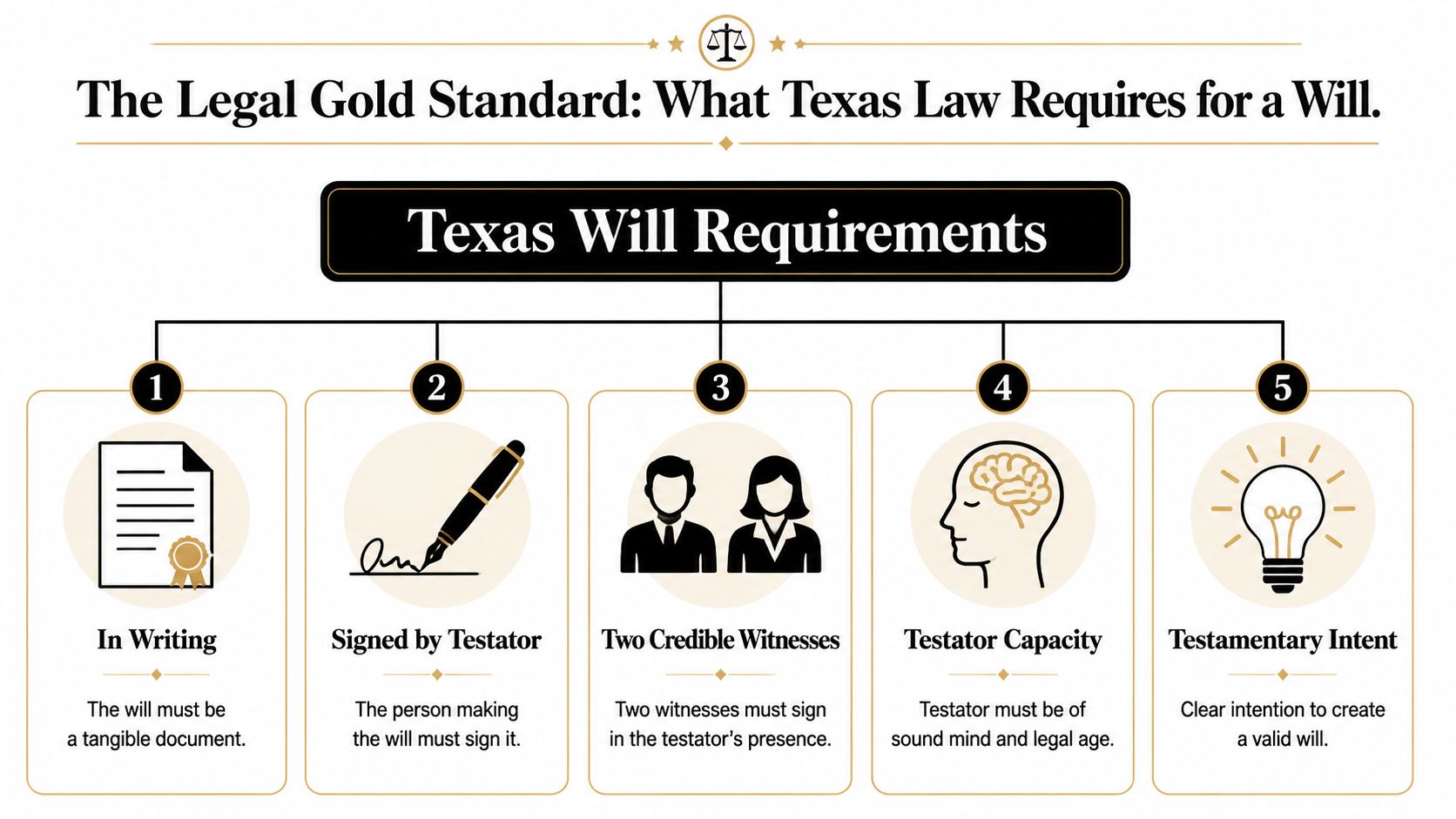
Texas gives a straightforward baseline for a formal attested will. Under Texas Estates Code §251.051, a will must be in writing, signed by the person making it, and attested by two credible witnesses who sign in the testator's presence. You can review a fuller discussion of signing formalities in this guide on how wills are executed in Texas.
The three pillars that matter most
Texas baseline: the will must be in writing, signed by the testator, and signed by two credible witnesses in the testator's presence.
Those are the core formalities. In everyday language:
- In writing means there has to be an actual written will. A conversation, note to a child, or verbal statement usually won't do the job for a standard attested will.
- Signed by the testator means the person making the will must sign it, or have someone sign at that person's direction and in that person's presence if the law allows.
- Two credible witnesses means two people must witness the signing and sign the will in the required setting.
What “credible” and “present” mean in real life
Families frequently encounter difficulty with this. “Credible witness” is not just “someone nice” or “someone who was nearby.” In practice, lawyers pay close attention to whether the witnesses are disinterested, meaning they are not receiving property under the will in a way that creates a conflict.
Likewise, “in the testator's presence” doesn't mean one witness signs now and the other signs tomorrow after hearing what happened. The execution should be treated as a formal event. Everyone who needs to sign should be there, together, doing it correctly.
Here is what that often looks like in a lawyer's office:
| Step | What happens |
|---|---|
| Review | The will is reviewed for names, gifts, and executor choices |
| Signing | The testator signs the will |
| Witnessing | Two proper witnesses sign while present with the testator |
| Affidavit | A self-proving affidavit is often signed to make probate easier later |
Texas law also cares about capacity and intent. The person making the will should understand, in a general way, what property they own, who their family members are, and that they are signing a will. Those issues often become important when someone later claims the deceased was confused or pressured.
For families creating or updating estate plans, individualized advice often matters more than the template itself. A wills-and-estates review through a Wills & Trusts resource can help catch execution issues before they become probate disputes.
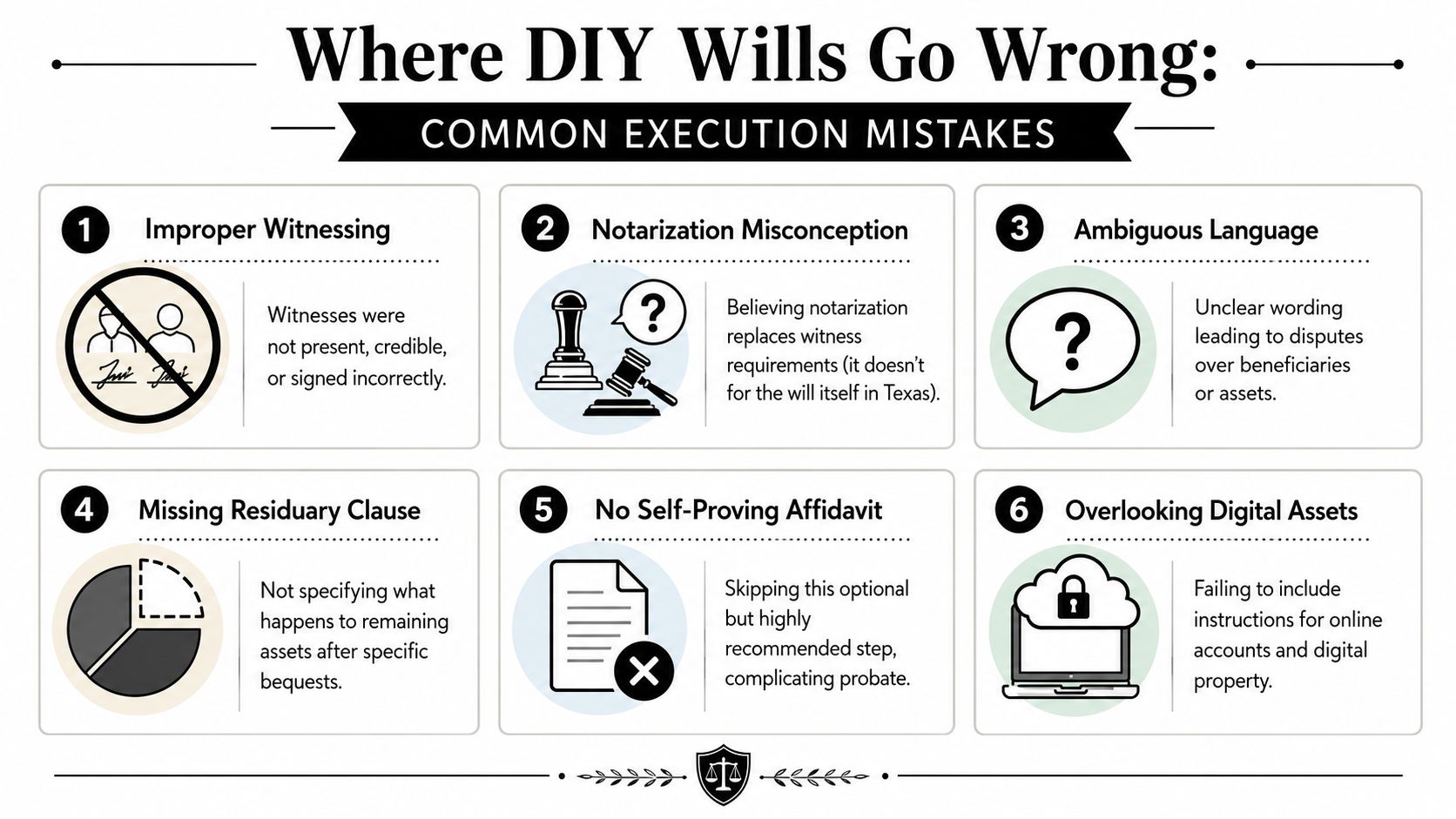
Where DIY Wills Go Wrong Common Execution Mistakes
The biggest weakness in many do-it-yourself wills isn't the printed language. It's the gap between downloading the document and completing the legal steps correctly. That gap is what lawyers mean by execution risk.
As noted in this discussion of online will validity and execution risk, the form itself doesn't complete the legal formalities for the user. People often assume the brand made the will valid, when the real issue is whether it was signed and witnessed exactly as state law requires.
Mistakes that create probate trouble
Some errors are small inconveniences. Others can derail the will entirely.
- A beneficiary serves as a witness. A father leaves property to his daughter, then asks her to witness the will. That can create problems because the witness has a personal stake in the outcome.
- The testator signs alone first. A person signs the will on Monday, then asks two friends to add their signatures later. That can undercut the required ceremony.
- The witnesses weren't present. One witness signs in the living room. Another signs later at work. That may not satisfy Texas formalities.
- Everyone relies on a notary and skips witnesses. In Texas, notarization can help with a self-proving affidavit, but it does not replace witness requirements for the will itself.
- The original can't be found. A scanned PDF may exist, but the signed original is missing. That creates another layer of proof problems in probate.
Problems that don't always void a will but still slow everything down
A will may survive, yet still become harder to probate if it lacks a self-proving affidavit. That affidavit is a sworn statement, usually signed before a notary, that helps the court accept the will without later chasing down witnesses to testify. If the affidavit is missing, the will may still be admitted, but the process can become more cumbersome.
Another issue is unclear drafting around family dynamics. Blended families, separate property, community property, and digital accounts can all create confusion if the language is too general.
Practical rule: If a DIY will was signed casually, witnessed by family members who inherit, or completed in stages, treat it as a document that needs review before anyone assumes probate will be routine.
When these mistakes lead to a contest, the dispute often lands in probate litigation. Families dealing with that kind of conflict often need guidance on probate litigation issues in Texas.
A Tale of Two Wills The Probate Journey
The difference between a solid will and a flawed one becomes clear when a family enters probate.
The Martinez family had two recent losses in the same extended family. Their father had signed a will with an attorney, along with witnesses and the usual supporting paperwork. Their uncle had used an online will and handled the signing at home.
The smoother file
When the father died, the executor filed the will, attended the prove-up hearing, and received authority to act for the estate. The court process was still serious, but it was predictable. The family could gather assets, pay final expenses, and move toward distribution without arguing over whether the document counted.
That's what many people hope probate will look like. Not effortless, but orderly.
The hard file
The uncle's situation was different. He had a LegalZoom will, but his two children, who were also the main beneficiaries, signed as witnesses. Nobody thought that choice mattered at the time. It mattered later.
The executor then faced questions the family had not expected. Was the will properly witnessed? Would the court accept it? If not, who inherited under Texas law? Could title to the house be cleared without a full fight?
A defective will can push a family toward a contest, delay property transfers, and strain relationships that were already fragile. If you're facing that kind of dispute, this overview of contesting a will in Texas explains the issues that often arise.
For readers who want a plain-language overview of why wills, powers of attorney, and probate planning matter together, EHF Mortgages' advice on wills and probate gives a helpful non-Texas general primer.
The lesson from these two files is simple. Probate stress usually doesn't come from the paper alone. It comes from uncertainty about whether the paper will survive court review.
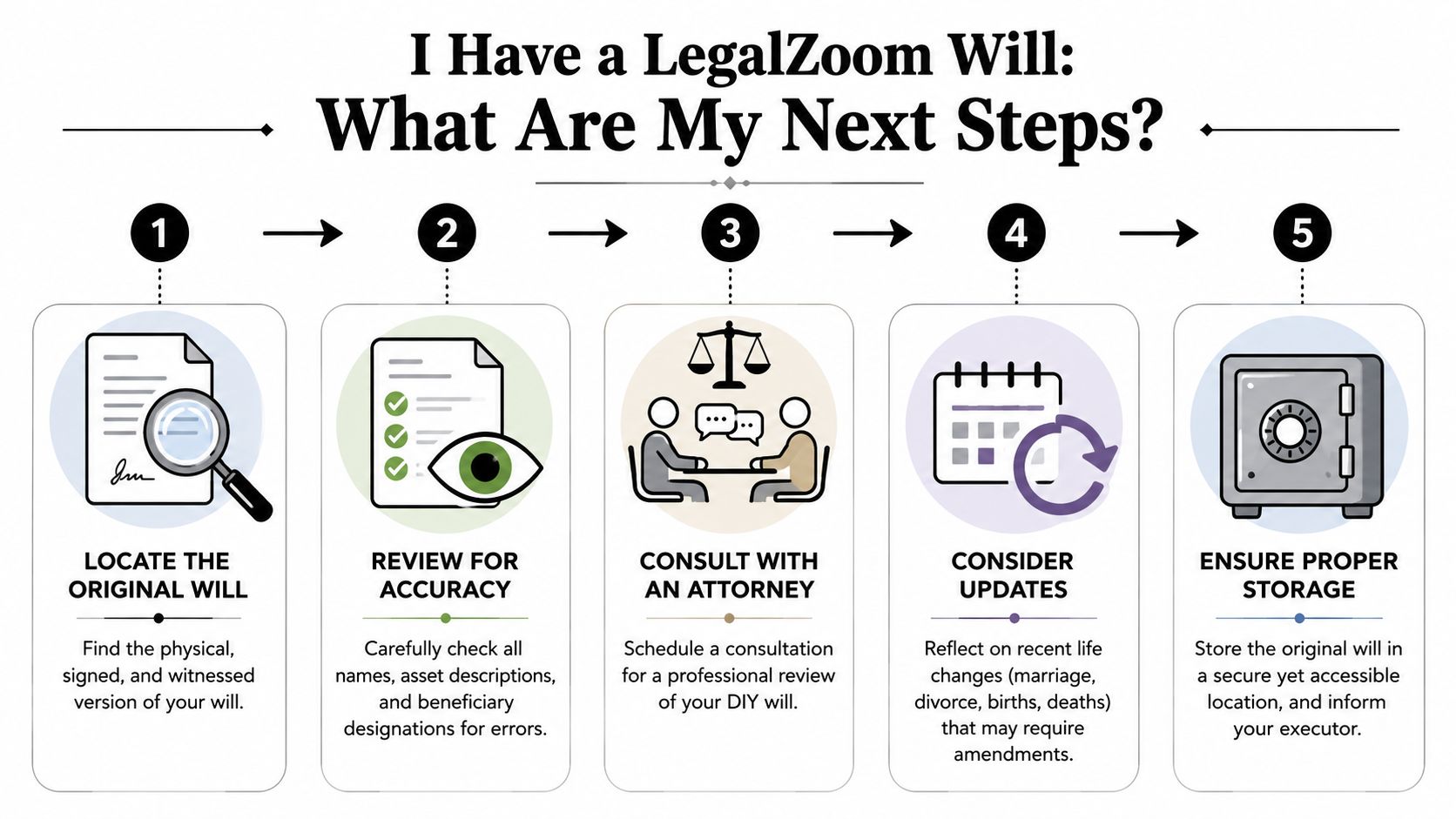
I Have a LegalZoom Will What Are My Next Steps
If you're holding a LegalZoom will right now, don't panic and don't assume anything. Start with a calm document check.
Online wills remain a common entry point because they are accessible and lower cost. LegalZoom says only 24% of Americans have a will, and retirees are expected to transfer more than $124 trillion; the same source lists basic online will pricing around $129, which helps explain why many families start there, even though legal force still depends on proper execution under state probate rules, according to LegalZoom's estate-planning statistics page.
Start with the document itself
Find the original signed will
Courts prefer the original. A copy may still matter, but the original signed document is far stronger.Check for the testator's signature
Look at the signature page carefully. Make sure the person who made the will signed it.Look for two witness signatures
Confirm there are two witnesses. If the witnesses are also beneficiaries, flag that immediately for legal review.Check for a self-proving affidavit
This is often attached near the end and notarized. If it exists, probate may be simpler. If you want to understand that document better, this guide on a Texas self-proving affidavit for a will is useful.
Here is a short video that helps frame the probate side of the issue:
Understand the possible Texas paths forward
If the will appears valid, the next step may be standard probate. That usually means filing the will, asking the court to admit it, and requesting authority for the executor to act. A practical overview of that process appears in this guide to the Texas probate process.
If the will has execution problems, the remedy depends on the estate:
- Muniment of Title may help in some simpler situations, especially when the primary need is to transfer title and there are no unpaid debts requiring full administration.
- Affidavit of Heirship can be useful when there is no usable will or no probate is being opened, particularly for certain real-property title issues.
- Full probate administration may still be necessary if there are debts, disputes, or questions about authority.
When to get legal review
If any of the following apply, get the will reviewed before taking the next step:
- Missing original
- No witness signatures
- Beneficiaries acted as witnesses
- Handwritten changes on the document
- Family conflict about what the deceased wanted
A probate lawyer can usually tell fairly quickly whether the issue is a fatal defect, a fixable probate problem, or a matter of choosing the right procedure. The Law Office of Bryan Fagan, PLLC handles probate administration, affidavits of heirship, muniment of title cases, and probate litigation, which are the kinds of proceedings that often become relevant when a DIY will has execution flaws.
Key Insights and When to Call for Help
If you remember only a few points, remember these.
Key insight
- A LegalZoom will can be valid in Texas. The company name alone doesn't make it valid or invalid.
- Execution is the key pressure point. Texas courts care whether the will was signed and witnessed properly.
- DIY wills often fail at the ceremony, not the template. Family members sign in the wrong roles, witnesses aren't present together, or the original can't be located.
- A flawed will does not always mean the estate is stuck. Texas may still offer workable paths such as probate by another method, muniment of title, or an affidavit of heirship depending on the facts.
- Early review saves stress. It is much easier to assess the document before someone starts transferring property, closing accounts, or relying on assumptions.
Texas probate law can feel intimidating, especially during a loss. Most families aren't looking for a law school lecture. They want to know who inherits, who can act, whether the house can be sold, and how to avoid a court fight. Those are practical questions, and they deserve practical answers.
If you're dealing with a LegalZoom will after a death, the most useful first step is usually a document review focused on signatures, witnesses, original paperwork, and the estate's assets. If you're creating your own plan now, the lesson is just as important. The signing process is not a formality to rush through. It is the part that gives the document legal force.
And if the will is defective, that still doesn't mean all is lost. It means the family needs the right Texas probate strategy.
If you're facing probate in Texas, our team can help guide you through every step, from filing to final distribution. Schedule your free consultation today with Law Office of Bryan Fagan, PLLC.