Skip to content
Losing a loved one is hard enough. Then the practical problems start. A bank freezes an account, a mortgage company asks who has authority to speak for the estate, or a title company says it needs “Letters Testamentary” before anything can move forward.
If that's where you are, your confusion is normal. Most executors have never heard the term until they're already grieving and trying to keep up with bills, property, and family questions. In Texas, many families assume a will is enough to start handling assets, but it isn't. Until the probate court issues Letters Testamentary, the executor has no legal authority to access accounts, transfer property, or manage estate assets, and acting too soon can create personal liability for unauthorized transactions, as explained by Burch Law's discussion of executor authority in Texas.
A Guide for Executors Navigating Loss and Legal Duties
A common situation looks like this. A daughter finds her father's will in a desk drawer. The will names her as executor, so she assumes she can close his bank account, pay his final bills, and list his home for sale. Then the bank says no. The title company says no. Everyone asks for the same document she doesn't have.
That document is usually the turning point between confusion and clarity.

In plain terms, Letters Testamentary are the court's official confirmation that the executor named in the will may now act for the estate. Before that happens, the will expresses the decedent's wishes, but it does not by itself confer the legal power to carry them out.
That's where many Texas families get tripped up. They want to do the responsible thing quickly, but speed without legal authority can cause trouble. A bank may reject transactions. A title company may stop a sale. Family members may question decisions. What feels like “just helping” can become a legal problem if the court hasn't formally appointed the executor.
Practical rule: If an institution asks for Letters Testamentary, treat that as a sign that probate authority is required before you act.
Texas probate law is built to create order during a difficult time. Titles 2 and 3 of the Texas Estates Code govern many of the rules families encounter in probate, including wills, estate administration, and the authority of personal representatives. The process can feel formal, but it exists to protect the estate, the beneficiaries, and the executor too.
If you've been handed this role, you don't need to know everything on day one. You just need to understand the next right step.
What Are Letters Testamentary in Plain English
A lot of executors hit the same confusing moment. You have the will in your hands, family members are asking what happens next, and a bank or title company says they need something called Letters Testamentary before they can talk to you. That can feel cold and bureaucratic at a time when you are just trying to do right by someone you love.
In plain English, Letters Testamentary are the probate court's written proof that you have legal authority to act for the estate. The will tells the court who the deceased person wanted to serve as executor. The Letters Testamentary are what show everyone else that your authority is now official.
That difference matters more than many families expect. A will is the instruction sheet. Letters Testamentary are the document that lets you carry out those instructions with confidence.
What the letters let you do
Once the court issues them, Letters Testamentary usually let an executor:
- Access estate accounts so money can be collected, protected, and used for estate purposes
- Work with creditors and pay valid debts in the proper order
- Handle real property such as a home that may need to be transferred or sold
- Speak with banks, insurance companies, and title companies that need court-issued proof of authority
- Carry out the will by getting property to the right beneficiaries at the proper time
Without this document, you may be the named executor but still be unable to complete basic tasks. With it, you step into a fiduciary role recognized by law. “Fiduciary” sounds technical, but the idea is simple. You must act ethically, carefully, and in the best interests of the estate and the beneficiaries.
Why the court is involved
The court is not trying to make a hard season harder. It is creating a clear chain of authority so institutions know who can act, beneficiaries know who is responsible, and the executor has legal protection while carrying out the job.
That is why a family can have a valid will and still be stuck. Until the will is admitted to probate and the executor is formally appointed, money may stay frozen, property transfers may stall, and routine financial tasks may be denied.
For readers trying to understand the procedures for Letters Testamentary in Texas, one rule keeps things straight: the will names the executor, and the court-issued letters confirm the executor's power to act. If you want to see how that starts in practice, this guide to filing a probate application in Texas explains the first filing step.
For many executors, this is the point where the role starts to feel less mysterious. Letters Testamentary are not just paperwork. They are the document that lets you carry out your loved one's final wishes in an orderly, legally recognized way.
How to Get Letters Testamentary in Texas Step by Step
A lot of executors reach this point with a stack of papers on the kitchen table, a phone full of unanswered voicemails, and one question that keeps repeating: what do I do first?
The good news is that Texas probate follows an ordered process. Once you see the sequence, it feels less like a maze and more like a checklist. Your job is to move through each step carefully so the court can confirm your authority and let you carry out your loved one's wishes with confidence.
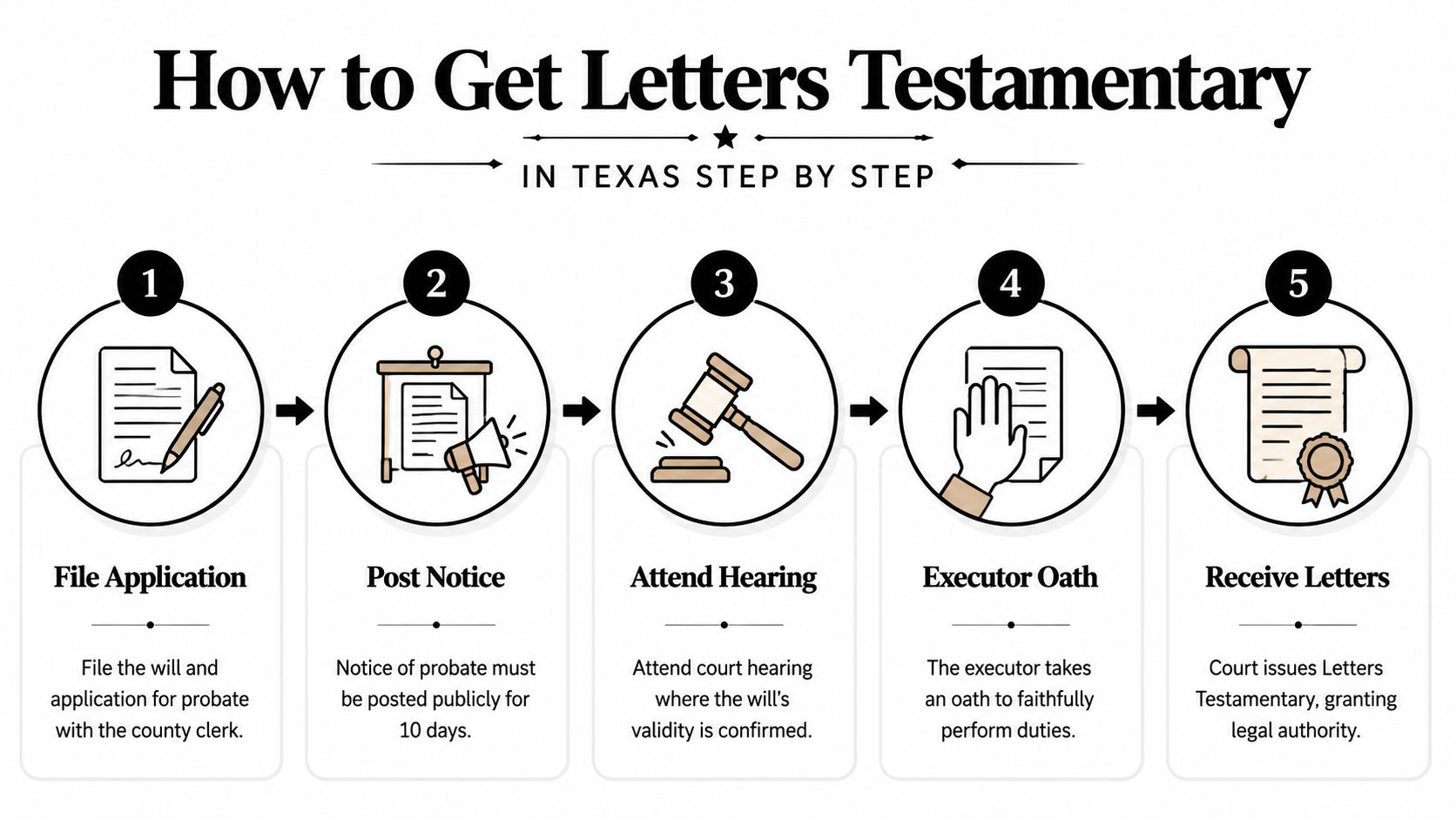
File the probate application
The process begins in the probate court for the county where the deceased person lived at death. The usual filing is an Application to Probate Will and for Issuance of Letters Testamentary. Courts commonly expect the original signed will and a certified death certificate with that filing.
If you want a practical walkthrough of that first stage, this guide to filing a probate application in Texas explains the paperwork and filing sequence in more detail.
This first filing matters because it starts the legal case. Until that application is on file, the court has nothing in front of it to approve, and you remain the person named in the will rather than the person officially authorized to act.
Watch the filing deadline carefully
Texas law sets a deadline that many families do not realize exists. In general, an application to probate a will must be filed within four years after death.
That deadline has real consequences. If too much time passes, the will may not be admitted to probate in the usual way, and the estate can become much harder to administer. In some situations, property may end up passing under Texas inheritance rules instead of under the will. For a grieving family, that can feel like losing control of the plan your loved one carefully put in writing.
Wait for notice and prepare for the hearing
After the application is filed, the clerk posts notice, and the case is set for a hearing. Many people hear the word "hearing" and picture a courtroom battle. In an uncontested probate, it is often much simpler than that. Still, it is an important step.
At the hearing, the court needs enough proof to admit the will to probate and appoint the executor. The judge may ask basic questions about the will, the death, and your qualifications to serve. If you have never been in probate court before, that can feel intimidating, but the purpose is straightforward. The court is confirming that the right person is stepping into the role.
The process usually looks like this:
- Application filed: The probate case is opened in the correct county.
- Original will submitted: The court typically wants the original signed document.
- Notice posted: Public notice is given before the hearing.
- Hearing held: The executor or another proper witness answers the court's questions.
- Will admitted to probate: The judge accepts the will and appoints the executor.
- Oath taken: The executor formally accepts the duty to serve.
- Letters issued: The clerk prepares the document banks and others usually request.
A short visual walkthrough may help if you're trying to picture how these steps fit together.
Take the oath and receive the letters
Once the judge approves the will and appoints you, you must take the executor's oath. After that, the clerk can issue the Letters Testamentary.
This is the moment many executors feel the ground shift under their feet. Before, you were trying to help your family while hoping others would accept your word. Now you have court-issued proof of authority. That document is the key that usually lets you open an estate account, speak with financial institutions, collect estate property, and begin settling affairs in an orderly way.
If the estate includes a house, land, or other inherited property that may later be sold, tax questions can come up early. For a practical explanation of basis and sale issues, see Allied Tax Advisors guidance.
In many Texas estates, the administration is independent, which usually means fewer court approvals after appointment. In others, closer court supervision is required. Either way, receiving the letters marks a turning point. You are no longer guessing about your authority. You have the legal tool you need to carry out your loved one's final instructions.
Your Duties After the Court Issues Letters Testamentary
The day you receive Letters Testamentary, your role changes in a very practical way. You are no longer just the family member trying to sort through papers and answer anxious questions. You are the person the court has authorized to carry out your loved one's final instructions.
That can feel heavy. It can also bring clarity.
Letters Testamentary work like an official set of keys. They let you speak for the estate, deal with banks and title companies, protect property, and begin putting the estate in order. The job is still serious, but it becomes much easier once you know the first steps and the order they usually happen.
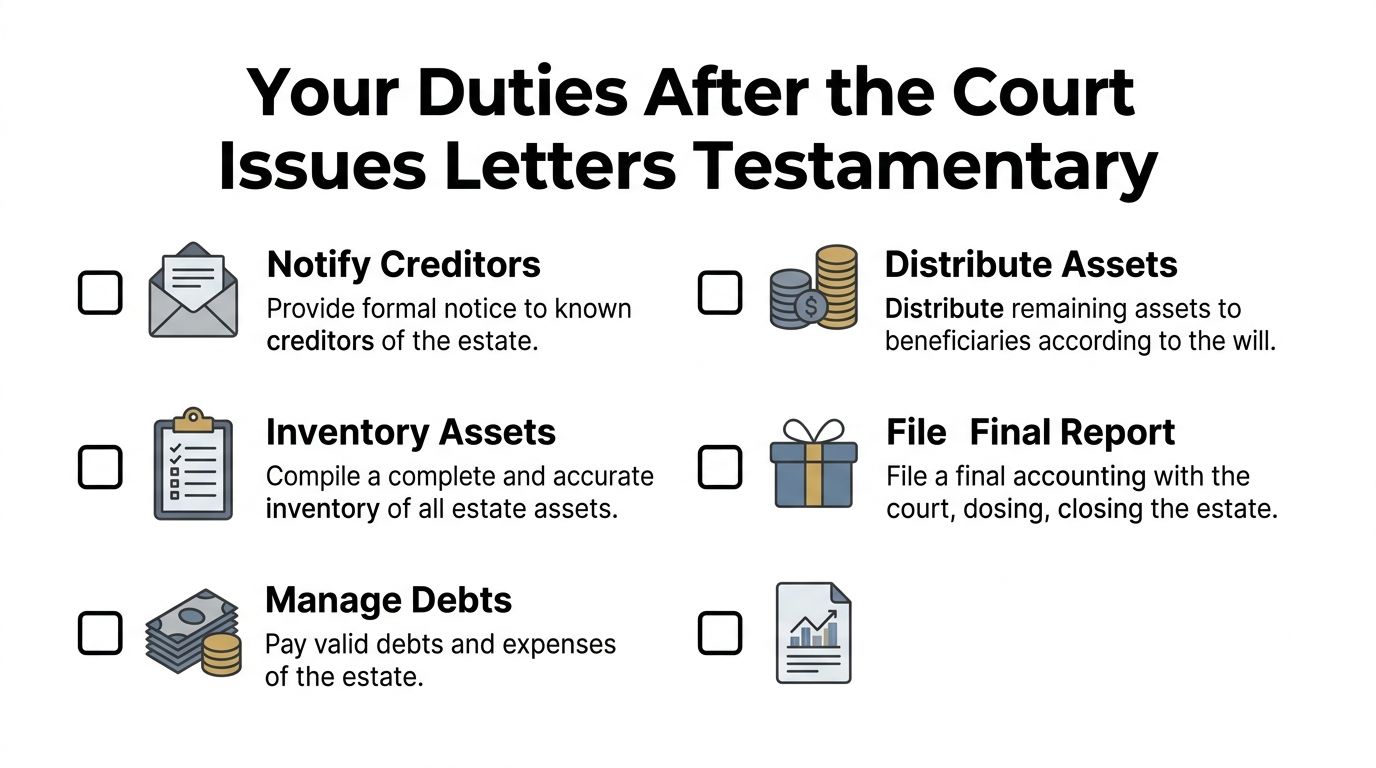
The first wave of responsibilities
Start by treating the estate like a household that now needs one careful manager. Your first job is protection and organization. That usually means securing the home, forwarding mail, locating financial records, and making sure insurance remains in place if the estate includes a house or vehicle.
Then turn to notice and paperwork. In many Texas independent administrations, the executor must notify beneficiaries and creditors, then file either an Inventory, Appraisement, and List of Claims or an Affidavit in Lieu of Inventory within a set deadline after appointment. As noted earlier, Texas probate rules also require formal notice steps, so it helps to calendar each deadline as soon as your letters are issued.
These early duties often include:
- Protect estate property: Secure homes, vehicles, valuables, and important records.
- Identify what the estate owns: Gather deeds, account statements, insurance policies, tax documents, and business records.
- Notify the right people: Provide the notices Texas law requires for beneficiaries and creditors.
- Review claims carefully: Do not pay bills just because someone sends one. Confirm the debt and whether it is properly presented.
- Create a paper trail: Keep copies of letters, receipts, bank records, and notes of important conversations.
If you want a practical overview of the day-to-day role, this guide to the duties of an executor of an estate explains what carrying those responsibilities looks like in real life.
Managing debts, property, and distribution
A common mistake is assuming the will lets you hand out assets right away. Usually, the estate has to be settled before property is distributed. That means identifying assets, dealing with valid debts, handling taxes and expenses, and making sure title issues are cleared up.
A simple example shows why order matters. Suppose your mother's estate includes a home, one bank account, and a few outstanding credit card balances. Before you transfer the house or divide the bank account, you may need to keep utilities on, gather the account funds into an estate account, review creditor claims, and determine what the estate owes. Taking those steps protects the beneficiaries and protects you.
Real estate often brings extra questions. If the family may sell inherited property, tax consequences can follow, especially if the sale happens months later after values have changed or improvements are made. In that situation, some executors read Allied Tax Advisors guidance to get a clearer sense of how inherited property sales can affect taxes.
Good records prevent many problems. Save receipts. Keep statements. Document when you sent notices, when you received claims, and why you made each payment. If a beneficiary later asks, "What happened to this account?" you should be able to answer with documents, not memory.
Distribution comes last, after the estate is ready. Handling the work in that order often turns the executor's role from stressful guesswork into a steady process. You are honoring your loved one's wishes, one careful step at a time.
Alternatives to Full Probate in Texas
A full probate administration is not the only path in Texas. In some estates, a shorter legal route gives the family what they need without appointing an executor and going through every step required for Letters Testamentary.
That can be a relief to hear when you are already carrying a lot. If your job is to carry out a loved one's wishes, the first question is not, “How do I do the biggest probate process?” The better question is, “What legal tool fits this estate?”
When a simpler option may work
A muniment of title may work when there is a valid will and the estate has no unpaid debts other than debt tied to real property. In plain English, the court uses the will itself to transfer title, usually without naming an executor. This can be a good fit when the main goal is to move a house or other property into the right hands.
A small estate affidavit may be available for some lower-value estates that meet Texas requirements. Families usually explore this option when there is no need for a full administration and the estate falls within the state's limits. If you want to compare that path more closely, this guide to the Texas small estate affidavit requirements and process is a practical starting point.
An affidavit of heirship serves a different purpose. It is commonly used to help establish the history of ownership for real estate when someone died without a will. It can solve title questions, but it does not replace probate in every situation.
The easiest way to understand these options is to picture the job each one does. Letters Testamentary give someone authority to act for the estate. A muniment of title lets the will do much of the transfer work. A small estate affidavit can help qualifying heirs collect property without a full administration. An affidavit of heirship helps show who inherited real property when the family needs a clear ownership record.
Texas Probate Options at a Glance
| Method | Best For | Court Involvement | Typical Timeframe |
|---|---|---|---|
| Letters Testamentary | A valid will exists and an executor needs authority to act | Formal probate with court appointment | Varies by county and case complexity |
| Muniment of Title | A valid will exists and the estate has no unpaid debts other than secured real property debt | Limited court involvement after admission of the will | Often faster than full administration |
| Small Estate Affidavit | Qualifying smaller estates meeting Texas requirements | Reduced court process compared with full administration | Often simpler than full probate |
| Affidavit of Heirship | Real property issues where no will exists and heirs need to clarify ownership history | Usually used alongside title-related steps rather than full administration | Depends on title company and property circumstances |
A simpler procedure is not a lesser one. It may be the right legal fit for carrying out your loved one's wishes with less cost, less delay, and less strain on the family.
The right choice depends on several practical questions. Was there a valid will. Are there unpaid debts. Is real estate involved. Will a bank, title company, or other institution accept the probate tool you plan to use.
Those details matter because the goal is not just to finish paperwork. The goal is to choose the process that gives you enough legal authority to settle the estate correctly and with confidence.
Common Pitfalls and Special Considerations
A lot of executor problems start the same way. Someone is grieving, trying to keep the peace in the family, and doing the practical tasks first. They clean out the house, forward the mail, and pay a few urgent bills. Then a bank, title company, or buyer asks for court-issued proof of authority, and the executor realizes good intentions are not the same as legal authority.
That moment can feel discouraging. It does not mean you have failed. It usually means the estate has reached the point where careful probate work matters most.
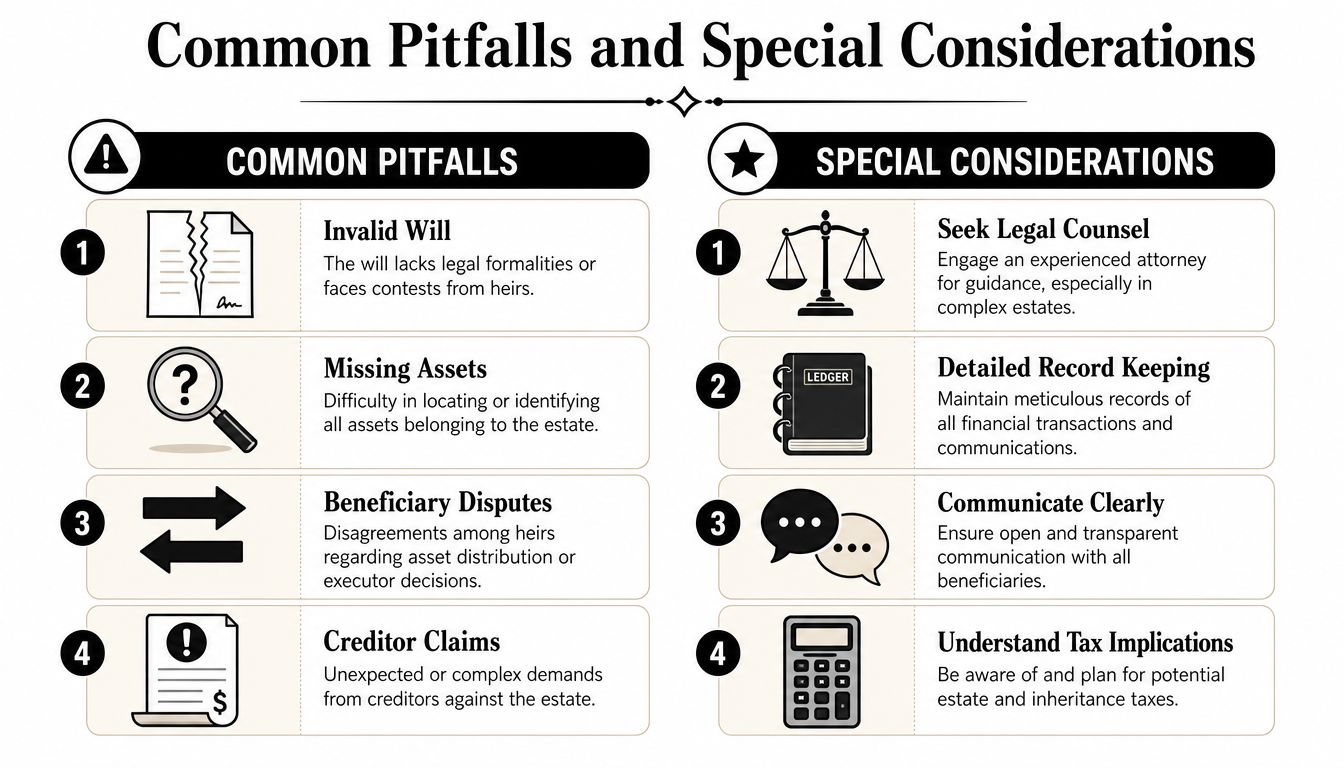
A realistic example
An executor may do everything in good faith, get certified copies of the Letters Testamentary, and then spend months sorting personal property and coordinating with siblings. Later, the executor goes to the bank expecting a routine transfer. The bank asks for recently issued certified letters.
That surprises many families. The letters may still reflect valid court authority, but some institutions prefer a fresh certified copy before they release funds or retitle an account. In practice, the solution is often simple. The executor requests updated certified copies from the clerk. Still, the delay can create real stress when mortgage payments, insurance, taxes, or property upkeep are already due.
This is one of the hardest parts of serving as executor. You may be acting responsibly the whole time and still run into procedural roadblocks.
Problems that call for extra care
Some issues raise the difficulty level quickly because they affect the court's confidence, the estate's timeline, or both:
- The original will cannot be found: A photocopy is not automatically treated the same as the signed original. If the original is missing, the court may require additional proof, and the case can become more expensive and time-consuming.
- Someone contests the will: A challenge from an heir or beneficiary can slow everything down and turn a routine probate into a dispute over validity, capacity, or undue influence.
- Minor beneficiaries or serious family conflict are involved: These facts can lead to closer court supervision and more formal procedures, especially if there are concerns about protecting a child's interests or preventing misuse of estate property.
- The named executor lives outside Texas: An out-of-state executor can still serve in many cases, but practical and legal requirements often become more complicated. Texas courts commonly require a nonresident executor to work through a Texas-licensed attorney. Texas Law Help's probate court basics gives a helpful overview of that court process.
There is another trap families often do not see coming. Probate may seem unnecessary at first because no one plans to sell the house right away, no account appears urgent, and the family is getting along. Months or years later, a title issue appears, an asset is still frozen, or a buyer refuses to close without probate authority. By then, delay may limit the options available and create a more difficult path than if the estate had been addressed early.
The executor's job is part legal, part practical, and part emotional. You are carrying out a loved one's final instructions while other people are still processing the loss. That is why prevention matters so much. Keep records. Ask questions early. Treat deadlines and paperwork as tools that help you carry out those wishes with confidence, not as obstacles placed in your way.
Takeaways for Texas Executors and When to Call for Help
The call comes in. A bank says it cannot release funds. A title company asks for probate papers. Family members look to you for answers, and you are still trying to process the loss yourself.
That moment is often when the executor role becomes real.
The good news is that probate in Texas follows a path. Letters Testamentary are the court's written permission slip. They let you step out of guesswork and into a defined job, one that exists to carry out your loved one's final wishes lawfully and carefully.
Keep these takeaways in view:
- Your authority begins when the court recognizes it: Even if you are named in the will, other institutions usually need proof that the court has appointed you.
- Time matters: As noted earlier, Texas law places a deadline on filing an application to probate a will, and waiting too long can limit your options.
- The simplest answer is not always full probate: Some estates can be handled through a shorter or less formal process, depending on what was owned and how it was titled.
- Your job continues after appointment: Gathering assets, protecting property, handling notices and debts, keeping records, and making distributions are all part of finishing the estate the right way.
Many executors feel pressure to know everything at once. You do not need to know everything on day one. You do need to recognize when a problem is larger than ordinary paperwork.
Call for help if the original will cannot be found, relatives disagree about what should happen, the estate includes a business or real estate with title issues, creditors may have strong claims, or you are serving while living outside Texas. Those situations often require strategy, not just forms.
The Law Office of Bryan Fagan, PLLC handles probate and estate administration matters in Texas, including independent administration, dependent administration, and disputes that arise during the process.
A good probate lawyer does more than file documents. The lawyer helps you avoid missteps, explains what the court expects, and gives you a plan you can follow. For many families, that clarity brings real relief. It lets the executor stop reacting to one problem at a time and start completing the work with confidence and respect for the person who died.
If you're facing probate in Texas, our team can help guide you through every step, from filing to final distribution. Schedule your free consultation today.