A DNR medical bracelet is not legally binding on its own in Texas. It's an important signal that tells emergency responders to look for a valid written order, and protection comes from making sure that signal is backed by the right Texas paperwork.
Many families land on this question in a stressful moment. A parent has serious health issues. A spouse wants to avoid unwanted CPR. Someone already wears a bracelet, and the family assumes that means everything is settled. Often, it isn't.
That gap matters. In real emergencies, first responders have to make quick decisions, and they need more than jewelry. They need a legally recognized medical order they can rely on. For Texas families, the safest approach is to treat the bracelet as the alert and the written order as the authority.
That's also why this issue belongs inside a larger estate plan. The same family that needs a DNR often also needs clear health care instructions, updated powers of attorney, and a plan that reduces confusion if a later guardianship or probate dispute arises under Texas Estates Code Titles 2 and 3, which govern many core probate and estate administration rules in Texas.
The Critical Moment What a DNR Bracelet Really Means
A paramedic arrives at a home after a 911 call. Your loved one is unresponsive. The medic notices a bracelet marked DNR and immediately faces a hard question. Is that bracelet enough to stop CPR?
The practical answer is no. A bracelet matters, but by itself it usually doesn't carry the legal force needed for emergency medical teams to withhold resuscitation. In most jurisdictions, it works as an immediate alert that the patient has chosen to forgo CPR, and responders generally still need to confirm the existence of the written order before honoring it, as explained in this overview of DNR orders and emergency verification.
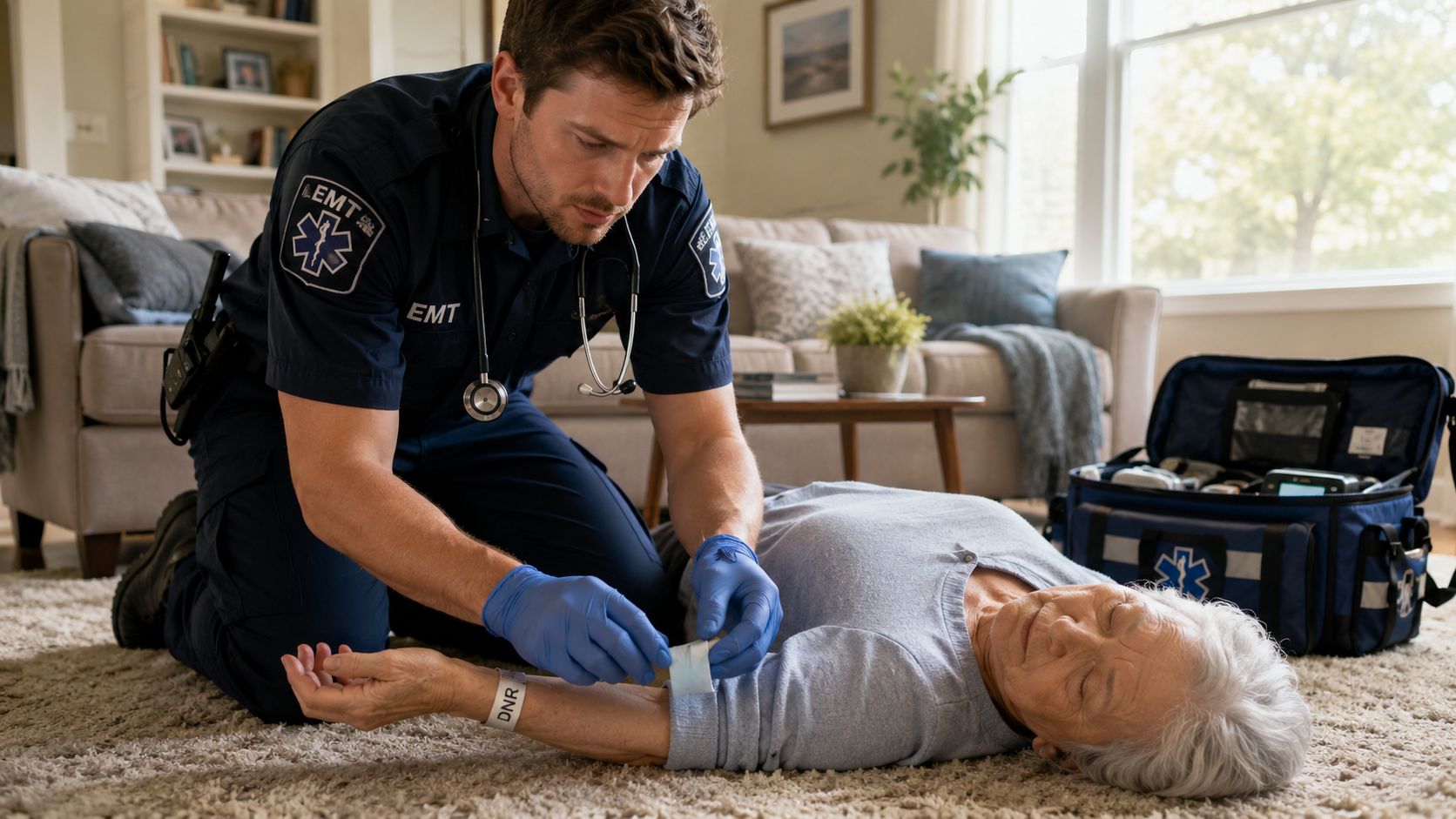
That's where families get tripped up. They see a bracelet as the decision itself. Medical teams often see it as a warning flag that says, “Check for the valid paperwork now.”
Why the bracelet still matters
The bracelet is still useful because emergencies are chaotic. A visual cue can help responders ask the right questions faster, look for the right form, and contact the right people.
Practical rule: If a bracelet exists without a matching written order that Texas responders can recognize, the bracelet may create confusion instead of certainty.
A family caregiver might keep medicines organized, carry a copy of a living will, and assume that's enough. It helps, but a DNR decision is one of those situations where details matter. Families trying to organize this part of care may also find helpful checklists in these Family Caregiving Kit estate planning resources, especially when several documents need to stay coordinated.
The confusion most people have
People often mix up three different ideas:
- A bracelet means a visible alert.
- A DNR order means a doctor's medical order about CPR.
- An estate plan means the broader set of legal documents that support a person's wishes and decision-makers.
Those are related, but they aren't the same thing. If you remember one point from this section, remember this. The bracelet speaks first, but the paperwork speaks last.
DNR Bracelet Versus a Legal DNR Order
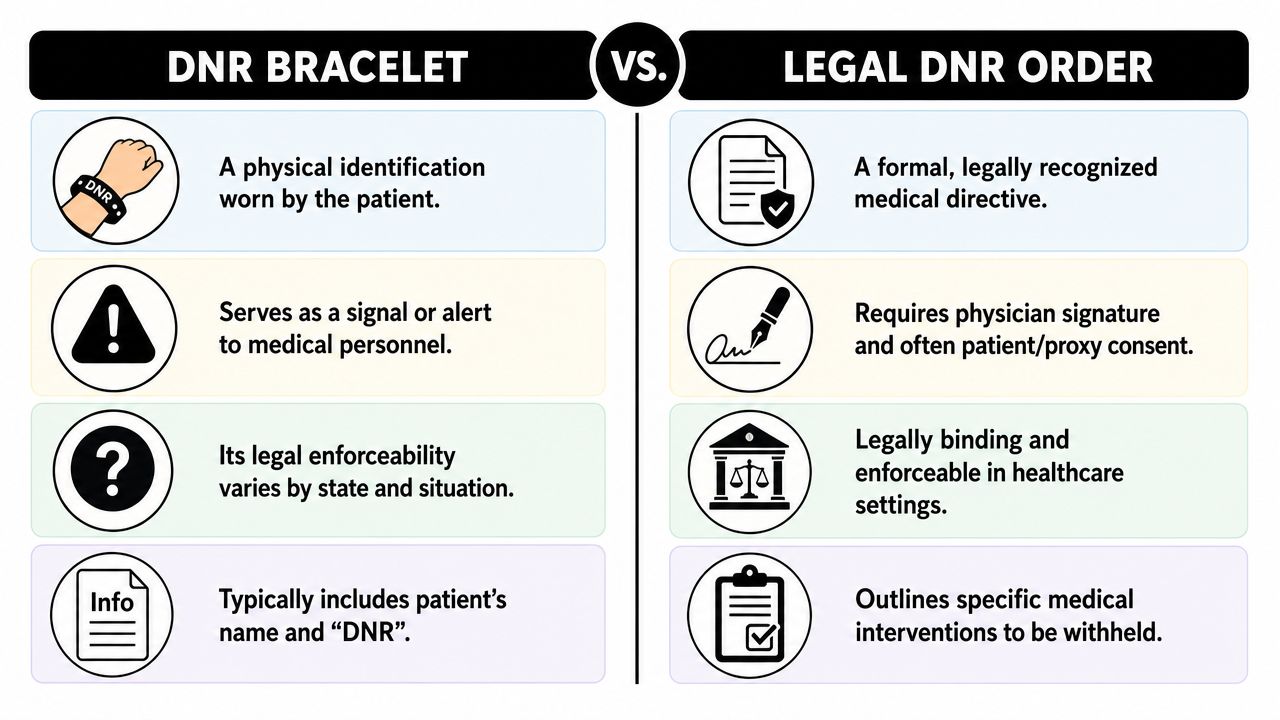
A simple way to think about this is to compare a bracelet to a smoke alarm. The alarm tells everyone there may be a fire. It does not replace the fire department's official response. A DNR bracelet works the same way. It alerts. The written order authorizes.
In states that recognize DNR jewelry within a formal system, the legal force still rests on the physician-signed order. Wisconsin is a useful example. A Wisconsin legal analysis explains that the bracelet serves as a visual indicator of a standing DNR order, not a freestanding legal document, and that emergency and emergency department providers still typically verify the corresponding written order through the Wisconsin Lawyer discussion of Chapter 154 and provider knowledge.
The two items serve different jobs
One item is wearable. The other is enforceable.
| Feature | DNR Medical Bracelet | Official Out-of-Hospital DNR Order |
|---|---|---|
| Primary role | Visual alert to responders | Formal medical order |
| Legal weight | Limited by itself | Carries the actual legal authority |
| Who creates it | Usually obtained after a DNR decision | Physician-signed order under state rules |
| Use in an emergency | Signals responders to look deeper | Gives responders the order they can follow |
| Risk if used alone | May not be enough to stop CPR | Stronger basis for honoring wishes |
Why families confuse them
Part of the confusion comes from how they appear in daily life. The bracelet is visible all the time. The written order may be in a file, a folder, or posted in the home. Because the bracelet is what everyone sees, people assume it's the stronger document.
It usually isn't.
The legal weight of a DNR rests on the signed medical order, not the jewelry that points to it.
A realistic example
Suppose your father signs the proper medical paperwork with his doctor and later gets a bracelet. If the bracelet is visible and the paperwork is accessible, emergency responders have a much clearer path.
Now change one fact. He has the bracelet, but the written order can't be found, and no one on scene knows where it is. That's when a family may discover, at the worst possible time, that the bracelet alone doesn't answer the legal question.
This same distinction shows up in probate and administration matters. Families often have a document somewhere, but not in a form that the right person can use when needed. Under Texas Estates Code Title 2, estate administration depends on proper authority and proper procedure. End-of-life planning works much the same way. Intention matters, but recognized authority matters more.
Understanding Texas Out-of-Hospital DNR Laws
Texas families need to focus on Texas Health and Safety Code Chapter 166, which governs advance directives and related end-of-life medical decisions, including the Texas out-of-hospital DNR framework. In plain English, an out-of-hospital DNR is the medical order designed for emergencies outside a hospital setting.
That matters because many people assume a hospital chart note, a living will, or a generic bracelet will automatically control in every location. Texas law is more specific than that.
What Texas responders need
Emergency personnel generally need the right Texas documentation and identification, not just a general expression of wishes. That's one reason state-specific details matter so much. Some states even impose very specific jewelry rules. For example, Virginia requires certain engraving information for DNR jewelry, and more broadly, state-specific bracelet formats may not be honored across state lines, as described in this discussion of state recognition and engraving requirements for DNR jewelry.
The lesson for Texans is straightforward. A bracelet bought online, inherited from another state's system, or engraved in a generic format may not do what your family thinks it does.
What makes a Texas plan stronger
For a Texas family, the safer process usually includes these pieces working together:
- A valid Texas out-of-hospital DNR order completed in the proper form.
- Physician involvement so the medical order exists in a recognizable legal format.
- Recognized identification such as approved bracelet or necklace options tied to that order.
- Accessible records so caregivers, agents, and responders can locate what they need quickly.
A living will also plays a different role. It generally addresses treatment preferences in serious medical circumstances, but it doesn't automatically function the same way as an out-of-hospital DNR in the field. A durable power of attorney for health care in Texas is also distinct. In plain language, that document names the person who may make health care decisions if you can't speak for yourself. It doesn't replace the medical order itself.
A good Texas plan doesn't rely on one document to do every job. Different documents answer different questions.
Where estate planning overlaps
This issue often surfaces in the same meetings where families discuss wills, heirship, and future administration. For example, if someone is also worried about what happens after death, Dying Without a Will in Texas: Intestate Succession explains how Texas law distributes an estate when there is no will.
That may seem like a separate topic, but the family dynamics are often the same. If wishes are undocumented, incomplete, or inconsistent, the burden falls on relatives during a crisis.
Under Texas Estates Code Title 3, guardianship and related protective proceedings can also become relevant when a person has lost capacity and no one is sure who has authority to act. That's one more reason to prepare the medical side and the estate side together, while the person can still make clear choices.
A Step-by-Step Guide to an Enforceable Texas DNR
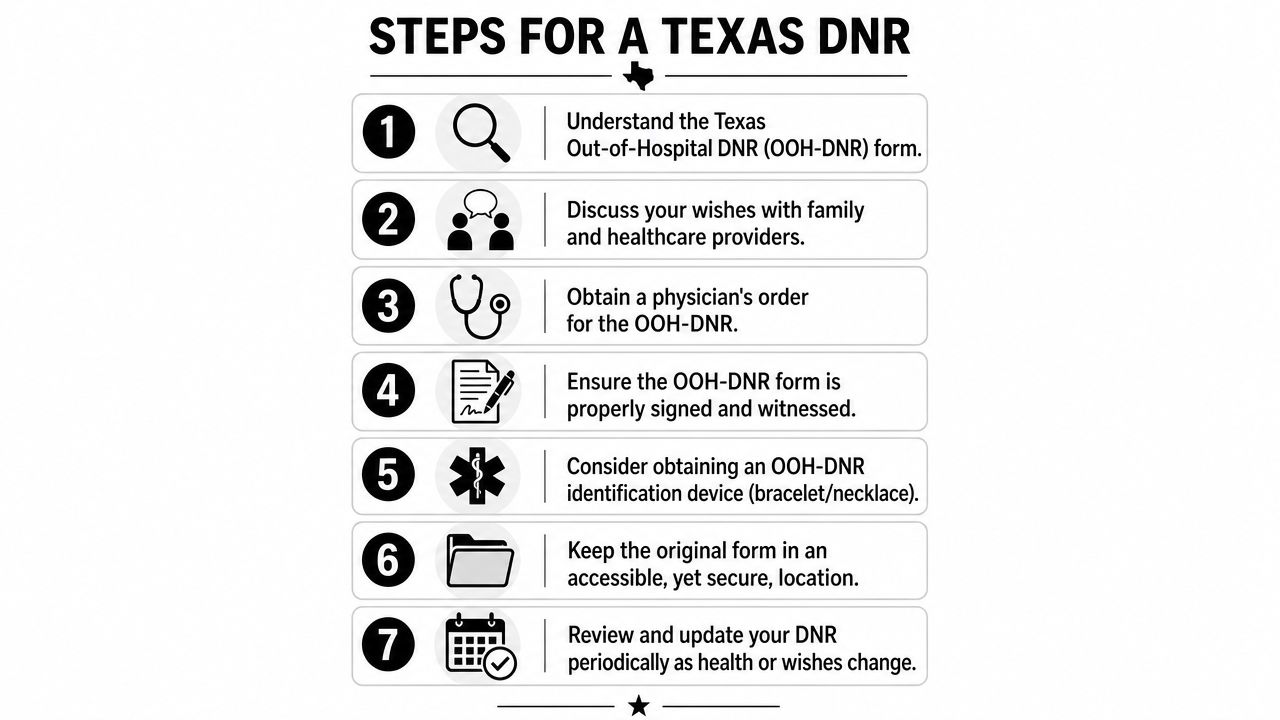
Families often feel better once they have a checklist. This is one area where a simple sequence helps.
Start with the conversation
Begin with the person whose wishes are at stake. Talk through what CPR means, when they would want it withheld, and who needs to know. This should include family members, caregivers, and the treating physician.
If you're also reviewing broader planning documents, a Texas living will form and related advance directive guidance can help clarify how treatment preferences fit together.
Turn wishes into a medical order
A personal preference is not enough. The next step is working with the physician to create the proper out-of-hospital DNR order in the form Texas recognizes.
That conversation should also cover whether the patient has other documents in place, such as a medical power of attorney, guardianship papers, or earlier directives that may need review for consistency.
Here's a helpful visual overview before moving further:
Follow a practical checklist
Confirm capacity and wishes. Make sure the patient understands the decision and can express it clearly, or confirm who has lawful authority to act if the patient cannot.
Use the correct Texas form. Families should avoid relying on a generic internet document or a form designed for another state.
Obtain the required signatures. The order needs to be completed correctly, with the physician's participation and any other formalities Texas requires.
Choose identification carefully. If the person will wear a bracelet or necklace, treat it as a companion to the order, not a substitute.
Place the original where responders can find it. A locked safe that no one can open during an emergency won't help.
Give copies to the right people. Family members, caregivers, facilities, and the named health care decision-maker should know where the order is kept.
Review the plan over time. Health status changes. So do family roles, treatment goals, and care settings.
A home example
Consider a Houston widow with advanced illness who wants comfort-focused care. Her daughter keeps a bracelet on her mother's wrist, but the doctor-signed paperwork stays in a drawer no one can find. That setup leaves room for confusion.
A stronger setup is simple. Keep the proper order accessible, make sure the daughter and the physician's office know its location, and use the bracelet to point responders toward that order. If the family wants help coordinating these documents with probate and incapacity planning, the Law Office of Bryan Fagan, PLLC handles Texas probate, powers of attorney, guardianship matters, and related estate planning.
Navigating Conflicts and Complex Scenarios
The hardest cases usually aren't about whether someone bought a bracelet. They're about what happens when the documents don't line up, or the family doesn't agree.
When a family member objects in the moment
Take a common scenario. A man has a valid out-of-hospital DNR order and wears a bracelet. He collapses at home. One adult child tells EMS, “He never wanted this.” Another is crying and begging for CPR.
That kind of conflict is exactly why paperwork matters. When a valid medical order exists and responders can verify it, it gives them a firmer legal basis for action than an argument at the scene.
When later documents say something different
Another source of confusion is inconsistency between documents signed at different times. Guidance in this area often skips a key question. What if the bracelet reflects an older decision, but a later directive or POLST points the other way?
In Texas, public guidance is often thin on this exact problem, even though the issue matters a great deal. Texas law recognizes multiple end-of-life orders, and POLST documents can override prior DNR directives in some circumstances, which can leave families uncertain if records aren't aligned.
If one document says “do not resuscitate” and a later medical order points elsewhere, the family shouldn't guess. The records need immediate review.
The role of agents and guardians
The role of decision-making authority takes on significance. A person named under a Texas guardianship resource or other health care authority may have a role in revoking, changing, or clarifying prior instructions, depending on the circumstances and the patient's capacity.
A medical power of attorney can be powerful, but it is not unlimited in every context. Temporary guardianship disputes, family challenges, and facility disagreements can complicate what seems clear on paper. If the conflict spills into court or a dispute over authority, that can move into Texas probate litigation involving contested family and estate disputes.
A practical way to reduce risk
Families can lower the chance of conflict by checking these points together:
- One current instruction set. Remove outdated forms and old bracelet information.
- Shared knowledge. Tell the key family members what the current plan is.
- Named decision-maker. Make sure the right agent or guardian documents are current.
- Consistent paperwork. DNR, living will, and related medical instructions should not pull in different directions.
Under Texas Estates Code Titles 2 and 3, clear authority is a recurring theme in probate and guardianship matters. The same principle helps here. Clear authority reduces family conflict when emotions are high and time is short.
Key Insights and Integrating a DNR into Your Estate Plan
A DNR bracelet can help, but it can't carry the whole burden. The safer Texas approach is to combine a visible identifier with the proper out-of-hospital medical order, then align that order with the rest of the person's planning documents.
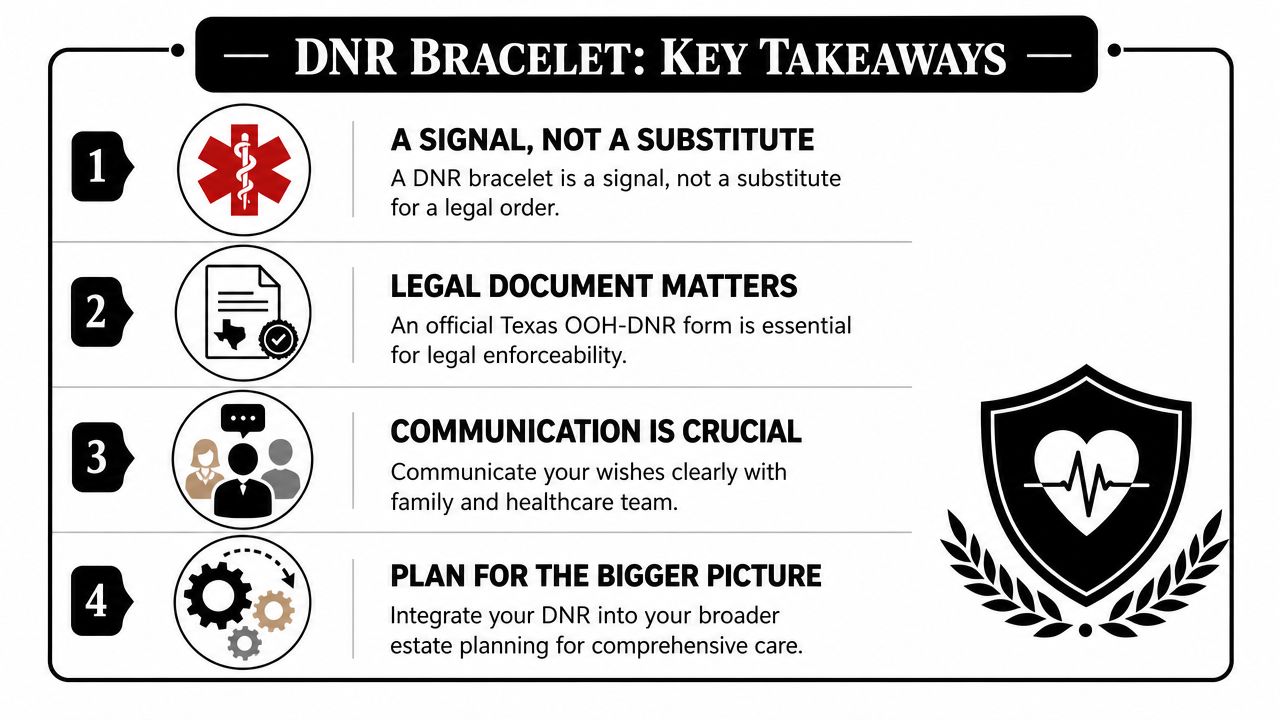
Takeaway
- The bracelet is a signal. It helps responders notice that a DNR may exist.
- The written Texas order is the legal core. That's the document that gives the instruction real force.
- Consistency matters. A DNR should match the person's living will, medical power of attorney, and any later medical orders.
- This can be changed. DNR orders are generally revocable by the patient, guardian, or health-care agent through clear communication and removal of the bracelet, and ignoring a valid documented order can create legal exposure in some jurisdictions, as summarized in Wisconsin's DNR guidance on revocation and provider obligations.
Why this belongs in a full estate plan
A DNR is only one part of a larger plan for incapacity, death, and family decision-making. A complete plan should also address who manages medical choices, who handles finances if incapacity occurs, what happens to property at death, and how conflict is avoided.
That's why many Texas families prepare DNR planning alongside living wills and powers of attorney in Texas, as well as Wills & Trusts and guidance on the Texas Probate Process. When those documents fit together, families have fewer surprises and less room for disagreement during a crisis.
If you're grieving a loss or trying to prepare for one, clarity matters more than complexity. The law should make things more manageable for your family, not harder.
If you're facing probate in Texas, our team can help guide you through every step, from filing to final distribution. Schedule your free consultation today with Law Office of Bryan Fagan, PLLC.