When legal professionals talk about "executing" a will, they aren't referring to a dramatic event. In plain English, it means the formal signing process that gives the document its legal power. This is the single most important moment in a will's creation—the point where your instructions on paper transform into a legally binding instrument that directs how your life's work will be distributed to the people you love.
We understand that planning for the future can feel overwhelming, especially when you are thinking about your family’s well-being. This guide is designed to provide clear, compassionate answers and demystify the process of how wills are executed in Texas.
What It Means to Execute a Will in Texas
Think of executing a will as the official ceremony that validates your final wishes. It’s a specific, legally-defined process designed to prove to a court that the will is authentic and truly reflects what you intended. This process provides certainty and reassurance for your family during a difficult time.
To understand how this works, there are two key players. The testator is the person making the will—that's you. Your signature is the centerpiece of the ceremony. Then there’s the attestation, which is the formal act of having witnesses watch you sign. They then sign the will themselves, "attesting" that they saw you do it, confirming your intentions were clear and voluntary.
The Importance of Correct Execution
Getting the execution right is about more than just checking boxes. It's about protecting your legacy and shielding your family from the kind of stressful legal battles that can cause deep rifts. When a will is executed correctly according to the Texas Estates Code, it becomes very difficult to challenge in court. This gives you peace of mind, knowing your wishes are secure.
Unfortunately, this step is often overlooked. A recent survey found that a startling 60% of Americans don't have a will. This can force their families into a complicated, impersonal, and expensive court process called intestacy, where the state, not you, decides who gets your assets.
Takeaway: The will execution ceremony is the foundation of a valid will. It's a protective measure designed to confirm the testator's intentions were clear, voluntary, and witnessed—all of which are essential for a smooth probate process that honors your legacy and cares for your family.
Core Requirements for a Valid Texas Will at a Glance
Navigating the Texas Estates Code can be a headache, but the core requirements for a valid will are fairly straightforward. We've summarized them here in plain English to give you a clear, at-a-glance overview of what the law demands.
| Requirement | Description (Plain English) | Texas Estates Code Reference |
|---|---|---|
| In Writing | The will must be a physical written document. Oral wills are not valid in Texas (with very rare exceptions for military members). | § 251.051 |
| Signed by Testator | You must sign the will yourself, or another person can sign it on your behalf, in your presence, and under your direction. | § 251.051 |
| Attested by Witnesses | The will must be signed by at least two credible witnesses who are 14 years or older. They must sign it in your presence. | § 251.051 |
Understanding these three pillars is the first step toward creating a document that will stand up to scrutiny in a Texas probate court.
A properly executed will gives your executor—the person you name to carry out your instructions—a clear, legally sound roadmap to follow. It minimizes ambiguity and dramatically cuts down on the risk of disputes among your heirs. People often ask, "Can an Executor Change a Will?" The answer is a firm no, and a flawlessly executed will reinforces their duty to follow your wishes to the letter.
For a deeper dive into the specific formatting and language, our guide on the Texas Last Will and Testament form is a great resource.
The Will Signing Ceremony: Turning Paper into a Legal Document
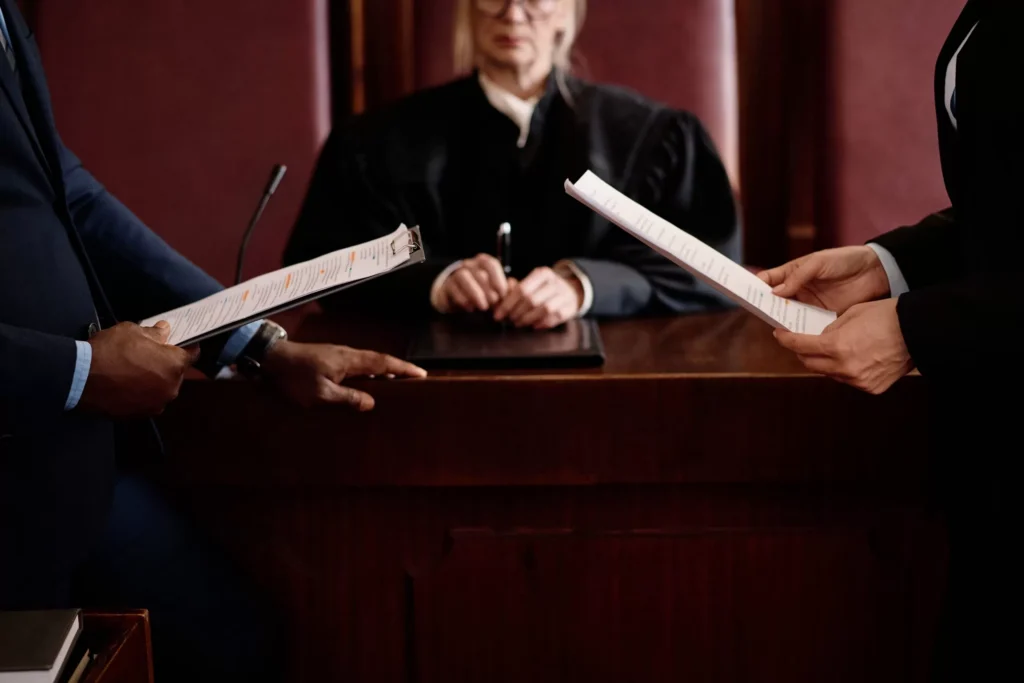
The formal signing ceremony, known as attestation, is the moment your will truly comes to life. It’s a structured event, and for good reason—every step is designed to leave no doubt about your intentions. While it might sound a little intimidating, it's a straightforward process that exists to protect your wishes and your family.
Think of it as a small, official gathering with a single, clear purpose. This isn't just about putting a signature on a piece of paper; it’s about creating an ironclad legal record that a court can trust, years down the road. Every part of this ceremony, from your signature to the witnesses watching you, builds a fortress around your final requests.
The People in the Room and What They Do
For a standard Texas will, the ceremony involves you (the testator) and at least two witnesses. The Texas Estates Code is very clear about who can fill this critical role.
Your witnesses must be:
- Credible, which means they are trustworthy and competent.
- At least 14 years of age.
- Most importantly, they must sign the will in your presence.
That "in your presence" rule is not just a formality. It means your witnesses have to physically see you sign the will, or at the very least, see you acknowledge that the signature already on the document is yours. This strict requirement is there to prevent fraud and ensure the integrity of your will.
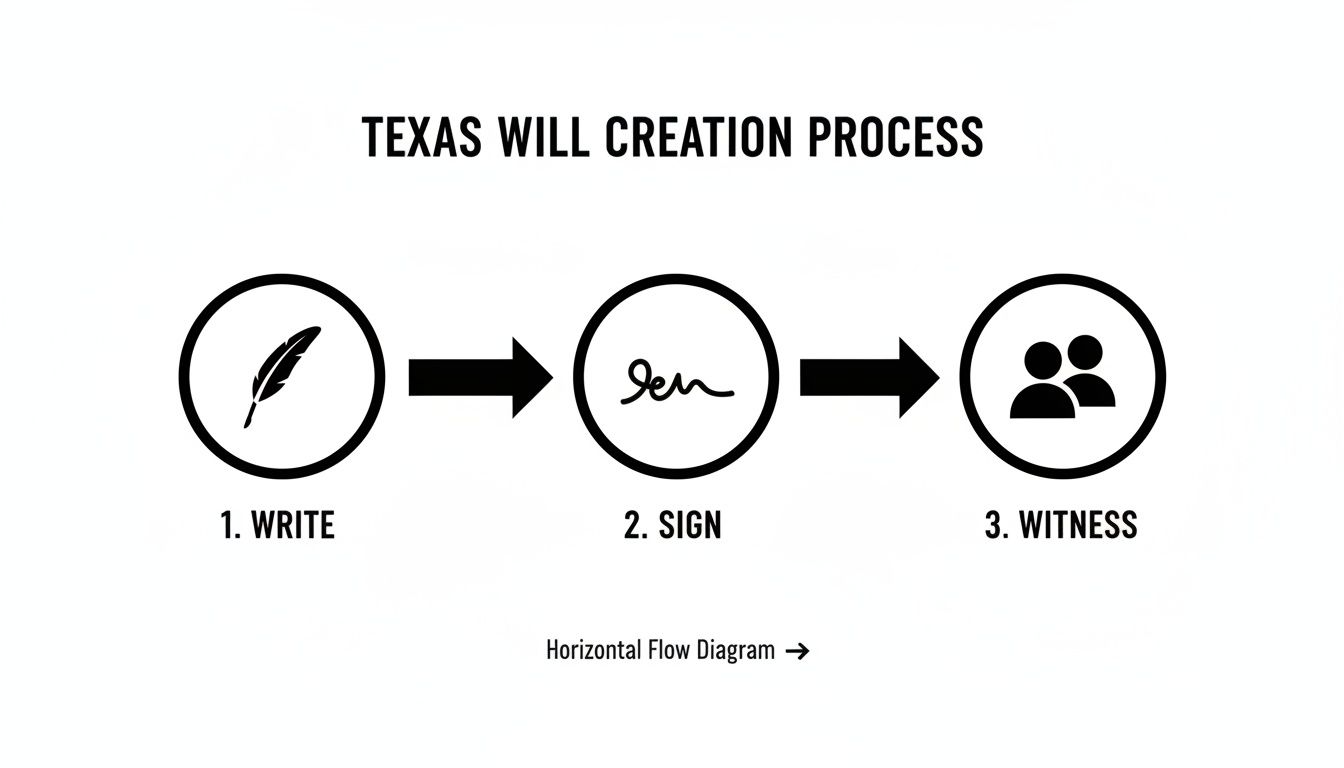
As this visual shows, after you've written the will, the signing and witnessing steps are the final, essential actions that make the document legally binding under Texas law.
A Real-World Signing Ceremony: An Example
Let's walk through what this looks like in practice. Imagine a woman, Brenda, is at her attorney's office with her two chosen witnesses—a trusted neighbor and a longtime friend who are not beneficiaries in her will. The lawyer places the final draft of her will in front of her.
- Declaration: Brenda states out loud to her witnesses, "This is my Last Will and Testament. I have reviewed it, and it reflects my final wishes."
- Testator's Signature: In full view of both witnesses, Brenda signs her name at the end of the will.
- Witnesses' Signatures: Immediately after she signs, her witnesses each sign their names. By doing this, they are "attesting" that they watched her sign and heard her declare that it was her will. Their signatures also serve as proof that she appeared to be of sound mind and was not being pressured by anyone.
This entire sequence—Brenda's declaration, her signature, and her witnesses' signatures—must all happen as one continuous event to be valid.
Takeaway: The signing ceremony is a critical legal procedure. Every single element, from the witnesses' ages to the "in your presence" rule, is there to ensure the will's authenticity and shield it from challenges during the Texas probate process. Executing your will correctly is one of the most profound acts of care you can take for your loved ones.
Streamlining Probate with a Self-Proving Affidavit
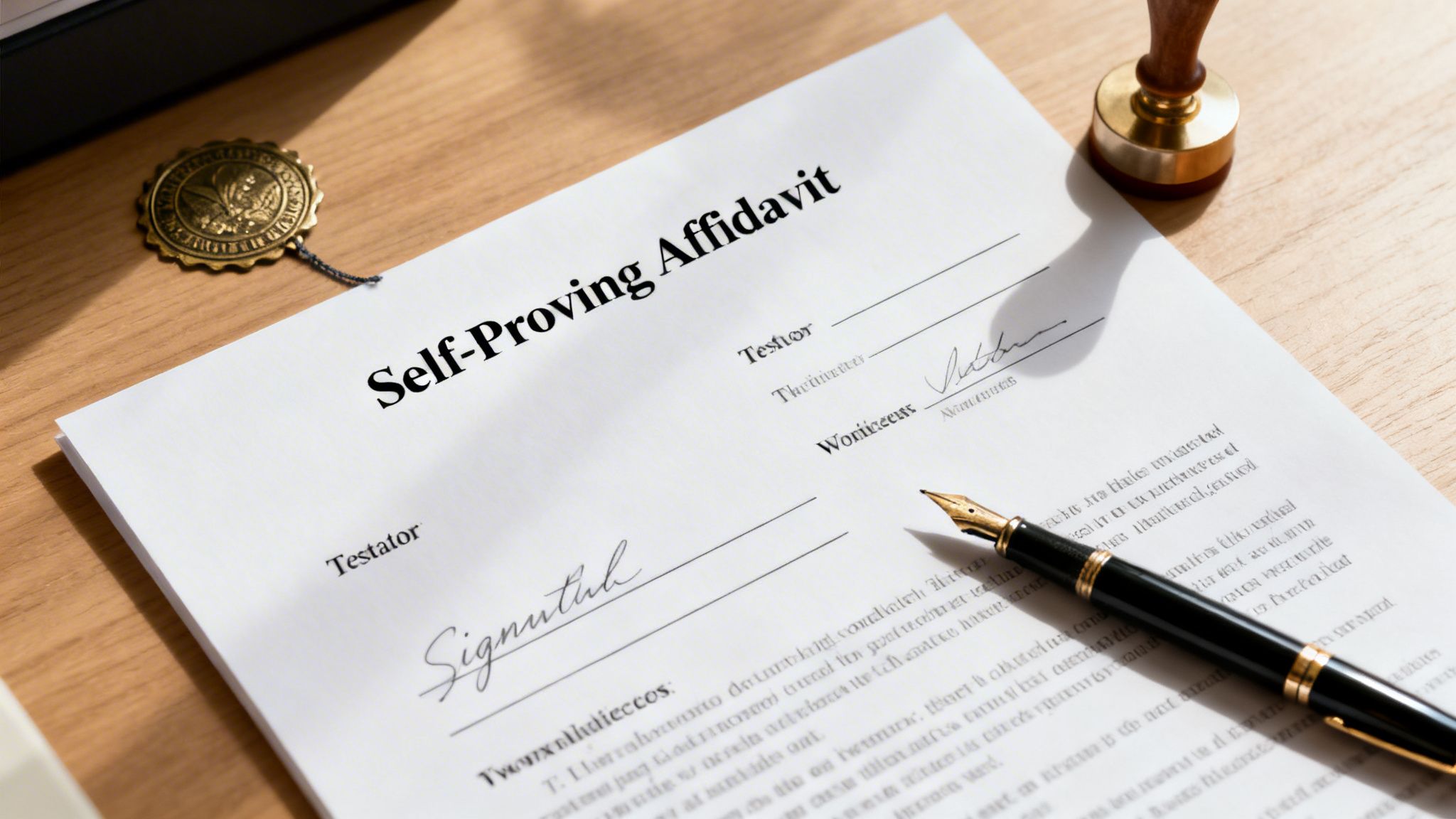
What if one extra page attached to your will could save your family significant time, money, and stress during probate? That’s not an exaggeration—it’s the reality of what a self-proving affidavit can do. While optional, it’s one of the most powerful and highly recommended tools in modern Texas estate planning.
A self-proving affidavit is a separate statement that gets attached to the will. In it, you (the testator) and your two witnesses sign your names again, but this time you do it in front of a notary public. By signing, you are all swearing under oath that every formality of the will execution was followed perfectly.
Think of it as pre-validating the will for the court. When a will has this affidavit, the court can accept it as properly executed without needing to track down the original witnesses to testify.
Why This Extra Step Matters So Much
Imagine what can happen years, or even decades, after a will is signed. Witnesses move away, pass away, or simply become impossible to find. Without a self-proving affidavit, your executor might have to spend precious time and resources trying to locate those witnesses for their court testimony.
This can delay the entire probate process, leaving your family in limbo during an already emotional time. The affidavit completely bypasses this potential roadblock. It locks in sworn testimony at the moment of signing, creating a much smoother path for your executor and heirs.
The combination of proper witnessing and a self-proving affidavit creates a powerful legal shield for your will. Texas law already helps by requiring two witnesses for a formal will, a rule that reduces the chances of a will being declared invalid to just 8%, compared to 15% in places with looser requirements. Adding the affidavit strengthens the will's standing in court even more.
Takeaway: A self-proving affidavit is not required for a will to be valid, but it is a cornerstone of thoughtful estate planning. It’s a simple, proactive step that can drastically simplify probate by eliminating the need for witness testimony in court, saving your loved ones from a huge logistical headache and emotional strain.
What the Affidavit Looks Like
The Texas Estates Code provides the specific language needed for this document, so there’s no guesswork involved. The affidavit confirms that you, the testator, signed the will, declared it was your will, and appeared to be of sound mind. It also confirms that the witnesses signed it in your presence.
To dig deeper into how this works and what might be right for your situation, you can explore the key differences between self-proving vs. traditional wills and make an informed choice for your family.
Understanding Handwritten or Holographic Wills
While most wills are formal, typed documents signed in front of witnesses, Texas law makes a special exception for something more old-fashioned: the holographic will. This is simply a will written entirely by hand.
The key phrase from the Texas Estates Code, Section 251.052, is "wholly in the testator's handwriting." This is a strict, non-negotiable rule. Unlike a standard will, a holographic will does not need any witnesses. The law assumes that a document written completely by hand is harder to forge and more likely to be authentic.
When Is a Handwritten Will Actually Valid?
For a holographic will to hold up in court, every single word must be in the testator's own handwriting. This includes who gets what, descriptions of the property, and the signature. This is a point that trips up many people and often leads to documents being thrown out by the court.
Let’s walk through a common scenario. An elderly father, Robert, decides to write his will on his own.
- Invalid Will Scenario: He finds a pre-printed, fill-in-the-blank will form. He carefully fills out the names of his children and lists what each should inherit, then signs it. This document is not a valid holographic will because it's not wholly in his handwriting. It also fails as a formal will because he didn't have it witnessed. It is legally worthless.
- Valid Will Scenario: Instead, Robert grabs a blank sheet of notebook paper and writes, "This is my last will. I give my house to my daughter, Sarah, and my savings account to my son, Michael." He signs and dates the bottom. Because the entire document is in his own handwriting, a Texas court would likely recognize this as a valid holographic will.
Takeaway: The "wholly in the testator's handwriting" rule is absolute. If any pre-printed text is mixed with handwriting—even just a letterhead—the will is void. Your estate could end up being divided by state law, not your wishes, causing unintended consequences for your family.
The Hidden Dangers of a Holographic Will
While legally recognized, holographic wills are a frequent source of conflict during the probate litigation process. The handwriting itself can be hard to decipher, and the language used is often vague or ambiguous. This ambiguity easily sparks disputes among family members over what the person really meant.
Proving the handwriting actually belongs to the deceased can also become a drawn-out, expensive battle in court. While a handwritten will might seem like a good idea in an emergency, it’s a significant gamble. A professionally drafted and formally executed will offers far more security and peace of mind for your loved ones. You can learn more about the specific legal hurdles tied to a hand-written will in Texas.
Common Will Execution Mistakes to Avoid
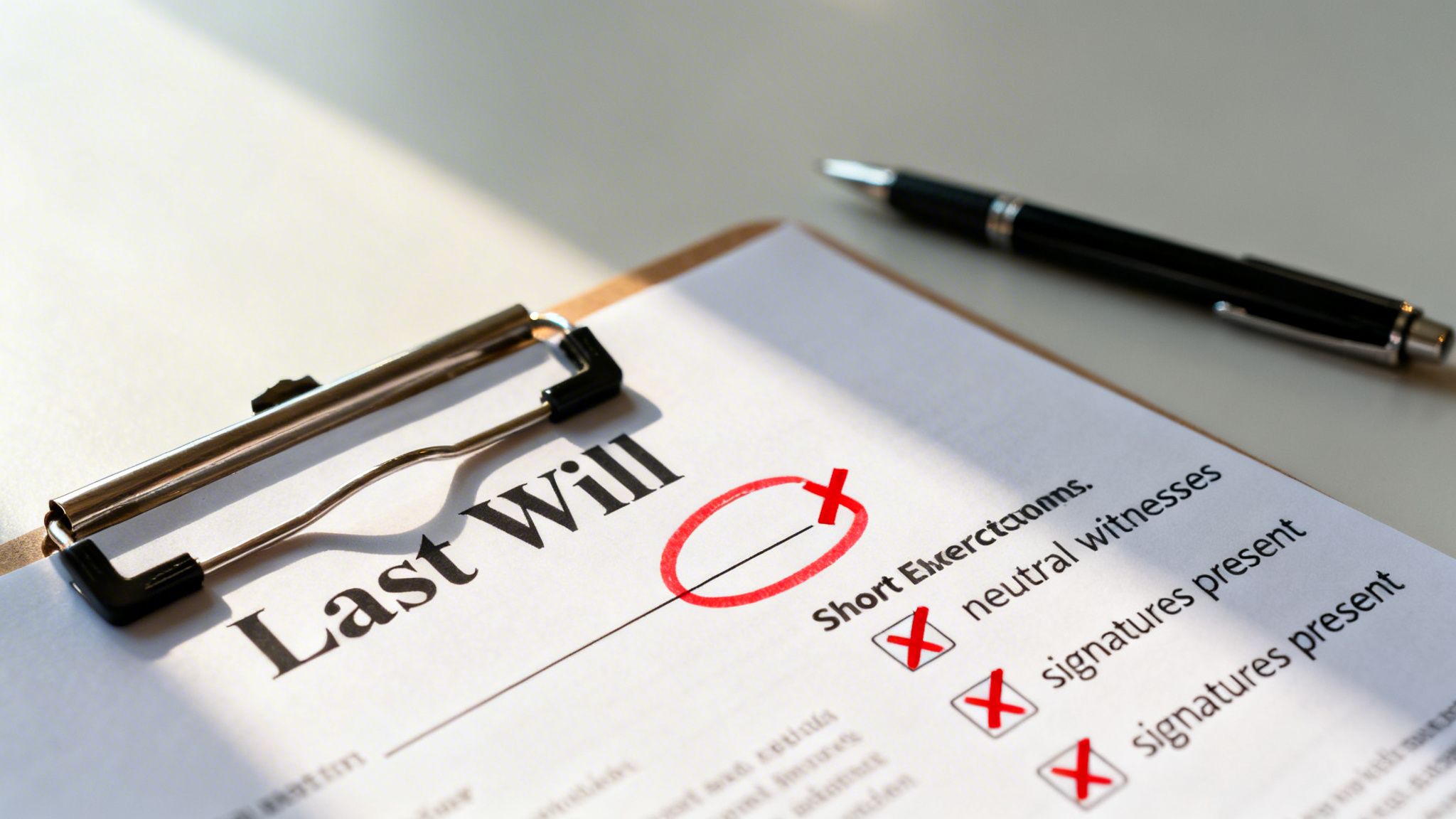
A well-drafted will is supposed to be the final word, a roadmap that ensures your wishes are followed and your family is protected. But a perfectly written will can be rendered worthless by simple, avoidable mistakes made during the signing ceremony.
These execution errors are devastating. They open the door to will contests, bitter family disputes, and expensive legal battles that can drain the very inheritance you hoped to protect. At our firm, we’ve seen how one small oversight can unravel years of careful planning. Knowing these pitfalls is the first step to avoiding them.
The Beneficiary-Witness Trap
The most common landmine we see is having someone who stands to inherit from the will also act as a witness. It may seem convenient, but Texas law strictly guards against any hint of coercion or self-interest.
Under the Texas Estates Code, Section 251.102, using a beneficiary as a witness creates a conflict of interest. While it might not invalidate the entire will, it can—and often does—void the gift to that specific person. The result? That beneficiary might only get what they would have inherited if no will existed, or worse, nothing at all.
For example, a mother’s will leaves her house to her son and savings to her daughter. The son, wanting to help, signs as a witness. After her passing, a court could void the son's inheritance of the house, completely subverting the mother’s wishes. The fix is simple: always use "disinterested" witnesses—people with zero financial stake in your will.
The "In the Presence Of" Rule
Another critical mistake is failing to have witnesses sign the will in the testator’s presence. This requirement is a cornerstone of will execution law, designed to prevent fraud. The witnesses must physically see the testator sign the will (or see the testator acknowledge their signature) as part of a single, continuous event. This ensures the integrity of the signing ceremony and prevents someone from fraudulently getting a pre-signed will witnessed later.
Doubts About Capacity or Intent
A will is only valid if the person signing it has testamentary capacity. This means they must be of sound mind and fully understand what they are doing. Any legitimate doubt about their mental state at the moment of signing can become grounds for a will contest.
To have capacity, the testator must understand three basic things:
- They are signing a will that will distribute their property after death.
- The general nature and value of their assets.
- Who their closest family members are (the "natural objects of their bounty").
If the person signing is heavily medicated, suffering from advanced dementia, or being pressured, the will is vulnerable. The signing ceremony must be free from coercion, with the testator lucid and clear-headed.
Will Execution Mistakes vs. Best Practices
Navigating the technicalities of a will signing can feel overwhelming, but getting it right is non-negotiable. The table below breaks down common errors and contrasts them with the Texas best practices that safeguard your final wishes.
| Common Mistake | Potential Consequence | Texas Best Practice |
|---|---|---|
| A beneficiary signs as a witness. | The gift to that witness is voided by the court. | Use two disinterested, credible witnesses over age 14 who have no financial stake in the will. |
| Witnesses sign after the fact, not in the testator's presence. | The will is declared invalid for improper execution. | All parties (testator and witnesses) sign in the same room as part of one continuous ceremony. |
| The testator is confused, medicated, or pressured during signing. | The will is challenged and overturned for lack of capacity or undue influence. | Ensure the testator is clear-minded and the signing is free from coercion. A self-proving affidavit helps confirm this. |
| The will is not signed by the testator. | The will is completely invalid. | The testator must sign the will, or have another person sign on their behalf in their presence and under their direction. |
| Using only one witness. | The will fails to meet the statutory two-witness requirement and is invalid. | Always have at least two credible witnesses sign the attestation clause in the testator's presence. |
Following these best practices doesn't just check a legal box; it builds a fortress around your estate plan, making it far more resilient to future challenges.
Takeaway: Preventing execution mistakes is proactive estate planning. By selecting neutral witnesses, ensuring the signing ceremony is conducted correctly, and confirming the testator's clear state of mind, you create a powerful defense against future probate litigation and protect family harmony.
Wrapping It Up: Securing Your Legacy and Protecting Your Family
Getting your will signed and witnessed correctly is the single most important action you can take to ensure your final wishes are honored. It’s the final, critical step that transforms a piece of paper into a legally binding directive, securing your family’s future and paving the way for a smooth Texas probate process.
All the technical rules around executing a will—the formal signing ceremony, the two credible witnesses, the specific language—are there for one reason: to protect your family from chaos and conflict when they are at their most vulnerable. In Texas, this signing ceremony, legally known as "attestation," has to be done just right. You need two credible witnesses who aren't inheriting anything to sign the will in your presence. While adding a self-proving affidavit isn't mandatory, it's a best practice we can't recommend enough.
Takeaway: Taking a few extra minutes to execute your will flawlessly is one of the greatest gifts you can give your family. It's an act of love that provides peace of mind and slashes the risk of expensive probate litigation that can tear families apart. This one moment of careful preparation locks in your legacy and gives your loved ones a clear, simple path to follow.
Our compassionate attorneys are here to ensure your wills and trusts are structured and executed perfectly, protecting your final wishes and the people you love. Whether you're planning for the future, need help with a guardianship, or are facing the Texas probate process, we offer clear, straightforward guidance.
Frequently Asked Questions About Executing a Will
Families often come to us with common, yet critical, questions about the will signing process. Getting these details right can be the difference between a smooth probate and a costly, painful court battle. Here are plain-English answers to some of the most frequent questions we hear.
What Happens If a Witness to the Will Is Also a Beneficiary?
This is a scenario we strongly advise against. While the Texas Estates Code says a will isn't automatically voided if a beneficiary acts as a witness, it creates a major problem. If the will doesn't also have a notarized "self-proving affidavit," that beneficiary-witness could be forced to give up their inheritance—at least any amount beyond what they would have received if no will existed. The law is designed this way to prevent any hint of undue influence.
Key Insight: The best practice is always to use "disinterested" witnesses—people who have absolutely nothing to gain from the will. It’s a simple step that closes a common door to will contests during the Texas probate process.
How Long After Death Is a Will Probated in Texas?
Here’s a deadline you can't afford to miss. In Texas, you generally have four years from the date of death to file a will for probate. Waiting longer makes the process exponentially harder and more expensive. While there are a few, very rare exceptions for filing late, the burden of proof is incredibly high. Prompt action is the key to a straightforward estate administration for your family.
Does a Will Need to Be Notarized to Be Valid?
Technically, no. A standard Texas will only needs two things to be legally valid: the testator's signature and the signatures of two credible witnesses who watched the testator sign. However, we believe skipping the notary is a mistake. We highly recommend including a self-proving affidavit with the will, and that part must be notarized. This affidavit is a sworn statement from the testator and witnesses, and it makes probate infinitely faster and less stressful, as the court can accept the will without hauling the witnesses into court to testify.
Can I Execute My Will Remotely or Electronically?
Yes. Texas law has adapted to allow for remote will execution. This involves signing your will during a live audio-video conference while an approved online notary oversees the process and also notarizes the document remotely. However, the procedural rules for remote execution are extremely strict. One small misstep can invalidate the entire document. Given the complexity, working with an experienced attorney is essential to ensure every legal requirement is met perfectly.
If you’re facing probate in Texas, our team at The Law Office of Bryan Fagan, PLLC can help guide you through every step — from filing to final distribution. Schedule your free consultation today.