A parent dies in Texas. Their daughter lives in Colorado, their son is in North Carolina, and the person named as executor now lives overseas for work. Everyone is grieving. Everyone assumes the will should make things simple.
Then probate starts, and the court needs proof that the will was signed properly.
The family realizes the witnesses signed the will years ago. One moved. One may have died. Nobody is sure where the notary page is, or whether there even was one. What felt like a straightforward estate suddenly turns into phone calls, document requests, mailing originals, and delays that feel especially heavy while a home, bank accounts, and personal belongings remain tied up.
That is the problem a self proving affidavit texas will is meant to prevent. It is not just one more legal form. It is a practical shortcut built into Texas probate law so the court can accept the will without forcing the family to track down witnesses later.
For families handling probate from another state, this tool matters even more. Distance turns every missing signature and every incomplete form into a bigger obstacle. If you're trying to settle a Texas estate while living elsewhere, the right paperwork can spare you a great deal of frustration.
The Unseen Hurdle in Settling a Loved One’s Estate
Maria thought her father had done everything right. He had a typed will, named her as executor, and told the family where he kept the original. She lived outside Texas, but she figured she could fly in once, file what the court needed, and then wrap up the estate from home.
Instead, she learned that having a will and proving a will are not always the same thing.
The probate court needed assurance that the will had been signed with the required formalities. If the will wasn't self-proved, someone might need to locate a witness and obtain testimony or another proper statement to establish that the will was validly executed. For a family already dealing with funeral arrangements, property access, and unanswered questions about bills, that extra step can feel overwhelming.
Many families often get blindsided. They assume the hard part was getting the will written. Often, the harder part comes later, when the person who signed it is gone and the people who watched the signing are no longer easy to find.
A will can be perfectly sincere and still create probate problems if it wasn't signed and documented in the right way.
For Texas families trying to reduce those problems in advance, planning tools matter. Some people also explore broader strategies to avoid probate in Texas, but when a will is going to be used, making it self-proved is one of the most important steps.
Why families get stuck
A few recurring issues cause trouble:
- Witnesses disappear: People relocate, change names, or pass away.
- Documents are incomplete: The will may be signed, but the affidavit may be missing or defective.
- Executors live elsewhere: Every extra court requirement becomes harder when you're handling things remotely.
- Time matters: Delays can postpone access to property, title transfers, and administration of the estate.
A self-proving affidavit addresses this problem before it starts. It gives the probate court sworn proof, prepared in advance, that the will was signed correctly. That simple step can spare a grieving family from doing detective work years later.
What Is a Self-Proving Affidavit in Texas
A self-proving affidavit is a sworn statement connected to a will. In plain English, it tells the probate court that the person making the will and the witnesses already swore, before a notary, that the will was signed correctly under Texas law.
A useful way to think about it is this. The affidavit works like a pre-verified passport for the will. When the will reaches probate court, the court usually doesn't need to stop and ask the witnesses to come back and confirm what happened at signing.
What the affidavit actually does
Under Texas law, the affidavit serves one central function. It lets the will be admitted to probate without live witness testimony in the usual case. That matters because witnesses are often the weak point in an older estate plan.
The authority for this appears in Texas Estates Code §251.107 and related provisions. Texas introduced self-proving affidavits in 1955, and on September 1, 2011, the law changed to allow the affidavit language to be built directly into the will so only one set of signatures is needed. Today, over 90% of probated wills in major Texas counties like Harris and Dallas are self-proved, according to Texas Law Help’s discussion of self-proving wills in Texas.
That last point is important. A self-proved will isn't some rare upgrade. In modern Texas estate planning, it's the standard way to prepare a will for probate.
How this changed over time
Before the law changed in 2011, creating a self-proved will was more awkward. The will had to be signed, and then a separate notarized affidavit had to be completed with its own formalities. That created more chances for mistakes.
Now, in many situations, the self-proving language can appear at the end of the will itself. The testator, the witnesses, and the notary complete the process together. Fewer moving parts usually means fewer probate headaches later.
Attested wills and holographic wills
Texas recognizes different kinds of wills, and readers often confuse how self-proof works for each.
| Type of will | Basic idea | Self-proving issue |
|---|---|---|
| Attested will | A typed or formal written will signed with witnesses | Usually made self-proved during signing |
| Holographic will | A will entirely in the testator's handwriting and signed by that person | Can also be self-proved, but the method is different |
A holographic will does not require attesting witnesses for validity in the same way a standard attested will does. But if someone wants a holographic will to be easier to probate, a self-proving affidavit can still help.
Practical rule: A self-proving affidavit doesn't replace the need for a valid will. It supports a valid will by making probate smoother.
Why people mix this up
Many people hear "notarized will" and assume the notary is what makes the will valid. That's not quite right. In Texas, the self-proving affidavit is what gives the will its probate shortcut. The notary's role is part of that sworn process.
So if you're searching for "self proving affidavit texas will," the short answer is this: it's the sworn proof attached to or built into the will that helps the probate court accept the document without chasing down witnesses later.
Why This Affidavit Is Crucial for a Smooth Probate Process
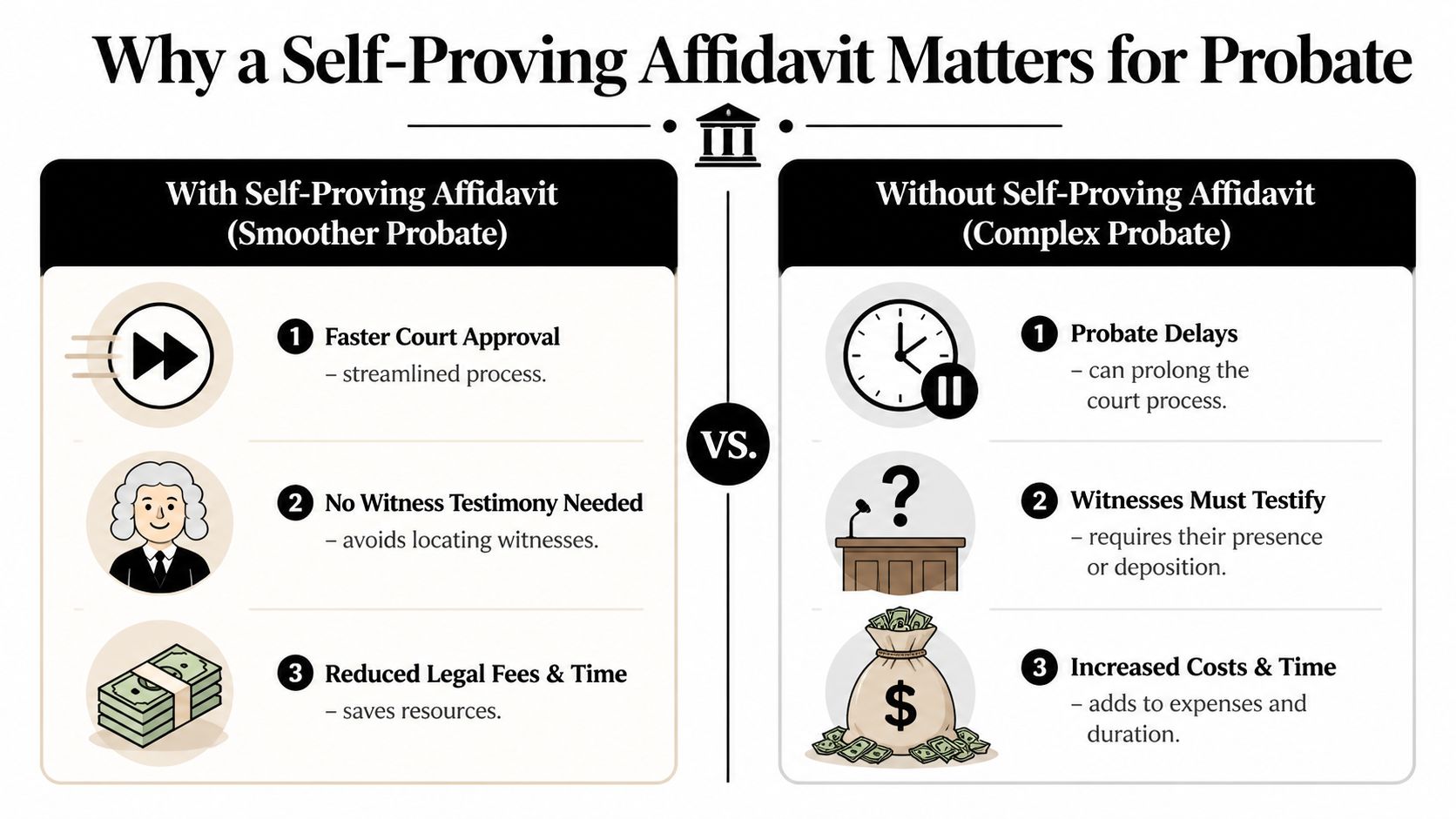
When a will is self-proved, the court usually has what it needs to move forward without requiring testimony from the original witnesses. That changes the probate experience in practical ways.
When a will is not self-proved, the estate may still be probated. But proving the will becomes more work. Someone has to supply additional proof that the signing happened properly. If the witnesses are hard to find, uncooperative, or no longer living, the process can become far more complicated than the family expected.
A side by side look
Here is the simplest contrast:
| Probate with self-proof | Probate without self-proof |
|---|---|
| Court has sworn proof attached to the will | Court may require additional proof of execution |
| Executor can focus on administration sooner | Family may need to locate witnesses |
| Fewer moving parts at the hearing | More risk of delay and procedural issues |
| Easier for out-of-state families | Harder when everyone is remote |
The difference isn't just legal. It's emotional. Families often need access to the estate to secure a house, collect mail, transfer title, and deal with financial institutions. Every extra procedural step can leave them waiting in uncertainty.
What delays look like in real life
Take a common situation. A mother signs a will many years before her death. Her two witnesses were neighbors at the time. By the time probate begins, one neighbor has moved out of Texas and the other has serious health issues.
Now the executor has to ask questions no family wants to ask in the middle of grief:
- Who were the witnesses?
- Are they still alive?
- Can they be reached?
- Will they cooperate?
- Does the court need them in person, by affidavit, or in another acceptable form?
If the will had been self-proved, most of those questions would never matter.
Why this matters for remote probate
This issue is magnified when the executor or heirs live outside Texas. Mailing original wills, coordinating filings, arranging appearances, and managing court procedures from another state creates friction even in a clean case.
A self-proved will removes one major variable. It doesn't eliminate probate, and it doesn't prevent will contests based on issues like fraud or undue influence, but it does remove the need for witness testimony in the routine probate setting.
For people who want a fuller picture of administration after the will is admitted, this overview of the Texas Probate Process helps place the affidavit in the larger timeline.
Probate moves more predictably when the court can rely on paperwork prepared while the testator was alive, competent, and available to sign.
What the affidavit is really buying
A self-proving affidavit buys certainty.
It means the family is less likely to be pulled into avoidable procedural problems. It means the executor can spend less time proving the document and more time doing the actual work of estate administration, such as gathering assets, handling notices, and preparing for distribution under Texas Estates Code procedures in Titles 2 and 3.
In many families, that is the difference between a manageable probate and a draining one.
Texas Legal Requirements and Official Language
Texas probate law is precise about self-proved wills. Precision matters here because small drafting or signing errors can defeat the very benefit the affidavit is supposed to create.
The relevant framework appears in Texas Estates Code Chapter 251, especially the rules governing self-proved wills and affidavits. Readers often look for a shortcut form online, but this is one area where exact language and exact execution matter.
What the statute requires in plain English
For a standard witnessed will, the affidavit must show that:
- The testator signed the will as their will
- The witnesses observed the required signing
- Everyone swore to those facts before an authorized officer, usually a notary
- The form used complies with Texas law
That sounds simple, but each phrase carries weight. If the wording is outdated, incomplete, or paired with a flawed signing ceremony, the court may not treat the will as self-proved.
A helpful background explanation of execution formalities appears in this guide on how wills are executed in Texas.
Language people often see
Texas statutes use formal wording because the affidavit is sworn evidence. The exact approved form can depend on the route used, but the ideas remain the same. The testator identifies the instrument as their will. The witnesses confirm they signed as witnesses in the required setting. The notary certifies the oath.
Here is a plain-English breakdown of the concepts behind the statutory language:
| Legal phrase | What it means in everyday language |
|---|---|
| Last will | This document is meant to control what happens at death |
| In the testator's presence | The signing happened where the required people could observe it |
| Being duly sworn | The signer took an oath before a person authorized to administer it |
| Subscribed | Signed |
| Witnesses | People who saw the will signed and signed to confirm it |
Why exact wording still matters
Families sometimes ask whether "close enough" is enough. Usually, that is not the right approach.
Courts want to know whether the affidavit substantially complies with Texas law. A homemade form pulled from a random website may create uncertainty. An outdated clause copied from an old document may also create problems if it doesn't match current Texas requirements.
If the affidavit is wrong, the will may still be valid, but the shortcut may be lost.
That distinction matters. People often think the only issue is whether the will survives. But the practical issue is whether probate becomes more burdensome because self-proof failed.
The point of the official form
The official language isn't there to confuse families. It exists to lock down a few key facts while everyone is present and able to swear to them.
Those facts include:
Identity
The court needs confidence about who signed.Intent
The signer must be treating the document as a will.Formalities
The signing and witnessing must comply with Texas law.Oath
The affidavit is sworn, not casual.
For that reason, copying language into a will without understanding the ceremony is risky. A valid self proving affidavit texas will requires both the right text and the right signing process.
A Step-by-Step Checklist for Signing Your Will Correctly
Many will problems begin at the signing table. The document may be carefully drafted, but the ceremony is rushed, witnesses are chosen casually, or the notary isn't present at the right time.
The good news is that most of these problems are preventable.
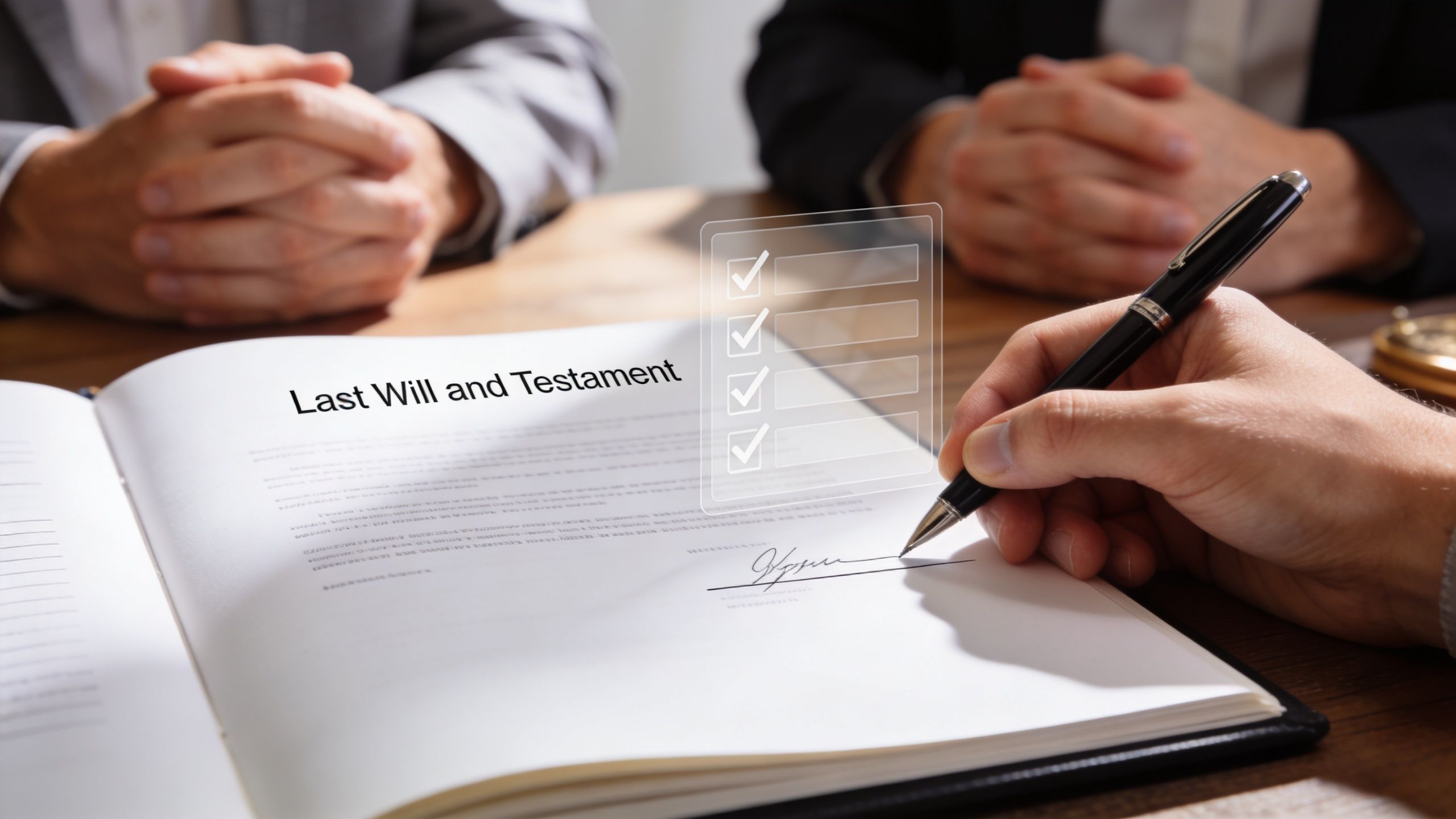
Before anyone signs
Start with the right people in the room.
- Choose proper witnesses: For an attested will, Texas requires two credible witnesses. As noted earlier, readers commonly use disinterested adults to avoid unnecessary disputes.
- Have the notary ready: The self-proving affidavit is sworn. That means an authorized notary must be part of the process.
- Use the final version only: Don't sign a draft, and don't handwrite changes at the last minute unless your attorney has confirmed the effect.
The signing checklist
A clean signing usually follows this sequence:
Gather everyone together
The testator, both witnesses, and the notary should all be present for the signing event required for the will and affidavit being used.Confirm what the document is
The testator should make clear that the document is their will.The testator signs
The will should be signed in the proper setting required by Texas law.The witnesses sign
The witnesses sign in the required presence.Complete the self-proving portion
The oath and notarization are completed correctly.Store the original safely
A self-proved will still needs to be found after death. Safe storage matters.
For readers dealing with probate proof issues after a death, this resource on proofs in Texas probate affidavits and witnesses can help explain why each of these steps matters.
A realistic example
Suppose James signs a will at his kitchen table. His niece and his neighbor sign as witnesses, but the notary arrives later that afternoon and only notarizes one page after everyone has left. James believes he has a self-proved will.
That setup may create serious questions. The problem isn't just the stamp. The issue is whether the affidavit was properly sworn and executed under the required circumstances.
Good probate results usually start with a careful signing ceremony, not with last-minute fixes after death.
A short video can also help make the process easier to visualize:
A practical storage habit
After signing, keep the original where the executor can locate it. Tell the executor where it is. Many probate delays happen because a family has copies but cannot find the original signed will.
A well-executed will deserves a clear storage plan.
Common Mistakes That Can Invalidate an Affidavit
The most dangerous mistakes are usually small. A wrong witness. A missing oath. A form borrowed from another state. A family may believe the will is "done," only to learn later that the self-proving feature does not work.
That doesn't always mean the will fails completely. It often means the family loses the convenience the affidavit was supposed to provide.
Frequent execution errors
Some errors appear again and again in probate files.
- Interested witnesses: A beneficiary serving as a witness can create avoidable disputes.
- Wrong sequence: People sign in different rooms or at different times without the required shared presence.
- No proper oath: A notary stamp appears, but the affidavit was not sworn.
- Outdated forms: The language does not match current Texas practice.
- Missing original document: The family has a copy, but not the signed original.
The false comfort of notarization
One of the most common assumptions is that if a notary stamped something, everything must be valid.
That isn't safe thinking. A notary can acknowledge a signature on a page, but a self-proving affidavit requires more than that. It requires a valid sworn procedure tied to the will and its witnesses. A defective notarization can leave the family with a signed will that still isn't self-proved.
Out-of-state executors face a different set of problems
Overlooked issues arise. For approximately 15% of Texas estates involving non-resident heirs or executors, a self-proving affidavit becomes even more important, but remote administration also creates its own challenges. Texas has permitted Remote Online Notarization since 2020, yet recognition can vary, and remote cases can see expenses rise 20% to 30% because of travel or agent fees if the process is not managed carefully, as discussed in this article on muniment of title and self-proved affidavits in Texas.
For out-of-state families, a few practical problems come up often:
| Remote issue | Why it matters |
|---|---|
| Cross-state notarization questions | Families may not know whether the notarial act will be accepted without issue |
| Mailing originals | Texas probate courts usually need original signed documents |
| Virtual hearing coordination | Remote appearance procedures vary by court |
| Power of attorney logistics | A helper may need authority to act on limited tasks |
A remote probate example
Assume an executor lives in Arizona and the decedent owned a home in Harris County. The executor has the original will, but the self-proving page was signed through a process that involved people in different states and an unfamiliar online notary platform. The executor now has to determine whether the affidavit will be accepted as intended.
That question may affect hearing preparation, filing strategy, and timing. If the affidavit is challenged or viewed as defective, the executor may need to gather additional proof, coordinate witness statements, or make another trip to Texas.
Distance magnifies every paperwork mistake. What would be inconvenient for a local executor can become expensive and exhausting for a nonresident one.
Mistakes that often lead toward conflict
Problems with self-proof can also push a case closer to litigation. If a disappointed heir already distrusts the will, execution defects give that person something concrete to question. In those situations, disputes may spill into Probate Litigation, where the focus shifts from efficient administration to evidence, testimony, and challenges.
That is why accuracy matters so much at the planning stage. The affidavit is simple when done correctly. It can become messy when handled casually.
Key Insight Securing Your Family’s Future
A self-proving affidavit is more than a probate shortcut. It is a final act of organization for the people who will already be carrying enough.
When families lose someone, they should be able to focus on gathering records, securing property, and supporting one another. They should not have to reconstruct a signing ceremony from years earlier. That is why a carefully prepared will matters. It reduces confusion at exactly the moment when confusion is hardest to handle.
This is also a reminder that wills are only one part of a larger plan. Many families benefit from reviewing related planning tools through Wills & Trusts and, when care decisions may become necessary, Guardianship. Good planning connects these pieces before a crisis forces rushed decisions.
Property issues don't end with probate either. If heirs inherit a house or land, tax consequences may become part of the conversation. A practical follow-up resource is this guide on tax solutions for inherited property owners, which helps families think through what happens after title passes.
The best estate planning documents don't just express your wishes. They make those wishes easier to carry out.
If you remember one point, let it be this. A self proving affidavit texas will helps protect your family from avoidable procedural stress when they are least equipped to handle it.
When to Consult a Texas Probate Attorney
Some estates are simple enough to understand in broad outline, but many are not simple enough to handle casually. Legal help becomes especially important when any of the following are present:
- Blended families or strained family relationships
- A child or relative may contest the will
- The decedent owned real estate in Texas
- The original will is missing, damaged, or incomplete
- The executor lives outside Texas
- There are questions about mental capacity or undue influence
- The self-proving affidavit may be defective
An attorney can review whether the will is self-proved, identify probate risks early, and help the executor choose the right procedure under the Texas Estates Code. That matters even more for nonresident executors who must manage filings, hearings, and original documents from another state.
Probate should not become harder because a family is forced to guess what the court needs. Clear advice early often prevents costly delay later.
If you’re facing probate in Texas, our team can help guide you through every step, from filing to final distribution. Schedule your free consultation today.
If you need help with a Texas will, probate filing, remote executor issues, or questions about whether a self-proving affidavit was done correctly, contact Law Office of Bryan Fagan, PLLC for a free consultation. Their team helps Texas families through probate with clear guidance, practical next steps, and compassionate support.