A parent has died. You're trying to do the right thing. Then one sibling stops returning calls, another refuses to sign anything, or someone starts accusing the executor of hiding money before the estate is even opened.
That's when many families ask the same question: what if a family member won't cooperate in probate?
In Texas, a difficult relative can absolutely make probate slower, more expensive, and more stressful. But noncooperation doesn't always mean the process is legally blocked. Often, the core issue is determining whether the person is merely being difficult or whether they possess standing, meaning a legal right to challenge what's happening.
Texas probate law gives courts tools to keep estates moving. Titles 2 and 3 of the Texas Estates Code deal with estates, probate procedure, personal representatives, notices, administration, and related disputes. In plain English, that means the court has a process for appointing the right person, requiring notice, supervising administration when needed, and resolving fights that family members can't sort out on their own.
A calm strategy matters more than a forceful one. The executor's job is to protect the estate, gather assets, pay valid debts, and distribute property according to the will or Texas law. That duty doesn't disappear because one relative becomes hostile.
The First Steps When a Relative Will Not Cooperate
The first mistake people make is treating probate like a family vote. It isn't. Probate is a legal process, and the executor or applicant needs to start acting like a record keeper from day one.
If a relative has gone silent or turned confrontational, start with documentation, notice, and transparency. Those three habits help de-escalate some conflicts and protect you if the matter ends up in court.

Build a paper trail immediately
Don't rely on memory. Keep a communication log that records dates, times, who said what, and whether the communication happened by phone, text, email, or mail.
Also preserve estate records from the beginning. A practice-focused review explains that when a family member won't cooperate in probate, the strongest first response is usually a formal accounting-and-documentation strategy. That includes preserving bank records, appraisals, receipts, and correspondence, and using court-supervised accounting when needed rather than relying only on informal negotiation, as noted in this discussion of transparency and family estate disputes.
A clean file can change the entire tone of a dispute.
Practical rule: If you may need to explain it to a probate judge later, document it now.
Give clear information before accusations grow
Many heirs become suspicious because they feel shut out. That doesn't mean every suspicion is justified. It does mean silence from the executor can make things worse.
A simple written update often helps:
- List the known assets: home, bank accounts, vehicles, business interests, or personal property.
- Explain the current stage: waiting for a hearing, collecting records, applying for Letters Testamentary, or preparing an inventory.
- State what you need: keys, account statements, mail forwarding, access to property, or cooperation with appraisals.
This isn't about pleasing the loudest relative. It's about showing that the estate is being handled carefully.
Understand your fiduciary duty
A fiduciary duty means the executor must act in the best interests of the estate and its beneficiaries, not based on pressure, guilt, or family politics. Under the Texas Estates Code, that duty includes safeguarding property, handling claims properly, and following court orders and estate documents.
That matters in ordinary situations. It matters even more when someone is pushing you to make side deals, distribute property early, or ignore a problem because “the family can handle it.”
A realistic example helps. Suppose your brother refuses to let you into your mother's house, even though the house is part of the estate and bills still need to be paid. Don't argue in the driveway. Send a written request, preserve every message, confirm what property is inside, and speak with counsel about the next probate step. A documented response is almost always more useful than an emotional one.
Diagnosing the Conflict Nuisance vs Legitimate Dispute
A stalled probate often turns on one practical question. Is this relative creating noise, or do they have the legal ability to force a real fight?
Executors often treat every angry phone call like a lawsuit. That is a mistake. In Texas probate, volume does not equal influence. The person who can slow, contest, or redirect the case is the person with standing, a specific objection, and enough facts to put that objection in front of the court.
That is the diagnosis to make early.
A useful outside explanation appears in this guidance on being excluded from the probate process. The practical point is simple. A disappointed family member and a legally interested person are not always the same thing. Before you spend estate money responding, identify what role this person has and what they are claiming.
Signs you may be dealing with a nuisance
A nuisance heir or relative can still make administration miserable. They may delay access to property, stir up suspicion, or pressure you to make decisions you should not make. But if they are not filing objections, producing documents, or asserting a recognizable legal basis, they usually cannot stop a properly handled probate.
Common signs include:
- Refusing to answer messages: They ignore updates, then complain they were not informed.
- Demanding decision-making power they do not have: They act as if every sale, inventory decision, or court filing needs their approval.
- Making vague accusations: They call the process unfair, secretive, or suspicious without identifying a legal defect.
- Using signatures to gain an advantage: They insist probate cannot continue unless they sign off, even when Texas procedure does not require that consent.
That person still deserves a careful response. The right response is usually documentation, formal notice, and steady administration. It is rarely surrender.
Signs you may be dealing with a legitimate challenger
A legitimate challenger is different because the complaint has legal shape. They may have standing as an heir, beneficiary, creditor, or prior fiduciary. They may also have a claim the court can decide.
Watch for allegations such as:
- Undue influence: someone pressured the decedent into changing estate documents
- Lack of capacity: the decedent did not understand the nature of the will or the property involved
- Improper execution: the will was not signed or witnessed as Texas law requires
- A later will or codicil: a newer document may control
- Executor misconduct: estate funds were misused, assets disappeared, or required disclosures were not made
Those claims are not proven just because someone says them. But they deserve a different level of attention. Medical and legal analysis discussed in this review of testamentary capacity and undue influence evidence explains why these disputes often turn on records, witness testimony, timing, and surrounding circumstances, not family suspicion alone.
A relative who is merely difficult can waste time. A relative with standing, evidence, and a filing deadline can change the case.
A quick way to assess the risk
Start with four questions:
Do they have standing?
Are they named in the will, an intestate heir, a creditor, or someone whose legal rights are directly affected?What exactly are they claiming?
“I do not like this” is different from “this will was signed after a dementia diagnosis.”What have they done besides complain?
A written demand, a filed objection, a competing application, or a request for accounting carries more weight than threats by text message.What happens if you ignore them?
Sometimes the answer is very little. Sometimes the answer is a contested hearing.
This framework helps match the response to the risk:
| Situation | Likely category | Typical response |
|---|---|---|
| Refuses to sign but never files an objection | Nuisance | Proceed with notice and administration |
| Demands records and asks for an accounting | Could be either | Provide records and evaluate carefully |
| Claims the will is fake or signed under pressure | Legitimate dispute possible | Preserve evidence and prepare for contest |
| Occupies estate property and blocks access | Nuisance with legal consequences | Seek court authority to recover property |
The trade-off matters. Underreacting to a real contestant can cost you evidence and court position. Overreacting to a nuisance can drain estate funds and reward bad behavior. Executors do better when they sort the problem before they choose the remedy.
If you are weighing settlement pressure against the strength of the claim, this comparison of mediation versus litigation in Texas probate helps frame that decision.
Paths to Resolution Without Court Negotiation and Mediation
A lot of probate disputes do not start with a real legal contest. They start with mistrust, old family grievances, or fear that the executor is moving too fast. In those cases, the goal is not to "win." The goal is to keep a nuisance problem from turning into a formal fight that drains the estate.
That starts with choosing the right tool.
Negotiation fits cases where the legal issues are limited
Negotiation usually works best when the uncooperative relative has opinions, complaints, or demands, but no strong basis to stop the probate itself. If the will is likely valid and the dispute is really about administration, direct discussion can solve a lot.
Typical examples include disagreements about:
- when to sell a house,
- who gets temporary access to personal property,
- reimbursement requests,
- choice of realtor or appraiser,
- timing of distributions.
In those situations, I usually want the executor to slow the temperature down and tighten the paper trail. Put the proposal in writing. Set a response deadline. Share the information that the person is reasonably entitled to see. A person who feels ignored often becomes louder. A person who gets a clear answer, backed by documents, is easier to assess.
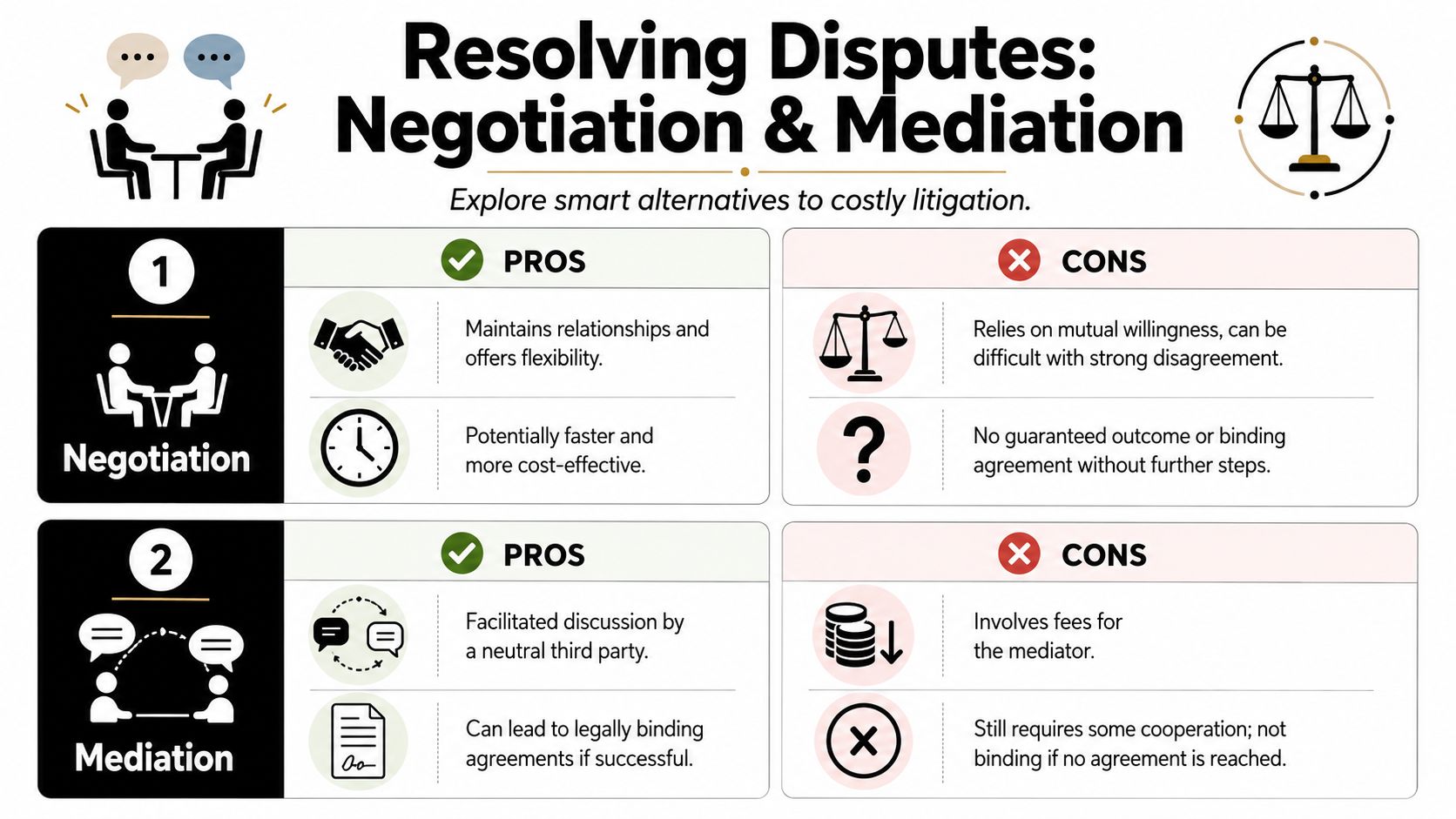
Negotiation also lets the executor test whether the relative is a nuisance or a real contestant. If the person keeps shifting positions, refuses reasonable document review, or makes threats without filing anything, that often points to noise more than legal strength. If the person raises a specific concern and responds to records, appraisal data, or a proposed timeline, settlement may be realistic.
Mediation makes more sense when distrust is the real obstacle
Mediation is more structured. A neutral mediator works with both sides to see whether a deal is possible before everyone spends more on hearings, discovery, and motion practice.
This option is often useful when the family conflict is bigger than the legal issue. Siblings may all know the estate needs to sell property, pay debts, or close accounts, but they may not trust each other enough to agree on the process. Mediation gives them a controlled setting to work through that.
It also helps clarify risk. A relative who has standing and a plausible complaint may use mediation to negotiate guardrails, such as an agreed appraisal process, a deadline for sale, or a written accounting. A relative who only wants to vent may look much less dangerous once a neutral third party asks for specifics.
For a closer comparison of how these two paths differ in cost, speed, and control, see mediation vs. litigation in Texas probate.
A practical example
Suppose the executor needs to sell a parent's home because taxes, insurance, and upkeep are eating into the estate. One sibling says the listing price is too low. Another accuses the executor of favoritism. No one has filed a will contest, and no one has produced evidence that the executor lacks authority.
That is often a settlement problem, not a probate-blocking problem.
A useful agreement in negotiation or mediation might include:
- a neutral appraisal,
- a short period to test a higher listing price,
- written approval for a minimum sale price,
- a deadline for objections,
- and a distribution schedule after closing.
Those terms do not require anyone to become friends. They just create enough structure to keep the estate moving.
Know the limits
Negotiation and mediation are tools, not cures. They are often worth trying when the dispute is about valuation, timing, communication, or mistrust. They are much less effective when someone is hiding property, ignoring fiduciary duties, or preparing a formal challenge with evidence.
That distinction matters. An executor should not spend months trying to appease a relative who cannot legally stop the case. An executor also should not dismiss a person who has standing and a concrete basis to object. The right response depends on which kind of problem you have.
When Court Is Unavoidable Formal Legal Remedies in Texas
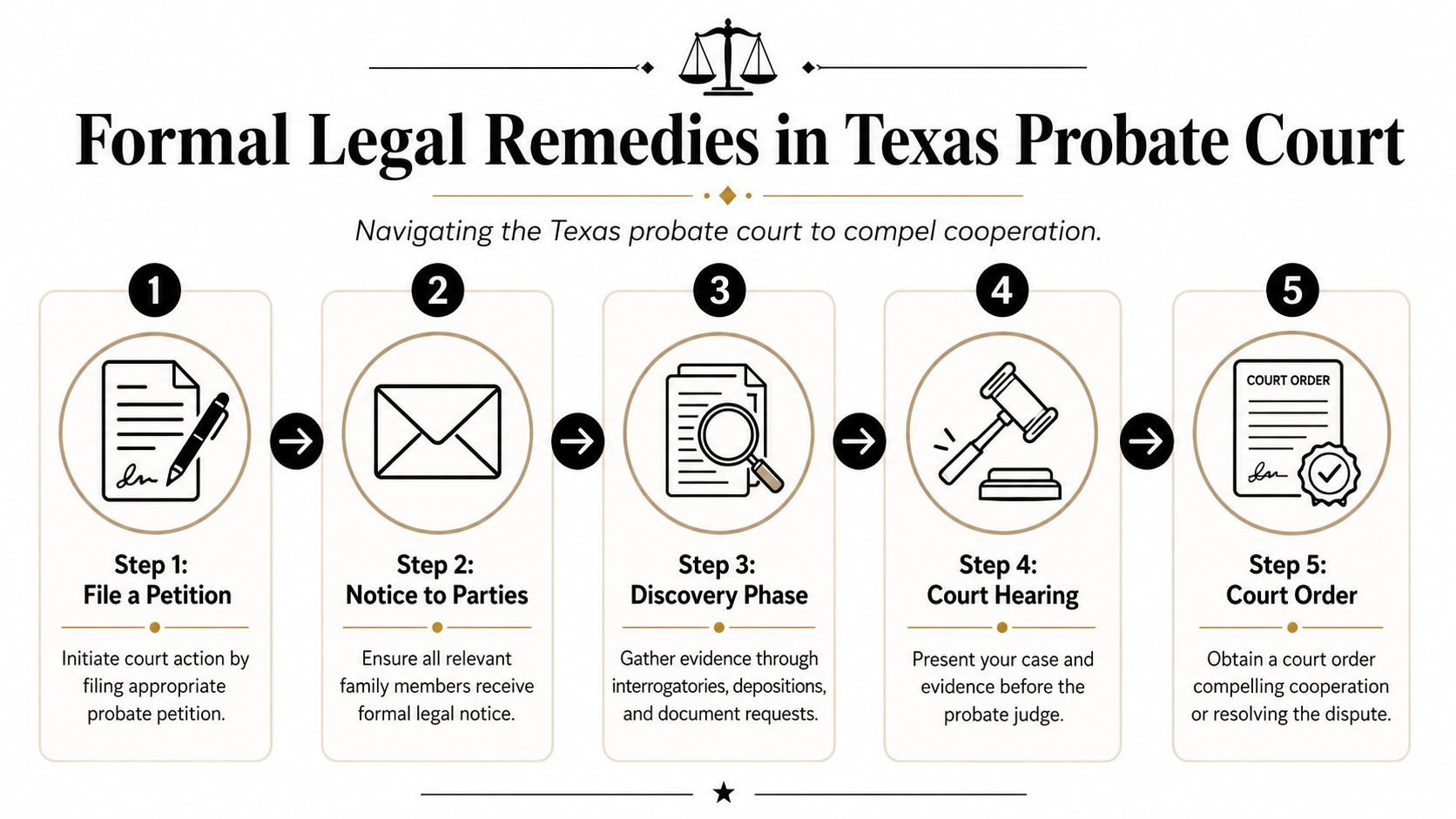
Sometimes cooperation ends. At that point, the goal shifts from persuasion to enforceable action.
Texas probate courts are built for this. Family members don't have to agree before an estate can move forward. A probate article focused on family conflict notes that estates can still be opened under statutory priority rules and required notices, which means one difficult relative usually can't block probate forever, as discussed in this article on reducing the risk of family fights in probate court.
Texas Estates Code Title 2 covers estates of decedents, including probate procedure, notices, application requirements, probate of wills, and issuance of letters. Title 3 addresses guardianship matters, which can become relevant if the dispute overlaps with incapacity issues affecting surviving family members or prior planning. For most executors facing noncooperation after death, the key tools are found in the probate and administration provisions of Title 2.
Filing the right petition matters
The court can only grant relief that someone has properly requested. That's why the first formal step is often a petition or motion designed for the actual problem.
Examples include:
- Application to probate a will and issue Letters Testamentary: used when a relative is refusing to cooperate before the estate is even opened.
- Application for administration: used when there is no will, the will can't be used in a simpler procedure, or additional authority is needed.
- Heirship proceeding: used when family relationships and inheritance rights must be formally determined.
If the dispute concerns the person serving as executor, this guide on how to sue an executor in Texas probate court may help you understand the litigation posture.
Common court tools in plain English
Here are the remedies Texas families most often need when a relative won't cooperate.
Motion to compel
A motion to compel asks the court to order someone to do something required by law or prior order. In probate, that might involve producing records, turning over estate property, or responding to discovery requests.
Use it when a person is withholding information or property, not when you merely dislike their attitude.
Petition to remove a personal representative
If the executor or administrator is the one causing the problem, Texas law allows removal in certain circumstances. Plainly stated, removal is the process of asking the court to take authority away from the current representative and appoint someone else.
This is serious relief. Courts usually expect evidence of misconduct, incapacity, conflict, failure to qualify, or failure to perform required duties. Removal is not a tool for ordinary family frustration.
Subpoena
A subpoena is a court-backed demand for testimony or documents from a person or institution. Banks, medical providers, business partners, or caregivers may become important witnesses in a contested probate.
Subpoenas are often central when the dispute involves missing assets, suspicious account activity, or capacity issues.
A short video may help if you're trying to picture how formal probate disputes unfold in practice.
Contempt
Contempt of court applies when someone disobeys a court order. This is different from someone being rude or unhelpful before any order exists.
If a judge orders a person to turn over estate property or appear for testimony and they refuse, contempt may become available. The key point is sequence. First, get the order. Then enforce it.
A realistic Texas scenario
Suppose your aunt was named executor in your grandfather's will. After he dies, a cousin takes his truck and several firearms from the property, says they were “promised,” and ignores requests to return them. The items appear to belong to the estate, but the cousin won't discuss it.
The likely court path is:
- probate the will and qualify the executor,
- send formal written demand,
- file a motion or related petition seeking turnover of estate property,
- use discovery if needed,
- obtain a court order,
- pursue enforcement if the cousin still refuses.
That process isn't quick, but it is effective because it replaces argument with authority.
One practical note for readers comparing options. The Law Office of Bryan Fagan, PLLC handles Texas probate administration and litigation, including disputes involving executors, heirship, and contested estates.
The Practical Realities Costs Timelines and Hiring a Lawyer
By the time an executor asks about legal fees, the estate is usually already paying for the conflict in other ways. The house is still sitting vacant. Insurance premiums keep coming. Tax deadlines do not pause because one heir refuses to sign, return property, or stop making accusations.
The practical question is not just whether a difficult relative is being obstructive. It is whether that person has enough legal footing to force hearings, delay rulings, or expand the work required to finish the estate. A nuisance creates friction. A person with standing and a colorable claim can change the budget, the timeline, and the level of proof you need.
That difference shows up quickly in cost.
A routine administration can become much more expensive when the dispute requires formal steps such as:
- Additional hearings: preparation time, court appearances, and follow-up orders
- Written discovery and depositions: gathering records, answering requests, and preserving testimony
- Property carrying costs: mortgage payments, utilities, insurance, maintenance, and taxes while assets remain tied up
- Professional support: appraisers, accountants, handwriting experts, medical witnesses, or other specialists when the facts are contested
Sometimes the estate pays these expenses. Sometimes the parties fight about who should be reimbursed. Either way, every extra month of conflict tends to reduce what is left to distribute.
How delay usually plays out
In my experience, executors often underestimate the time cost of half-measures. They keep trying to reason with a relative who has already decided not to cooperate, even after it becomes clear the problem is no longer emotional. It is procedural.
If the person is only a nuisance, a lawyer may be able to limit the damage with one targeted demand letter, a clear filing, or a hearing that sets boundaries. If the person has standing to contest the will, challenge the executor, or claim estate property, the case can shift into litigation with deadlines, evidence issues, and a much longer timeline.
That is usually the point where self-help stops saving money.
When hiring counsel makes financial sense
You should consider bringing in probate counsel when the dispute begins to affect legal rights, not just family harmony. Common examples include:
- A formal objection or contest has been filed
- Someone claims the executor mishandled money or property
- Estate assets are missing, locked away, or being used by someone else
- The dispute turns on capacity, undue influence, or alleged promises by the decedent
- A hearing date, notice deadline, or inventory deadline is approaching
- The family history is legally messy, such as prior marriages, possible heirs, or unclear title to property
If you are weighing that decision, this guide on how to choose the right probate attorney in Texas gives a practical framework for evaluating fit, experience, and cost.
What a lawyer actually helps you do
A probate lawyer does more than file paperwork. Good counsel identifies what kind of problem you have.
That diagnosis matters. If the other side is creating noise without real legal grounds, the strategy may be to keep administration moving, document every request, and ask the court for narrow relief only where necessary. If the other side has standing and a plausible claim, the strategy changes. You may need evidence preservation, witness preparation, formal discovery, and a litigation plan built around Texas probate procedure.
Texas probate cases are won and lost on process as much as on facts. Deadlines matter. Notice rules matter. The type of administration matters. A well-timed filing can shorten a dispute. A late or sloppy one can give the other side room they did not have before.
For smaller estates, or disputes driven mostly by grief and mistrust, limited legal advice may be enough to keep costs in proportion. For estates involving real property, contested wills, missing assets, or claims against the executor, waiting for tempers to cool often increases both risk and expense.
Your Action Plan A Checklist and Key Takeaways
A typical probate problem looks like this. One sibling refuses to return calls, another is threatening to "stop probate," and the executor is left wondering whether to wait, push harder, or call a lawyer. The right answer depends on one question first. Is this person causing delay, or do they have the legal standing and facts to force a real court fight?
That distinction changes everything. A difficult relative can slow communication and increase stress. A person with standing, evidence, and a timely objection can affect who serves, whether a will is admitted, how assets are handled, and how long the estate stays open.
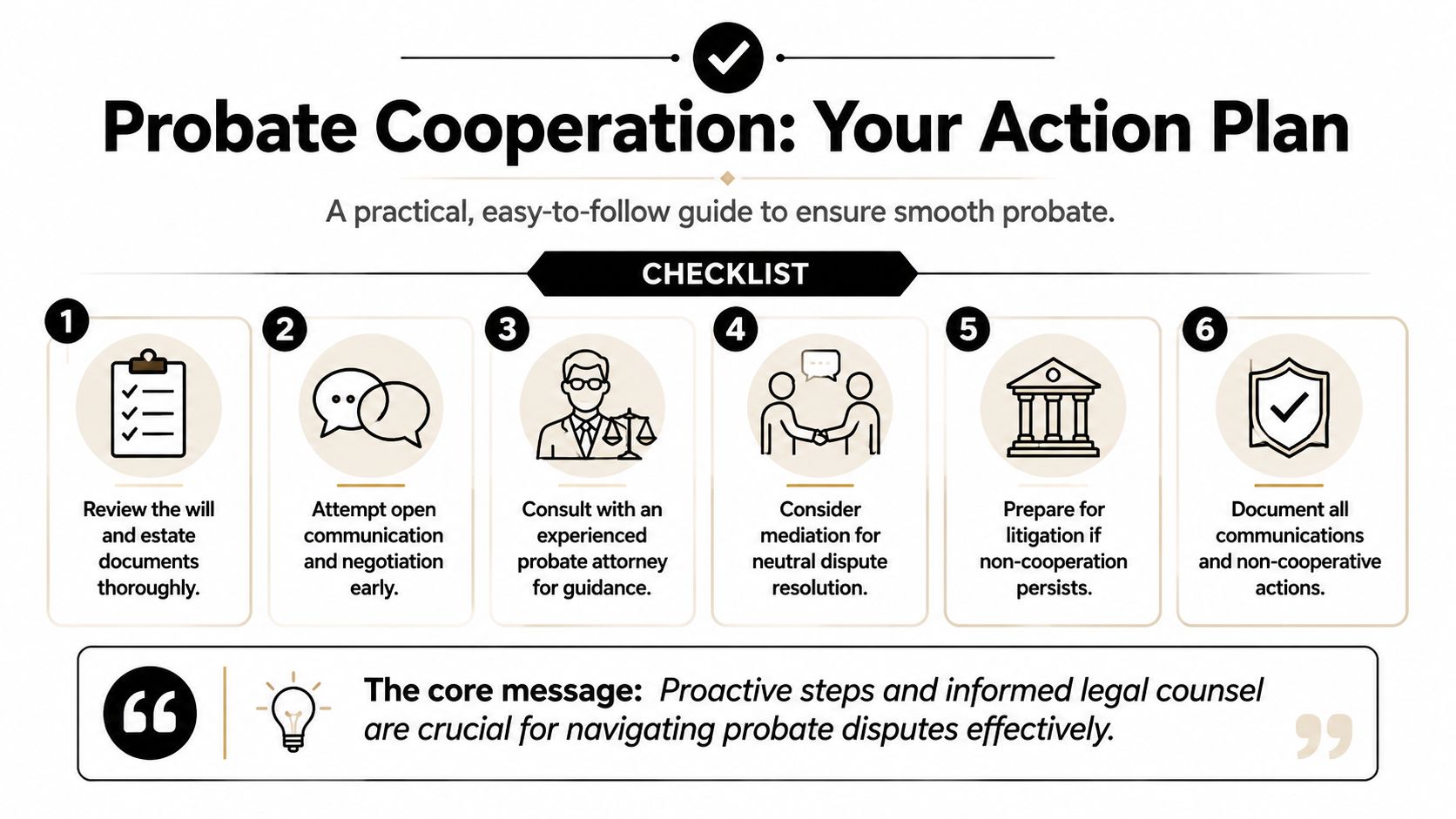
Key insight
The core message: To handle probate disputes well, you need a clear diagnosis, prompt action, and legal advice that matches the size of the problem.
Executor's checklist for handling an uncooperative family member
- Start with the paperwork: Review the will, death certificate, beneficiary designations, deeds, account statements, and any prior probate filings. Confirm what belongs in the estate and who has a legal interest in the case.
- Identify whether the person has standing: Ask whether this relative is an heir, beneficiary, creditor, named executor, or someone with a documented claim. If the answer is no, the response is usually firmer communication and tighter boundaries, not immediate litigation.
- Separate noise from risk: Angry messages, suspicion, and family pressure are common. A signed objection, competing will, claim of undue influence, or accusation of executor misconduct deserves a different level of attention.
- Create a record early: Keep texts, emails, letters, receipts, inventories, account records, and notes of conversations. Good records help resolve minor disputes and protect you if the matter reaches court.
- Use formal communication when informal contact fails: Clear written notices often calm a situation or expose whether the other person has a real legal position.
- Protect estate property: Secure the home, safeguard valuables, redirect mail, preserve digital and financial records, and avoid early distributions.
- Try settlement where the dispute is practical, not legal: If the conflict is about timing, information, personal property, or mistrust, negotiation or mediation may solve it faster and at lower cost than a hearing.
- Ask the court for targeted relief when needed: Texas probate courts can admit a will, appoint or remove a personal representative, compel accountings, determine heirship, approve sales, and enforce orders.
- Get legal advice promptly if the case shows signs of becoming contested: That includes claims about capacity, undue influence, forged documents, missing assets, self-dealing, or disputes over who should serve.
One practical point matters here. Delay is expensive even when nobody files a formal contest. Houses sit vacant, insurance issues develop, bills continue, records go missing, and family positions harden. If the dispute is only a nuisance, the goal is to keep administration moving in an orderly way. If the dispute is legitimate, the goal is to respond early and with proof.
If you're facing probate in Texas, our team can help guide you through every step, from filing to final distribution. Schedule your free consultation today.
If you're dealing with a family member who won't cooperate in probate, the next step does not have to be guesswork. The Law Office of Bryan Fagan, PLLC helps Texas families, executors, and heirs understand their options, protect estate property, and move probate forward with a clear plan. If you're facing probate in Texas, our team can help guide you through every step, from filing to final distribution. Schedule your free consultation today.