Losing a spouse is hard enough. In a second marriage, grief often arrives with another layer of fear. You may be looking around your home, your bank accounts, your paperwork, and wondering whether the life you built is still secure.
For many Texas families, that fear shows up in very practical questions. Can I stay in the house? Do my stepchildren now own part of what my spouse and I used together? If my husband or wife meant to protect me, did the law do that?
Those questions are common, and they aren't a sign that your family is greedy or broken. They usually mean your family is blended, emotions are high, and Texas probate law has stepped into a personal moment.
Navigating Grief and Uncertainty in a Second Marriage
A surviving spouse in a second marriage often comes into my office carrying two burdens at once. One is obvious: the loss itself. The other is the shock of realizing that love, daily life, and legal ownership don't always line up the way people assumed they would.
Take a familiar situation. A wife loses her husband after years of sharing bills, maintaining a home together, and planning for retirement. He also had adult children from an earlier relationship. Everyone may care about one another, but within days, the same questions start circling: who has rights to the house, who receives what, and who gets to make decisions while the estate is being sorted out?
That uncertainty is especially common in remarriage. One Texas-facing source notes that second marriages often create complicated inheritance problems, with divorce risk for second marriages often cited at 60% to 67%, compared with about 40% to 50% for first marriages. That reality leaves many estates involving a surviving spouse and children from a prior relationship, which is why planning matters so much in these families (Texas divorce statistics and second-marriage context).
Grief makes every legal question feel heavier. Clear answers help families make decisions without adding unnecessary conflict.
Why this feels so personal
Probate isn't just a paperwork process. It's the legal method for identifying property, paying proper debts, and transferring what remains to the right people under a will or under Texas law if no valid plan controls.
In second marriages, readers often assume the surviving spouse automatically receives everything. That's one of the biggest misunderstandings I see. In Texas, whether a spouse inherits all, part, or only limited rights often depends on how the property is classified and whether the deceased left children from another relationship.
What you need most right now
If you're in this situation, start with three goals:
- Get accurate information: Assumptions create conflict quickly in blended families.
- Identify the assets: The house, accounts, personal property, and land may each follow different rules.
- Separate inheritance from control: Sometimes a person has rights in property but still can't easily sell it, access it, or manage it during probate.
That last point surprises many families. Ownership is only part of the story. Control during administration can matter just as much.
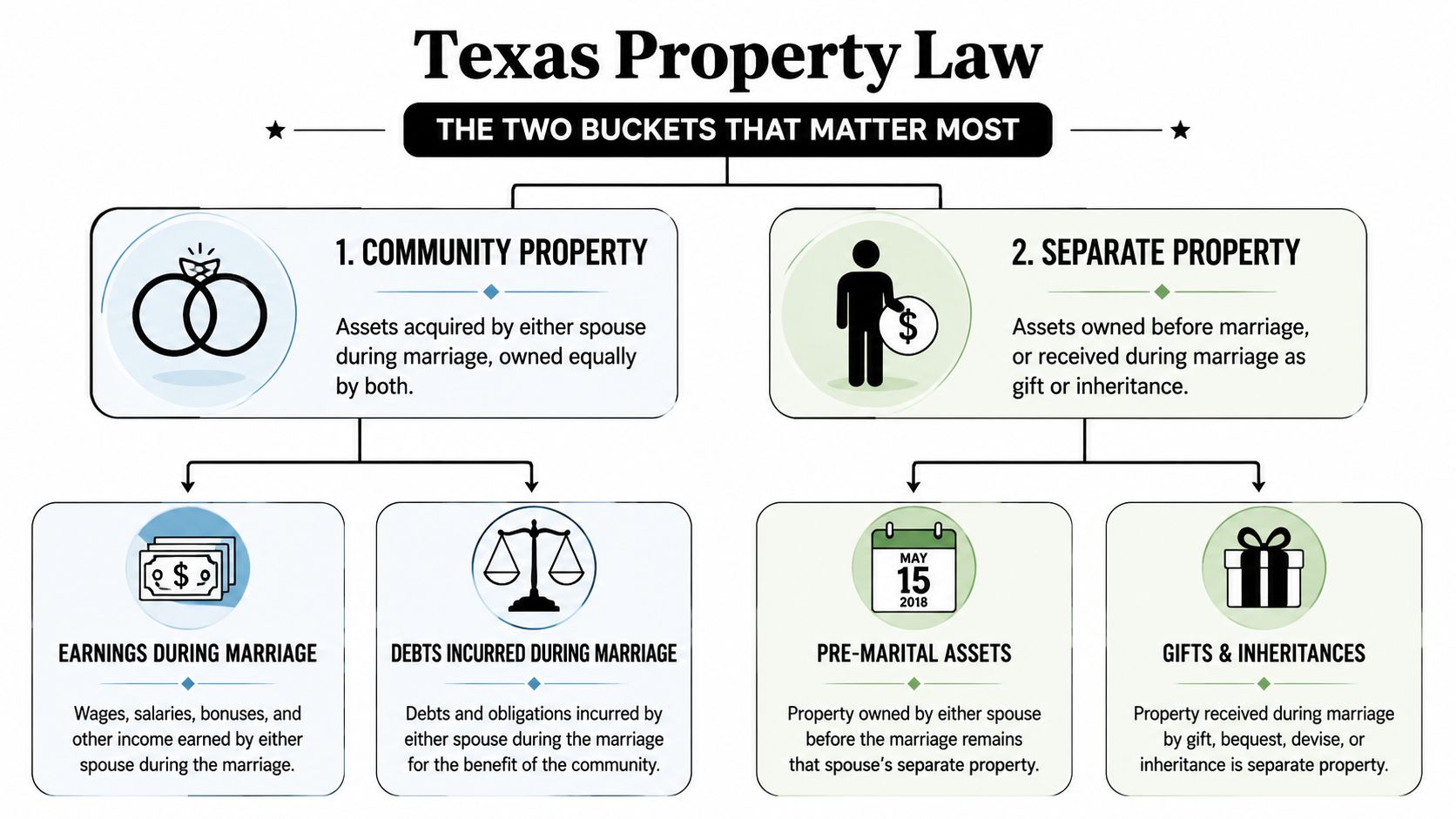
Texas Property Law The Two Buckets That Matter Most
Texas probate for second marriages starts with one question: what kind of property are we dealing with? If you don't answer that first, everything else gets blurry.
A simple way to understand it is to think of property in two buckets. One bucket is community property. The other is separate property. Texas law treats those buckets differently, and that difference can decide who inherits and who doesn't.
Community property
In plain English, community property generally means property acquired during the marriage. Earnings during the marriage often fall into this bucket, and so do many things bought with those earnings.
That doesn't mean every item used by both spouses is automatically community property. The legal question is how the asset was acquired and whether it can be traced to one spouse's separate property.
Texas blended-family probate often turns on this distinction. In Texas, probate outcomes in a second marriage depend heavily on whether property is characterized as community or separate. For intestate estates involving children from a prior relationship, the decedent's half of the community property passes to those children rather than to the surviving spouse (Texas probate and blended-family community property rules).
Separate property
Separate property usually means property one spouse owned before the marriage, or property received individually as a gift or inheritance. That category matters because separate property follows different inheritance rules from community property.
The hard part is that families often mix these buckets in everyday life. A spouse may bring money into the marriage, use it to help buy or improve a home, or keep an old account but add marital funds later. That can create disputes over characterization and tracing.
Practical rule: Before anyone argues over "who gets what," identify which bucket each asset belongs in. That's often the real dispute.
Why readers get confused
People naturally think in terms of fairness. Texas probate law often works in terms of classification. Those aren't always the same thing.
If you want a comparison point from another state system, this overview of understanding marital property in Florida can help show how different states approach spousal rights and survivorship issues. But for Texas families, the controlling issue is Texas characterization law and how that property enters probate.
For a deeper local explanation, this guide on community property laws in Texas is a helpful next step if you're sorting assets after a death.
- Community bucket: Often includes assets acquired during marriage.
- Separate bucket: Often includes premarital property, gifts, and inheritances.
- Probate impact: The same family can see very different outcomes depending on which bucket holds the asset.
When There Is No Will The Default Rules for Blended Families
When someone dies intestate, it means they died without a valid will controlling the distribution of probate property. Texas then uses default inheritance rules found in the Estates Code. For second marriages with children from a prior relationship, those rules can produce outcomes that surprise nearly everyone involved.
The most important statute here is Texas Estates Code Section 201.003. Under that section, when a married person dies without a will and leaves children from another relationship, the surviving spouse doesn't automatically receive the deceased spouse's entire share of community property.
What happens under Texas Estates Code Section 201.003
One Texas probate source explains the rule this way: if a person with children from a prior relationship dies without a will, that person's one-half share of the community estate passes to those children. The surviving spouse may be left with only their own half of the community property and a limited life estate in certain separate real property (Texas Estates Code Section 201.003 and remarriage planning).
A life estate is a right to use property during your lifetime. It is not the same as owning it outright. That's where many surviving spouses feel blindsided. They may be able to live in property, yet still not have full control to sell or transfer it as they wish.
A plain-English comparison
Here is the basic framework many blended families are dealing with when there is no will.
| Asset Type | Surviving Spouse's Share | Deceased's Children's Share |
|---|---|---|
| Community property | Keeps their own one-half interest | Receive the deceased spouse's one-half interest |
| Separate personal property | May receive only a portion under intestacy rules | Inherit the remaining portion |
| Separate real property | May receive a life estate in part of the property | Inherit the remainder interest and other applicable shares |
This table gives the big picture, but families usually need to apply it asset by asset. A house may raise one set of issues. A vehicle, jewelry, or a brokerage account may raise another.
Where the confusion usually starts
Many spouses say, "But we were married, so doesn't everything go to me?" Not necessarily. In a first marriage with no children from outside the marriage, the answer may look very different. In a second marriage with blended-family facts, intestacy can split ownership between the surviving spouse and the deceased spouse's children.
That can create problems quickly:
- The house becomes shared in an unexpected way: One party may want to stay. Another may want a sale.
- Cash can become tight: A spouse may have possession of property but limited liquid funds.
- Administration can become harder: More heirs often means more signatures, more disagreement, and more delay.
A spouse can feel "protected" because they were married, then learn that Texas law protected only part of their position.
What probate looks like in practice
The estate still has to be administered. Someone may need to apply to probate court, identify heirs, gather estate property, address creditor issues, and eventually distribute what the law requires. That process falls within the Texas Estates Code provisions governing estates and administration, especially the areas lawyers often discuss under Titles 2 and 3.
If you're trying to understand how an intestate estate moves through court, this guide to the intestate succession process in Texas can help you see the procedural side of what happens after death.
A Realistic Scenario The Miller Family's Probate Journey
Susan and Tom were married for years in Texas. It was a second marriage for Tom. He had two adult children from his first marriage, and everyone got along well enough at holidays. Tom always meant to "get around to" updating his estate plan, but life stayed busy.
Then Tom died.
Susan assumed she'd keep control of the home because she and Tom had lived there together and paid household expenses together. She also knew Tom had property from before the marriage, including an old retirement account and a small ranch interest that had come through his family.
What Susan learns first
The lawyer's first task isn't deciding who deserves what. It's identifying what property belongs in which legal category.
If the home is community property, Susan already owns her half. But Tom's half doesn't automatically slide to her if he died intestate and left children from a prior relationship. Under the default rule discussed earlier, that half may pass to Tom's children.
Susan is stunned. She still lives there, still grieves there, and still pays bills connected to the property. Yet she may now be in a co-ownership position with her stepchildren.
The separate property problem
Tom's older 401(k), if tied to premarital ownership or structured outside the probate estate depending on beneficiary designations, may raise a different set of issues from the house. His inherited ranch interest is another matter. In Texas probate, inherited property is often treated as separate property, and separate real property can leave a surviving spouse with only limited rights rather than full ownership.
So Susan may learn two difficult truths at once. She may not own Tom's share of the house outright, and she may have only a lifetime right to use certain inherited real estate rather than the power to fully control it.
What feels like "our property" in marriage can become several different legal categories in probate.
Why this turns emotional quickly
Tom's children aren't necessarily trying to push Susan out. They may be hearing that they now own rights in property that mattered to their father. Susan, meanwhile, may hear every probate step as a threat to her housing and financial stability.
That tension often creates conflict. It isn't always greed. It's uncertainty, timing, and fear.
For readers comparing how probate systems differ from state to state, this overview from Olson & Sons offers a useful outside example of how another jurisdiction handles estate administration. Texas families, though, have to work through Texas property characterization and Texas inheritance rules.
The practical lesson from Susan's story
Families usually focus on the final distribution. Susan's immediate problem is control.
- Can she access estate funds to keep paying expenses?
- Can she refinance or sell if she needs to?
- Can administration move forward if the heirs disagree?
Those are the questions that often determine whether probate feels manageable or overwhelming.
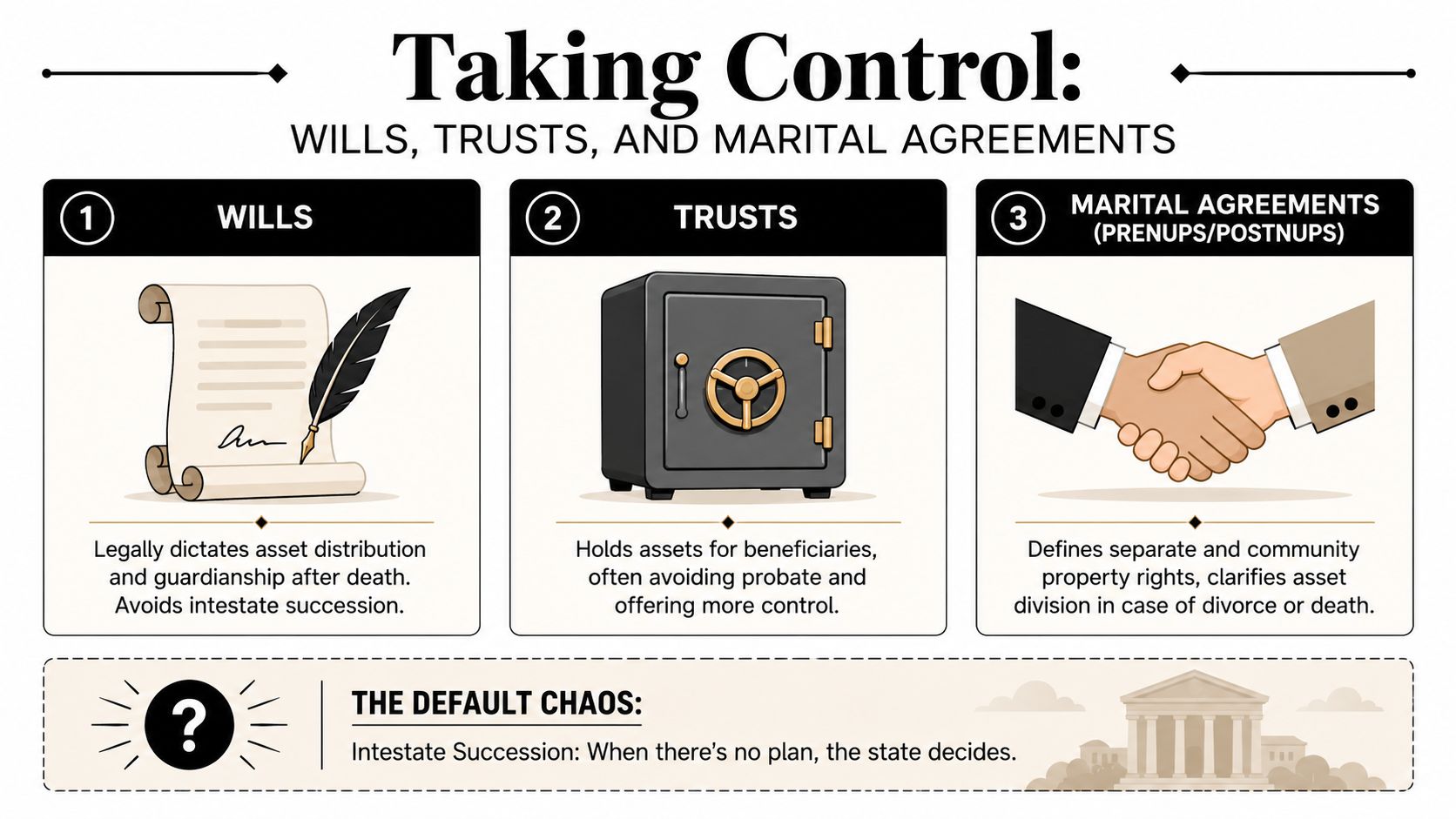
Taking Control With Wills Trusts and Marital Agreements
A second marriage often needs more than a basic will update. In Texas, the primary planning question is not only who should inherit later. It is who should have authority, access, and usable cash if one spouse dies first.
That distinction changes everything for blended families. A surviving spouse may be told, "You are protected," yet still be unable to sell a house, reach estate funds, or make decisions without cooperation from stepchildren or court approval. Good planning aims to prevent that kind of freeze.
A will can direct both inheritance and authority
A well-drafted will does more than name beneficiaries. It can name the executor, authorize independent administration, explain who may stay in the home, and spell out how expenses should be handled while the estate is being administered.
That matters because probate is partly about instructions and partly about traffic control. If no one clearly has authority to act, even a family with good intentions can get stuck paying bills late, arguing over access, or waiting on court orders.
For couples reviewing old documents after remarriage, this guide to estate planning for blended families is a useful starting point.
Trusts can provide support without handing over the entire asset
A trust works like a set of operating instructions for property. Instead of giving an asset outright and hoping everyone agrees later, the trust can say who benefits now, who manages the asset, and who receives what remains later.
That structure is often helpful in second marriages because support and final inheritance are not always the same issue.
One common example is the QTIP trust. It can provide income or use rights for a surviving spouse during life while preserving the underlying asset for children chosen by the spouse who created the trust (QTIP trust planning in second marriages). In practical terms, that can mean a surviving spouse has financial support without gaining full power to redirect the property away from the first spouse's children.
A short video can help you think about these planning choices in practical terms.
Marital agreements can settle the "which bucket" question early
In many second marriages, the hardest probate fight is not over intent. It is over classification. Was the house separate property, community property, or a mix? Was a business interest partly marital? Did one spouse mean to keep an inheritance separate?
A prenuptial or postnuptial agreement can answer those questions while both spouses are alive and able to agree. That can reduce later disputes between a surviving spouse and children from an earlier relationship.
These agreements also help with control. If property is clearly defined in advance, the family is less likely to spend months arguing over who has decision-making power before anyone can access or manage the asset.
A practical planning checklist
- Review beneficiary designations: Some accounts pass outside the will, so the paperwork on file may control more than the estate plan.
- Update first-marriage documents: Older wills and trusts often fail to address a current spouse, stepchildren, or mixed separate and community property.
- Match authority to the actual need: Decide who should pay bills, manage a home, collect income, or handle a sale during administration.
- Plan for liquidity: A spouse may receive rights in property but still need cash to cover taxes, insurance, mortgage payments, and daily expenses.
- Use tools together: A will, trust, and marital agreement each solve different problems. The best plan often combines them.
Beyond Inheritance The Battle for Control in Probate
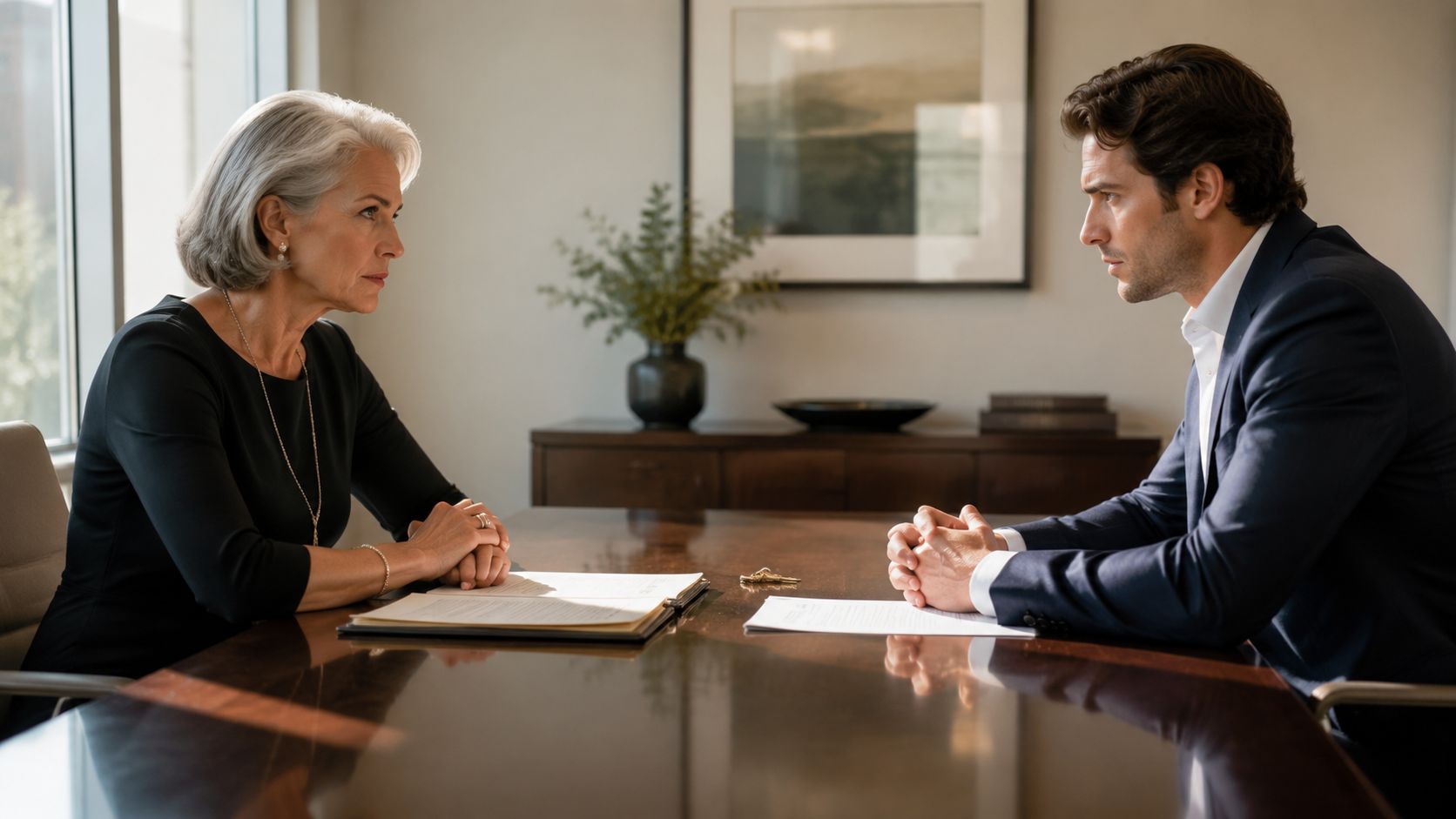
The question families ask first is usually, "Who gets what?" The question that causes the hardest probate fights is often different: who controls the asset right now?
That distinction matters because a person can have an ownership interest on paper and still be unable to use, sell, refinance, or manage the property in a practical way during administration.
Why control becomes the real issue
One Texas source makes the point clearly: the biggest risk in blended-family probate is often not who inherits, but who controls the assets. A surviving spouse can end up with only a partial interest in a home and no easy access to cash, while conflict with step-heirs freezes administration and drives up the burden of the case (control problems in second-marriage intestate succession).
That is why probate can feel so unfair even when everyone technically receives the share the law assigns.
Common control problems families face
- The home is the main asset: A surviving spouse may live there but still lack full power to sell it.
- The estate is illiquid: There may be land or a house, but not much available cash.
- Heirs disagree about timing: One person wants stability. Another wants distribution now.
In many cases, the surviving spouse's immediate concern isn't long-term title. It's paying taxes, insurance, repairs, and everyday expenses while probate is still open.
The hardest probate cases often aren't about legal entitlement alone. They're about delay, access, and decision-making.
Where probate procedure matters
The administration structure holds significant importance. Whether the estate proceeds smoothly may depend on the available probate process, the quality of the filings, and whether the family can avoid a fight over management authority.
If you need a broader overview of how estates move through court, the firm's Texas Probate Process page explains the major stages from filing through distribution. If conflict is already brewing over property, authority, or heir rights, the Probate Litigation page addresses the kinds of disputes that can arise when blended families cannot agree.
Key Takeaways for Protecting Your Blended Family
Second marriages and probate in Texas are rarely simple, but they are understandable once you focus on the right questions. Start with property classification. Then look at whether a valid estate plan controls. Then consider the practical issue many families overlook: who will have control of the assets while probate is pending.
Key insight: In Texas blended-family probate, property characterization drives inheritance, intestacy can divide ownership in surprising ways, and planning tools like wills, trusts, and marital agreements give families far more control.
Keep these points in mind:
- Property type matters first: Community and separate property don't pass the same way.
- No will means Texas decides: That often creates unwanted co-ownership between a surviving spouse and children from a prior relationship.
- Control matters as much as inheritance: A spouse may have rights in property but still face cash-flow and management problems.
- Planning should be thorough: Wills, trusts, powers of attorney, and, in some families, future Guardianship concerns all deserve attention.
If you're dealing with a recent loss, you don't have to solve every issue in one day. But you shouldn't leave these questions unanswered, either. Clear legal guidance can protect housing, reduce conflict, and make probate more manageable for everyone involved.
If you're facing probate in Texas, our team can help guide you through every step, from filing to final distribution. Schedule your free consultation today with Law Office of Bryan Fagan, PLLC.