Missing a probate deadline in Texas, especially the 4-year deadline for filing a will after death, can prevent the will from being probated in the normal way and may cause the estate to be handled under state law instead of the deceased person's wishes. That can change who inherits, who has authority to act, and how hard it is to transfer property.
If you're reading this because a parent, spouse, or other loved one died some time ago and the will has only now surfaced, you're not alone. This happens more often than families expect. A will gets tucked into a desk drawer, stored in a safe, or forgotten during the first difficult months after a loss, and by the time someone tries to sell the house or access an account, a deadline has already passed.
The good news is that missing a deadline doesn't always mean every option is gone. The bad news is that waiting longer usually makes the problem harder. Texas probate law has strict timing rules, and the consequences are practical, not just technical. Title problems can delay a home sale. Family disagreements can harden. A court may limit the ways the estate can be handled.
The Weight of a Missed Deadline in Texas Probate
A common situation looks like this. A mother dies, and her adult children believe everything was “taken care of.” No one opens probate because the family agrees on what she wanted. Years later, one child finds an original will while clearing out a closet. The will names an executor and leaves the home to one specific child. By then, the family is trying to refinance or sell the property, and the title company wants proof of authority that no one has.
That's usually the moment panic sets in.
Grief delays paperwork. Families live in different cities. Some relatives assume a will works automatically without court involvement. Others think probate only matters if there's a fight. None of those assumptions change the deadlines.
Why this feels so overwhelming
Probate deadlines matter because they affect real control over real assets. If a deadline is missed, the issue isn't just “late paperwork.” It can affect:
- Who inherits property if the will can't be used in the ordinary way
- Who manages the estate if the named executor can't be formally recognized
- Whether a house can be sold or refinanced without extra court work
- Whether family conflict grows into probate litigation
When people ask, “What happens if you miss a probate deadline in Texas?”, what they usually mean is, “Did we ruin everything?” In many cases, no. But the path forward may be narrower, and it often depends on why the deadline was missed.
Practical rule: If you think a deadline may have passed, stop making assumptions about who owns what. Get the documents together before anyone transfers, sells, or distributes estate property.
Texas Estates Code rules in Titles 2 and 3 govern how estates are administered, how wills are probated, and what happens when they aren't. Those rules can feel intimidating, but the key idea is simple. Time changes your legal options.
Understanding the Four-Year Rule for Probating a Will
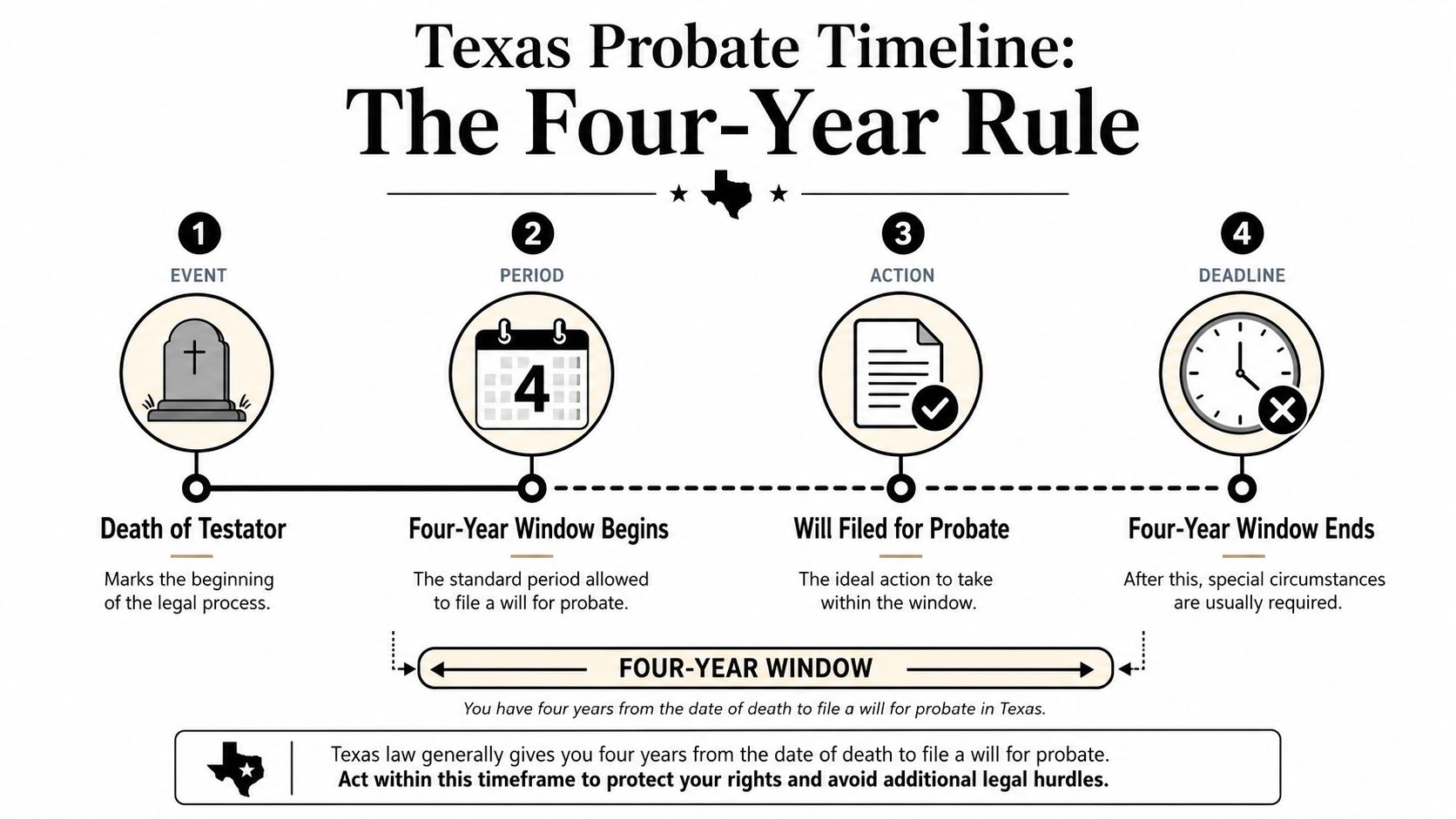
The central deadline in Texas probate law is the 4-year rule. Under Texas Estates Code § 256.003, a will generally must be filed for probate within 4 years of the testator's death, and that deadline is the line between standard probate and much more limited remedies, as explained in this discussion of the Texas four-year probate rule.
A useful way to think about it is this: the will doesn't expire in the everyday sense, but the right to use it in the normal probate process can.
Here is the timeline most families need to understand first:
When the clock starts
The clock starts on the date of death. It does not usually start when the family finds the will. It does not usually start when someone first talks to a lawyer. It does not pause just because the estate seemed simple.
That point causes a lot of confusion. Families often say, “But we didn't know there was a will,” or “We thought the surviving spouse could just handle everything.” Those facts may matter later when a court looks at whether the delay can be excused, but they do not change when the basic deadline begins.
What ordinary probate means
In plain English, probate is the court process used to recognize a will and authorize the person handling the estate. If the will is filed on time, the court can usually admit it through the standard process, and the named executor may be able to act with court authority.
That authority matters because third parties often want proof. Banks, buyers, title companies, and others usually don't accept family understandings alone.
A short overview can help if you prefer video before legal reading:
Why Texas uses a hard deadline
The law favors finality. Estates need to be settled. Property needs a reliable chain of ownership. People need to know whether they can rely on past transfers.
If there were no meaningful deadline, a will discovered much later could disrupt ownership questions long after everyone thought matters were settled. Texas addresses that concern by setting a firm filing window, then limiting what can happen after that window closes.
The four-year mark is the threshold that separates ordinary probate from more limited options.
That's why this deadline gets so much attention. It isn't just another procedural date on a court calendar. It determines what legal doors are still open.
Consequences of Missing the Four-Year Filing Deadline
Once the four-year filing period has passed, the will is not automatically ignored in every circumstance. But the estate can lose access to standard probate, and the choices left are often narrower and more fragile.
The biggest practical consequence is that Texas intestacy law may take over. Under Texas Estates Code § 201.001, property may be distributed according to statutory family priorities rather than the decedent's written wishes, as discussed in this explanation of Texas probate time limits and intestacy consequences.
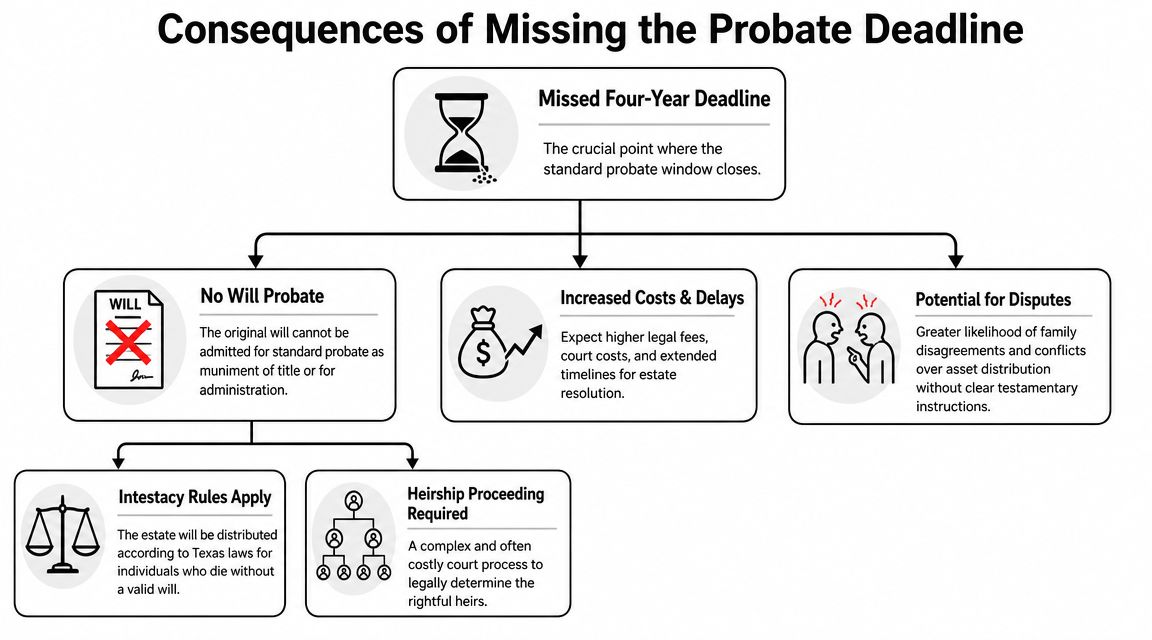
The three paths families usually face
Standard probate may no longer be available.
That means the court may not admit the will in the usual way or appoint the executor in the ordinary course.
Intestacy may control distribution.
“Intestacy” is the legal term for dying without an effective will for probate purposes. In plain language, the state's default inheritance rules control who receives property.
Muniment of title may still be possible in limited cases.
A muniment of title is a simplified probate tool mainly used when there are no meaningful debts and no full administration is needed. It can sometimes help transfer title to property, but it is not a full replacement for regular probate.
Why muniment of title is not the same as full probate
Families often hear “There's still a way to use the will” and assume the problem is solved. Not necessarily.
Muniment of title is narrower. It is mainly about using the will as evidence of title. It is often most useful when the estate does not need a full administration. If the estate has complications, debts, disputes, or unanswered questions about who should act, a simpler title-based remedy may not accomplish what the family expected.
That difference becomes very important with real estate. A house may still be occupied by one heir, but selling it, refinancing it, or proving clean ownership later can become much harder if the probate path is limited.
The real-world fallout
When the deadline is missed, families often run into problems such as:
- Property going to different people than the will named
- No clear executor authority, which can stall estate business
- Title issues on homes and land
- More conflict among relatives, especially in blended families or second-marriage situations
- Pressure toward court disputes, which may require probate litigation guidance
A missed deadline can turn a quiet estate into a disputed one because uncertainty creates room for disagreement.
This is why the question isn't only whether the will exists. The better question is whether the will can still be used effectively enough to carry out what the person wanted.
Other Important Probate Deadlines to Know
The four-year will-filing rule gets most of the attention, but it isn't the only deadline that can affect a Texas estate. Probate has multiple timing points, and each one can change someone's rights or responsibilities.
One of the clearest examples is the deadline for a will contest. In Texas, a will contest is typically barred if it is not filed within 2 years after the will is admitted to probate, which means someone who believes the will is invalid can lose the right to challenge it if they wait too long, as explained in this review of Texas probate deadlines.
The two-year will contest deadline
This rule surprises many families because the clock is tied to the date the will is admitted to probate, not the date of death. If a beneficiary believes there was undue influence, lack of capacity, or another problem with the will, delay can be costly.
A late challenge may leave people bound by an instrument they believe should never have controlled the estate.
Court orders and executor risk
Deadlines also matter after probate starts. If an executor ignores probate court orders, Texas courts can escalate from requiring compliance to civil contempt, monetary fines, removal of the executor, personal liability for losses, and even temporary confinement in rare cases, according to this discussion of the time limit for challenging a will and related probate enforcement issues.
That's a very different problem than filing late at the beginning. But it shows the same pattern. Delay can convert an administrative matter into a liability issue.
Probate courts expect action, records, and compliance. Silence or inaction can have legal consequences.
Key Texas probate deadlines at a glance
| Deadline | Action Required | Typical Timeframe | Consequence if Missed |
|---|---|---|---|
| Filing a will for probate | Submit the will to the probate court for admission | Within 4 years of death | Standard probate may be unavailable, and the estate may be pushed toward intestacy or a narrower remedy |
| Contesting a will | File a legal challenge to the will after admission | Within 2 years after the will is admitted to probate | The challenge is typically barred |
| Responding to court-directed probate obligations | Comply with orders entered in the estate | Court-driven and case-specific | Risk of enforcement, fines, removal, personal liability, or other sanctions |
Why families get tripped up
Some people assume probate has one filing date and that's it. In reality, Texas Estates Code provisions in Titles 2 and 3 create a process with stages. At each stage, someone may have to act, object, notify, account, or comply.
That's one reason legal guidance matters. The issue isn't just “Do we have a will?” It's also “What has to happen next, and by when?”
For a broader understanding of timing, filings, and estate administration steps, it helps to review the full Texas Probate Process.
Exceptions to the Rule Proving You Were Not in Default
Texas law is stricter than most families expect, but it is also more nuanced than a simple automatic forfeiture rule. A will may sometimes still be accepted after four years if the applicant can show they were not “in default” for the delay, as the Texas State Law Library probate guide explains.
That phrase, not in default, is one of the most important concepts in late-filed Texas probate cases.

What “not in default” means in plain English
In everyday language, the court is asking whether the delay was really your fault. Not in a moral sense. In a legal sense.
The question is often whether the applicant failed to act because of neglect, or whether there was a legally acceptable reason for the delay. That is why evidence matters so much. Courts don't just want a general explanation. They usually need a credible, documented story.
A realistic example
Suppose a daughter lives out of state. Her father dies, and a relative tells her there is no will. She later discovers the original will while sorting old records after the family home is emptied. By that point, the four-year mark has passed.
Her situation may be very different from someone who had the will all along, knew probate was needed, and never took action. The first scenario raises a possible argument that the applicant was not in default. The second is harder.
That doesn't mean the late filing will automatically be allowed. It means the court may examine the reason for delay instead of treating every late case exactly the same.
What kind of proof matters
A court may want a clear timeline and supporting facts, such as:
- When the applicant learned of the will
- Where the will was found
- What the family believed at the time
- Why no one filed earlier
- What documents or witness testimony support that explanation
The legal issue is not merely that the deadline was missed. The issue is whether the delay can be excused with sufficient evidence.
Related planning documents can also matter. Estates often overlap with wider concerns involving beneficiary incapacity, prior powers of attorney, or older estate plans. In some families, reviewing Wills & Trusts services helps clarify what documents exist and what options are still available.
Courts don't usually reward vague explanations. Specific dates, records, and testimony carry far more weight than “we just didn't know what to do.”
A Step-by-Step Guide if You Have Missed a Deadline
If you think a probate deadline has passed, take a breath and slow down. The worst response is usually a rushed one. Families sometimes make the case harder by transferring property informally, paying out assets too early, or relying on advice from someone who isn't handling Texas probate matters regularly.
Start with control, not panic
Locate the original will and related papers.
Gather the original signed will, death certificate, deeds, account statements, prior court documents, and any letters or emails that explain what happened.Write down a timeline right away.
Memory fades fast, especially when several family members are involved. Note when the person died, when the will was found, who had possession of it, and what the family understood at each stage.Stop informal distributions.
Don't deed the house, divide bank funds, or “agree among yourselves” about who gets what until a lawyer reviews the situation. Informal transfers can create new disputes and may complicate the court's view of the estate.
Protect the estate's paper trail
Missing the probate deadline can create downstream title and finance problems. Even where the estate seems small, a weak or incomplete probate record can make it difficult for heirs to sell or refinance inherited real estate because title companies want a clean chain of authority, as noted in this article about Texas probate and title-transfer issues.
That is why your document file matters. The issue may not show up until years later, when someone tries to close a sale.
Get legal advice before taking the next step
Ask what remedy is still available.
The right question may be whether the estate can still use the will in a limited way, whether a different probate proceeding is needed, or whether additional court action will be required.Consider whether related issues are present.
If an heir is a minor or lacks capacity, the estate may also intersect with Guardianship concerns. If probate was opened before and then stalled, a lawyer may need to evaluate options for reopening a Texas probate matter.Speak with a qualified Texas probate attorney promptly.
One option is the Law Office of Bryan Fagan, PLLC, which handles Texas probate filings, estate administration, and related disputes. What matters most is getting a lawyer who can evaluate the missed deadline, the available evidence, and the practical steps needed to protect title and inheritance rights.
Key Insights and Your Next Steps
If you're dealing with a late probate issue, the most important thing to remember is that timing changes everything, but it doesn't always end everything.
Key insight
- The four-year rule is the main deadline for filing a will for probate in Texas.
- Missing it can block normal probate and push the estate toward intestacy or a narrower remedy.
- The difference between being at fault and having a valid excuse matters.
- Real estate problems often show up later, especially when a family tries to sell or refinance.
- A two-year deadline can also bar a will contest after the will has been admitted.
- Fast, organized legal action gives families the best chance to protect the estate.
If you want a broader non-firm resource for context on the overall process, this guide to Texas estate settlement can help you understand how probate fits into the larger task of settling a loved one's affairs.
When families wait, options tend to narrow. When families act quickly, even after a mistake or delay, there is often more room to solve the problem cleanly. That's especially true when the case involves an old will, title questions, blended-family inheritance issues, or disagreement about what happened.
The next best step is simple. Gather the documents, stop informal transfers, and get legal advice specific to the county and facts involved.
If you're facing probate in Texas, our team can help guide you through every step, from filing to final distribution. Schedule your free consultation today with Law Office of Bryan Fagan, PLLC.