A Muniment of Title is a simplified Texas probate process for passing clear title to property from a valid will when the person who died had no unsecured debts, and the application generally must be filed within 4 years of death. For the right estate, it can be a much lighter path than full probate, but if there are unsecured debts or Medicaid issues, it usually isn't the right fit.
When a loved one dies, most families aren't looking for a legal lesson. They're trying to figure out who pays the mortgage, how to deal with the house, and what to do with the will tucked inside a desk drawer. If you're in that position, you're not alone, and you're not expected to know Texas probate rules while you're grieving.
A Simpler Path for Your Loved One's Estate
Maria's mother died with a valid will. The will left the family home to Maria and her brother. There was still a mortgage on the house, but no credit card balances, no unpaid medical bills, and no fight among family members. What Maria wanted was simple. She needed a legal way to show that title to the home had passed under the will.
For a family in that kind of situation, Muniment of Title may be the practical answer. It's a narrow probate option under Texas law that lets the court admit a will for the purpose of establishing title to property, without opening a full estate administration. That matters because a full probate can feel like using a moving truck when all you need is a key.
When the simpler route makes sense
This option tends to fit estates that are straightforward, especially when the main goal is clearing title to real estate. A common example is a parent who owned a home, left a clear will, and didn't leave behind unsecured debt.
Here is the rough profile of the estate that often fits:
- A valid will exists: The family has the will and wants the court to recognize it.
- The estate is simple: The main task is transferring ownership, not managing a long list of estate problems.
- There aren't unsecured debts: A mortgage can still exist because it's tied to the house, but general unpaid bills can be a problem.
- No executor needs to actively manage things: Because this process doesn't appoint a personal representative, it works best when nobody needs authority to collect, negotiate, or fight over estate assets.
Grieving families often assume every probate has to be long and complicated. In Texas, that's not always true.
Texas Estates Code Titles 2 and 3 govern much of probate and estate administration in Texas, and Chapter 257 creates this simplified route for certain estates. The catch is that it is specific, not flexible. If your loved one's estate fits the rules, Muniment of Title can reduce stress. If it doesn't, trying to force it can create delays and confusion later.
That practical decision is what matters most. Not whether the term sounds simple, but whether it fits your family's facts.
What Is a Muniment of Title in Plain English
A Muniment of Title is a court order that lets a valid will serve as proof that property passed to the people named in that will. In plain English, it is a shortcut for showing ownership, usually when the family mainly needs to clear title to a house, land, or another asset and does not need a full estate administration.
The word muniment means written evidence. Title means legal ownership. Put together, the term describes a legal paper trail that shows who now owns the property after death.
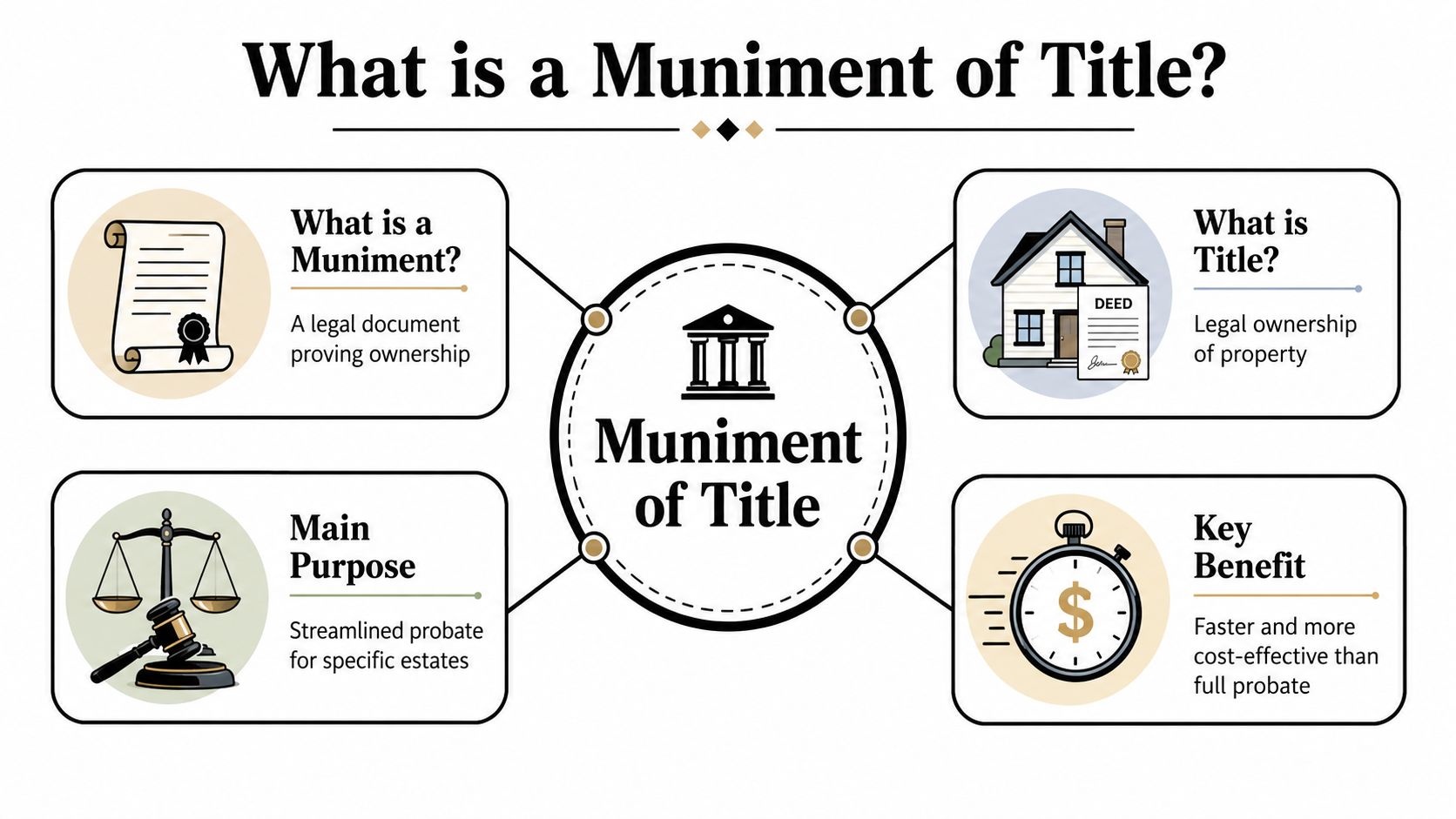
A deed transfers ownership from one living person to another. A Muniment of Title order lets the will do a similar job after someone dies. Once the judge signs the order, the will and the order can be recorded in the county property records. That recorded paperwork helps show that ownership moved under the will.
This is why families often use a muniment when the main problem is, "How do we get the house into the right name?" If your situation is more about title than management, this option can fit. If your family needs someone with legal authority to collect accounts, deal with creditors, or sort out disputes, this process is often too limited.
Under Texas Estates Code Chapter 257 and Section 257.001, a court may admit a will solely to establish title to the decedent's assets without appointing an executor, issuing Letters Testamentary, or opening a full administration. That limited purpose is the whole point. The court is recognizing the will as evidence of ownership, not creating an estate manager.
Families sometimes confuse this with other shortcuts. For example, an affidavit of heirship in Texas is often used when there is no will or when heirs are trying to establish family history tied to title. A Muniment of Title is different because it depends on a valid will and a court order admitting that will.
What it does and what it does not do
A Muniment of Title has a narrow job. That narrow job is also its strength.
It does help with:
- Showing who owns real estate under the will: The court order and will can be recorded in the county deed records.
- Providing proof of title to some institutions: Banks, title companies, or buyers may accept the order as part of the ownership record.
- Avoiding a larger probate process when no active administration is needed: That can reduce paperwork, court involvement, and delay.
It does not appoint someone with broad authority to act for the estate. No executor means no one automatically has power to gather all assets, negotiate claims, pay general debts, or handle conflict the way a personal representative could in a traditional probate.
That distinction matters for practical decision-making. A muniment works best when the family needs a clean chain of title and little else. It works poorly when hidden problems exist, especially unsecured debts or possible Medicaid recovery issues, because those facts often mean the estate needs a different probate route.
Is Your Estate Eligible for Muniment of Title
Eligibility is the heart of the decision. Most families don't struggle with the definition of Muniment of Title. They struggle with the disqualifiers. In Texas, the big deal-breakers are usually unsecured debts and Medicaid benefits.
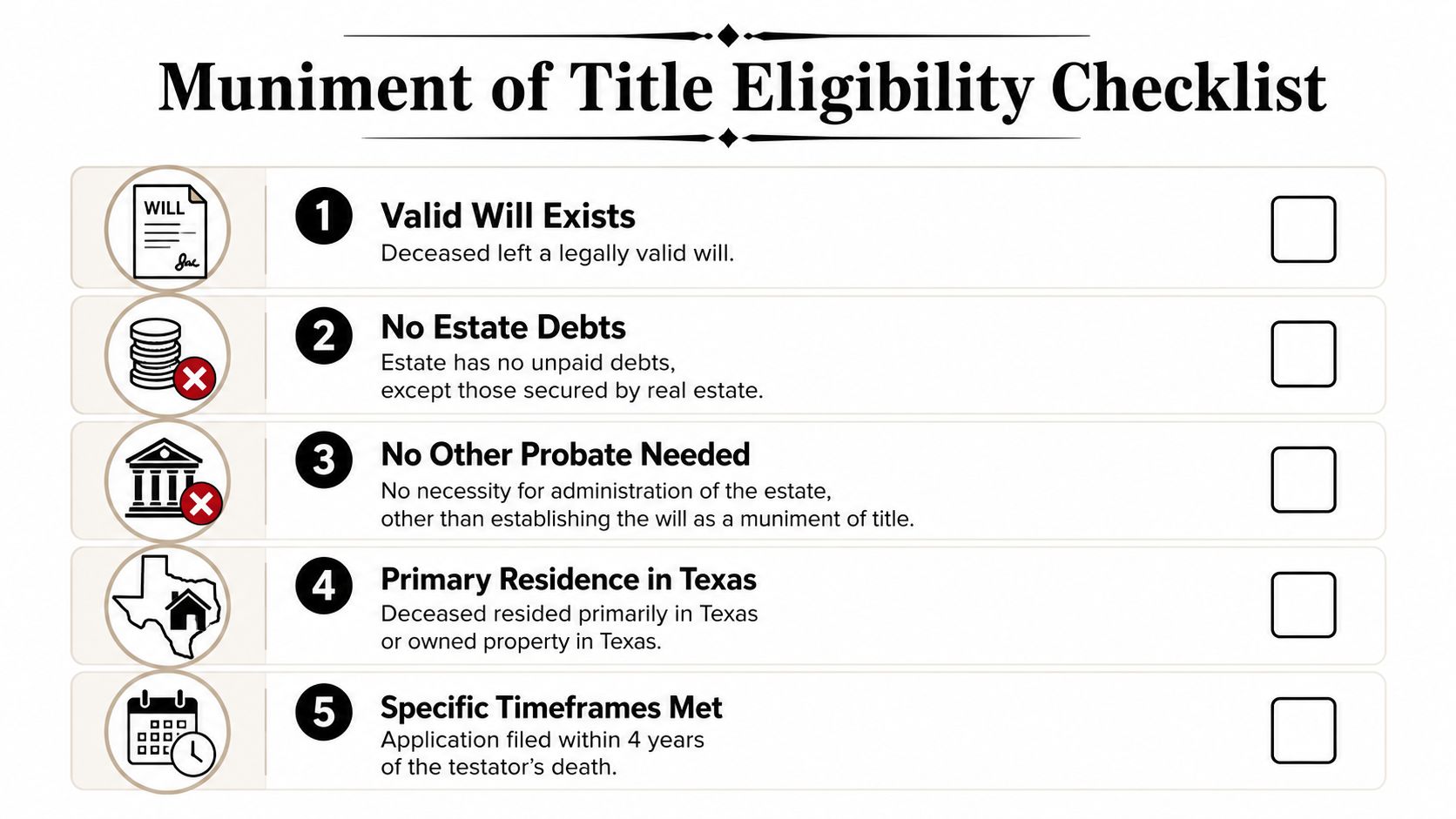
The short checklist
Texas courts look for a narrow set of facts before admitting a will as a muniment.
- There must be a valid will: This process is for probating a will. If there is no will, you're looking at other probate paths.
- There can't be unpaid unsecured debts: Texas law allows this option when the decedent died without unsecured debts, and debts secured by liens on real estate, such as a home mortgage, are the kind of debt usually permitted under Chapter 257 eligibility guidance.
- The decedent must not have received Medicaid benefits: Medicaid can trigger a claim through the Medicaid Estate Recovery Program, often called MERP, which can disqualify the estate from this simplified route.
- There must be no real need for full administration: If someone needs legal authority to collect assets, deal with creditors, or resolve disputes, a muniment may not be enough.
- The filing deadline matters: A will generally must be filed as a Muniment of Title within 4 years of death. The timing issue is addressed in more detail below.
Secured debt versus unsecured debt
Families often need plain language in such situations.
A secured debt is tied to property. A mortgage is the classic example because the lender has a lien on the house. A secured debt doesn't automatically disqualify the estate in this context.
An unsecured debt is a debt without that kind of property lien behind it. Common examples include credit card balances, personal loans, and many medical bills. Those are the debts that usually block the use of Muniment of Title.
If you're unsure what kind of debt you're looking at, don't guess. One overlooked bill can change the correct probate path.
A realistic example
Suppose your father died owning a house in Harris County. His will leaves the house to you. The home still has a mortgage, but he had no unpaid credit cards, no outstanding personal loans, and no Medicaid history. That may be a strong candidate for Muniment of Title.
Now change one fact. He also had an unpaid hospital bill and an old credit card account. That estate may need a different probate approach.
A family in that second situation might look at other tools, including an Affidavit of Heirship in Texas, depending on the facts and whether there is a will, but that document serves a very different purpose and doesn't replace a valid-will probate in every case.
Later in the eligibility review, many people also benefit from hearing a lawyer explain the rule out loud:
If there's a valid will but the estate has unsecured debt or a Medicaid recovery issue, the faster-sounding option can become the wrong option.
The Muniment of Title Filing Process Step by Step
A muniment case is often the probate version of using the correct key for one lock. You are not opening every door in the estate. You are asking the court for a specific order that lets the will do its job, mainly to clear title to property.
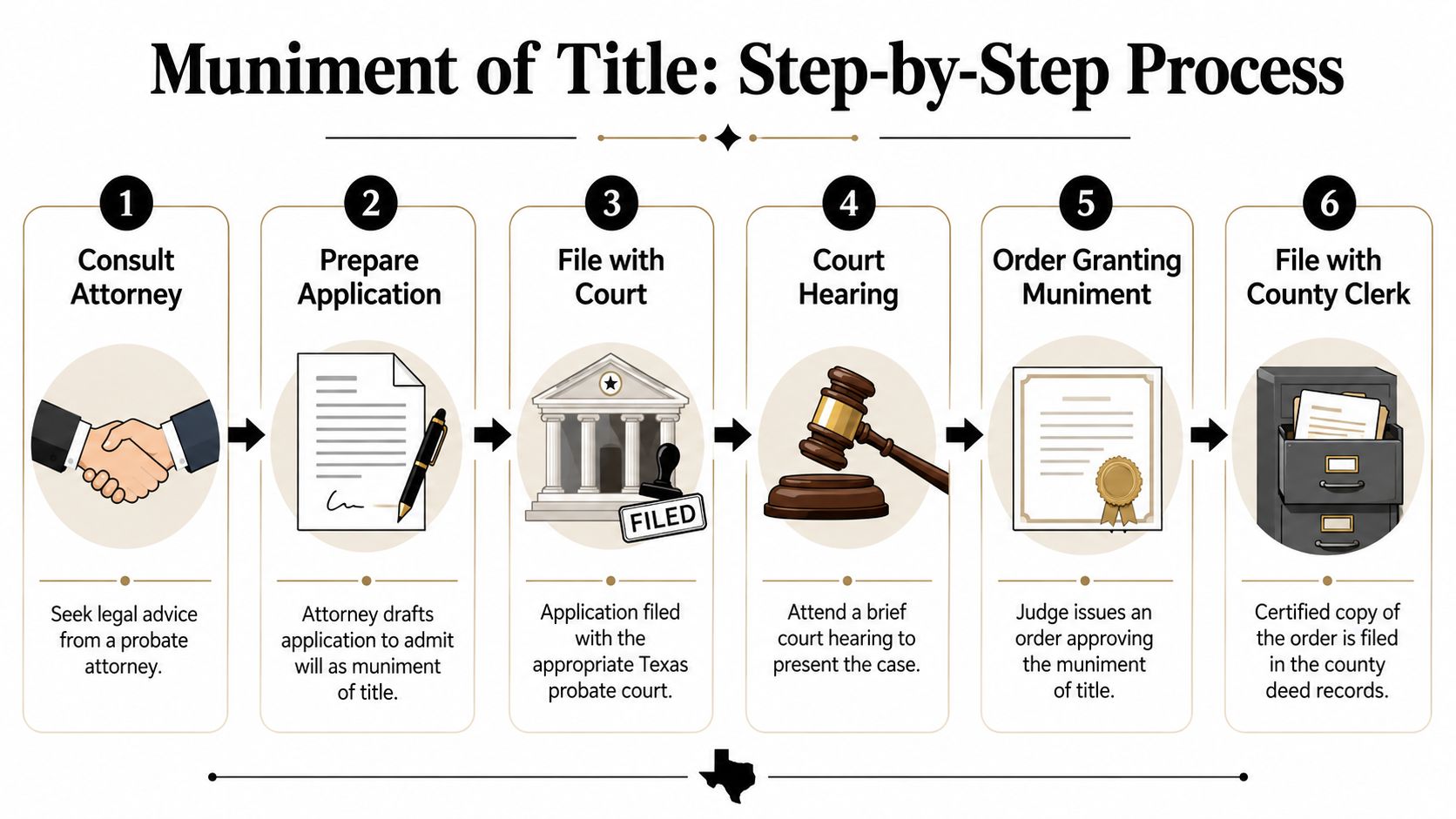
Families often feel better once they see the sequence. The court still requires paperwork, notice, and a hearing, but the process is narrower than a full administration because no executor is being appointed to collect assets, pay claims, and manage the estate over time.
A practical summary appears in this discussion of the Texas muniment process, which describes the filing, hearing, court order, recording step, and follow-up affidavit. Here is the same process in plain English, with the decision points families usually care about most.
1. Prepare the application and supporting documents
The case begins with an Application to Probate Will as a Muniment of Title filed in the proper county. The court usually needs the original will and a certified copy of the death certificate.
This is also the moment to slow down and confirm the facts one more time. If new information surfaces about unsecured debts or a Medicaid claim, filing for muniment may send you down the wrong road and cost time. Families comparing simplified probate options sometimes also review this guide on probate vs. small estate affidavit in Texas.
2. File the case and wait for posted notice
After filing, the clerk posts notice before the hearing. That public notice gives others a chance to object and gives the court a basic due-process record.
For many families, this part feels passive. That is normal. The main job during this period is to stay organized and make sure the person who will attend the hearing is ready to answer simple factual questions.
3. Attend the prove-up hearing
The hearing is usually short. The judge or court staff will want testimony covering points such as where the decedent lived, whether the will is valid, and whether the estate qualifies for this limited procedure.
A helpful way to view the hearing is as a checkpoint, not a trial. The court is confirming that muniment is the right lane for this estate. If the facts fit, the judge signs an order admitting the will as a muniment of title.
4. Get the signed order and use it correctly
That signed order is the document people rely on later. It connects the will to the public record so title companies, county records offices, and some financial institutions can see the legal basis for ownership.
For real estate, the order and the will should usually be recorded in the deed records of the county where the property is located. Recording matters because an unrecorded order may not solve the practical problem the family is trying to fix. On paper, the will has been admitted. In real life, you still need the property records to reflect that chain of title.
5. File the post-admission affidavit if the court requires it
Many muniment cases do not end the day of the hearing. Unless the court waives the requirement, the applicant must later file an affidavit stating what parts of the will have been carried out and what parts have not.
That follow-up step is easy to miss, especially for a family that thought the hearing was the finish line.
Why these steps matter in real life
Each step has a practical purpose:
| Step | Why it matters |
|---|---|
| Prepare and file the application | Gives the court the will, death information, and the legal request for a title-only probate |
| Posted notice | Protects due process and allows objections if someone believes muniment is improper |
| Prove-up hearing | Lets the court confirm the will and the estate fit this limited procedure |
| Signed order and recording | Creates a usable chain-of-title document for real property records |
| Follow-up affidavit | Closes out the reporting requirement if the court has not waived it |
One point surprises many families. No executor is appointed in a muniment case, so no Letters Testamentary are issued. If a bank, transfer agent, or another institution insists on letters, the problem is usually not that you filed incorrectly. The institution may be asking for a different kind of probate authority than muniment provides.
If you reach that kind of roadblock, getting probate legal support can help you sort out whether the institution can accept the muniment order or whether the estate needs a different probate path.
Muniment of Title vs Other Texas Probate Options
Muniment of Title fills a very specific role in Texas probate. It isn't a substitute for every other estate tool. When you're deciding what to do, side-by-side comparison usually helps more than abstract definitions.
Texas Estates Code Titles 2 and 3 include multiple procedures for transferring property or administering an estate. The right one depends on whether there's a will, whether debts exist, and whether someone needs legal authority to act.
Texas Probate Options Compared
| Feature | Muniment of Title | Independent Administration | Small Estate Affidavit | Affidavit of Heirship |
|---|---|---|---|---|
| Will required | Yes, this option is based on probating a valid will | Often used when there is a will, though administration issues vary by case | Typically used in limited situations and not as a substitute for probating every will | No will is commonly the reason families consider it |
| Debt limits matter | Yes. Unsecured debt is usually a deal-breaker | Better suited when estate affairs need active management, including debts | Debt and asset limits are critical, and separate rules apply | Doesn't resolve creditor issues the way an administration can |
| Executor or administrator appointed | No | Yes | No formal personal representative in the same sense | No |
| Best use case | Clearing title when the estate is simple and debt-free except permitted liens | Estates that need someone to gather assets, pay claims, and complete administration | Certain smaller estates that fit statutory requirements | Establishing a record of family history and heirship, often for title purposes |
| Court involvement | Limited | More involved than a muniment | Limited, but only if the estate qualifies | Usually outside full administration, though acceptance by third parties can vary |
| Main limitation | No broad authority to act for the estate | More paperwork and administration steps | Not available for every estate and not interchangeable with will probate | May not be enough when a valid will exists or when administration is necessary |
For families deciding between these options, this guide on probate vs small estate affidavit in Texas can help clarify where a simpler affidavit fits and where it doesn't.
If your family is comparing options and gathering documents before hiring counsel, resources that explain probate legal support can also be useful for understanding the kinds of administrative tasks that come up in estate matters.
The practical choice
If the estate has a valid will and doesn't need administration, Muniment of Title can be efficient. If the family needs someone with legal authority to act, Independent Administration is often the better fit. If there is no will, or if the estate falls into a different category, the analysis changes quickly.
The mistake I see most often is treating these options as interchangeable. They aren't. Each one solves a different problem.
Practical Costs Timelines and Common Pitfalls
A lot of families reach this stage with the same hope: "If the will is clear, maybe this part will be quick and inexpensive."
Sometimes it is. A Muniment of Title often costs less and takes less work than a full probate administration because there is no ongoing executor appointment and fewer court steps. But the savings only hold if the estate is suitable for this narrow procedure. If a disqualifier shows up late, the family can lose time, pay for a second probate path, and start over with more stress than they expected.

What families should expect on timing
The court process is usually measured in weeks or a few months, not in a same-day filing. The exact timing depends on the county, the court's docket, whether the original will is available, and whether the paperwork is prepared correctly the first time.
One timing issue deserves immediate attention. Texas generally expects a will to be offered for probate within four years of death. If your family is already close to that mark, do not assume delay is harmless just because everyone agrees about who should inherit what. In probate, agreement among relatives does not stop the deadline.
A simple way to think about this is a boarding gate at the airport. Even if every passenger has the right ticket, the plane still leaves at a set time.
Where "simple" cases usually go off track
The biggest mistakes are rarely dramatic. They are usually small facts the family did not know to check before filing.
- An unsecured debt turns up late. Credit cards, old medical bills, and personal loans matter here because this procedure is built for estates that do not need administration.
- Medicaid history is discovered after the case starts. This is one of the most common deal-breakers. If there may be a Medicaid Estate Recovery Program claim, the family should pause and confirm that before treating muniment as the easy answer.
- Someone expects the order to work like executor papers. A Muniment of Title transfers title under the will. It does not give broad authority to act for the estate in the way Letters Testamentary do.
- Real property records are never updated. If the estate includes a house, the court order usually needs to be recorded in the county deed records so the chain of title is clear.
- The family waits because there is no conflict. Lack of conflict helps, but it does not solve debt issues, Medicaid issues, or deadline problems.
That is why the practical question is not only, "Is there a will?" The better question is, "Is this estate clean enough for this shortcut?"
Costs, without false certainty
No careful lawyer should quote a one-size-fits-all number before reviewing the will, the debts, the county, and whether title problems exist. Filing fees, attorney time, hearing preparation, and recordation costs can all affect the final amount.
Still, the comparison that matters most is usually this one: will a muniment avoid the larger cost of full administration, or will a hidden issue force the family into a second procedure anyway? For many families, that is the critical budget decision.
If you want a clearer picture of filing fees, attorney work, and what tends to increase expenses, this guide to understanding the cost of probate in Texas is a useful reference. The Law Office of Bryan Fagan, PLLC also handles probate filings, estate administration, and disputes when a case first appears simple but needs a different approach.
A short review on the front end often saves money on the back end. Check the debt picture. Check for Medicaid history. Check the filing date. Those three points decide many muniment cases before anything is filed.
Key Insights for Your Family's Next Steps
Takeaway: Muniment of Title is a strong option for the right Texas estate, but the right estate is a narrow one. The will needs to be valid. The estate generally can't have unsecured debts. Medicaid history can stop the process. And the filing deadline matters.
If your family mainly needs to transfer title to a home or other property and doesn't need an executor to do active estate work, this route may save time, expense, and emotional wear. If unsecured debt, MERP concerns, or administration needs are present, a different probate path is usually safer.
What to do before filing anything
A calm first review can prevent expensive detours later.
- Gather the core documents: The original will, death certificate, and basic asset information.
- Make a debt list: Separate mortgage or lien-based debts from credit cards, medical bills, and personal loans.
- Check for Medicaid history: That single fact can change the entire analysis.
- Ask what authority is really needed: If someone must act for the estate, a muniment may be too limited.
- Consider broader family needs: Some readers dealing with elder care or incapacity planning may also need information about Guardianship.
You don't need to carry all of this alone. A short conversation with a Texas probate attorney can usually tell you whether Muniment of Title fits your facts or whether another route will protect the estate better.
If you're looking for practical guidance from Law Office of Bryan Fagan, PLLC, our team helps Texas families evaluate probate options, prepare filings, and move from uncertainty to a clear plan. If you're facing probate in Texas, our team can help guide you through every step, from filing to final distribution. Schedule your free consultation today.