When someone you love dies, the paperwork can feel cruelly out of place. You may still be making funeral arrangements, answering family texts, and trying to process your own grief. Then someone asks, “Has the will been filed?” or “Who's handling the estate?” and suddenly you're expected to make legal decisions you never wanted to make.
That's where many families start looking for a probate attorney in Dallas. They aren't looking for complicated legal theory. They want a calm explanation, a clear path, and reassurance that they won't make a painful situation worse.
Probate is often the process that brings order to the practical side of loss. It creates a legal way to identify the will, appoint the right person to act, deal with debts, and transfer property to the people who are supposed to receive it. In Texas, those rules largely come from Titles 2 and 3 of the Texas Estates Code, which govern matters such as wills, estate administration, and related probate procedures.
Your Guide Through Probate in Dallas Texas
If you're the person everyone is turning to after a death, you may feel like you have to know everything immediately. You don't. Most executors and family members begin with the same questions: Do we need probate? How long will this take? Do we have to go to court? What if family members disagree?
A Dallas probate case is rarely just about forms. It's about a home, a bank account, a parent's wishes, or a sibling relationship that suddenly feels fragile. The legal process matters because it protects all of those moving parts at once.
Here's the simplest way to think about probate. It's the court-supervised method for wrapping up a person's legal and financial affairs after death. Sometimes that supervision is light. Sometimes it's more hands-on. The right path depends on whether there's a will, what assets exist, and whether anyone expects a dispute.
What grieving families usually need first
Most families benefit from focusing on a short list before anything else:
- Find the original will if there is one.
- Identify the person named as executor or the family member most likely to handle paperwork.
- Gather basic records such as the death certificate, property information, account statements, and contact details for heirs.
- Pause major decisions like selling property or emptying accounts until you know what authority is required.
Probate feels less overwhelming when you break it into tasks. One document, one filing, one deadline at a time.
In Dallas, local court practice matters. So does timing. So does choosing the correct procedure from the start. When families get early guidance, they usually feel less pressure because the process stops feeling mysterious and starts feeling manageable.
What is Probate and Why is It Necessary
A lot of Dallas executors reach this point with one urgent question: If everyone in the family agrees, why does a court need to be involved at all?
Probate exists because good intentions are not the same as legal authority. After a death, banks, title companies, and other institutions usually need proof that the right person is acting for the estate. The probate court provides that proof. If there is a will, the court can accept it and confirm the executor's authority. If there is no will, the court can determine who has the right to serve and who inherits under Texas law.
In plain terms, probate is the legal process for settling a person's estate. It creates an orderly way to deal with property, debts, and authority at a time when families are already carrying enough emotional weight.
Under Title 2 of the Texas Estates Code, probate serves a practical purpose as much as a legal one. It helps prevent confusion over who can sign documents, collect assets, pay valid claims, or transfer a home. In Dallas County, that structure matters because even simple estates can stall if an executor tries to act before the court has recognized their authority.
What probate actually accomplishes
Probate usually handles three jobs:
Confirms the will, if one exists
The court decides whether the will meets Texas legal requirements and should be followed.Creates authority for someone to act
The executor or administrator needs recognized authority to deal with accounts, real estate, and estate paperwork.Clears the path for transfers
The estate can address debts and move property to heirs or beneficiaries in the correct legal order.
A helpful comparison is a baton pass in a relay race. Your loved one held legal control of their property during life. After death, that control does not automatically pass to the next person just because the family knows what should happen. Probate is the formal handoff.
Why probate is often necessary in Dallas
For many families, the biggest surprise is that a will does not give immediate power on its own. A will states the decedent's wishes, but the executor often still needs the Dallas probate court to admit the will and issue authority before third parties will cooperate.
That can matter quickly. A house may need insurance attention. Utility accounts may need to stay active. A bank may freeze individual accounts. If the estate includes Dallas real estate titled in one person's name, probate is often the process that lets that property be sold, transferred, or refinanced with clear authority.
For families who are new to the process, this overview of navigating Texas probate offers a helpful plain-language starting point.
Probate does not cover everything
Many assets pass outside probate, which is one reason families get mixed signals about whether they "need probate" at all. Property in a trust, accounts with named beneficiaries, and some jointly owned assets may transfer without full probate. Other assets, especially those titled in a person's name alone, may still require court involvement.
That distinction is easy to miss when you are sorting through paperwork in the first week or two after a loss. Families often see one bank account transfer smoothly and assume the house or another account will work the same way. Often, it does not.
A simple Dallas example
Suppose your father lived in Dallas County, owned a house in his name alone, had a checking account with no payable-on-death designation, and left a will naming you as executor.
You may know exactly what he wanted.
The title company and the bank still may not act until the probate court confirms the will and recognizes your authority. Probate gives you the legal standing to step in, protect the property, handle valid estate obligations, and transfer assets the right way.
Practical rule: Probate is the court process that turns a family member's responsibility into recognized legal authority.
For an executor, that shift matters emotionally as well as legally. You are not just "helping out." You are taking on a formal role with duties to the estate, the beneficiaries, and sometimes creditors. Understanding that early can prevent mistakes and make conversations with a Dallas probate attorney much more productive.
Takeaway
Probate creates legal order after a death. It confirms who can act, helps protect the estate, and allows property to pass according to a valid will or Texas inheritance law.
Navigating the Different Types of Texas Probate
Texas doesn't use a one-size-fits-all probate system. That's one reason families get confused. The word “probate” sounds singular, but Texas law recognizes four distinct procedural frameworks, including Independent Administration, Dependent Administration, Muniment of Title, and the Small Estate Affidavit, as summarized by Sharpe Law's explanation of Texas probate procedures.
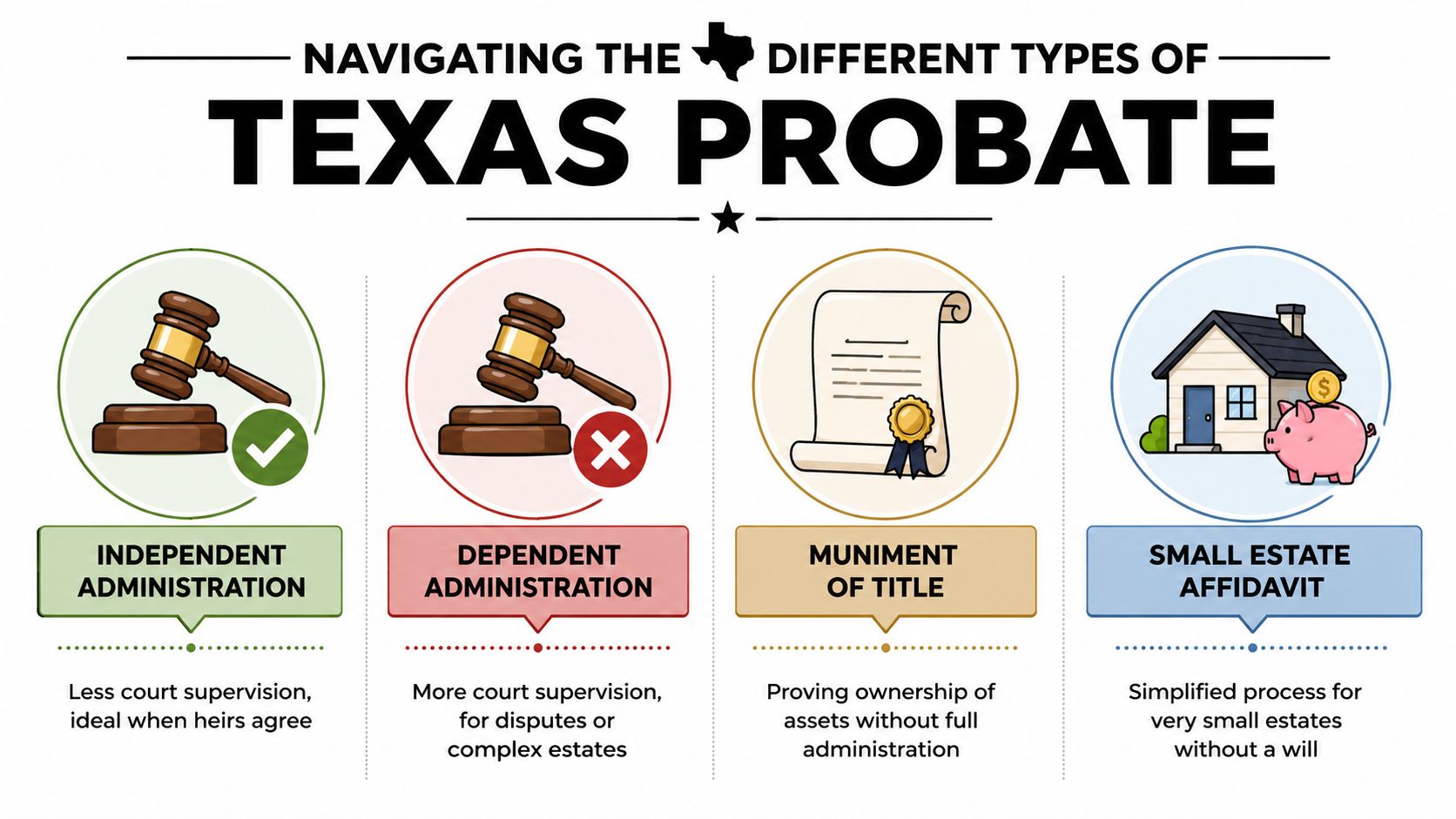
A side-by-side view
| Probate path | When it often applies | Court involvement | Plain-English meaning |
|---|---|---|---|
| Independent Administration | Often used when there's a valid will and an executor can serve | Lower | The executor can handle most estate tasks without asking the court for permission each time |
| Dependent Administration | Often used when there's no will or when beneficiaries disagree | Higher | The court closely supervises the estate and must approve many actions |
| Muniment of Title | May fit when there's a valid will and no unpaid debts, other than secured debt on real property | Limited | A streamlined way to transfer title without full administration |
| Small Estate Affidavit | May fit when the decedent died without a will and the probate estate does not exceed $75,000 under Texas Estates Code §205.001 | Simplified | A shortcut for certain small intestate estates |
Independent Administration
This is the route many families hope for because it's usually more efficient. The executor gets authority from the court, but doesn't need court approval for every routine decision. Under the verified Texas probate framework, the executor must file an Inventory, Appraisement, and List of Claims within 90 days of the hearing when this procedure applies.
That matters in real life. If an executor needs to collect funds, manage property, or pay ordinary estate expenses, less court supervision usually means fewer delays.
Dependent Administration
Dependent administration is more hands-on. The court remains closely involved, and the administrator may need approval before taking actions such as selling real estate or paying certain debts. This path is often required when there is no will or when family members can't agree on who should serve or how the estate should be handled.
For grieving families, this can feel like every decision has to be checked twice. That isn't necessarily bad. It can protect people when trust is low. But it usually means more steps, more oversight, and more expense.
Two streamlined options
Some estates can use narrower tools instead of full administration:
- Muniment of Title works best in a limited set of cases where there is a valid will and no debts that require full administration.
- Small Estate Affidavit may help when someone died without a will and the probate estate falls under the legal threshold.
Families also avoid probate entirely for some assets through stronger planning. If you want to understand how wills, trusts, and ownership choices affect that outcome, our page on Wills & Trusts is a helpful next step.
The biggest probate mistake is assuming every estate follows the same path. In Texas, the right procedure depends on the facts.
Takeaway
Choosing the right probate framework early can save time, reduce stress, and prevent avoidable court complications.
The Step-by-Step Probate Timeline in Dallas
You have the death certificate in one hand, a will in the other, and three family members asking what happens now. For many Dallas executors, that is the moment probate stops feeling like a legal term and starts feeling like a job they never asked for.
A clear timeline helps because probate usually moves in stages, not all at once. The court is confirming authority, setting deadlines, and creating a paper trail so assets can be gathered, debts handled, and property passed to the right people. In Dallas County, that process can feel slow at first. That does not always mean something is wrong.
A realistic Dallas example
Maria lives in Dallas. Her father died with a will naming her as executor. He owned a house, a few bank accounts in his sole name, and personal property. Her siblings are cooperative, but Maria has never dealt with Probate Court No. 1, 2, or 3 in Dallas County, and she is worried about making a mistake.
Her path often looks like this.
Step 1. File the probate application
The case starts when the will and an application are filed with the proper Dallas County probate court. This filing asks the court to admit the will to probate and appoint the executor.
A helpful comparison is a relay race. Before Maria can carry the baton, the court has to hand it to her. Filing opens the case, but it does not yet give her legal authority to act for the estate.
Timing matters here. Texas law has deadlines for offering a will for probate, and local court procedures can affect how quickly a hearing is set.
Step 2. Attend the hearing and receive authority
At the hearing, the judge reviews the will and the application. If everything is in order, the court signs an order appointing the executor.
After that, the clerk can issue Letters Testamentary. Those letters are the documents banks, title companies, and other institutions often want to see before they will speak with Maria or let her access estate information.
This step often brings emotional relief. It is the point where an executor goes from worried family member to recognized decision-maker.
Step 3. Give required notices
Probate includes notice requirements because other people may have legal interests in the estate. Beneficiaries may need formal notice. Creditors also have to be addressed under Texas rules.
Families are often surprised by this part. They assume probate is only about dividing property among heirs. In reality, the executor is also responsible for dealing with the estate's legal housekeeping. That includes making sure the right people are informed and that claims are handled in the right order.
Step 4. Identify, secure, and value estate property
Next, Maria has to figure out what the estate owns. That can include real estate, bank accounts, vehicles, business interests, refunds, and personal items with financial value.
In probate, timelines frequently expand. A house may need a title review. A safe deposit box may need to be opened. A missing account statement can slow everything down for weeks. If an asset passes outside probate, such as a payable-on-death account, it may not be part of the probate estate at all. Executors often need help sorting those lines.
In many independent administrations, the executor must also file an Inventory, Appraisement, and List of Claims, or use another allowed procedure, within the required deadline after appointment.
Step 5. Pay valid debts and keep records
Before beneficiaries receive their shares, the estate usually has to settle proper debts, taxes, and expenses of administration. That might include funeral expenses, final bills, mortgage payments, property insurance, or costs needed to preserve estate property.
Good recordkeeping matters more than many executors expect. A simple ledger can prevent major confusion later. If Maria pays a bill from estate funds, she should be able to show when, why, and from which account. Clear records protect the executor, not just the estate.
Step 6. Distribute the remaining assets and close the estate
Once debts and required tasks are handled, the executor can distribute what remains according to the will or, if there is no will, under Texas intestacy rules. That may involve signing deeds, transferring funds, getting receipts from beneficiaries, and filing any closing documents the case requires.
This final stage is often slower than families expect. The legal work may be nearly done, but practical issues still come up. A beneficiary may live out of state. A house may need to be sold first. Someone may disagree about personal property. Probate ends only after both the legal and practical pieces are addressed.
For a broader explanation of how timing can vary, this guide on how long probate can take in Texas gives helpful context.
Why one Dallas probate case finishes faster than another
Two estates can look similar on paper and move at very different speeds. Common reasons include:
- Dallas County court scheduling, which affects hearing dates and processing time
- The type of administration, because a dependent administration usually requires more court involvement
- Real estate issues, such as title problems, homestead questions, or a sale that cannot happen right away
- Family tension, even if no one files a formal contest
- Missing paperwork, including the original will, account records, or deeds
- Creditor and tax issues, which can force the executor to pause distribution
One more point often gets missed. Executors are not only following a timeline. They are carrying stress, grief, and responsibility at the same time. A Dallas probate attorney can help by turning a confusing stack of tasks into an ordered checklist, explaining what has to happen now, what can wait, and where attorney fees may stay flat versus where litigation can shift costs into hourly or, in some disputed matters, contingency-based arrangements.
Key Insight
Executors rarely need to master every probate rule on day one. They need a reliable sequence, clear deadlines, and guidance on the Dallas County steps that can delay an estate if handled incorrectly.
Understanding the Costs of Probate
Cost anxiety is common in probate. Families often worry that they'll be hit with fees they didn't expect, at a time when they're already managing funeral expenses, mortgages, and day-to-day bills.
The total cost depends on the kind of probate involved. A simpler estate usually costs less to administer than an estate with disputes, bond requirements, repeated court hearings, or property problems that need extra work.
The main categories of probate expense
Probate costs often include several moving parts:
- Court-related charges for filing and processing the case
- Notice expenses connected to required legal notices
- Bond costs if the court requires a fiduciary bond in a more supervised administration
- Attorney fees based on the fee structure and the complexity of the work
In Dallas and across North Texas, many firms offer flat-fee services for certain probate and estate planning matters. The verified Dallas probate market information also notes that Nathan Law, PLLC offers flat-fee services for documents such as wills, powers of attorney, medical directives, affidavits of heirship, small estate affidavits, and muniment of title probate, while Michael Duran has helped over 2,000 clients with uncontested probate, guardianship, and estate planning matters in the Dallas legal market, as described at Dallas Probate Law Lawyer.
Flat fee, hourly fee, and contingency fee
Families often understand flat fees and hourly billing, but they get confused about litigation fees. In a routine probate, lawyers frequently use flat or hourly arrangements. In a contested matter, the fee conversation can be different.
The underserved issue in Dallas is contingency fee availability for probate litigation. Verified data reflects that some Dallas probate litigators do accept contingency cases for disputes such as will contests or heirship disputes, and that 29% of contested probate cases in Dallas involved plaintiffs who sought contingency-based representation, while only 12% of local firm marketing pages clearly state that availability, based on the verified source tied to Avvo's discussion of contingency-fee probate representation.
That doesn't mean every contested probate case qualifies for contingency representation. It means families should ask directly rather than assume the answer is no.
Why the right legal help can save money
A lawyer doesn't make probate free. But clear guidance can prevent expensive mistakes, especially when an executor files the wrong procedure, misses a deadline, mishandles a creditor claim, or acts before having authority.
If you want a fuller discussion of categories of estate expense, this resource on probate costs in Texas can help you frame the questions to ask during a consultation.
Takeaway
The most useful cost question isn't just “What do you charge?” It's “What fee structure fits this specific estate, and what problems could make costs rise?”
Common Probate Pitfalls and Family Disputes
Probate problems usually don't start with dramatic courtroom scenes. More often, they begin with delay, confusion, or assumptions. Someone assumes the will can wait. Someone assumes a sibling will cooperate. Someone assumes a house can be sold before legal authority is in place.

Missing the filing deadline
One of the most serious issues in Texas probate is waiting too long to file the will. Under Texas Estates Code §256.003, a will must be admitted to probate within four years after death, and if that deadline is missed, the will may be admitted only as a muniment of title unless the applicant proves they were not in default, as explained in this discussion of the four-year probate rule in Texas.
That rule surprises many families. They may have honored the will informally for years and think they can “take care of probate later.” Sometimes later is too late.
Will contests and family conflict
Another common pitfall is assuming everyone will stay on the same page once probate begins. Grief can sharpen old tensions. A child may question whether the will was signed properly. A second spouse may clash with adult children from an earlier marriage. An heir may accuse someone of pressure or manipulation.
Texas law also imposes a deadline for formal contests. Under Texas Estates Code §256.204, a challenge to the validity of a will must generally be brought within two years after the will has been admitted to probate, although claims involving forgery or fraud may extend to two years from discovery, according to RMO Lawyers' discussion of Estates Code §256.204.
A probate dispute is still a family dispute. Legal deadlines matter, but so do emotions, communication, and early intervention.
Other trouble spots
Some estates become complicated because of related issues outside standard administration:
- Executor conflict when the named personal representative isn't acting transparently
- Capacity concerns when relatives question whether the decedent understood the will
- Heirship problems when there is no will and family history is unclear
- Vulnerability issues that may overlap with the need for Guardianship in related family situations
- Formal court fights that may require Probate Litigation rather than routine administration
Key Insight
Most probate disputes become harder and more expensive once positions harden. Early legal guidance often helps families preserve both options and relationships.
How to Choose the Right Dallas Probate Attorney
You may be holding a death certificate, a will, and a list of questions no one prepared you for. The court wants specific filings. Family members want updates. You want to do this correctly without making a painful time harder.
In Dallas County, your choice of lawyer affects more than convenience. Local court guidance explains that the person filing an application to probate a will must be a licensed attorney. A non-lawyer who tries to file that application can be treated as engaging in the unauthorized practice of law. Estate Planning DFW summarizes that Dallas County requirement here.
That local rule changes the question from "Should we hire counsel?" to "Who is the right fit for this family, this estate, and this level of conflict?"

Questions worth asking in the first call
A good first call should feel like someone handing you a map. You may still have hard work ahead, but the route should make more sense by the end.
Ask questions that reveal how the lawyer thinks, not just what the lawyer charges:
- What probate path do you expect for this estate based on the will, the assets, debts, and whether anyone may object
- What does Dallas County require first and what documents should I gather before filing
- How do your fees work for routine probate and how do they change if the matter turns into litigation
- Do you offer hourly, flat-fee, or other billing arrangements, and in a will contest or similar dispute, are contingency fees ever available
- Who will keep me updated if I am the executor and other heirs live out of state or disagree with each other
- What problems do you see early so we can address them before they become expensive
Those questions matter because probate attorneys do not all solve the same problem. One lawyer may focus on routine uncontested administrations. Another may spend much of the practice handling heirship disputes, contested wills, or executor misconduct claims. If your family situation has tension under the surface, you want to know that before papers are filed.
Some families find it helpful to compare criteria before making calls. This guide on how to choose the right probate attorney in Texas offers a useful starting framework.
For example, if you are the executor, ask how the lawyer will help you carry two jobs at once. One job is legal. File the right documents, meet deadlines, account for assets, and follow court rules. The other job is human. Answer a sibling's text, explain delays, and make careful choices while grieving. The right attorney should understand both.
A firm may also provide broader probate and estate administration services through Law Office of Bryan Fagan, PLLC, including matters involving administration, probate litigation, estate planning, and related probate support for Texas families.
For readers who prefer to watch an overview before scheduling a call, this short video may help frame the conversation.
The right fit matters
Clarity matters. So does candor.
A strong probate lawyer explains legal terms in plain English, tells you what the Dallas court is likely to expect, and discusses fees without hedging. If the estate looks routine, you should hear that. If the facts suggest a future dispute, you should hear that too, along with what that could mean for cost, timing, and family stress.
Takeaway
The right Dallas probate attorney helps you handle both the court process and the responsibility of serving your family. Look for clear explanations, honest fee discussions, and experience that matches the estate in front of you, whether that means straightforward administration or a dispute that may require litigation.