Losing a loved one can leave you holding a stack of papers and one urgent question: Do you have to go through probate in Texas? If you're asking that right now, you're not alone, and you're not behind.
A daughter may be sorting through her father's mail and find a deed, a checking account statement, and a will tucked into a desk drawer. A surviving spouse may be told by a bank that no one can access an account yet. An out-of-state son may wonder whether Texas law applies differently because he lives somewhere else. In each of those moments, probate feels bigger and scarier than it needs to.
The short answer is not always. Some estates in Texas need formal court involvement. Others can use a simpler path. Some assets pass directly to a named person and never enter the probate process at all. What matters most isn't just whether your loved one had money or property. It's how those assets were owned, whether there was a valid will, whether debts must be handled, and which Texas procedure fits the situation.
Texas probate law, mainly found in Titles 2 and 3 of the Texas Estates Code, gives families more than one route. The hardest part is figuring out which route applies before making a mistake that causes delay, conflict, or unnecessary expense.
The Question Every Texas Family Asks After a Loss
Maria had just finished the funeral when practical problems started piling up. Her mother left a house, a car, and a bank account. One relative said, “You always have to probate a will in Texas.” Another said, “If there's a will, you can skip court.” The bank gave her a different answer entirely.
That confusion is common. Probate gets talked about as if it's one thing, but in Texas it can mean several different procedures, ranging from a simple filing to a much more involved court process.
In plain English, probate is the legal process used to settle a person's estate after death. That usually means proving a will, identifying property, paying valid debts, and transferring what's left to the right people. Texas Estates Code Title 2 covers many of the rules about estates, administration, and probate proceedings. Title 3 covers guardianship, which can become relevant if an heir is a minor or lacks legal capacity to manage an inheritance.
For many families, the most helpful first step isn't filing anything. It's slowing down long enough to identify what you have. This practical guide on what to do immediately after a loved one dies in Texas can help you get organized before you decide on the next legal move.
Probate isn't a punishment or a sign that something went wrong. It's a tool Texas courts use when property can't pass cleanly without legal authority.
Determining if probate is necessary in Texas comes down to this: it depends on the estate's structure. If assets were arranged to pass automatically, formal probate may be unnecessary. If property is stuck in the deceased person's name alone, court action may be needed to move it.
That distinction gives families something valuable in a hard season. It gives them a way to make calm, informed decisions instead of acting from fear.
When Texas Law Requires Formal Probate
A common moment of panic comes a few days or weeks after the funeral. A daughter finds the house deed, a bank statement, and a car title, all in her father's name alone, and asks the question many Texas families ask at that point: "Can we handle this ourselves, or do we need the court?"
That question usually turns on one practical issue. Does any property still need legal authority to change hands?
If the answer is yes, formal probate may be required. Texas courts step in when property cannot pass cleanly on its own, or when someone needs official authority to deal with debts, sign documents, sell property, or transfer title. A court order works like the key that lets the estate move again.
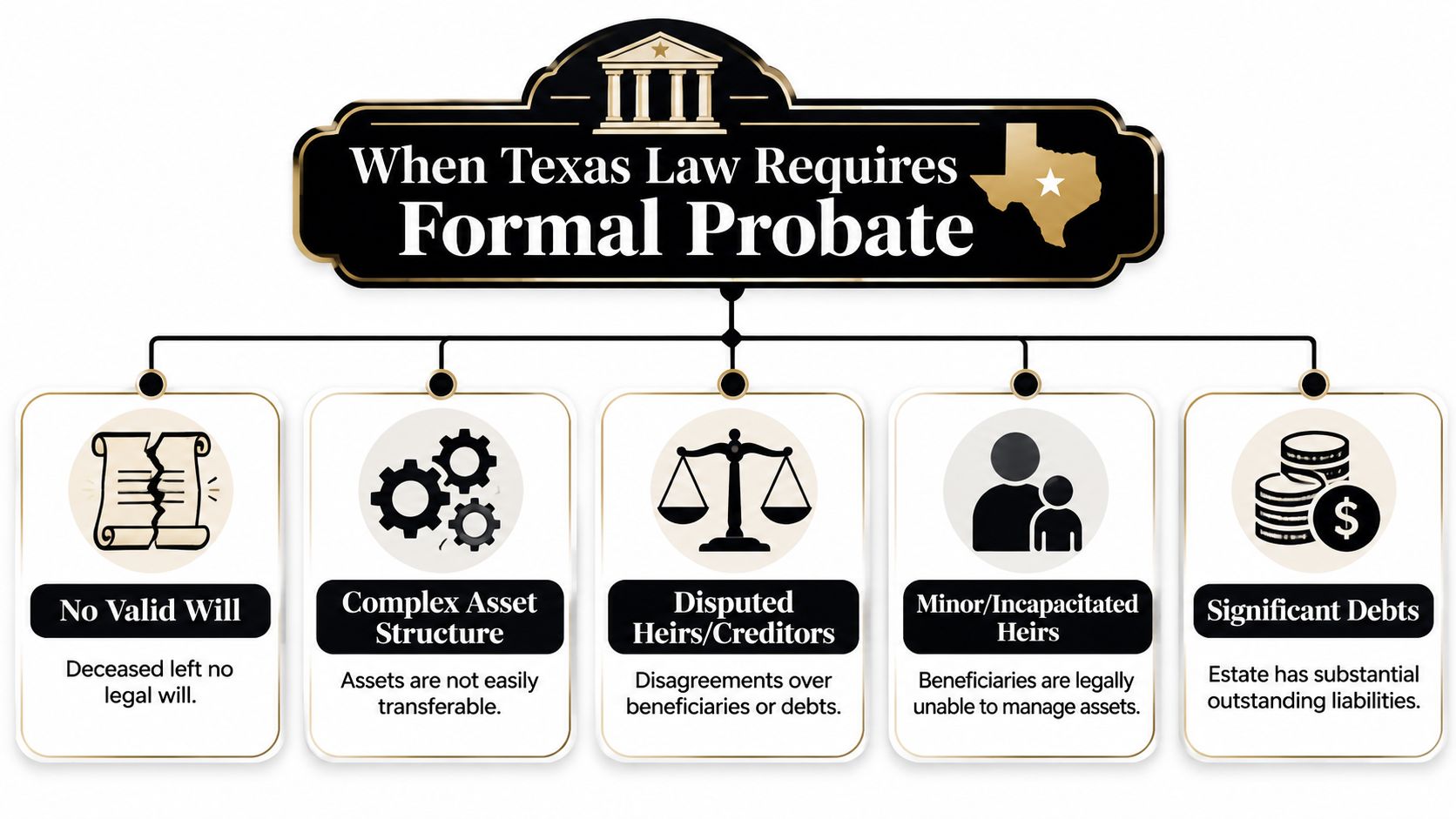
The core trigger Texas families need to check
One rule causes a lot of confusion. In Texas, a Small Estate Affidavit may be available only in a narrow set of cases, including when the person died without a will and the estate fits the legal limits for that shortcut. If the estate does not fit that smaller path, formal probate often becomes the next option.
The focus is not "Was my loved one wealthy?" It is "What was still stuck in their name alone?"
A modest estate can require probate if there is a house, account, or other asset that no one can legally transfer without court authority. A larger estate may need less court involvement if major assets already have beneficiary designations, survivorship rights, or trust ownership. If you want a clearer way to sort those facts, this guide on when probate is required in Texas can help you identify where your family falls.
Situations that often lead to formal probate
Formal probate is more likely when families are dealing with one or more of these problems:
- Property owned only in the deceased person's name. This often includes a home, land, a bank account, or an investment account with no built-in transfer feature.
- A will exists, but no one has legal authority yet. Even with a valid will, banks and title companies often want proof from the probate court before they will honor it.
- No beneficiary, no survivorship right, and no trust. When there is no other transfer method in place, probate is often the legal path that clears title.
- Family conflict or uncertainty about heirs. If relatives disagree, or if it is unclear who should inherit, court supervision becomes much more important.
- A beneficiary is a minor or lacks legal capacity. Extra protections may be needed before property can be distributed.
- The estate has debts that need formal handling. Probate creates a structured process for dealing with creditors before assets are passed out.
These cases are hard for the same reason. Someone needs recognized authority to act, and no private agreement can safely replace that.
Practical rule: Probate is often less about filing papers and more about getting legal authority. Without it, families can be left waiting while bills, property taxes, insurance issues, and title problems continue in the background.
Why the type of probate matters
Families often hear the word "probate" and assume every case will be long, expensive, and court-heavy. Texas does not treat every estate that way.
Many estates can move through Independent Administration, which usually allows the personal representative to handle many tasks with less ongoing court involvement. Dependent Administration involves closer court supervision and more approvals along the way. The difference matters because it affects cost, timing, and stress level for the family.
So if your loved one left property with no clear exit lane, the next question is not just whether probate is required. It is which type of probate gives your family the safest and least burdensome way to finish what needs to be done.
Assets That Can Bypass the Probate Process
Many families breathe easier when they learn that some property never has to pass through probate at all. These assets move by contract, beneficiary designation, survivorship rights, or trust terms rather than by court order.
That matters because the probate question is often too broad. A better question is: Which assets require probate, and which ones already have their own legal exit lane?

The assets that usually transfer outside probate
Texas families commonly see these categories bypass the court process:
- Life insurance with a named beneficiary. The proceeds usually go directly to the person listed on the policy.
- Retirement accounts. Accounts such as IRAs and 401(k)s often pass to the named beneficiary.
- Payable-on-death and transfer-on-death accounts. These accounts usually transfer directly based on the designation already on file.
- Joint ownership with survivorship rights. If survivorship rights were properly created, the surviving owner may receive the asset outside probate.
- Property held in a trust. Assets owned by a living trust are typically managed and distributed under the trust terms instead of through probate.
This is why estate planning can feel uneven inside the same family. One account may transfer in days because a beneficiary is listed. Another may be frozen because no transfer mechanism exists.
Why families get confused
People often assume that having a will avoids probate. Usually, it doesn't. A will tells the court and the family who should receive probate assets, but it doesn't automatically transfer those assets by itself.
By contrast, non-probate assets act more like a standing instruction already attached to the property. The transfer doesn't depend on the will first being carried out.
If you're sorting through statements, deeds, and account documents, this guide to probate and non-probate assets in Texas can help you identify which category each asset likely falls into.
A will and a beneficiary designation do different jobs. The will directs probate property. The designation directs the asset itself.
Where planning changes the outcome
This is also where proactive planning under Texas Estates Code Title 2 can spare a family unnecessary court involvement later. Wills still matter. So do trusts. The difference is that a trust can hold property during life and direct its management after death without relying on the same probate route.
For families thinking ahead, the firm's Wills & Trusts page explains the planning tools Texans often use to reduce confusion, protect beneficiaries, and make later administration more manageable. Trust planning can be especially helpful when a family wants privacy, has blended-family concerns, or wants to avoid leaving every transfer question to the probate court.
Exploring Probate Alternatives for Simpler Estates
Not every estate that needs legal cleanup requires full administration. Texas offers simplified procedures for some smaller or cleaner estates, but the rules are exact. Families often run into trouble by choosing the wrong shortcut.
Two of the most common alternatives are the Small Estate Affidavit and Muniment of Title. They sound similar, but they serve different situations.
Small Estate Affidavit
A Small Estate Affidavit, often called an SEA, is available only in a narrow set of cases. In Texas, an SEA may be used only if the person died without a valid will and the total value of non-exempt assets is $75,000 or less, excluding the homestead and other exempt property, under Texas Estates Code Chapter 205 as summarized by TexasLawHelp.
There is also a timing rule. At least 30 days must pass after the date of death before filing a Small Estate Affidavit, which gives time for any will to surface, as explained in this article on the Texas small estate affidavit waiting period.
An SEA can be a compassionate option for a family with a modest estate, no will, no major conflict, and assets that fit the statute. But it isn't a general substitute for probate.
Muniment of Title
A Muniment of Title is different. It is a simplified probate process used when there is a valid will and the estate is simple enough that full administration may not be necessary. Families often use it when they mainly need a court order to clear title to property and there are no unresolved estate debts that call for a full administration.
The practical appeal is clear. If the estate is limited and the legal purpose is mainly to recognize the will and transfer title, Muniment of Title can be more efficient than opening a full administration.
Comparing Small Estate Alternatives in Texas
| Feature | Small Estate Affidavit (SEA) | Muniment of Title |
|---|---|---|
| Will required | No. The decedent must have died intestate. | Yes. A valid will is required. |
| Estate size rule | Non-exempt assets must be $75,000 or less, excluding homestead and exempt property. | No specific dollar threshold stated here. Suitability depends on the estate's overall simplicity. |
| Waiting period | At least 30 days after death before filing. | No specific waiting period stated here. |
| Best fit | Small, uncomplicated intestate estate. | Estate with a valid will and limited need for ongoing administration. |
| Main purpose | Allow heirs to collect certain assets without full probate. | Admit the will to probate and transfer title without full administration. |
| Common limit | Not available just because an estate is small. The statutory requirements must all fit. | Not designed for estates that require full debt handling or active administration. |
A realistic example
Suppose your brother dies without a will. He leaves a homestead, household items, and a bank account. The family agrees on who the heirs are. No one is fighting, and the estate fits the SEA requirements. In that case, a Small Estate Affidavit may offer a simpler path.
Now change one fact. He left a will that gives the home to one child and the account to another. That situation points away from an SEA, because an SEA is for intestate estates. A Muniment of Title or another probate procedure may be the correct path instead.
The best probate alternative isn't the shortest form. It's the one that actually matches the facts of the estate.
A Simple Guide to the Texas Probate Process
The hardest part for many families is not the paperwork. It is figuring out what the court is asking you to do, and in what order, while you are still grieving.
If your family has already ruled out the simpler options, formal probate usually follows a fairly predictable path in Texas. In many estates, that path is Independent Administration. This means the person in charge of the estate can handle many tasks without going back to the judge for permission at every step. It often feels more manageable for families because the court opens the case, appoints the executor or administrator, and then allows that person to do the day-to-day work of settling the estate.

The usual path in an independent administration
A helpful way to view probate is as a checklist, not a courtroom fight. Each step builds on the one before it.
File the probate application
The case begins when the right paperwork is filed in the proper probate court. If the person who died left a will, the original will is usually filed with the application.Give legal notice
Texas probate requires notice so interested people and potential creditors have a chance to learn that the estate has been opened. This is part of the court's way of making the process fair and orderly.Attend the court hearing
At the hearing, the judge decides whether the will should be admitted to probate, if there is one, and whether the proposed executor or administrator should be appointed.
A short visual overview can help if this still feels abstract:
What the executor does after appointment
Once the court appoints the executor, that person has legal authority to act for the estate. If there is a will, that authority is often shown through Letters Testamentary. You can think of those letters as the executor's proof that banks, title companies, and others can rely on.
From there, the executor usually has several practical jobs:
- Find and organize estate property so accounts, vehicles, real estate, and personal items are not overlooked
- Notify creditors and review any claims made against the estate
- Prepare the required inventory, or use an affidavit in place of inventory if the law allows it
- Pay valid debts and expenses
- Distribute what remains under the will, or under Texas intestacy rules if there is no will
This stage is where families often feel both relief and pressure. Relief, because someone now has authority to act. Pressure, because that person must be careful, organized, and fair. Probate is often less about dramatic disputes and more about steady follow-through.
When probate becomes more demanding
Some estates need closer court supervision. That process is called Dependent Administration. It can come up when the will does not permit independent administration, when the people involved cannot agree, or when debts, title problems, or family conflict make extra oversight necessary.
For a grieving family, the difference can feel similar to the difference between handling a move with a clear checklist or having to ask for approval before each box is packed. Both paths can get the job done. One involves more court involvement, more delay, and often more expense.
One deadline deserves careful attention. A will generally needs to be filed for probate within four years after death. Missing that window can create serious problems and may change how property passes.
Families often feel calmer once they know the path in front of them. The process is still work, but it becomes a series of decisions and tasks rather than one large unknown.
Key Insights and When to Call for Help
If you've made it this far, you already know more than many families do when they first face probate. The hard part isn't memorizing legal terms. It's matching the law to the facts sitting on your kitchen table.
Key Insight
- Probate isn't automatic in every Texas estate. Some assets transfer outside court, and some estates qualify for simpler procedures.
- Asset title often matters more than the family expects. Property held only in the deceased person's name creates the biggest transfer problems.
- A small estate isn't always a simple estate. The right procedure depends on whether there is a will, what kinds of assets exist, and whether debts or disputes are involved.
- Deadlines and classification matter. Missing a required filing window can change how property passes.
- Court involvement may increase if a beneficiary is a minor or lacks capacity, which is one reason some families also need guidance on Guardianship.
When legal help becomes especially important
Some families can move forward with clarity once they identify the right probate lane. Others should get legal advice quickly.
You should strongly consider speaking with a probate attorney if:
- There is family conflict about the will, the heirs, or who should serve as executor
- The estate includes real estate title issues
- A beneficiary is a minor
- You live outside Texas and are trying to manage a Texas estate remotely
- You suspect the wrong probate procedure is being used
- A will may be contested or administration has already become adversarial, in which case Probate Litigation may become relevant
The Law Office of Bryan Fagan, PLLC handles probate administration, small estate affidavits, muniment of title proceedings, guardianship matters, and estate planning for Texas families who need help matching the right legal tool to the right facts.
The safest path is often the calmest one. Get the documents together. Identify the assets. Find out whether they are probate or non-probate. Then get guidance before signing, filing, or distributing anything that can't easily be undone.
If you're facing probate in Texas, our team can help guide you through every step, from filing to final distribution. Schedule your free consultation today with Law Office of Bryan Fagan, PLLC.