A single beneficiary usually can't legally block the entire probate process just by refusing to cooperate, and probate fees are often estimated at about 2% to 5% of the value of the assets that pass through probate. In Texas, that means one person can create delay, expense, and stress, but they usually can't force a complete deadlock when the court has authority over the estate.
If you're reading this after a parent, spouse, or sibling has died, the legal problem probably doesn't feel abstract. It feels personal. One family member won't return calls. Another says the will is unfair. Someone is demanding access to accounts that may not even belong to the probate estate. Meanwhile, the executor is stuck wondering whether anything can move forward.
That fear is understandable. Probate already asks a grieving family to handle paperwork, property, debts, and deadlines at the same time they're dealing with loss. When one beneficiary starts objecting, many people assume that person now controls the whole case.
Usually, they don't.
Texas probate law is built to keep administration moving, even when disputes arise. The court can hear objections, decide who has standing, clarify what property is part of the estate, and authorize the executor to continue doing the job. The primary concern is rarely whether one beneficiary can stop everything forever. The more pertinent question involves how much delay they can cause, and what the executor can do about it.
A Difficult Crossroads Navigating Grief and Disagreement
A common scene in Texas probate looks like this. A father dies. One child is named executor. At first, everyone agrees to “keep things simple.” Then the disagreements start. One sibling thinks the executor is moving too fast. Another wants the family home kept off the market. A third insists certain accounts should be split through probate, even though they may pass outside of it.
At that point, the executor often asks the same question: can one beneficiary block the entire probate process?
The answer is still no, but that answer doesn't always feel comforting in the moment. Delay can feel like a shutdown when bills are due, property must be secured, and family tension is rising.
Probate courts exist for exactly this kind of moment. They don't require perfect family harmony before an estate can be administered.
Under the Texas Estates Code, especially the parts governing probate proceedings and estate administration in Titles 2 and 3, the court's role is to supervise the legal transfer of a decedent's probate property. The executor or administrator isn't there to satisfy every demand from every heir. That person's duty is to gather assets, deal with claims, protect property, and distribute what remains according to the will or Texas intestacy rules.
If you're an executor or heir, the most reassuring point is this: family conflict may complicate probate, but it doesn't automatically erase the court's authority. A difficult beneficiary can make the road rougher. They usually can't close the road entirely.
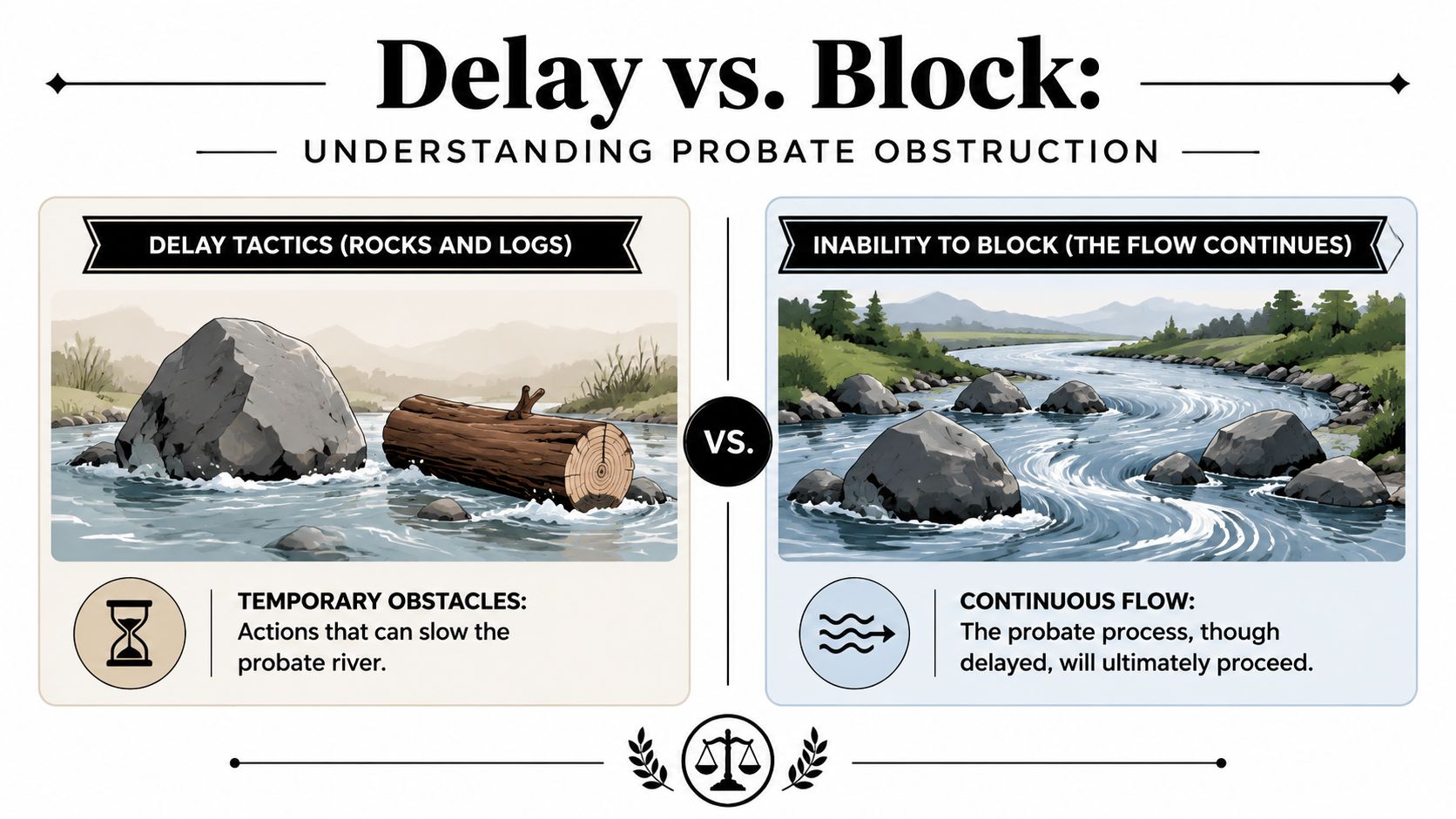
The Power to Delay Is Not the Power to Block
A beneficiary's influence is often misunderstood. In practice, the difference between delay and block matters more than any angry email or threat made around a kitchen table.
Think of probate like traffic on a major highway. One wreck can back everything up. It can even stop cars for a while. But that isn't the same as permanently shutting down the highway. The court clears the obstruction, sets the route, and traffic starts moving again.
What actually causes the delay
A beneficiary usually does not stop probate by being unhelpful, refusing to sign informal paperwork, or making verbal accusations. The bigger risk begins when that person files a formal objection with the court.
When that happens, the court may need to decide issues such as:
- Validity of the will if someone contests whether it was properly made
- Standing if the person objecting may not be a legally recognized interested party
- Entitlement if there's a real dispute over who should receive a probate asset
- Timing of distribution because an executor who distributes property too early can face personal liability if the court later rules differently
That practical point is well explained in this discussion of probate objections and paused distributions. The process may continue in part, but final distributions can be frozen until the judge gives the executor a safe path forward.
What doesn't work for the objecting beneficiary
Some families assume that if one beneficiary refuses to cooperate, probate can't proceed. That's usually wrong. Texas courts can appoint a personal representative, issue orders, require notices, and move the estate through the statutory process even when one person remains hostile.
What matters is not volume. It's legal relevance.
A beneficiary's obstruction usually fails when it amounts to:
- Refusing to agree without filing anything
- Demanding assets without showing a legal basis
- Insisting on control over property that isn't part of the probate estate
- Using delay as a pressure tactic without evidence
For executors trying to understand their responsibilities, An Executor's Duties in a Texas Probate outlines what an executor must do to administer the estate properly. That matters because the executor's best protection is often steady compliance with those duties, not reactive arguments with beneficiaries.
Practical rule: If an objection isn't turned into a real court filing with a legal issue attached to it, it usually has far less power than the family drama around it suggests.
Common Obstruction Tactics Beneficiaries May Use
Most beneficiaries who interfere with probate don't announce that they're trying to “block” it. They frame their actions as demands for fairness, transparency, or delay “until things are explained.” Sometimes those concerns are legitimate. Sometimes they're tactical.
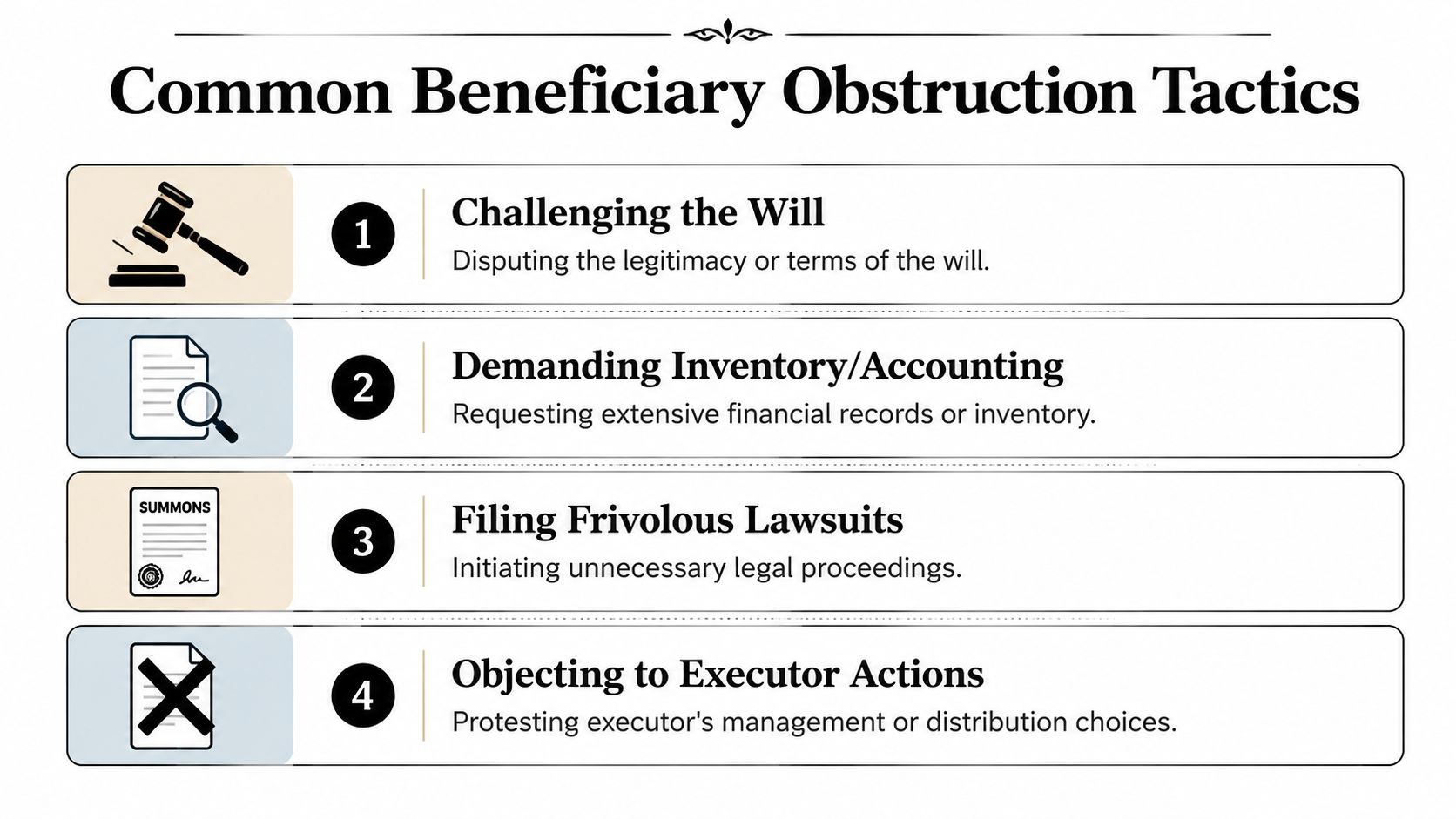
Four tactics that commonly slow probate
-
Challenging the will. A beneficiary may claim the will wasn't valid because of undue influence, lack of capacity, fraud, or improper signing. Once filed, that dispute has to be addressed before the court can safely move to final distribution.
-
Objecting to the executor. Instead of attacking the will, a beneficiary may argue that the named executor is unqualified, biased, or mishandling the estate. In Texas, disputes over appointment and removal can create real friction because the representative is the person charged with carrying out the administration.
-
Disputing the inventory or accounting. The objecting person may say assets were omitted, values are wrong, or debts shouldn't be paid. Some of these objections are proper. Others are broad attempts to force delay and increase pressure on the executor.
-
Claiming rights to excluded property. This is one of the most confusing issues for families. A person may demand access to life insurance proceeds, retirement accounts, payable-on-death accounts, or trust property as though those assets must pass through probate.
Many probate fights also turn on whether the complaining person even has the legal right to object, and whether the property they want is part of the estate. This article on exclusion from probate and standing issues highlights that a person can be excluded from probate without being entitled to block it, and many assets never enter probate at all.
What a formal objection looks like in real life
The filing is usually more structured than the family argument behind it. It may say, in substance, that the beneficiary objects to probating the will, disputes the executor's appointment, or claims the estate inventory is incomplete.
A realistic example would read something like this:
A beneficiary objects to the application to probate the will and asks the court to deny letters testamentary because the beneficiary believes the will was the product of undue influence and doesn't reflect the decedent's true intent.
That kind of filing changes the case. It moves the dispute from family disagreement into court procedure.
For families already dealing with control issues among heirs, power struggles in probate when one heir tries to control everything is a useful related read because these conflicts often overlap with executor objections, possession of property, and misinformation about who has authority.
A short video can also help frame what contested probate looks like in practice.
Why these tactics work at least for a while
An executor cannot ignore a filed contest and distribute property anyway. That's where delay gains its power. The more serious the allegation, the more likely the court will require a hearing, briefing, records, witness testimony, or a more formal accounting before authorizing the next step.
That doesn't mean the beneficiary wins. It means procedure has to catch up with the accusation.
An Executor's Legal Tools to Overcome Obstruction
An executor does not have to sit still while a beneficiary creates delay. Texas law gives the executor a job to do, and it gives the court tools to enforce that job when someone interferes.

The practical first step is to define the fight. Before spending estate time and money on arguments, the executor should sort property into probate assets and nonprobate assets. That often shrinks the dispute. If an account passes by beneficiary designation, survivorship rights, or trust ownership, the probate court may not need to decide who gets it through the estate at all. Property held with beneficiary designations, survivorship features, or trust ownership generally transfers outside probate.
Once the estate is properly defined, the executor can ask for targeted relief instead of arguing in circles with family members.
Tools Texas executors can use
Executors in Texas commonly use several remedies to keep administration moving:
-
Motion to compel
If a beneficiary is holding estate records, keys, financial information, or other property, the executor can ask the court to order turnover and compliance. -
Set a hearing on objections
Delay often grows when accusations are left hanging. Setting a hearing forces the objecting beneficiary to put evidence and legal arguments in front of the judge. -
Application for instructions or declaratory relief
If the dispute is about what the will means, whether property belongs to the estate, or whether the executor can sell or distribute an asset, the court can give direction before the executor acts. -
Proceed with uncontested parts of the estate
A dispute over one issue does not always freeze everything else. The executor may still be able to marshal assets, protect property, address creditor matters, and prepare required filings while the contested issue is pending. -
Request orders protecting estate property
If a house is being occupied without cooperation, valuables are at risk, or estate funds are being mishandled, the executor can seek court orders to preserve the asset until the dispute is resolved.
The point is practical. A beneficiary may slow the process, but that person does not get a permanent veto over lawful administration.
In my experience, executors get better results when they stop treating obstruction as a family argument and start treating it as a record for the court. Keep communications in writing. Document missed deadlines, refusals, and threats. Save texts, emails, and account statements. Judges respond better to a clean timeline than to a stack of emotional accusations.
If a relative is refusing to sign, surrender property, or cooperate with basic estate tasks, this discussion of what happens when a family member will not cooperate in probate explains the practical steps in more detail.
Texas procedure also depends on the kind of administration involved. In an independent administration, the executor often has room to act without asking the court for permission at every step. But if a beneficiary's conduct starts interfering with the estate, the court can still step in under Titles 2 and 3 of the Estates Code. That is often the turning point. Once the issue is presented clearly, the case can move again.
Law Office of Bryan Fagan, PLLC handles probate filings, administration disputes, and litigation when objections turn into court proceedings.
A Realistic Scenario The Disputed Family Home
A mother dies with a valid will leaving her estate equally to her three adult children. Her daughter, Sarah, is named independent executor. The main probate asset is the family home. Her brothers, Michael and David, are beneficiaries.
Everyone agrees the will is valid. The conflict isn't about who inherits. It's about what happens next.
David lived in the home with their mother before her death. After probate begins, he refuses to move out, won't cooperate with listing the house, and tells the others that no sale can happen unless he agrees. Sarah delays because she doesn't want to inflame the situation. The utilities still need to be paid. Maintenance issues begin piling up. Michael wants his share, but no one can distribute the estate fairly while the house remains unsold.
That doesn't mean David has blocked probate. It means he has created a dispute around one estate asset.
Probate has long been structured to let courts resolve disputes without handing one beneficiary a permanent veto.
Sarah eventually asks the probate court for relief. She presents the will, explains why a sale is necessary to carry out equal distribution, and asks for an order confirming her authority to proceed. David gets a chance to respond. He talks about his attachment to the house and his belief that he should have more time.
The judge may consider those concerns, but the court's focus stays on the legal administration of the estate. If the will calls for equal treatment and the home must be sold to accomplish that, the court can authorize the sale and require compliance.
That outcome fits the broader structure of probate described in Fidelity's overview of probate procedure and court supervision. The court doesn't erase family conflict. It gives the executor a lawful way through it.
For Texas families, that's often the turning point. Once the executor has a clear order, the dispute becomes manageable because authority is no longer being negotiated around the dinner table.
Key Insights and Practical Next Steps
The hardest part of contested probate is often uncertainty. Families don't know whether to wait, push back, distribute assets, or go to court. The clearest answer is usually the safest one: keep the administration organized, keep the record clean, and don't let one beneficiary redefine the case.
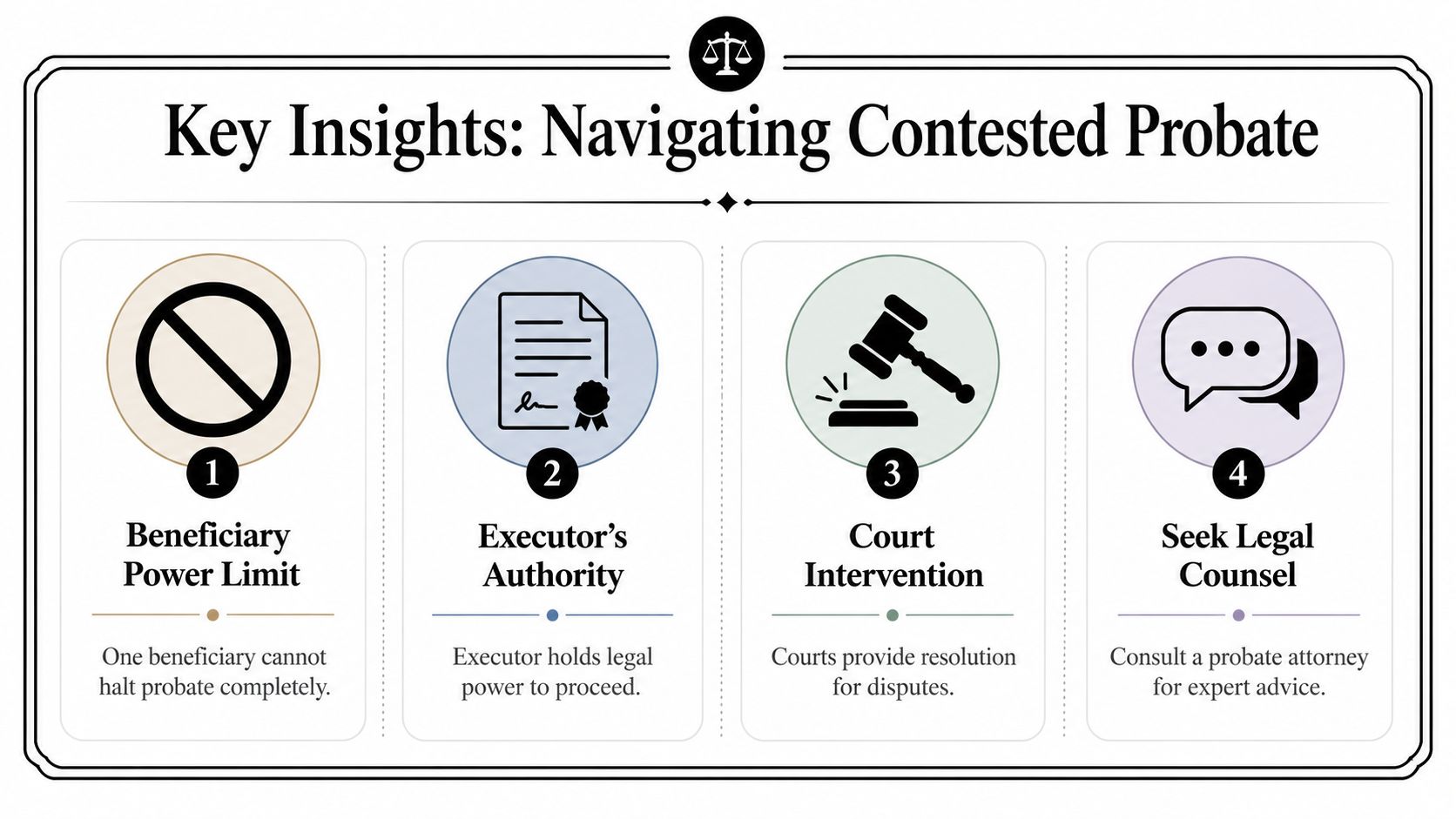
Takeaway
One beneficiary usually can't halt probate completely. That person's real power is delay. The executor's real protection is process.
Probate also involves cost. Because probate fees are often estimated at about 2% to 5% of the assets that pass through probate, disputes usually center on property with enough value to justify the fight, as explained in this discussion of assets subject to probate and related costs.
A practical checklist for executors and heirs
-
Document everything. Save emails, letters, text messages, and notes of calls. If the dispute ends up before a judge, your timeline matters.
-
Use formal written communication. Verbal conversations create confusion. Written communication creates a record of what was requested, what was refused, and what deadlines were given.
-
Don't distribute too early. If an objection is pending, early distributions can create personal risk for the executor.
-
Follow the will and the Estates Code. In Texas, your authority comes from the court, the will if there is one, and the governing probate statutes in Titles 2 and 3.
-
Separate emotional claims from legal claims. A beneficiary may feel hurt, excluded, or suspicious. Those feelings may be real. They still aren't the same as a legally valid objection.
-
Learn the related processes. For broader background, review the Texas Probate Process, and if the dispute is already escalating, review Probate Litigation. If your family is also dealing with incapacity or care decisions, Guardianship and Wills & Trusts may also be relevant.
Keep the estate moving where you can. Freeze only what the court actually needs you to freeze.
When to Hire a Probate Litigation Attorney
Some probate disputes stay manageable. Others cross a line where delay becomes legal exposure.
You should strongly consider hiring a probate litigation attorney if a beneficiary files a will contest, accuses the executor of theft or fraud, threatens suit, refuses to surrender estate property, or hires counsel and turns every routine step into a formal fight. The same is true when the conflict involves a home, business interests, or unclear title to major assets.
Waiting too long usually doesn't calm these cases down. It often does the opposite. The executor becomes more exposed, the paper trail gets messier, and family members settle into positions that are harder to undo.
A probate litigation attorney does more than argue in court. The lawyer can identify whether the objecting person has standing, narrow the issues to actual probate property, prepare motions, protect the executor from premature distributions, and seek orders that let administration continue. If your case is already heading toward litigation, this overview of probate litigation in Texas when family disputes turn into lawsuits is a useful starting point.
If you're facing probate in Texas, our team can help guide you through every step, from filing to final distribution. Schedule your free consultation today.
If you need practical guidance on whether a beneficiary is delaying probate, contesting it, or creating confusion, contact Law Office of Bryan Fagan, PLLC for a free consultation. We help Texas executors, heirs, and families understand their options, protect estate property, and move probate forward lawfully and efficiently.