A parent has died. The funeral has ended. The family is back at the house, sorting through papers, casseroles, and exhaustion. Then someone pulls out a will, and the room changes. One sibling says, “This can't be right.” Another says the executor is dragging their feet. Someone else thinks a caregiver had too much influence in the final months.
That's often how probate litigation in Texas begins. Not with a dramatic courtroom moment, but with grief, uncertainty, and a growing sense that something about the estate doesn't add up.
When Grief and Legal Battles Collide
Probate litigation is the court process used to resolve disputes about a deceased person's estate. In plain English, it means a judge may need to decide whether a will is valid, who inherits, whether an executor is handling things properly, or how estate property should be managed and distributed.

If you're in this situation, you're not alone. Probate litigation represents a significant portion of state court activity, with approximately 2.6 million probate cases filed annually across U.S. state courts. These disputes often grow out of family conflict, unclear wills, or larger estates, all while relatives are still mourning the loss. That overview appears in national probate case statistics.
For Texas families, the emotional strain is often just as hard as the legal process. People aren't only arguing about money. They may be arguing about fairness, promises, caregiving, old resentments, or whether a loved one really understood what they signed.
A common family situation
Take a familiar example. A widowed father updates his will late in life. One child lived nearby and helped with appointments, groceries, and medications. The other children lived farther away. After his death, the new will leaves most of the estate to the child who was present every day.
That doesn't automatically mean anyone did something wrong. But it can raise serious questions. Was the father thinking clearly? Did he understand the change? Did someone pressure him? Or was this his genuine decision?
Probate disputes often begin with confusion, not certainty. The legal process exists to sort facts from fear.
Texas probate courts handle these cases under the Texas Estates Code, especially the provisions in Titles 2 and 3 that govern estate administration, probate procedure, personal representatives, and related disputes. The law can provide answers, but the process can feel overwhelming if you don't know what happens next.
Families usually need three things at the start: a clear explanation of what kind of dispute they have, the deadlines that apply, and a realistic sense of how the process unfolds. Once those pieces are in place, the situation usually feels less chaotic and more manageable.
Understanding the Grounds for Probate Litigation in Texas
Probate lawsuits don't happen just because people are upset. A person who files in probate court needs a legal reason to ask the court for help. In Texas, those reasons often fall into a few recurring categories.
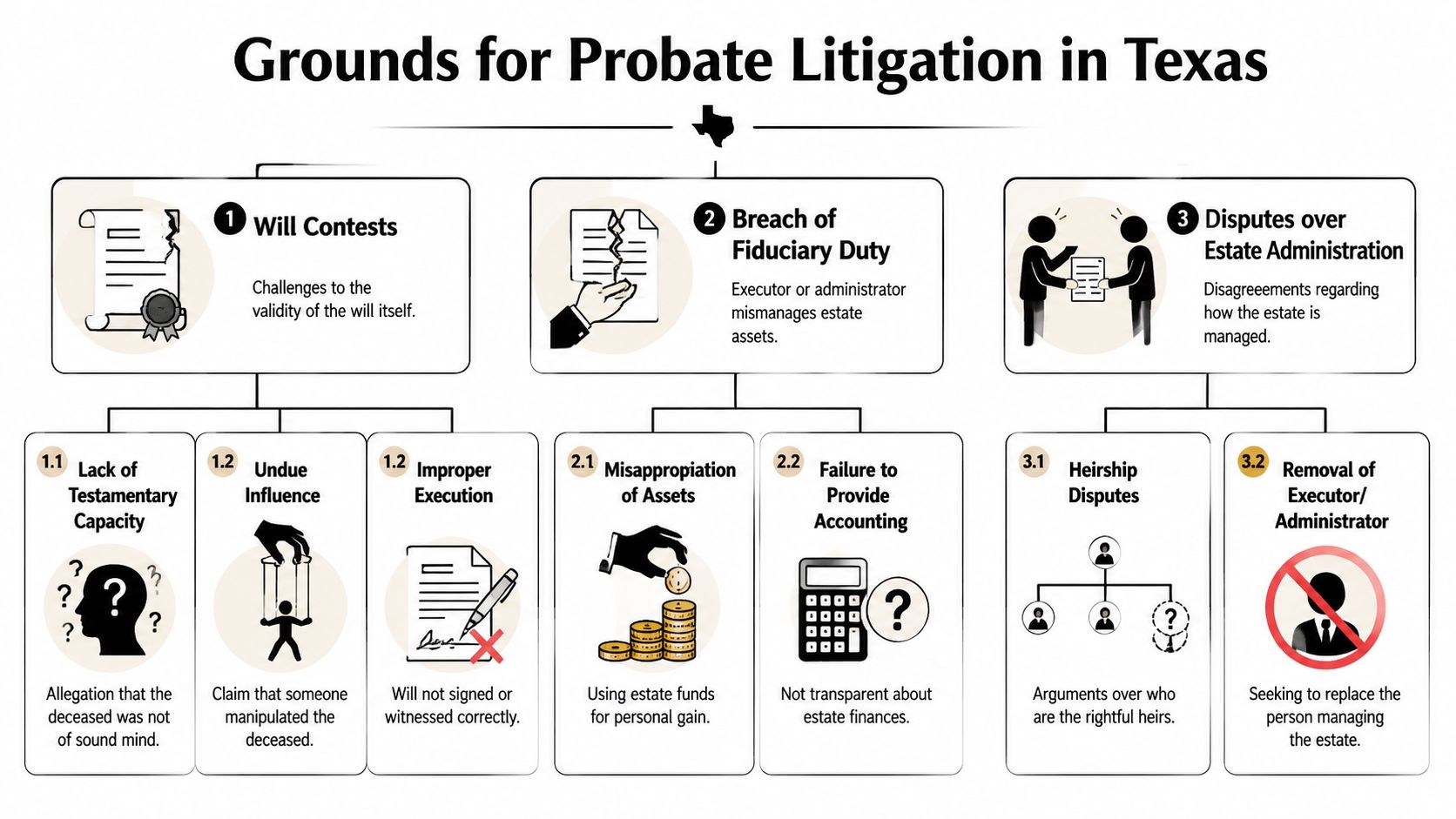
Will contests
A will contest is a challenge to the validity of the will itself. This is one of the most common forms of probate litigation in Texas.
Texas families usually raise one or more of these issues:
- Lack of testamentary capacity means the person who signed the will may not have understood what they were doing, what property they owned, or who their natural heirs were.
- Undue influence means someone may have pressured, manipulated, or overpowered the person into signing a will they wouldn't otherwise have signed.
- Fraud or forgery means the document may not be genuine, or someone may have tricked the deceased into signing it.
- Improper execution means the will may not have been signed and witnessed the way Texas law requires.
A simple example helps. Suppose an elderly aunt had memory problems, depended heavily on one relative, and signed a new will shortly before death that cut out the rest of the family. The issue isn't whether the change hurt feelings. The issue is whether the new document reflects her true, legally valid intent.
If you're trying to understand what proof may matter in a challenge like this, evidence needed to contest a will is often the starting point. Medical records, witness testimony, handwritten notes, and the circumstances surrounding signing can all become important.
Executor and administrator misconduct
The person managing an estate has a fiduciary duty. That means they must act in the estate's best interests, not their own. In Texas, Titles 2 and 3 of the Estates Code impose duties involving notice, inventory, accounting, asset protection, and proper distribution.
A dispute may arise when an executor or administrator:
- Uses estate property personally
- Fails to keep beneficiaries informed
- Refuses to provide records
- Delays administration without a valid reason
- Ignores court orders or mishandles assets
Here's a practical way to think about it. An executor isn't the owner of the estate. They are the manager of property that belongs, ultimately, to the estate and its rightful recipients.
Practical rule: If the executor treats estate funds like a personal checking account, the problem isn't just bad communication. It may be a legal breach of duty.
Heirship and administration disputes
Some families discover there is no valid will at all. In that situation, the court may need to determine heirship, meaning who legally inherits under Texas intestacy rules. That can become complicated in blended families, cases involving common-law marriage claims, or long-standing disputes over parentage.
Other conflicts focus less on the will and more on administration itself. Family members may disagree about selling a house, valuing a business interest, handling creditor claims, or choosing who should serve as administrator.
Medical evidence can matter in some of these cases, especially where capacity is disputed. Lawyers often review clinical records, diagnoses, and end-of-life documentation carefully. For families trying to understand how attorneys approach that process, Texas Autopsy Services' guide for lawyers offers a useful look at how medical records are reviewed in legal matters.
Why the legal ground matters
People often say, “I think this isn't fair.” That feeling may be valid, but probate court needs something more specific. The court asks: what legal wrong are you claiming, and what evidence supports it?
That's why identifying the exact ground matters early. It shapes what documents need to be gathered, which witnesses matter, what relief you can ask for, and how quickly you need to act.
Navigating Key Deadlines and the Texas Estates Code
Some probate disputes are lost before they're fully investigated because the filing deadline passes. That's one of the hardest truths in this area of law. A person may have legitimate concerns, but if they wait too long, the court may never reach the merits.

The two-year deadline for will contests
In Texas, the statutory deadline for filing a will contest is two years from the date the will is admitted to probate under Texas Estates Code § 256.204. Courts enforce that deadline strictly to bring finality to estate administration. If the deadline passes, the right to challenge the will is generally lost, with only narrow exceptions. That rule is summarized in this discussion of Texas will contest timing under Estates Code section 256.204.
That deadline often confuses families because the clock usually does not start on the date of death. It starts when the will is admitted to probate.
Here's why that matters. A family member may spend months trying to “work things out” informally, assuming there's still plenty of time. Meanwhile, the legal deadline is already running.
Why Texas courts are strict about timing
Probate courts aren't trying to be harsh for the sake of it. Estates need closure. Property has to be transferred, debts resolved, and distributions made. If challenges could be filed indefinitely, every estate would remain unstable.
Texas Estates Code provisions in Titles 2 and 3 reflect that need for order. If you want to read more broadly about the statutory framework, the Texas Estates Code overview gives families a better sense of how these rules fit together.
A few deadlines that commonly affect families include:
- Will contests: usually must be filed within the statutory period discussed above.
- Creditor claims: must be filed within four months of the executor's appointment.
- Executor obligations: deadlines may also apply to notices, inventories, and accountings depending on the type of administration.
Delay can change a strong concern into a weak legal position. Early review matters even when you're still gathering facts.
A short explanation from this video may also help if you're trying to make sense of how probate timelines work in real life.
Narrow exceptions
Families sometimes ask whether the deadline can be extended if they discover a problem later. Texas law recognizes limited exceptions, especially in situations involving fraud, forgery, or newly discovered evidence. But these are narrow, fact-specific issues. They aren't a reason to wait.
If you suspect a will was signed under suspicious circumstances, if records are disappearing, or if the executor isn't being transparent, it's wise to get legal advice right away. Acting promptly doesn't mean filing recklessly. It means preserving your options while there is still time to investigate.
The Stages of a Texas Probate Lawsuit
Once a dispute moves into court, families usually want to know one thing: what happens next? The answer depends on the type of claim, the county, the judge, and the level of conflict, but the path usually follows a recognizable sequence.
Stage one filing the case
A probate lawsuit begins with a petition or contest filed in the probate court handling the estate. That filing tells the court what the dispute is about and what relief the person is requesting.
For example, a beneficiary might ask the court to invalidate a will, remove an executor, compel an accounting, or determine heirship. The other side then has the opportunity to respond.
This early stage often feels technical, but it matters. A case should be framed correctly from the beginning because the legal theory affects what must be proved later.
Stage two notice and early hearings
After filing, the interested parties receive notice. The court may set an early hearing to address immediate issues, scheduling, or temporary concerns about estate management.
At this point, some families expect the judge to hear everything at once and make a quick decision. That usually isn't how contested probate works. Early hearings often focus on procedure and keeping the estate from being harmed while the dispute continues.
A realistic example is a sibling asking the court to stop the sale of a family home until the will contest is resolved. The court may address that narrow issue first, even though the larger dispute remains pending.
Stage three discovery
Discovery is the evidence-gathering phase, during which each side requests documents, sends written questions, and takes depositions. A deposition is an out-of-court interview under oath, recorded by a court reporter.
In a capacity case, discovery may include:
- Medical records
- Financial records
- Text messages or emails
- Notes from the attorney who prepared the will
- Testimony from witnesses who saw the signing
- Statements from caregivers or relatives
This is often the longest and most emotionally draining part of the case. Families may have to revisit painful details, including illness, dependency, and long-running relationship strains.
Most probate lawsuits are built during discovery, not at trial. The facts uncovered here often determine whether the case settles or continues.
Stage four mediation
Texas probate courts often encourage mediation. In mediation, a neutral third party works with both sides to try to reach a settlement. The mediator doesn't decide the case. The mediator helps the parties evaluate risk, discuss options, and work toward agreement.
This can be especially valuable in family disputes because a judge can issue orders, but a judge usually can't repair relationships. Mediation gives families more control over the outcome.
Recent Texas probate court data reported for 2025 indicates that the average contested probate case in Harris and Dallas Counties takes 18 to 24 months to resolve, while about 40% settle through mediation within the first 6 months. That summary appears in this discussion of contested probate timelines and mediation outcomes in Texas counties.
Stage five trial
If mediation doesn't resolve the dispute, the case may proceed to trial. At trial, each side presents documents, witness testimony, and legal arguments. The judge, and in some settings a jury on certain issues, decides the contested matters.
Trials are formal, public, and stressful. They also narrow the family's control. Once a judge decides, everyone has to live with the ruling unless there is a basis for appeal.
Stage six post-trial and appeal
Even after trial, the estate may not be finished. The court's ruling must be carried out. That may mean probating an earlier will, appointing a new representative, ordering an accounting, or supervising revised distributions.
An appeal is possible in some cases, but appeals add time, cost, and uncertainty. For many families, the wiser goal is reaching a legally sound resolution before the case gets that far.
Potential Outcomes and Remedies in Contested Estates
A probate lawsuit isn't only about proving that something went wrong. It's about what the court can do to fix the problem. The remedy depends on the type of dispute and the evidence presented.

If the will is upheld
Sometimes the court reviews the evidence and determines the will is valid. If that happens, the estate generally continues under that document's terms.
For beneficiaries, this can be disappointing, but it also brings clarity. Once the dispute is resolved, administration can move forward, debts can be handled, and distributions can be made with less uncertainty.
If the will is invalid
If a will contest succeeds, the court may declare the challenged will invalid. Then the next question becomes: what document or rule controls instead?
That may mean:
- An earlier valid will takes effect
- Part of the estate passes under Texas intestacy law if no valid will controls
- Specific distributions change because the disputed document no longer governs
In practical terms, this can completely reshape who inherits. A child disinherited by a later document may return as a beneficiary if an earlier will controls, or as an heir under Texas law if there is no valid will.
If the executor is removed
When the problem is estate management rather than the will itself, the court may remove the executor or administrator and appoint a replacement under the Estates Code.
This often happens when the court finds the personal representative hasn't carried out required duties. The practical effect is important. Estate records may have to be turned over, financial activity may be reviewed, and a new representative may take control to finish administration properly.
If assets must be returned
In some cases, the remedy is financial. If estate funds were taken, misused, or transferred improperly, the court may order those assets restored to the estate.
That doesn't erase the conflict, but it can protect the pool of property available for creditors, heirs, and beneficiaries. In families worried that “the money is disappearing,” this type of remedy is often central.
A probate case can change who manages the estate, which will controls, and where the property ultimately goes.
Settlement is also an outcome
Not every contested estate ends with a dramatic ruling. Many end in a negotiated settlement, often during mediation or shortly before trial.
A settlement might include one beneficiary receiving a cash payment, another receiving a specific asset, an executor agreeing to resign, or the parties agreeing on how to sell and divide property. In many families, that kind of resolution is more useful than a winner-take-all fight.
A settlement also allows room for practical choices that a court might not craft on its own. That flexibility can preserve value in the estate and reduce lasting damage between relatives.
The Costs and Alternatives to Probate Litigation
Families often ask two practical questions very early. How much is this going to cost, and do we have to go all the way to court?
The honest answer is that contested probate can become expensive quickly. The better answer is that litigation is not always the only path.
What families may spend
For a straightforward, uncontested Texas probate with a valid will, total court and attorney costs often fall between $2,000 and $4,000. Contested matters are much more expensive. Reported probate cost ranges include attorney fees starting at $1,500 to $5,000, court filing fees of $400 to $600, and asset appraisal fees of $300 to $700 per item, with additional expenses increasing as the case becomes more complex. Those figures appear in this summary of probate costs in Texas.
The problem isn't just the filing fee. It's the accumulation of work. Document review, witness preparation, hearings, appraisals, and contested motions all add time and expense.
A family fighting over a home, a business interest, or a disputed late-life will may also need outside professionals. That can include appraisers, medical experts, or forensic review of records.
Litigation and mediation compared
Not every dispute belongs in mediation. If there is serious fraud, hidden assets, or a complete refusal to cooperate, court intervention may be necessary. But many probate conflicts involve mistrust, poor communication, or disagreements about value and fairness. Those cases may be good candidates for mediation.
| Factor | Court Litigation | Mediation (ADR) |
|---|---|---|
| Decision maker | Judge decides the disputed issues | The family reaches its own agreement |
| Privacy | Court filings and hearings are generally part of the public process | Discussions are generally private |
| Tone | Adversarial by design | More collaborative |
| Control over outcome | Limited once the case is before the court | Much greater flexibility |
| Effect on relationships | Often worsens family divisions | May preserve working relationships |
| Usefulness | Necessary when facts are hotly disputed or orders are needed | Helpful when resolution is still possible through negotiation |
When alternatives make sense
Mediation tends to work best when the parties still have enough trust to exchange information and discuss options. It can also be effective after some discovery, when each side has seen enough evidence to understand the risks of trial.
For families weighing that path, probate mediation in Texas is one practical option to explore before costs and tension climb further.
The Law Office of Bryan Fagan, PLLC handles contested probate matters as one available legal resource for families who need help evaluating whether to litigate, negotiate, or mediate under Texas law.
A realistic way to think about cost
Families sometimes focus only on whether they can win. A better question is whether the likely outcome justifies the financial and emotional expense of the fight.
That doesn't mean backing down from a valid claim. It means being strategic. A strong probate lawyer should help you compare the legal merits, the available evidence, the likely timeline, and the cost of each path before the dispute consumes the estate itself.
Takeaways A Practical Checklist and Preventive Measures
Families rarely enter probate litigation at their best. They're grieving, tired, and often trying to make decisions with incomplete information. A calm, methodical response usually works better than a fast emotional one.
Key Insight: The best probate strategy is to act early, gather records before they disappear, and stay open to settlement when it protects both the estate and the family.
If you're already in a dispute
Use this checklist if conflict has already started:
- Get the key dates in writing: Find out when the will was admitted to probate, when the executor was appointed, and whether any notice has been issued.
- Secure the important documents: Gather the will, prior wills, trust documents, deeds, bank statements, emails, letters, and medical records if capacity is in question.
- Write down your concerns clearly: “This feels wrong” is understandable, but it helps to convert that concern into specifics such as missing money, a suspicious signature, or lack of communication from the executor.
- Avoid informal asset transfers: Don't agree to side deals, quick payouts, or handwritten arrangements without legal review.
- Communicate carefully: Angry texts and social media posts often become evidence. Keep your messages factual and brief.
- Ask whether mediation is realistic: A negotiated solution may save time, expense, and relationships if the dispute is still manageable.
If you want to prevent this for your own family
Prevention usually starts long before probate:
- Use clear estate planning documents: A carefully drafted will or trust can reduce ambiguity and limit later conflict. Families often benefit from planning through Wills & Trusts.
- Choose your executor thoughtfully: Pick someone organized, trustworthy, and capable of handling conflict.
- Update documents after major life changes: Marriage, divorce, deaths, and new property should trigger a review.
- Talk to your family when appropriate: Surprises fuel litigation. Clear communication can reduce suspicion later.
- Plan for incapacity too: Some disputes grow out of concerns about declining health, caregiving, or decision-making. In some families, Guardianship planning becomes part of that broader conversation.
- Match the plan to the estate: Some estates may qualify for simpler procedures, while others need more detailed planning. Understanding the Texas Probate Process and the possibility of future Probate Litigation can help families make smarter choices now.
If you're facing conflict after a death, don't assume waiting will calm things down. Sometimes it does. Sometimes it closes legal doors that can't be reopened. A prompt review of the facts, the deadlines, and the available options can make the path forward much clearer.
If you're facing probate in Texas, our team can help guide you through every step, from filing to final distribution. Law Office of Bryan Fagan, PLLC works with Texas families, executors, and heirs on probate administration, contested estates, and estate planning matters. Schedule your free consultation today.