Skip to content
Losing a loved one is hard enough. It becomes much harder when one family member suddenly has the keys to the house, the bank statements, the mail, and the answers, and no one else can tell what's really happening.
A common Texas probate conflict starts that way. One sibling says, “Mom named me executor, so I'm handling it.” Another sibling can't get a return phone call. The locks on the home get changed. Personal items disappear. A car gets sold. Everyone else is left wondering whether this is normal probate administration or something more troubling.

If that sounds familiar, your concern is not an overreaction. In Texas, probate often does put one person in a position of real authority. But authority is not ownership, and it is not permission to ignore the rest of the family. Texas law gives that person duties, limits, and accountability.
A significant problem in many estates is the disconnect between what feels fair and what the law permits. Families often expect shared decision-making. Probate usually works through formal authority instead. That gap creates anger, suspicion, and delay.
Under the Texas Estates Code, especially Titles 2 and 3, probate administration follows a structured process. The court recognizes a legal representative. That representative gathers assets, handles debts, and distributes property under the law and the governing estate documents. If the person in control follows those rules, probate can move forward. If not, heirs may need to act quickly to protect the estate.
Introduction When a Loved One's Estate Creates a Family Rift
Take a realistic example. A father dies in Harris County. He leaves a will naming his oldest child as executor. Within days, that child starts “taking care of things.” Utilities get changed. The father's mail is redirected. Family members asking for updates hear, “I'll let you know when there's something to say.”
At first, that may sound practical. Someone has to handle immediate tasks. But then the rest of the family learns the house may be listed for sale, no one has seen a full asset list, and personal property is already being divided informally. The question shifts from “Who is helping?” to “Who is in charge, and are they allowed to do this?”
Families usually don't call a probate lawyer because they dislike paperwork. They call because grief and uncertainty have mixed with a loss of trust.
That mix is common in disputes about when one heir controls everything in probate. The person in control may believe they're being efficient. The other heirs may feel excluded, disrespected, or financially threatened. Both reactions can exist at the same time.
Texas probate law tries to bring order to that situation. It does that by giving authority to a legally recognized representative, not by requiring the family to agree on every step. That can feel cold when emotions are already raw. Still, understanding that structure is the first step toward protecting your rights.
If you're an heir, beneficiary, or executor in Texas, it helps to know three things early. First, one person can legally gain estate authority quickly. Second, that authority comes with serious fiduciary duties. Third, if the person in control crosses the line, there are formal remedies available in probate court.
How One Person Legally Gains Control of an Estate
Your brother has the house keys, the mail is going to his address, and the bank says it can only speak with him. Everyone else in the family is left asking the same question. How did one person get this much authority so fast?
Under Texas probate law, that usually happens because the court recognizes one person as the estate's legal representative. If there is a valid will, that person is often the executor named in the will. If there is no will, or the named executor cannot serve, the court may appoint an administrator instead. Texas courts also use the broader term personal representative, which means the person legally authorized to act for the estate.
The court creates the authority
This point causes a lot of family conflict because it feels backward. Families often assume authority should flow from relationship. The oldest child, the child who helped most, or the child listed in the will should be in charge. Texas law does not work that way.
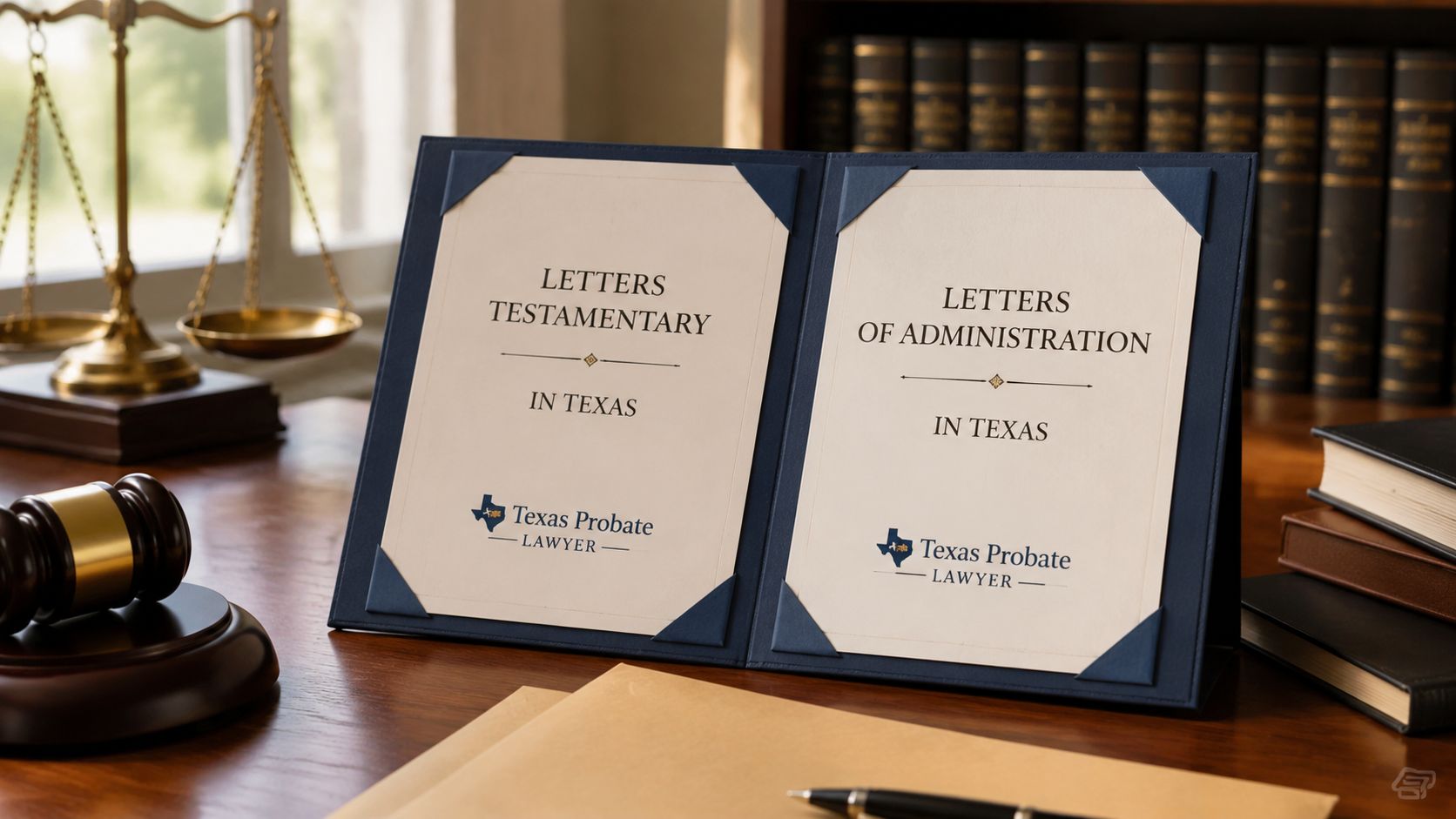
Legal authority flows from the probate process. Even a person named in the will usually cannot act with full estate authority until the court confirms the appointment and issues the paperwork that allows third parties to rely on that authority. Those court papers are called Letters Testamentary or Letters of Administration.
That is why a bank, title company, or buyer may deal with one person and refuse to deal with everyone else. From the family's point of view, that can feel secretive or unfair. From the institution's point of view, it is following the legal chain of authority.
Why control can shift so quickly
Probate often feels slow to heirs but fast in one important sense. Once the proper person is appointed, the system is designed to let that person handle the estate's business in a centralized way. Someone has to collect assets, secure property, deal with creditors, gather records, and communicate with financial institutions. Texas law prefers one legally accountable decision-maker over a committee of grieving relatives.
That structure solves one problem and creates another.
It helps the estate function. It also leaves other heirs feeling shut out, especially if they expected equal say from the beginning. The practical and emotional disconnect is real. Families hear, “We all inherit, so we should all decide.” Texas law often answers, “You may all benefit, but one representative manages the process.”
What this means in real life
A personal representative may be able to:
- access estate accounts
- collect mail and financial records
- secure or insure a house
- hire professionals for the estate
- begin the steps needed to pay debts and prepare property for distribution
That does not mean the representative owns the estate property personally. It means the law has put one person in the manager's seat for a period of time.
A helpful comparison is a trust manager handling property for a group. The manager has control over the process, but not a free pass to do whatever feels convenient. Control and ownership are not the same thing. Families often blur those concepts, and that confusion is where suspicion starts.
Why heirs often feel blindsided
What feels fair inside a family and what Texas law permits are often two different things. An heir may have a financial interest in the estate and still have no right to approve each day-to-day decision. A beneficiary may be entitled to information and a proper distribution, yet still not have the power to sign on behalf of the estate.
This is the gap to understand early:
| Family expectation | Texas probate reality |
|---|---|
| We are all children of the deceased, so we all control the process | The court usually authorizes one representative to act for the estate |
| The will alone gives someone power | The will helps identify the right person, but the court makes the role operative |
| Being an heir means immediate access to accounts and property | Being an heir gives a financial interest, not automatic management authority |
Once you see that gap clearly, the next question becomes more practical. Is the person in control using lawful authority the way Texas probate law requires, or using that authority as a shield against accountability?
An Executor's Duties A Mandate of Trust Not Tyranny
The person in charge of an estate is not supposed to act like a ruler. Under Texas law, that person is a fiduciary. In plain language, a fiduciary is someone trusted to handle other people's interests with honesty, care, and fairness.
That duty matters because the executor or administrator is handling property that may benefit several people, not just themselves. Even if the executor is also an heir, they don't get to treat the estate like a personal checking account or private storage unit.

What fiduciary duty means in plain English
Think of the executor as the estate's manager. The beneficiaries are more like the people with a financial stake in how that manager performs. The manager doesn't get to favor their own interests over everyone else's.
Under the Texas Estates Code, an executor or administrator may need to do things such as:
- Collect estate assets and protect them from loss
- Prepare an inventory or otherwise account for what the estate owns
- Handle valid debts and claims in the proper order
- Preserve records showing what came in, what went out, and why
- Distribute property properly after the legal requirements are met
The exact steps vary depending on whether the estate is under independent administration or dependent administration. Texas allows both, and the level of court oversight can differ. But in either setting, fiduciary obligations remain.
Four duties families should watch closely
Some fiduciary duties are especially important in disputes.
- Duty of loyalty means the executor must act for the estate's benefit, not for personal advantage.
- Duty of impartiality means the executor can't favor one beneficiary over another when the law requires equal treatment.
- Duty of prudence means the executor should manage property carefully, like a responsible person handling valuable property for someone else.
- Duty of disclosure means the executor must provide required information and shouldn't hide the ball.
Practical rule: Control over an estate is a job with legal duties. It is not a family promotion.
What this looks like in a real case
Suppose a daughter is named executor in her mother's will. She has legal authority to secure the home, gather financial information, open an estate account, and work with counsel to probate the will. That is proper.
Suppose instead she moves into the home rent-free, refuses to share financial records, and sells jewelry to a friend without documentation. That is not just “poor communication.” It may be a breach of fiduciary duty.
Texas Estates Code provisions governing personal representatives are designed to prevent that kind of conduct. When an executor forgets that they serve the estate, not themselves, the probate process can quickly turn into litigation.
Red Flags That an Executor Is Abusing Their Power
A family usually notices the problem before it can prove the problem.
One heir asks a simple question about the estate account and gets silence. Another learns the decedent's truck is being driven by the executor's son. Jewelry is gone, but no one has seen a receipt, an appraisal, or a sales record. At that point, the core question is not whether the family is upset. The question is whether the executor is treating estate property like property held in trust, or like a private prize.
That distinction matters because families often measure fairness by relationships, history, and promises made around the kitchen table. Texas probate law looks at conduct, records, authority, and fiduciary duty. Those are not the same lens. A relative can seem controlling, rude, or dismissive without violating the law. A different relative can sound calm and organized while breaching legal duties.
A useful way to evaluate the situation is to look for patterns that affect the estate itself.
Conduct that deserves closer attention
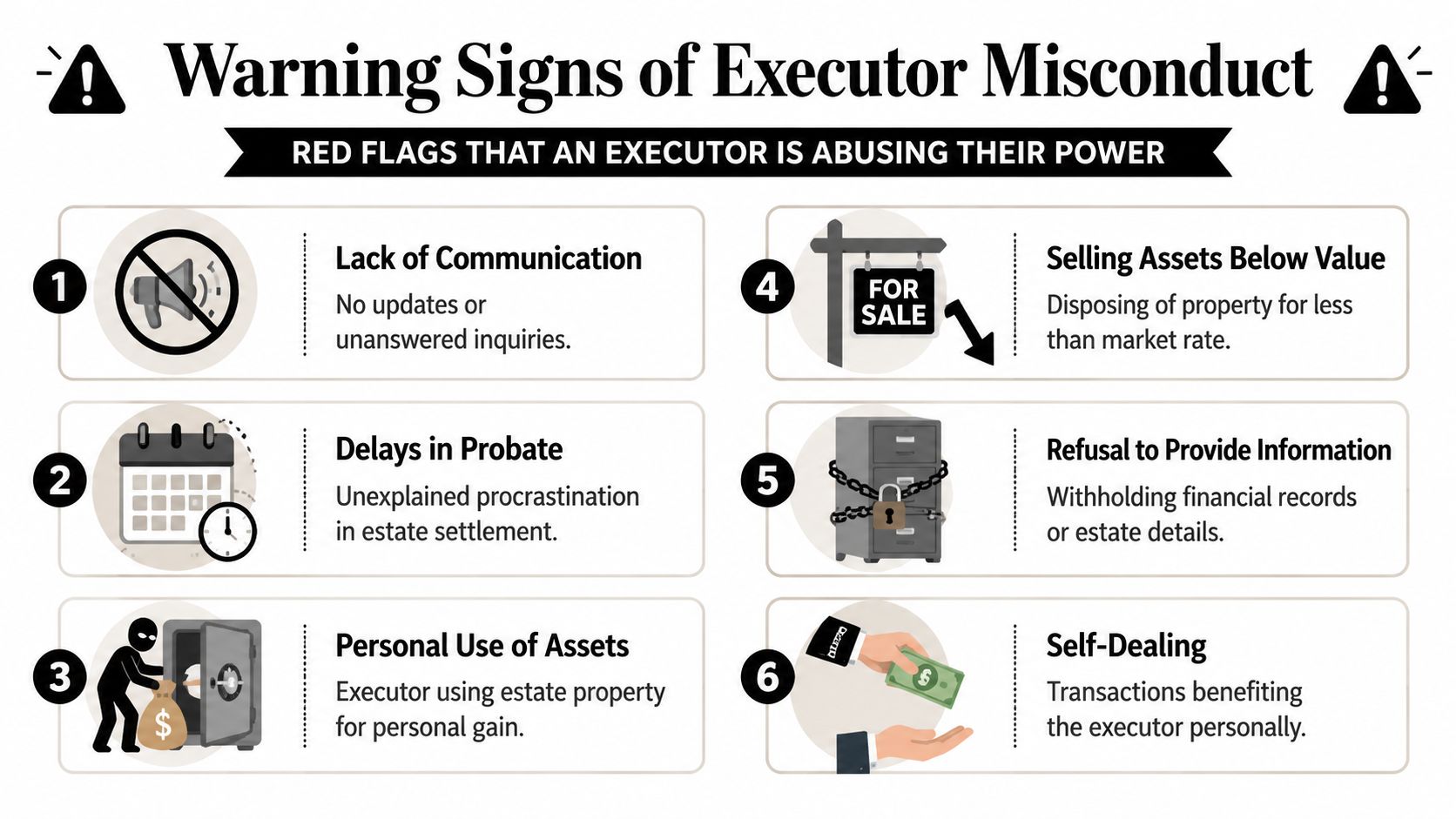
The warning signs below do not all carry the same weight. One delayed response may mean the executor is disorganized. A pattern of concealment, personal use of property, and unexplained transactions points to something more serious.
- Silence instead of updates. Reasonable questions about assets, debts, or probate status are ignored or postponed again and again.
- Missing records. Bank statements, inventories, receipts, appraisals, and closing documents are unavailable, incomplete, or constantly “still being gathered.”
- Personal use of estate property. The executor lives in the home without paying the estate, uses a vehicle as a personal car, or treats estate funds like a family checking account.
- Questionable sales. Property is sold quickly, to friends, below apparent value, or without documentation showing how the price was set.
- Blocked access to basic information. Heirs cannot get clear answers about what the estate owns, what has been paid, or what remains.
- Delay that benefits the person in control. Probate can take time. But delay deserves scrutiny when the executor is living in estate property, collecting income, or keeping others in the dark while time passes.
If several of those facts are showing up at once, this guide to probate executor abuse of power can help you compare your concerns to common misconduct patterns under Texas law.
Pay close attention to valuation and sales
Valuation disputes often sit at the center of executor abuse cases. A house, mineral interest, family business, or collection can be undervalued on paper long before anyone realizes what happened. Once a sale closes, it becomes harder and more expensive to sort out whether the estate received a fair price.
That is why appraisals and sale records matter so much. They work like a snapshot taken before the property changes hands. Without that snapshot, families are left arguing from memory, suspicion, and incomplete information.
When one person controls both the property and the paperwork, an unfair transaction can look proper until someone asks for the documents behind it.
A disagreement about value does not automatically mean misconduct. Real estate markets shift. Personal property can be hard to price. Family members often attach emotional value that the market does not share. But refusal to get a neutral appraisal, refusal to explain a sale, or a transaction that appears to benefit the executor personally should be examined carefully.
Here's a helpful overview before looking at remedies.
Your Legal Remedies to Challenge an Executor's Control
Your brother is living in the house, has the bank statements, and keeps saying, “I'm handling it.” Meanwhile, no one will answer basic questions about what has been paid, what has been sold, or when distributions will happen. That situation feels unfair. The hard part is that Texas law does not step in just because the family is upset. The court acts when someone asks for a specific remedy and backs that request with facts.
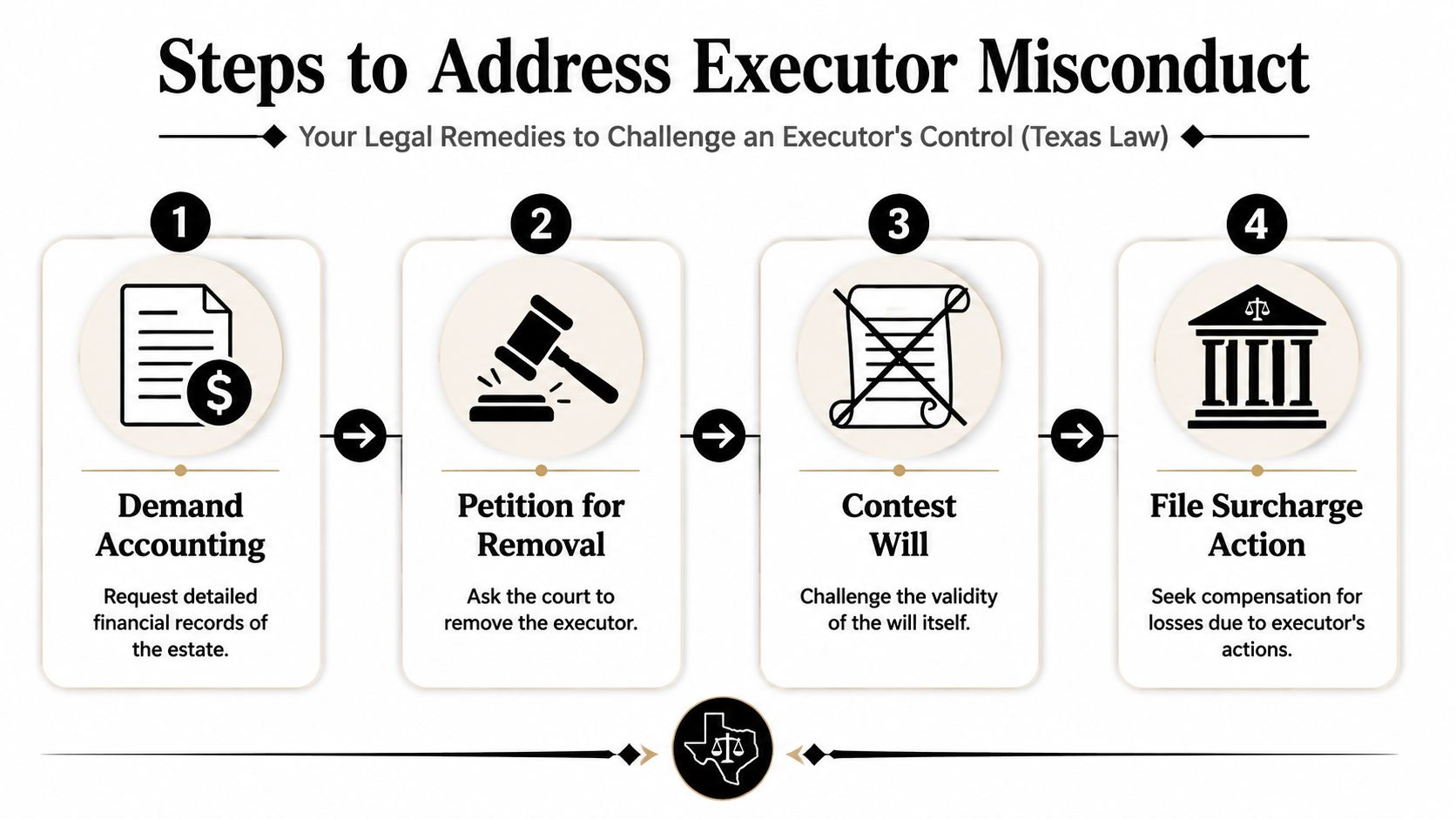
Texas probate law gives heirs and beneficiaries several ways to challenge an executor's control. The right tool depends on the problem. A judge will look very differently at poor communication, missed deadlines, self-dealing, and a will that may not be valid in the first place. Families often come in wanting the court to “make this right.” What the court can do is narrower, but still meaningful. It can order disclosure, restrict improper conduct, remove the executor in serious cases, and decide whether the will itself should govern.
Ask for an accounting
An accounting is often the first strong step because it shifts the dispute from family argument to paper trail.
In plain language, an accounting is a formal report of what came into the estate, what went out, what remains, and what the executor did with estate property. If the executor has acted properly, the accounting can calm suspicion. If records are missing, numbers do not match, or transactions cannot be explained, that gives the court something concrete to examine.
Probate judges typically require more than “something feels off.” They look for documents, dates, and transactions.
Request court intervention to stop specific harm
Sometimes the immediate problem is not removal. It is damage control.
If estate property is about to be sold, funds are being withheld without explanation, or records are being concealed, a beneficiary may ask the court for targeted relief. That can include orders requiring the executor to provide information, preserve assets, or follow duties already imposed by law. This approach works like putting a lock on the gate before more property disappears. It does not resolve every issue, but it can keep the situation from getting worse while the larger dispute is sorted out.
Ask the court to remove the executor
Removal is one of the strongest remedies, and Texas courts do not grant it on the sole basis of relatives' distrust. Judges usually want proof tied to recognized legal grounds such as misapplication of property, gross misconduct, incapacity, disqualification, or failure to perform required duties.
If you want a practical explanation of the standard, this guide on when you can remove an executor for misconduct in Texas lays out the issue in more detail.
A removal case often turns on questions like these:
| Issue | Why it matters |
|---|---|
| Did the executor fail to protect estate assets? | That can show neglect or mismanagement |
| Did the executor hide transactions or refuse records? | That can support an inference of bad faith |
| Did the executor profit from estate decisions? | That may point to self-dealing |
| Did the executor ignore court orders or legal duties? | That can justify removal |
Removal is serious because it changes control of the estate. It also sends a clear message that being named executor is not a license to rule the family. It is a fiduciary job, supervised by the court when necessary.
Contest the will if the problem began before probate
Sometimes the executor is not the actual starting point. Sometimes the deeper concern is that the wrong document was admitted to probate.
If there are facts suggesting undue influence, lack of mental capacity, forgery, or fraud, a will contest may be the proper remedy. That is a different case from arguing over missing paperwork or an unexplained sale. It asks whether this will should have legal effect at all. These claims usually depend on medical records, witness testimony, drafting history, and the circumstances surrounding the signing of the will.
Families often struggle here because fairness and legality are not always the same. A will can feel harsh and still be valid. On the other hand, a will that looks official on its face can still be set aside if the evidence shows it was procured improperly.
Use mediation if the dispute can still be contained
Some probate fights need a hearing. Others need a controlled setting where everyone has to put their position on the table.
Mediation can help when the conflict involves mistrust, uneven information, or disagreement about how estate documents should be carried out. It is often useful when the family still has a workable chance of resolving the dispute without a full trial. Mediation is less effective when an executor is actively stealing, hiding assets, or ignoring court orders. In that kind of case, formal court action is usually the better fit.
Texas law does provide checks on executor power, but those checks usually work only after someone asks the court for a specific remedy and supports it with records.
The practical lesson is simple. If the situation feels wrong, focus on matching the remedy to the misconduct. Asking for the wrong form of relief can waste time. Asking for the right one can restore balance to the estate and protect what the law allows you to claim.
Practical Steps to Protect Your Inheritance Rights
Before a judge hears anything, the quality of your evidence often shapes the whole case. In contested probate matters, judges weigh witness credibility against documents and other corroborating proof. When one heir controls the records, that creates what one probate source calls an evidentiary asymmetry, which is why early preservation and formal requests matter so much in contested estates (credibility, records, and document preservation in probate cases).
That principle has a simple takeaway. Stop relying on verbal assurances. Start building a record.
What to do right away
If you believe one heir is controlling everything unfairly, take practical steps early:
- Communicate in writing. Use email or letters whenever possible. If a phone call happens, send a short follow-up email confirming what was said.
- Preserve documents. Save texts, letters, voicemails, property listings, account notices, and photos of estate property.
- Request information clearly. Ask for specific items, such as a copy of the will, inventory details, closing documents, or account statements.
- Track dates and promises. Write down when requests were made and what response, if any, you received.
- Coordinate with other heirs carefully. A shared timeline and consistent documentation can help, but avoid turning grief into a group text war.
What not to do
Some actions can hurt your position:
- Don't remove property on your own unless your lawyer advises it and you have legal authority.
- Don't rely on social media arguments as a substitute for formal requests.
- Don't wait too long if assets may be sold, transferred, or retitled.
- Don't assume probate court handles every asset dispute without reviewing how the asset was titled.
A practical decision point often comes next. Is this a case for negotiation, mediation, or immediate court intervention? This overview of mediation vs litigation in Texas probate can help frame that choice.
When legal help becomes urgent
If records are being withheld, property is being sold, or an incapacitated heir is involved, delay can make the case harder. In some families, related guardianship issues under Texas Estates Code Title 3 may also affect who can act, who has standing, and how the court supervises certain decisions.
That doesn't mean every disagreement requires a courtroom fight. It does mean you should treat missing records and disappearing assets as legal issues, not just family drama.
Key Insight and How to Restore Balance to an Estate
A common Texas probate standoff looks like this: one sibling has the house keys, the account statements, and the lawyer's emails, so everyone else starts to believe that sibling controls the entire inheritance. That feeling is understandable. It also is not always how the law sorts the property.
Sometimes the dispute is larger than the probate case itself. A will controls probate assets, but some property passes under different rules. If one heir is also serving in another role, such as successor trustee, joint owner, or payable-on-death beneficiary, that person may have authority over assets that never enter the probate estate at all. That is why families can feel as if one person took over everything, even though each asset may belong in a different legal bucket, as explained in will versus trust control of inheritance assets.
That legal split creates an emotional split too. Families usually focus on fairness. Texas courts focus on authority, title, and duty. Those are not the same question.
A practical way to understand it is to sort the estate the way you would sort a set of keys. One key may open the probate estate. Another may open a trust. Another may open a joint account or transfer-on-death asset. If you use the wrong key in the wrong lock, nothing turns. The same is true in court. A probate case can solve some problems, but others may require trust litigation or a separate civil action.
The point to carry with you is simple:
- An executor has serious authority, but that authority has limits and duties
- An heir can have enforceable rights without having day-to-day control
- Good records often matter more than strong suspicions
- A fair outcome usually requires the correct legal process for each asset
Restoring balance starts with clarity on paper, not pressure inside the family. Identify which assets are part of the probate estate, which pass outside probate, who has legal authority over each category, what records already exist, and whether any deadlines are approaching. Once that map is clear, the conflict usually becomes easier to assess and easier to address.
If you are dealing with a Texas estate dispute while grieving, your confusion does not mean you are missing something. These cases are hard because family expectations and legal rules often pull in different directions. The Law Office of Bryan Fagan, PLLC works with Texas families on probate administration, guardianship concerns, estate disputes, and inheritance conflicts. Calm, organized action can protect both the estate and your peace of mind.