Skip to content
A parent dies. The funeral is over. Family members go back home, and then the waiting starts.
You know there was a will. You know an executor was appointed. You may even know roughly what you're supposed to receive. But months pass, your calls go unanswered, and the only update you get is something vague like, “We're still waiting on probate.”
That situation is more common than most families expect. It's also upsetting, because grief already makes everything feel unsteady. When money is involved, silence from the executor can make an ordinary probate delay feel like a personal betrayal.
Under Texas law, an executor can sometimes hold estate money for legitimate reasons. But they cannot withhold money indefinitely, and they cannot hold it back for personal reasons, favoritism, or punishment. The hard part for most beneficiaries is figuring out whether they're seeing a normal estate administration delay or a real legal problem.
That's the question behind Can an Executor Withhold Money From Beneficiaries in Texas? The answer depends less on emotion and more on process. Has the estate been inventoried? Are debts still unresolved? Is there a documented reason for the delay? Is the executor communicating transparently?
The good news is that Texas beneficiaries have rights, and there are practical steps to take before a dispute turns into full probate litigation.
Feeling Left in the Dark About Your Inheritance
A typical call starts like this: a son or daughter says their mother died several months ago, a sibling was named executor, and nobody seems to know what's happening with the money. The executor says they are “handling it,” but won't explain what has been collected, what debts exist, or when distributions might happen.
That kind of silence creates two problems at once. First, it leaves beneficiaries anxious and suspicious. Second, it prevents them from telling the difference between a lawful delay and wrongful withholding.

An executor's job is a lot like holding a family's valuables in a locked room while the estate is sorted out. Sometimes the lock stays on the door because bills, taxes, or court filings still need attention. That's normal. What isn't normal is keeping the room locked with no explanation and no paperwork to justify it.
A familiar Texas probate problem
Consider a simple example. Your aunt leaves a home, a checking account, and some investment assets. Her will names her oldest child as executor and divides the estate equally among three children. If the executor needs time to gather account records, notify creditors, and pay valid expenses, some delay is expected.
If that same executor starts saying, “You'll get paid when I think the time is right,” the problem changes. At that point, the issue isn't probate. It's control.
Beneficiaries usually don't need perfect answers right away. They need honest answers, a timeline, and proof that the executor is actually moving the estate forward.
What families should keep in mind
The law in Texas recognizes that estate administration takes time. It also treats the executor as a fiduciary, which means the executor must act for the benefit of the estate and its beneficiaries, not from personal preference.
That distinction matters. A temporary delay can be lawful. Indefinite withholding without a real estate reason is not.
The Executor's Role and Fiduciary Duty in Texas
An executor is the person responsible for carrying out the will after the probate court gives that person authority to act. In plain English, the executor is the estate's manager. Their job is to gather assets, protect them, deal with claims and expenses, and then distribute what remains according to the will.
That doesn't make the executor the owner of the estate. It makes the executor the caretaker.
The executor works for the estate
Many families assume the executor gets broad personal power. That's usually where conflict starts. The executor doesn't get to decide what seems “fair” or reward the sibling who helped more during a parent's life. The executor must follow the will and the Texas Estates Code.
A practical overview like this estate executor duties guide can help families understand the role at a high level. In Texas matters, though, the legal details become especially important because probate deadlines and fiduciary duties carry real consequences. For a Texas-specific explanation, see these executor of will responsibilities in Texas.
What fiduciary duty means in real life
Fiduciary duty is a legal phrase that sounds technical, but the idea is simple. The executor must act with loyalty, care, honesty, and transparency. They can't treat estate money as their own emergency fund. They can't play favorites. They can't hide the ball.
Texas probate practice also puts structure around that duty. A personal representative generally must file an inventory, appraisement, and list of claims within 90 days of appointment unless the court grants an extension, which gives beneficiaries a meaningful checkpoint for evaluating whether administration is moving normally or drifting into misconduct, as discussed in this Texas probate commentary on executor mismanagement.
Practical rule: Once that early filing deadline passes, beneficiaries should be able to tell whether the executor is doing the work or just talking about doing it.
Why this matters in inheritance disputes
When beneficiaries ask, “Can an executor withhold money from beneficiaries in Texas?” they are really asking whether the executor has the right to control access to family assets. The answer is only to the extent necessary to complete administration properly.
A good executor documents decisions, communicates clearly, and treats delays as temporary. A bad executor treats uncertainty like a shield.
Lawful Reasons an Executor Can Delay Distributions
There are times when an executor not only may delay distribution, but should delay it. Probate has an order of operations. If an executor distributes too soon and later discovers unpaid debts or unresolved estate obligations, the estate can be damaged and the executor can create problems for everyone involved.
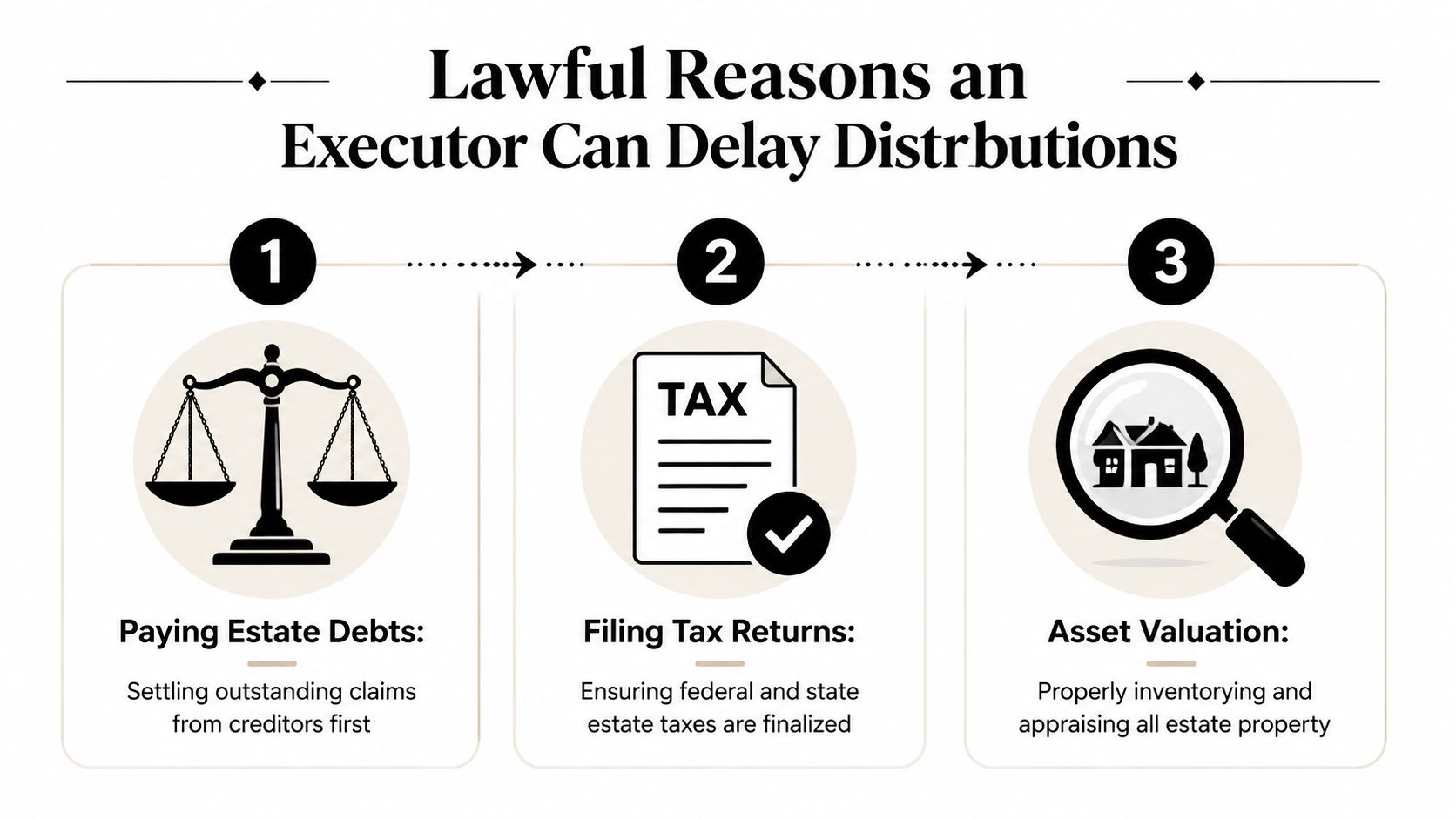
Texas guidance states that the executor must marshal assets, notify creditors, and pay estate debts, taxes, and administration expenses before distributing the residue, and Texas law also caps executor compensation at 5% of the estate's market value, excluding cash and certain accounts, which reinforces that estate funds are not the executor's personal reserve, as explained in the Texas State Law Library probate guide for estate executors.
Debts, taxes, and administration expenses come first
This is the most common lawful reason for delay. Before beneficiaries receive what's left, the executor has to determine what the estate owes.
That can include:
- Final bills of the deceased such as medical invoices or other valid claims against the estate
- Administration costs including filing fees, appraisals, and professional help needed to manage the probate
- Tax obligations that must be resolved before the executor can safely distribute everything
If the executor pays beneficiaries too early, the estate may not have enough to satisfy those obligations later.
Some assets aren't ready to divide
Not every estate consists of cash sitting in one account. A house may need to be sold. Property may need to be appraised. An account may need paperwork completed before it can be transferred or liquidated.
A beneficiary might assume, “There's money in the estate, so why can't I just get my share now?” The answer is that the executor usually has to look at the estate as one whole pool of assets and obligations, not as a set of immediate withdrawals.
Independent administration and dependent administration
Texas probate can proceed under different levels of court supervision. In an independent administration, the executor generally has more room to act without asking the court for permission at every turn. In a dependent administration, the court is more involved.
That difference affects timing. More court oversight often means more procedure and more delay. It doesn't necessarily mean the executor is doing anything wrong.
For readers trying to understand the sequence from appointment through payout, this overview of the Texas probate process is useful because it shows why distribution rarely happens immediately after death.
Probate is a little like closing out a business before dividing the remaining cash among owners. The executor has to figure out what exists, what is owed, and what can safely be released.
Disputes can justify holding back some funds
Sometimes the issue isn't misconduct. It's uncertainty.
If there is a contested claim, a disagreement over a property value, or a problem selling a major asset, the executor may need to hold funds in reserve. In some estates, a partial distribution may be possible while a reasonable reserve is kept for unresolved matters. What usually doesn't work is freezing the entire estate without explaining why that amount needs to remain untouched.
A careful executor can often tell beneficiaries two things at once. First, “I can't distribute everything yet.” Second, “Here is what has been done, here is what remains, and here is why the estate still needs to hold funds.”
That kind of explanation usually lowers tension fast. Silence does the opposite.
Red Flags Your Inheritance Is Being Wrongfully Withheld
At some point, delay stops looking like administration and starts looking like avoidance. The hardest part for beneficiaries is knowing where that line is.
Texas-focused guidance suggests using practical checkpoints such as whether the estate has been inventoried, whether debts and taxes are paid or reserved, and whether the executor has a documented reason for holding funds. It also notes that administration should be completed within a reasonable time, often around one year, and that repeated unexplained postponements or the absence of an accounting can signal misconduct, as discussed in this Texas article on executor authority and beneficiary rights.
The difference between delay and danger
An executor doesn't have to provide constant updates every few days. But beneficiaries should be able to get clear answers to basic questions.
Ask yourself:
- Has the executor explained what assets are in the estate
- Has anyone said what debts, taxes, or expenses are still unresolved
- Has the executor provided any written timeline or status update
- Is the same excuse being repeated month after month with no visible progress
- Are some beneficiaries getting information while others are ignored
If the answer to several of those questions is no, concern becomes reasonable.
Lawful delay vs potential red flag
| Executor's Action | Likely a Lawful Delay If… | Potentially a Red Flag If… |
|---|---|---|
| Holding money in the estate account | debts, taxes, or expenses are still being resolved | no one can explain why funds are still being held |
| Delaying sale proceeds | real property hasn't sold or transfer issues remain | the property issue is used as a blanket excuse for everything else |
| Refusing immediate payout | the executor is waiting to confirm claims and preserve a reserve | the executor says beneficiaries will be paid “when I decide” |
| Limited communication | the executor is gathering records and provides periodic updates | calls, emails, and written requests are ignored for long stretches |
| Uneven timing of distributions | there is a documented legal reason for different treatment | one beneficiary appears favored without support in the will or court record |
| No accounting yet | administration is still at an early stage and deadlines haven't run | months have passed with no inventory, no accounting, and no explanation |
If the executor cannot identify the task they are waiting on, the delay is much harder to defend.
Conduct that should put beneficiaries on alert
Some patterns show up again and again in probate disputes:
- No paper trail. The executor gives verbal excuses but produces no documents.
- Personal use concerns. Estate money seems to be treated like the executor's own checking account.
- Favoritism. One sibling gets updates, reimbursements, or early distributions while others get nothing.
- Moving target explanations. The reason for delay keeps changing.
- Total opacity. Beneficiaries still don't know the basic shape of the estate after many months.
If you're seeing those signs, the next move usually isn't a shouting match at a family gathering. It's a written request for information.
For estates that are sliding toward open conflict, probate disputes often move into a litigation track. That's when families usually need advice about remedies available through probate litigation in Texas.
Your Rights and Legal Options as a Texas Beneficiary
When an executor is withholding money and not giving straight answers, beneficiaries do have options. The best approach is usually gradual. Start with a clear written request. Escalate only if the executor fails to respond or the explanations don't match the facts.

Texas probate guidance notes that courts normally expect an executor to distribute estate assets within at least 15 months, absent exceptional circumstances, and that beneficiaries facing unjustified withholding may seek an accounting, compel distribution, or seek removal for breach of fiduciary duty. That same guidance also emphasizes the executor's duty of full disclosure to beneficiaries, which means poor communication can create liability, as explained in this discussion of executor withholding and beneficiary remedies.
Start with a written request
The first practical move is simple. Ask the executor in writing for a status update.
Request answers to these questions:
- What assets have been collected
- What debts, taxes, or expenses are still open
- Has an inventory been filed
- Is the executor holding a reserve, and if so, why
- Is a partial distribution possible
Written requests matter because they create a record. If the matter later goes before the court, it helps to show that you asked reasonable questions and gave the executor a chance to respond.
Ask for an accounting and real documentation
Under Texas Estates Code procedures, beneficiaries may be able to seek an accounting. In plain English, an accounting is a formal report showing what came into the estate, what went out, and what remains.
This often changes the tone of the dispute. Once numbers, transactions, and documents have to be produced, vague excuses become much harder to maintain.
If you're already dealing with an executor who won't distribute assets, this resource on an executor refusing to distribute assets in Texas explains the issue in a more focused way.
When court intervention becomes necessary
If the executor still won't act, a beneficiary can ask the probate court to step in. Depending on the facts, the court may order an accounting, compel distribution, or consider removing the executor for serious misconduct.
That doesn't mean every delayed estate requires a courtroom fight. Some cases involve genuine disputes. A will contest, a claim against the estate, or a hard-to-value asset can justify delay. In those situations, the question often becomes whether the executor can release the undisputed share while keeping a reasonable reserve for the disputed part.
Here's a realistic example. Three siblings inherit equally. The estate includes a house that hasn't sold yet, plus cash in an account. One sibling serving as executor says nothing can be distributed until the house is sold. But the estate has enough liquid funds to cover expenses and still make a partial distribution. If the executor refuses even to discuss that option or explain the reserve being held, a court may take interest in why.
A short video can help frame these concerns before you decide on next steps.
Related estate issues can overlap
Sometimes withholding disputes expose larger planning or family problems. A contested will may raise questions about prior estate planning. A disabled heir may require a more structured approach to asset management. Those situations can overlap with Wills & Trusts and Guardianship concerns.
If a family needs legal help evaluating those options, the Law Office of Bryan Fagan, PLLC handles probate administration and contested estate matters as one available Texas resource among others.
Key Insight Navigating Estate Distribution with Confidence
The most useful way to think about this issue is simple. An executor may be allowed to delay. An executor is not allowed to hide.
That's the practical line most beneficiaries need. Probate in Texas takes time because the executor has to gather property, deal with obligations, and protect the estate before final distribution. But lawful delay has visible signs. There is paperwork. There are reasons. There is communication. There is progress.
A short checklist for beneficiaries
If you're worried about withheld inheritance money, focus on these four steps:
- Learn the stage of probate. Find out whether the executor has moved past initial administration and whether key filings have been made under Texas Estates Code Titles 2 and 3.
- Communicate in writing. Ask direct questions and keep copies of every request and response.
- Separate reasons from excuses. “We are waiting on taxes” is not enough by itself. Ask what specifically remains unresolved and whether funds are being reserved for that purpose.
- Get advice early if the facts don't add up. Probate disputes are easier to address before records go stale and family positions harden.
Key insight: The strongest beneficiary position is usually calm, documented, and specific. Courts respond better to timelines, unanswered requests, and missing accountings than to generalized family frustration.
What usually works and what usually doesn't
What works is a paper trail, focused questions, and attention to whether the executor is performing estate tasks. What doesn't work is relying on family gossip, making assumptions from silence alone, or waiting indefinitely because no one wants conflict.
Families often tell themselves they should “give it more time” to keep the peace. Sometimes that's wise. Sometimes it gives a difficult executor more room to avoid accountability.
If you're grieving and confused, you don't need to know every procedural detail right away. You only need to know this: you are entitled to clarity, and Texas law provides tools to get it.
CTA Block
If you're facing probate in Texas, our team can help guide you through every step, from filing to final distribution. Schedule your free consultation today.
If you're facing probate in Texas, Law Office of Bryan Fagan, PLLC can help guide you through every step, from probate filings to estate administration disputes and final distribution. Contact our team to schedule your free consultation today.