Skip to content
Probate is already hard on a family. Then the person handling the estate dies before the case is finished, and everything can feel frozen overnight.
That usually happens at the worst possible moment. The home may still need insurance and upkeep. A bank may be waiting on updated probate papers. Heirs may be asking when distributions will happen. Someone may assume the whole case has to start over. In Texas, that usually isn't true. The law provides a path to keep the estate moving, but the transition has to be handled carefully and quickly.
An Unexpected Hurdle During a Difficult Time
A common situation looks like this. A parent dies, probate is opened, and a trusted sibling, aunt, or family friend is appointed executor. That person gathers records, starts dealing with the court, and maybe even begins communicating with banks and creditors. Then that executor dies before the estate is closed.
Families often ask the same urgent questions. Is probate over? Are prior filings still valid? Can anyone pay estate bills right now? Does everything have to be redone?
The short answer is reassuring. In Texas, the estate does not automatically stop moving forward just because the executor dies. The court can appoint a replacement, and if the will names a successor executor, that person can usually step in without restarting the case. Texas probate is also governed by firm timing rules. The executor generally has 4 years from the decedent's death to open probate, and once appointed must file an inventory, appraisement, and list of claims within 90 days unless an affidavit in lieu of inventory is allowed, as explained in this Texas probate overview on executor death and probate timing.
That doesn't mean the transition is automatic.
What families usually feel first
Most families feel two things at once. Grief for the newly deceased executor, and panic about the first death that already put them in probate court.
Those feelings are understandable. Probate depends on authority. Banks, title companies, and many financial institutions won't accept a family member's word that someone new is now in charge. They want current court authority.
Practical rule: Until the court recognizes the replacement representative, many estate actions become difficult or impossible to complete.
What helps right away
What works is prompt, organized action:
- Get the will and court file: Confirm whether a backup executor was named.
- Identify urgent estate issues: Mortgage payments, insurance renewals, vacant property, business operations, and tax correspondence need attention.
- Preserve records: Gather the deceased executor's probate paperwork, account statements, receipts, and communications.
- Notify probate counsel early: Delay usually creates more problems than the death itself.
What doesn't work is informal family agreement alone. Even when everyone gets along, the probate court still has to address the vacancy.
Texas law gives you a route forward. The key is understanding who can step in, what paperwork is needed, and how to prevent the estate from stalling during the gap.
The Legal Framework for Executor Succession in Texas
When people ask what happens if an executor dies during probate in Texas, the legal answer depends first on the will itself.
If the will names a successor executor
Some wills anticipate this problem. They name a first choice and then one or more backups. In plain English, a successor executor is the alternate person the will selects to serve if the original executor can't continue.
If the will contains that backup appointment, the transition is usually cleaner. The court still needs to recognize the new representative, but the will has already answered the biggest question, which is who the decedent trusted to finish the job.
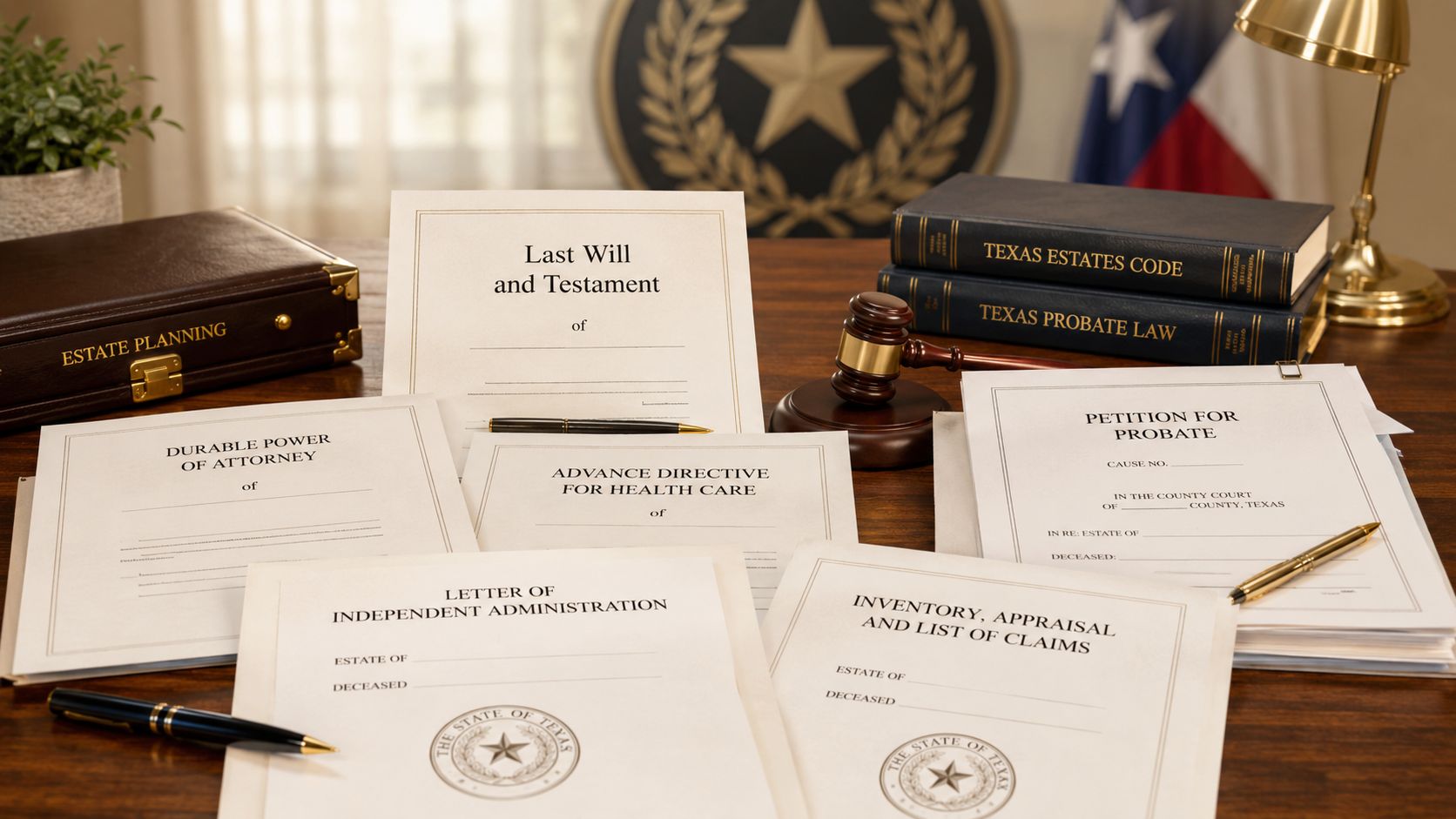
Texas probate courts work within the Texas Estates Code, especially Title 2 for decedents' estates and Title 3 for guardianship matters when incapacity becomes part of the picture. For probate administration, the court's concern is practical. Someone must have legal authority to secure property, pay valid obligations, and transfer what remains to the right people.
If the will does not name a backup
The bottleneck intensifies at this point. If the will is silent, the court must appoint another personal representative. In many cases, that person is called an administrator with will annexed, which means there is a valid will, but no acting executor is available to carry it out.
That title sounds technical, but the idea is simple. The court is not rewriting the will. The court is appointing someone to carry out the will because the named executor can't.
Probate in Texas is about securing property, paying debts and taxes, and transferring the rest to the people entitled to receive it.
That practical focus matters because replacement fights are rarely just about titles. They affect control of information, contact with creditors, and the timing of distributions. Public guidance often skips over the dispute risk when no alternate exists, especially in blended families or estates under creditor pressure, as noted in this discussion of executor replacement and contest risk.
Independent administration and dependent administration
Texas recognizes different kinds of administration. In independent administration, the executor usually has more room to act with less day-to-day court supervision after appointment. In dependent administration, the court supervises more closely.
That distinction can matter if the original executor dies. A dependent administration may already involve more court review. An independent administration may feel faster, but a vacancy can still stop momentum until a replacement is formally approved.
A quick comparison helps:
| Situation | What it means in plain English | Why it matters |
|---|---|---|
| Successor named in will | The decedent chose a backup | Fewer disputes over who should serve |
| No successor named | Court must choose someone | Greater risk of delay and disagreement |
| Independent administration | Less routine court supervision after appointment | Efficient when everyone cooperates |
| Dependent administration | More court oversight | More procedure, but sometimes more structure |
If you're trying to sort out whether the estate needs updated authority under Letters Testamentary or another form of appointment, this guide on Letters Testamentary vs. Letters of Administration in Texas is a helpful starting point.
Appointing a New Personal Representative Step by Step
The hardest part of this problem is the gap between the executor's death and the court's appointment of a replacement. That gap is where bills go unpaid, property sits unattended, and family conflict starts to grow.
Texas guidance confirms that executors have broad responsibilities and that probate court approval is required before administration can proceed. Public information often says only that “the court will appoint someone,” without explaining the filing sequence or how to keep the estate from stalling in the meantime, as described in this Texas probate court guide to estate executors.
A practical roadmap helps.
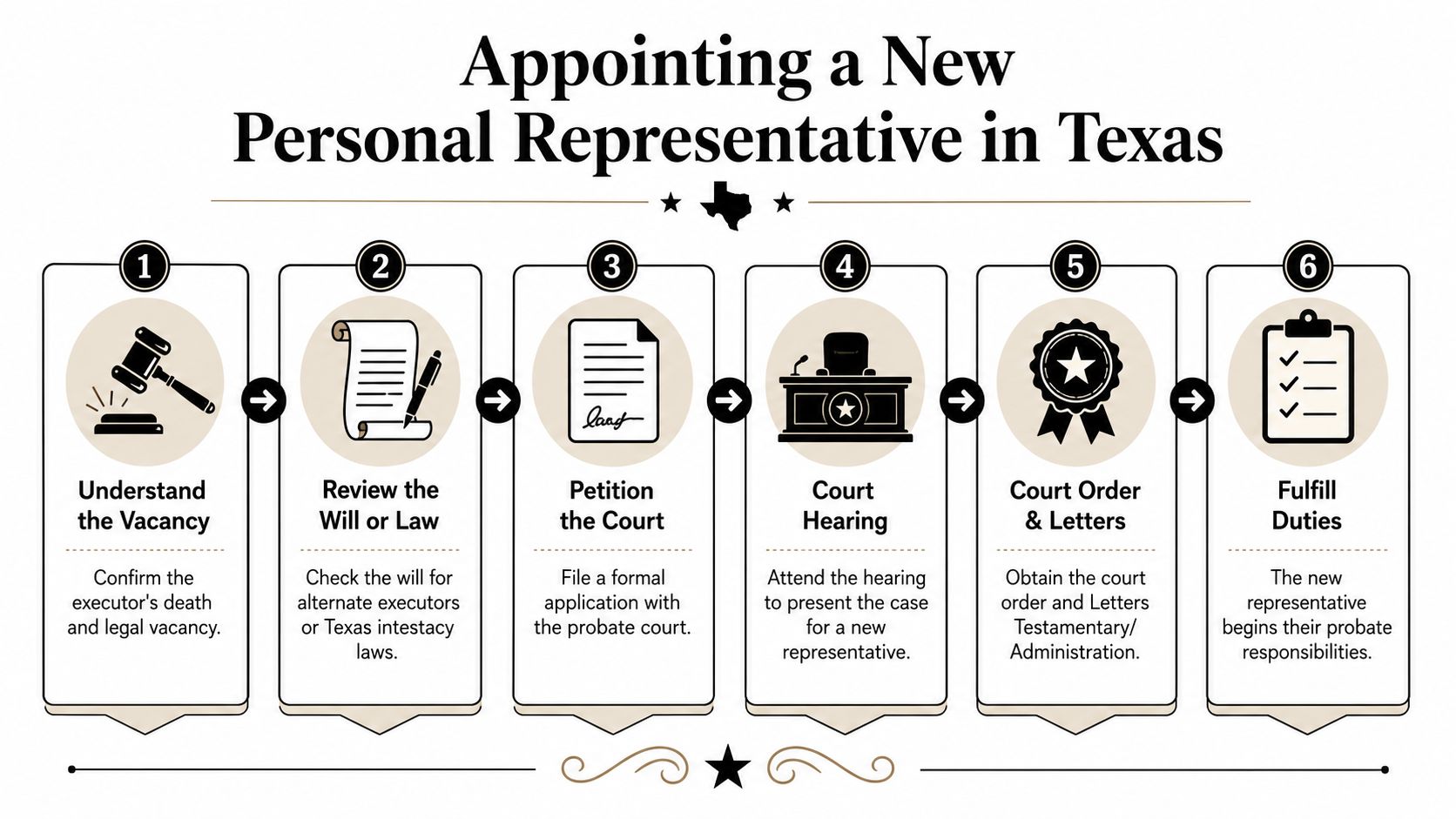
Step one confirms the vacancy
Someone needs to notify probate counsel and confirm that the currently serving executor has died. In practice, that means gathering the death certificate and checking the existing probate file.
If the deceased executor had possession of estate records, identify where those records are now. That includes:
- Court papers: Prior orders, the application, and the oath.
- Asset records: Deeds, account statements, vehicle titles, and insurance information.
- Administration records: Creditor notices, receipts, tax correspondence, and any draft inventory.
Step two reviews the will and the court status
The next question is whether the will names an alternate executor. If it does, the court process is usually narrower because the decedent already designated a replacement.
If it doesn't, the court will need an application for a new appointment. Who should apply depends on the family structure, the will's terms, and whether anyone is disqualified under the Texas Estates Code.
Here's a useful reference if the estate will need fresh appointment paperwork through the court: Texas Letters of Administration for estate appointment authority.
Step three files the right application
The exact filing name can vary by county practice and case posture, but the goal is the same. Ask the probate court to recognize a successor or appoint a new personal representative.
That application should be prepared with care. A rushed filing often leaves out necessary facts, creates notice issues, or invites an avoidable objection from another heir.
Watch the bottleneck: Most delays don't come from the legal rule itself. They come from incomplete records, unclear family agreements, and poorly prepared filings.
Step four prepares for the hearing
The hearing matters more than families expect. The judge isn't just filling a vacancy. The judge is deciding who can legally act for the estate.
The court may want clarity on:
- Whether the will names a successor
- Whether the proposed representative is willing and qualified
- Whether notice was handled properly
- Whether there is any dispute among heirs or beneficiaries
- Whether a bond should be required
This is also the point where unresolved family tensions become visible. If one sibling has controlled the deceased executor's paperwork and another sibling doesn't trust that person, the appointment may become contested quickly.
A short visual explanation may help if you're trying to understand how the process unfolds in practice.
Step five obtains updated letters
After the court signs the order, the newly appointed person must obtain updated authority. That may be Letters Testamentary if a successor executor is recognized, or Letters of Administration if the court appoints an administrator.
Those letters are what banks, title companies, and other institutions usually want to see. Without them, estate business often remains stuck.
Step six restarts motion, not the whole case
The replacement representative's job is to move the existing estate administration forward. The case doesn't start from zero. But the practical work often includes rebuilding the file, re-establishing contacts, and checking what was already done correctly.
That's where legal counsel can make a real difference. A probate attorney can coordinate the court filing, identify gaps in the record, and help prevent a dispute from turning into probate litigation. One option for that kind of representation is Law Office of Bryan Fagan, PLLC, which handles Texas probate and estate administration matters.
A Realistic Scenario What Happens on the Ground
The Miller family is dealing with their father's estate in Harris County. Their aunt was named executor in the will. She opened probate and had begun collecting records, but she died before the estate was finished. The will did not name a backup.
At first, the family thought the oldest son could take over because everyone knew he had been helping. The bank disagreed. So did the title company handling a possible sale of the father's home. Both wanted updated court authority.

Where the delay started
The aunt had kept a paper folder, but not every record was inside it. One sibling had email access to some estate communications. Another had keys to the house. No one knew whether all creditor notices had gone out or whether the inventory was complete.
That's how a simple vacancy becomes a bigger problem. Texas probate practice is time-sensitive, and delays can trigger more court involvement. A deceased executor can also create a chain reaction of delay, added oversight, and possible cost escalation, especially when the successor has to reconstruct records, as discussed in this Texas probate article on delays and court intervention.
What solved the problem
The family stopped trying to solve it informally and treated it like a court issue. They gathered the aunt's death certificate, reviewed the probate docket, and filed for appointment of a replacement representative.
One sibling wanted the role. Another was concerned that old family tensions would spill into the estate. Instead of forcing a quick private agreement, they addressed the question directly through the probate process and prepared for the hearing with complete records.
When families acknowledge the disagreement early, they usually save time. When they pretend no disagreement exists, it often resurfaces at the hearing.
Because the estate included a house that needed attention and financial accounts that required current authority, the family also looked at whether short-term protective action was needed. In some cases, families facing an immediate asset risk explore urgent probate options such as those discussed in this Texas emergency administrator guide.
The result was not instant. But it was orderly. The court appointed a new representative, the estate records were rebuilt, and administration resumed without having to erase every step the aunt had already taken.
Duties and Responsibilities of a Successor Representative
Once the court appoints a successor representative, the question changes from “Who's in charge?” to “What must be done now?”
The answer is usually continuity. In Texas, a successor can step in and continue administration. The fiduciary duties remain in place and include safeguarding assets, notifying creditors, and completing a final accounting before the estate can close, as explained in this Texas discussion of executor death during probate and continuing duties.
The first job is control and clarity
The new representative should secure estate property and obtain a working picture of what has already happened.
That often means:
- Securing assets: Homes, vehicles, accounts, mail, digital records, and business interests.
- Tracing prior actions: Identifying what the former executor already filed, paid, or transferred.
- Protecting deadlines: Making sure required notices, tax matters, and court obligations aren't missed.
A successor's role is not ceremonial. The representative owes duties to the estate and the people interested in it.
What usually remains valid
Many families worry that every act by the deceased executor is now void. Usually, that's not how this works. If the former executor was properly appointed and took valid actions within that authority, the estate doesn't normally rewind merely because the executor later died.
The successor typically picks up from the current point in the administration. That may include confirming prior payments, reviewing communications with creditors, and verifying whether an inventory or affidavit in lieu of inventory still needs attention under the court's deadlines and local practice.
What the successor should do early
A practical early checklist often includes:
- Request a full estate file: Paper documents, email records, bank statements, and correspondence.
- Create a timeline: What happened, what remains open, and what needs proof.
- Notify institutions of the change: After updated court authority is issued.
- Review distributions carefully: Don't distribute property until debts, taxes, and court requirements are addressed.
- Document everything: Good records reduce suspicion and protect the representative.
A careful successor doesn't assume the estate is fine just because probate was already opened. The replacement should verify the file before taking major action.
If the estate involves conflict, missing records, or allegations that the former executor mishandled assets, the replacement may need the court's guidance before moving forward.
Key Insights and When to Call an Attorney
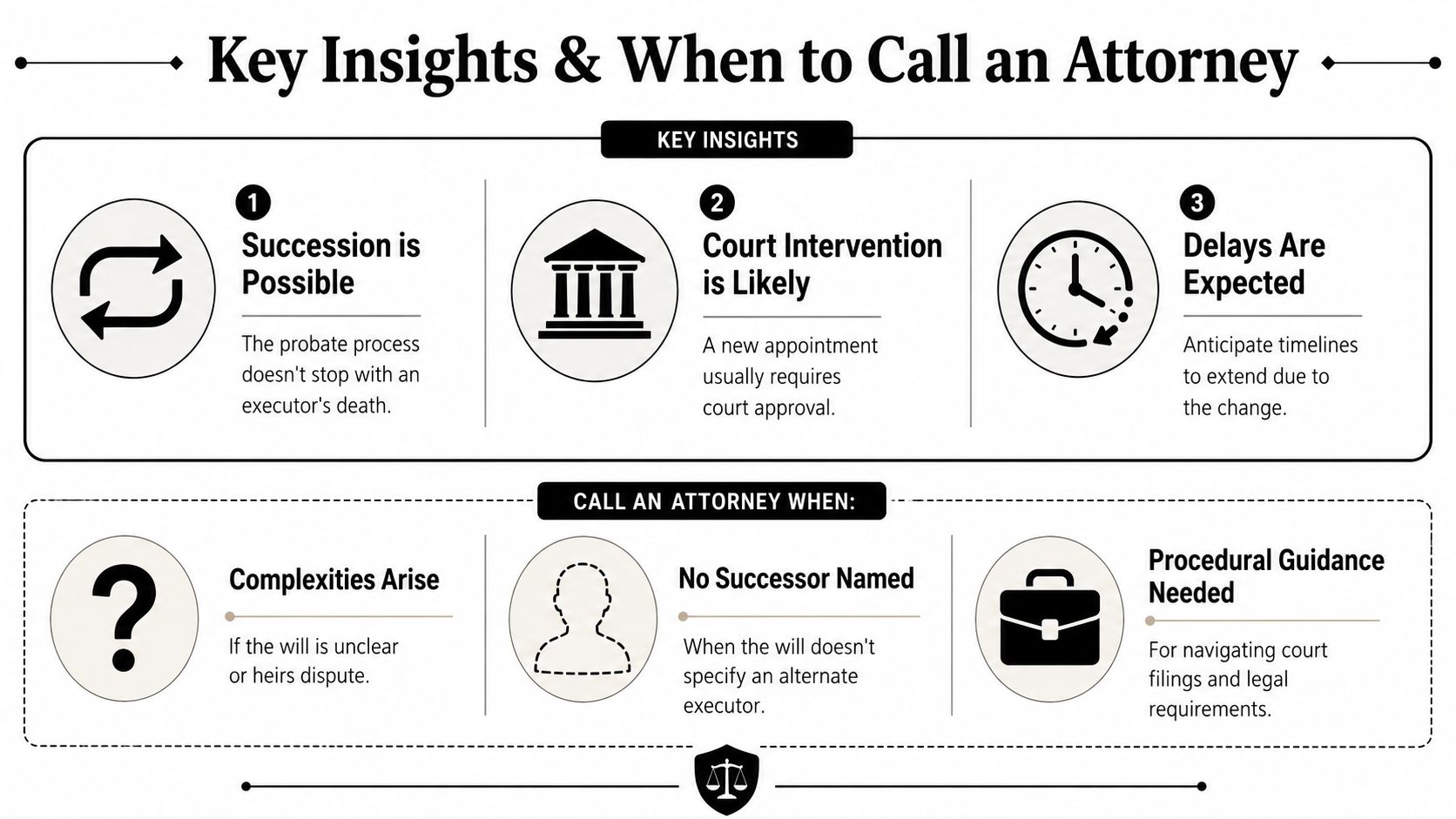
When an executor dies during probate in Texas, the case usually doesn't collapse. But it also doesn't run on autopilot. Someone must obtain legal authority to move the estate forward, and the period between the executor's death and the new appointment is where most practical damage happens.
Takeaway
Keep these points in mind:
- Check the will first: A named successor often makes the transition smoother.
- Treat the vacancy as a court matter: Informal family consent usually isn't enough.
- Move quickly on urgent estate issues: Property protection, records, and financial deadlines can't wait.
- Expect scrutiny if no alternate is named: Appointment disputes are more likely when family members have competing views.
- Understand the new role clearly: A successor continues the administration and must act as a fiduciary under Texas probate rules.
You should strongly consider probate counsel if the will doesn't name a backup, heirs disagree about who should serve, the deceased executor left incomplete records, or the estate includes real property, creditor pressure, or business interests. Those are the situations where delay becomes expensive and conflict becomes harder to contain.
If you need more background on related probate matters, these resources may help: Texas Probate Process, Probate Litigation, Wills & Trusts, and Guardianship.
If you're facing probate in Texas, our team can help guide you through every step, from filing to final distribution. Schedule your free consultation today with Law Office of Bryan Fagan, PLLC.