Losing a family member is a profoundly emotional experience, and stepping into the role of executor or administrator is often overwhelming. We understand that grieving families need clarity, not confusion. When you discover that a potential heir—someone legally entitled to inherit—is missing, it adds a significant layer of complexity to an already difficult time.
You might worry that the entire probate process will grind to a halt, leaving assets in limbo and other beneficiaries waiting indefinitely. But we want to reassure you: while the path forward is more involved, it is well-defined by Texas law. The process doesn't stop; it just becomes more formal and court-supervised. This guide will walk you through what to expect, step by step.
Navigating Probate When Heirs Go Missing
Texas has specific procedures designed to protect the rights of the missing person while still allowing the estate to be settled. You are not left to figure this out alone, but you do have to follow the rules carefully. The court's primary goal is to ensure fairness and due process for everyone, including those who can't be located.
To do this, the law requires you to take a series of deliberate steps. You will need to demonstrate that you have made a sincere, documented effort to find the missing person. In legal terms, this is known as a "diligent search."
The Legal Framework for Missing Heirs
If your diligent search comes up empty, the court steps in to protect the missing heir’s interests. This triggers a formal, court-supervised process designed to protect their rights through continued searching and legal representation. The relevant procedures are outlined in Title 2 of the Texas Estates Code.
The infographic below gives you a bird's-eye view of what this journey looks like.
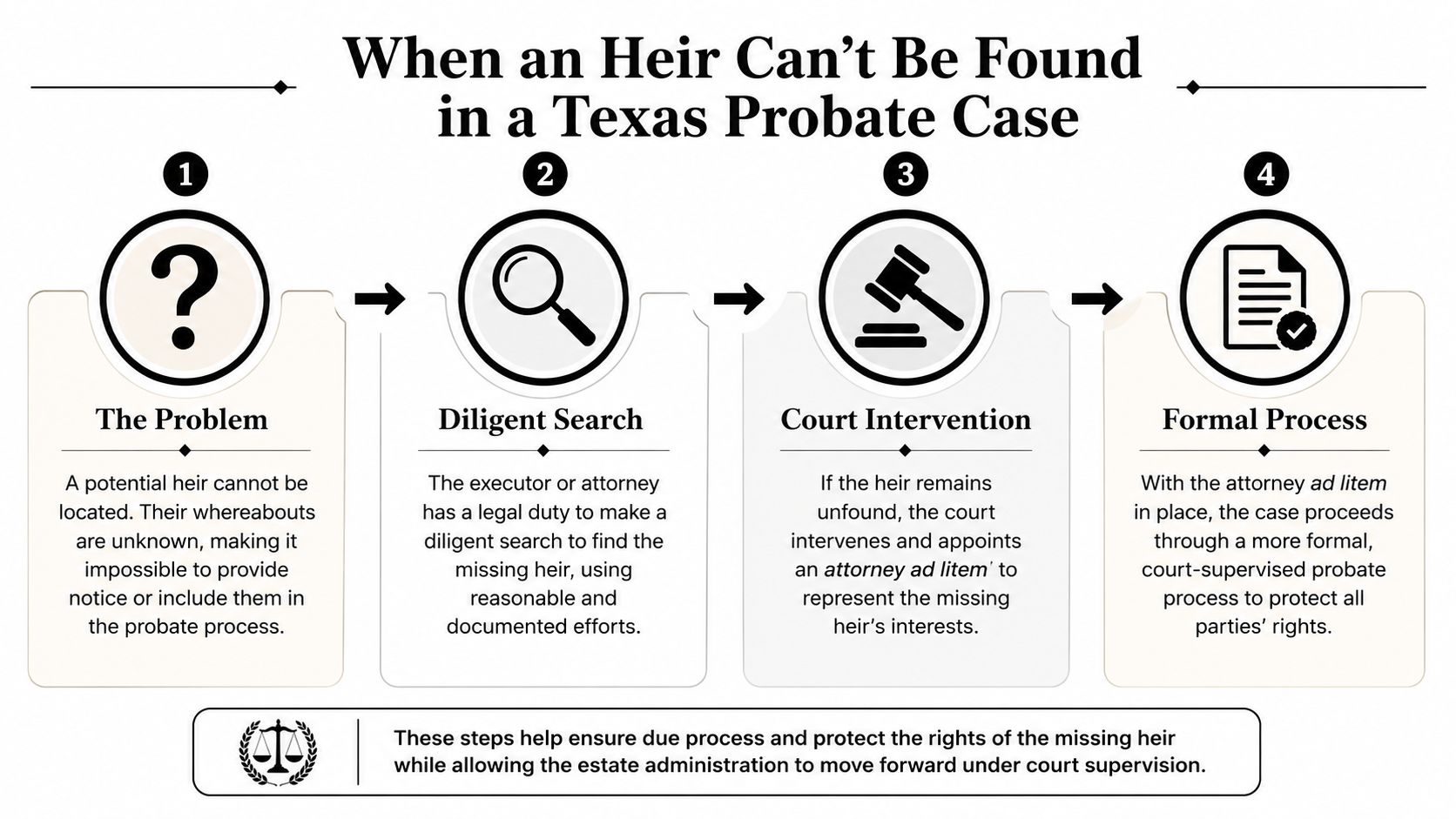
As you can see, a missing heir makes settling an estate significantly more complex. For a general overview of the entire settlement process, you might find this DIYAuctions estate settlement guide helpful.
Appointing an Attorney Ad Litem
One of the most important steps the court will take is to appoint an attorney ad litem. This is an independent attorney whose sole job is to represent the interests of the unknown or missing heirs. Think of them as a legal guardian for the missing person's potential inheritance.
This attorney will conduct their own investigation to try and locate the heir. They also ensure that every legal requirement is met before the estate's assets are distributed. You can find more details in our guide on solving mysteries in Texas probate court. This system provides a critical safeguard, ensuring the entire process remains fair, transparent, and legally sound.
Your Legal Duty to Conduct a Diligent Search
When an heir goes missing during a Texas probate case, the court doesn’t just let you shrug your shoulders and move on. As an executor or administrator, your first official job is to conduct what’s known as a "diligent search." This isn't a casual look-around; it's a legal standard that demands a sincere and thorough effort to find the missing person.
Think of it as building a case for the judge. You need to prove that you've turned over every reasonable stone before the court will consider other options. Getting this part wrong can lead to major delays, legal headaches, and even open the door for future lawsuits against the estate.
What a Diligent Search Involves
So, what does a "diligent search" actually look like in practice? It's an active, methodical investigation that goes far beyond a simple Google search. The court expects you to be persistent.
Your search should be a mix of old-school detective work and modern-day sleuthing. Here’s what that typically includes:
- Working the Phones: Start with the inner circle. Call every known relative, friend, and former colleague of both the deceased and the missing heir. Ask for last known addresses, phone numbers, email contacts, or even just stories about where they might have gone.
- Digging into Public Records: Official records can be a goldmine. Check for marriage licenses, property deeds, and other public filings. Understanding how to find probate records in Texas can also reveal family connections and addresses you didn't know about.
- Searching Online and on Social Media: Check social media platforms like Facebook and LinkedIn. Search for the heir’s name, their friends, and any professional connections that might lead you to them.
- Using the Last Known Address: Send a certified letter to the heir’s last known physical address. Even if the letter comes back as undeliverable, that returned mail is crucial evidence for the court.
- Contacting Former Employers: Reach out to the heir’s last known place of work. HR departments sometimes have forwarding information or professional contacts on file.
Documenting Your Search Is Not Optional
Here’s a critical piece of advice: documenting your search is just as important as the search itself. For every call you make and every website you check, you must keep a precise, detailed record.
Documenting Your Diligent Search for an Heir
| Search Method | What to Document | Why It's Important |
|---|---|---|
| Phone Calls | Date and time of call, person's name and relationship, and a summary of the conversation. | Shows you actively engaged with known contacts and followed up on leads. |
| Emails & Letters | Copies of all sent correspondence, including certified mail receipts and any returned mail. | Provides a paper trail of your attempts to make formal contact. |
| Online Searches | Screenshots of social media profiles, search engine results, and any messages sent. | Demonstrates that you utilized modern, publicly available resources. |
| Public Records | Copies of any documents found (e.g., property records, court filings) and a note of where you searched. | Proves you checked official databases for clues about the heir's whereabouts. |
| Hiring a Professional | Invoices and reports from any private investigator or heir search firm you hired. | Acts as powerful evidence of a serious and comprehensive search effort. |
Creating this "logbook" of your efforts isn't just about checking a box. It’s about building a strong, defensible record that satisfies the court’s requirements and allows the probate process to move forward. Without it, you’re just spinning your wheels.
The Heirship Determination Process in Court
When you can't find an heir after a thorough search, or if a loved one passed away without a will (intestate), the probate process hits a major roadblock. But Texas law doesn’t just let an estate get stuck in legal limbo. Instead, the focus must shift to a specific court proceeding designed to formally identify every rightful heir and figure out their correct share.
This is where the court steps in with a legal action called an Application to Determine Heirship. Think of it as asking a judge to solve the puzzle of who legally inherits the estate. This proceeding, governed by the Texas Estates Code, is absolutely essential for creating a clear, court-ordered record of inheritance, which you'll need to transfer property, close bank accounts, and wrap up the decedent’s financial life.
Who Can Initiate This Process?
The Texas Estates Code is pretty clear about who has the right to get the ball rolling on an heirship determination. This ensures the process can move forward even if the most obvious person, like a surviving spouse or child, isn't able or willing to act.
Several people can file the application, including:
- The personal representative of the estate (the executor or administrator).
- Anyone claiming to be a creditor or partial owner of the estate.
- A secured creditor who needs to enforce their lien on real estate in the estate.
- The guardian of the decedent’s estate, if one was appointed before their death.
This application is far more than a simple form. It's a sworn legal document detailing the deceased’s family history, a complete list of their property, and all known—and unknown—heirs. You can find a deeper dive into this legal process in our guide on the Texas heirship proceeding.
The Role of Disinterested Witnesses
One of the most critical parts of an heirship determination is testimony from independent witnesses. The court can't just take the family's word for it; it needs unbiased confirmation of the decedent's family history. Texas law requires two disinterested witnesses to testify in court.
So, who is a "disinterested witness"? It's someone who knew the decedent but has zero financial stake in the outcome. They won't inherit a dime. These are often longtime friends, neighbors, or colleagues who can credibly speak to the decedent's marriages, children, and other family relationships. Their job is to help the judge build an accurate family tree so no one is unfairly left out.
Scenario: Maria passes away without a will. Her only known relative is a nephew, David, who lives in Houston. David vaguely recalls Maria mentioning she had two children from a brief first marriage decades ago, but he’s never met them and has no idea where they are.
To settle the estate, David’s attorney files an Application to Determine Heirship. The court then appoints an attorney ad litem to track down the missing children. David brings two of Maria's old friends to court as disinterested witnesses. They testify that Maria was, in fact, married briefly and had two children but lost contact after she moved. This testimony, combined with the attorney ad litem's search, gives the court the facts it needs to formally address the existence of these unknown heirs.

In Texas, discovering a missing heir isn't just a small hiccup; it can completely change the probate strategy. It might force an estate that was headed for a simple independent administration into a more complex and supervised dependent administration. That’s because the law demands that every single heir be included in the lawsuit so the court can issue a final judgment on who inherits what. A missing heir triggers a formal legal process that adds significant time and expense to settling the estate.
Understanding the Attorney Ad Litem's Role
During an heirship proceeding, the probate judge will appoint an Attorney Ad Litem. When you hear another lawyer is getting involved in your family’s affairs, it's natural to feel a little uneasy. But this appointment isn’t a sign of trouble—it's a critical step designed to protect the integrity of the process, and understanding their role can bring you significant peace of mind.
An Attorney Ad Litem is a neutral, third-party attorney appointed by the court. Their one and only job is to represent the interests of the “unknown” or missing heirs—the very people no one can seem to find. They don’t work for you, the other known heirs, or the estate administrator. They work exclusively for the court to make sure the rights of that missing person are fiercely protected.
What Does the Attorney Ad Litem Do?
Think of the Attorney Ad Litem as a court-appointed detective and legal advocate rolled into one. Their responsibilities are clearly laid out in the Texas Estates Code, and their involvement ensures the whole process is fair and that every legal box has been checked before a single asset is distributed.
Their duties typically include:
- Conducting an Independent Investigation: The Attorney Ad Litem won’t just take your word for it that you performed a diligent search. They conduct their own investigation to try and locate the missing heir, often using resources and methods you might not have had access to.
- Reviewing the Administrator's Efforts: They will carefully scrutinize the "diligent search" records you created. Their goal is to verify that your search was truly thorough and met the high legal standard required by Texas law.
- Advocating for the Missing Heir: In court, the ad litem becomes the voice for the person who isn't there. They report their findings directly to the judge and make recommendations that serve the best interests of the missing heir, not the other beneficiaries who are present.
By making sure a truly independent search is done and all legal protocols are followed, the ad litem helps the court reach a final, legally sound decision. Their role is absolutely essential for officially determining heirship and allowing the estate to finally move forward.
The Impact on Your Timeline and Budget
When you’re dealing with a missing heir, it's natural to worry about the two things every family asks about: how long will this take, and what will it cost? Let’s be direct. The reality is that locating a missing heir—or proving to the court that they simply can't be found—will absolutely affect both the probate timeline and the estate's budget.
The minute a formal heirship proceeding begins and the court appoints an Attorney Ad Litem, your probate timeline gets longer. A process that might have taken a few months can easily stretch out for a year or more. Why? Because each step—the diligent search, the ad litem's separate investigation, and the court hearings required to approve it all—takes time to do correctly.
The Financial Realities of a More Complex Probate
These delays aren't just about waiting; they have real financial consequences. During this extended period, many of the estate's most valuable assets are essentially frozen.
- Real Estate: You likely won’t be able to sell the decedent's home or other property until the court officially declares who all the rightful heirs are.
- Investment Accounts: Brokerage firms will not transfer stocks, bonds, or mutual funds without a final court order clarifying who now owns them.
- Bank Accounts: While some funds might be available for estate expenses, major distributions to the known beneficiaries are typically on hold.
This holding pattern can be incredibly frustrating, especially when property taxes are due, maintenance bills are piling up, or the other beneficiaries are anxiously waiting for their inheritance.

What Happens to the Missing Heir’s Inheritance?
So, what about the missing heir’s share of the estate? It’s a common misconception that the money is simply forfeited or divided among the known heirs. That’s not how it works in Texas. The inheritance is not lost.
Texas law goes to great lengths to protect a missing heir's property rights. Instead of being redistributed, their share of the inheritance is typically paid into the court's registry or a special account managed by the Texas Comptroller. The funds are held there, waiting for the heir—or their descendants—to eventually appear and claim them.
This process is designed to protect due process while still allowing for the efficient transfer of property. However, as you can discover more about the applications for heirship on TexasLawHelp.org, a delayed heirship ruling can freeze the sale of land and complicate tax or debt resolution.
The key takeaway for families is that a missing heir makes the entire legal path more formal and more expensive. These steps aren't just bureaucratic red tape; they are essential legal protections that ensure the estate is settled correctly and guard against future legal challenges from a long-lost relative down the road.
Key Insight and Your Next Steps
Discovering a missing heir can feel like hitting a dead end in the Texas probate process, but it’s more of a detour than a full stop. The key is to understand that your primary duty is to conduct and document a “diligent search” for that person. You can't just give up; you have to prove to the court you’ve made a genuine effort.
If that search comes up empty, the court has a specific, structured path to follow. It involves filing an “Application to Determine Heirship” and the appointment of an “Attorney Ad Litem.” Think of this attorney as a legal guardian for the missing heir's potential rights, ensuring fairness and protecting the integrity of the entire estate.
Key Insight: The legal system is built to handle the problem of missing heirs, but it demands strict compliance with its procedures. Your job is to follow the court's direction, meticulously document every step you take, and collaborate with legal professionals to get it done right.
If you find yourself in this position, getting professional guidance isn't just a good idea—it's critical. The moment an attorney ad litem is appointed, you have an extra layer of court supervision and the potential for probate litigation increases. An experienced probate attorney is essential to protect the estate and navigate the complexities ahead, including potential guardianship issues if the heir is eventually found but is unable to manage their own affairs. This entire situation also highlights the incredible value of proper estate planning through clear Wills & Trusts, which can prevent these exact complications from ever happening.

Common Questions About Finding Heirs in Texas Probate
When an heir can't be found, it throws a wrench into the probate process. Families often come to us with a mix of practical and "what if" questions. Here are some of the most common ones we hear, along with straightforward answers.
What Happens If a Missing Heir Shows Up Years Later?
This is one of the biggest fears for executors. You've closed the estate, distributed the assets, and moved on—then an unknown cousin appears. The good news is, Texas law has a plan for this. You aren’t expected to keep the estate open forever.
Once the court confirms that you've made a diligent effort to find the heir, any money owed to them doesn't just disappear. Instead, it’s deposited with the Texas Comptroller's Unclaimed Property Division. This protects you, the executor, from future liability. The estate is closed, and the matter is out of your hands. The newly discovered heir’s claim is now with the state, not with you or the other beneficiaries.
How Much Does an Application to Determine Heirship Cost?
There’s no flat fee for this process, as the cost really depends on how complicated the search becomes. Think of it like a detective’s investigation—some cases are open-and-shut, while others require digging through layers of history.
Several factors will shape the final cost:
- Court Filing Fees: Every county has its own set fee just to get the case on the docket.
- Publication Costs: This is the fee for running a legal notice in a local newspaper, a required step to formally notify any unknown heirs.
- Attorney Ad Litem Fees: The court will appoint an independent attorney (the "ad litem") to conduct their own search for heirs. Their job is to protect the interests of the missing person, and their time is a billable expense to the estate.
A free consultation is the best way for us to understand your situation and provide a realistic estimate of the costs involved.
Takeaway: Hiring a professional genealogist or heir search company can be a huge help. They often have access to databases and research methods that can quickly track down relatives. While their findings can strengthen your case, remember that their report isn't a legal document. The information they uncover must still be formally presented to the court by your probate attorney to be legally recognized.
If you’re facing probate in Texas, our team can help guide you through every step — from filing to final distribution. Schedule your free consultation today.