When an executor is refusing to distribute assets, it can leave beneficiaries feeling frustrated, confused, and powerless. This is a deeply personal issue, often happening while you are still grieving the loss of a loved one. Your first move is to understand if the delay is a normal part of the Texas Probate Process or a genuine breach of the executor's legal duties. If quiet diplomacy fails, you have legal options, from formally demanding an accounting to petitioning the probate court to force their hand—or even remove them entirely.
The Executor's Role and Responsibilities in Texas
Losing a loved one is hard enough without having to navigate a complex legal maze. As a beneficiary, you're placing immense trust in the executor—the person named in the will to manage the estate honorably and efficiently. Their job isn’t to make their own rules; it's to follow the instructions left behind in the will and the laws of Texas.
An executor's role comes with a heavy legal obligation known as a fiduciary duty. This is the highest standard of care recognized by law, meaning they must always act in the best interests of the estate and its beneficiaries, never their own. This duty is one of loyalty, transparency, and fairness.
In Texas, an executor's core responsibilities are defined by Title 2 of the Texas Estates Code:
- Gathering All Assets: This means tracking down and securing everything the deceased owned, from bank accounts and real estate to family heirlooms.
- Paying Legitimate Debts: They are required to notify creditors and use estate funds to pay off valid bills, taxes, and final expenses.
- Communicating with Beneficiaries: Keeping you and other heirs reasonably informed about the estate’s progress is a critical part of the job.
- Distributing Property: Once all debts and taxes are settled, their final duty is to hand over the remaining assets to the beneficiaries exactly as the will directs.
These duties aren’t just suggestions. Understanding them is the first step in protecting your inheritance and ensuring your loved one's final wishes are honored.
Normal Delays vs. Unreasonable Refusals
Here’s where things get tricky for many families: probate isn't quick. Certain delays are a normal, and even necessary, part of administering an estate. For instance, an executor must give creditors a specific amount of time to come forward and make claims. They also need to file final tax returns, get property appraised, and ensure every financial loose end is tied up before a single dollar can be distributed.
But a reasonable wait can quickly sour into an unreasonable refusal. While Texas law generally anticipates an estate will be settled within about a year, it gives executors a significant amount of time before a court will intervene without a very good reason for the delay. Red flags that point to a problem include radio silence, vague answers about the estate’s finances, or failing to set up a dedicated bank account for the estate. You can learn more about the specific responsibilities of an executor of a will to better understand what’s expected.
Distinguishing between a standard hiccup and a true problem is critical. This table can help you tell the difference.
Normal Probate Delays vs. Red Flags for Executor Misconduct
| Activity | Acceptable Delay (What's Normal) | Red Flag (Cause for Concern) |
|---|---|---|
| Initial Communication | A few weeks to get organized and send initial notices to heirs. | Months of total silence with no updates or returned calls. |
| Asset Inventory | Several months to locate, secure, and appraise all assets (real estate, accounts, etc.). | The executor is vague or secretive about what assets are in the estate. |
| Paying Debts | A waiting period of several months for creditors to submit claims is required by law. | Selling assets below market value or paying questionable "debts" to themselves or friends. |
| Financial Transparency | Providing a general overview of finances but waiting for a final accounting. | Refusing to provide any financial information or mixing estate funds with personal funds. |
| Timeline for Distribution | 12-18 months is a common timeline for a straightforward estate to be settled. | Pushing past 2-3 years without a clear reason (e.g., a lawsuit, complex taxes). |
While patience is important during probate, these red flags suggest it might be time to stop waiting and start acting. If your executor’s behavior falls into the right-hand column, it’s a clear signal that something is wrong.
A Common Scenario: The Garcia Family
Let's consider a realistic example. After their father passed away, his brother, Uncle John, was named the executor. The first few months went fine—he was communicative and seemed to be handling things. Then, the updates just stopped. The Garcia siblings, Maria and Carlos, sent emails and left voicemails asking about their inheritance, but all they got was silence.
They started to worry. Was their uncle misusing the money? Had he sold their father's house without telling them? The uncertainty created enormous stress, and they had no idea what their rights were or what to do next.
The Garcias' situation is all too common. Under Texas Estates Code § 404.001, beneficiaries have a legal right to demand a formal accounting from the executor, but there's a catch: you generally have to wait 15 months after the executor is officially appointed by the court. If the executor then fails to provide that sworn financial report within 60 days of your demand, the court can compel them to do it. This long waiting period can leave families feeling completely powerless, which is why learning to tell the difference between a patient wait and a problematic delay is the first step toward protecting what's rightfully yours.
Initial Steps When an Executor Won't Communicate
It’s one of the most unsettling feelings in the entire probate process: the person in charge of your loved one's estate has gone silent. When an executor stops answering calls and emails, your mind immediately jumps to the worst-case scenarios. This radio silence leaves you in a painful state of limbo, completely in the dark.
Before you assume the worst, your first move should be to create a clear, professional paper trail. This isn't about picking a fight; it's about shifting from casual texts and voicemails to formal, documented communication that you can rely on if things escalate.
Drafting a Formal Request
Start by sending a polite but firm letter or email to the executor. Keep the tone professional and the purpose clear. You’re not accusing them of anything; you’re simply asking for the information you're legally entitled to have.
This initial communication should cover three key points:
- State your relationship to the estate (e.g., that you are a beneficiary named in the will).
- Request an update on the status of the estate administration, including what debts have been paid and what assets have been collected.
- Ask for a general timeline for when you might expect a final accounting and the distribution of your inheritance.
This simple act of putting your request in writing often gets the ball rolling. Sometimes, an executor is just disorganized or overwhelmed, not malicious. A formal letter can be the nudge they need to get back on track. Be sure to keep a copy for your records.
Demanding a Formal Accounting
What if your polite requests are met with more silence? Now it’s time to use a powerful legal tool you have as a beneficiary. Under Texas Estates Code § 404.001, you have the right to formally demand an “accounting.”
This isn't just a casual update. An accounting is a sworn, detailed report of every single financial activity related to the estate.
A formal demand for an accounting turns your request for information into a legal obligation for the executor. It’s a game-changer that forces transparency by requiring a complete financial breakdown of the estate, putting the executor on a strict deadline to respond.
A proper accounting must legally include a detailed list of all estate property the executor has managed, along with:
- All payments made from the estate.
- All debts and expenses the estate still owes.
- All property still on hand.
Making this demand is a serious move. It signals to the executor that you know your rights and are prepared to enforce them. Once they receive this formal demand, they have a strict 60-day deadline to provide you with the sworn accounting. If they fail to do so, your next step is to get the probate court involved.
This flowchart maps out the decision-making process when you’re dealing with an executor who is dragging their feet in Texas.
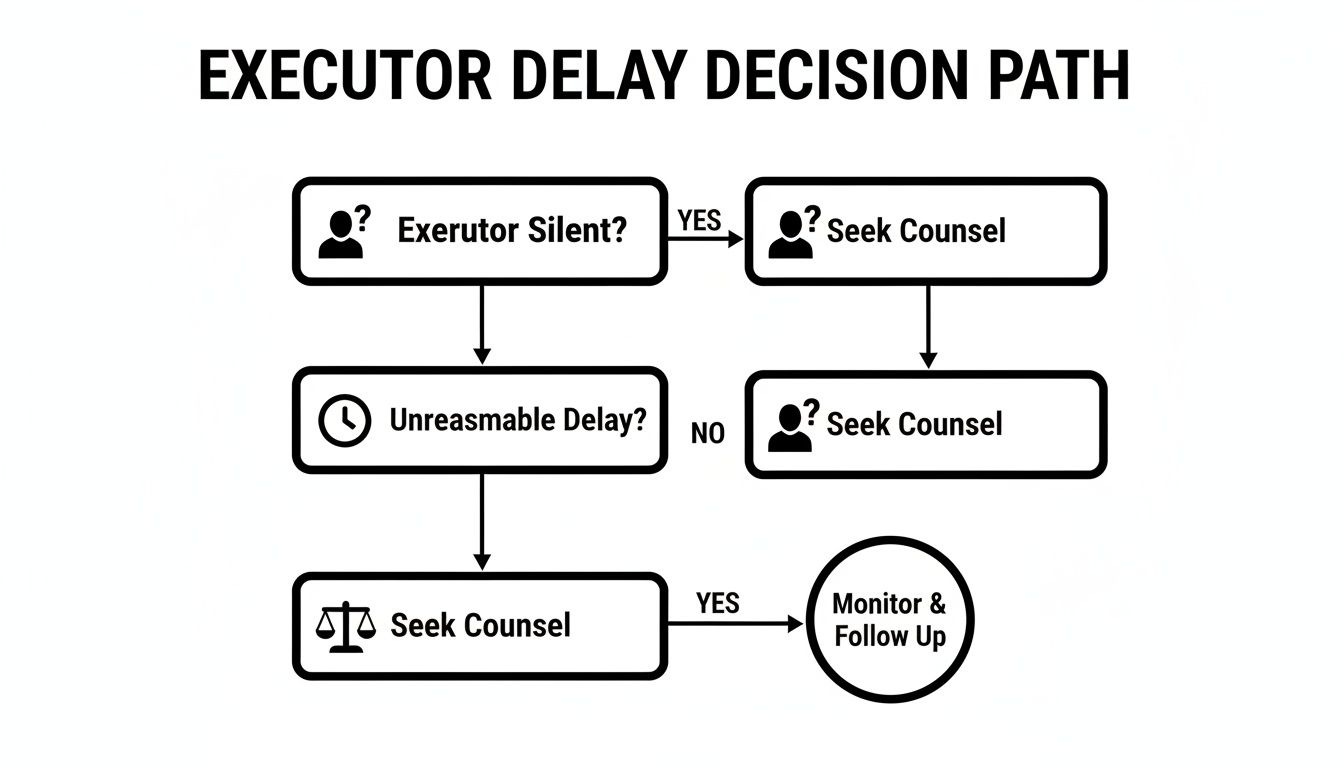
Let’s go back to the Garcia family’s story. After months of their uncle ignoring their calls and emails, Maria and Carlos hired an attorney to send a formal demand for an accounting. That official letter, citing the Texas Estates Code, made it crystal clear they were done asking nicely. This was now a legal demand—a critical step that put their uncle on notice and set the stage for court action if he continued to stonewall.
Recognizing a Breach of Fiduciary Duty

When a Texas probate court appoints an executor, it isn't just handing them the keys to an estate. The court is bestowing a position of immense trust, legally known as a fiduciary duty. This is the highest standard of care recognized under the law, and it’s a non-negotiable obligation.
This duty legally binds the executor to act with unwavering loyalty and good faith toward you and the other beneficiaries. An executor’s refusal to distribute assets isn't just frustrating; it's often a massive red flag that they are failing to uphold this fundamental duty. They are required to put your interests first, but when they don’t, they are not just making a poor decision—they are breaking Texas law.
What a Breach of Fiduciary Duty Looks Like
A breach of this duty can range from blatant theft to more subtle, manipulative behavior. At its core, any breach involves the executor failing to act in the best interests of the estate and its heirs. This is a serious legal issue that goes far beyond simple delays or communication breakdowns.
Common actions that violate this sacred trust include:
- Self-Dealing: The executor sells an estate property to themselves or a close relative for a price far below its actual market value.
- Co-mingling Funds: The executor moves estate funds into their personal bank account, making it impossible to tell what money belongs to the estate and what belongs to them.
- Playing Favorites: The executor ignores the will's instructions and distributes assets unfairly, giving one heir more than their share.
- Hiding Information: The executor refuses to answer questions, won’t provide a detailed accounting of expenses, or outright lies about the estate’s finances.
These aren't just missteps. These are direct violations of the Texas Estates Code. An executor who does these things isn't just managing the estate poorly; they are actively harming the beneficiaries and disrespecting the final wishes of your loved one. Spotting these signs is the first step toward holding them accountable.
Key Insight: An Executor’s Fiduciary Duty Demands Absolute Fairness and Transparency
An independent executor in Texas does have some flexibility, but that power is not a license for unfairness. A notable Texas court case illustrates this point perfectly. An executor was in charge of dividing an estate with several valuable pieces of real estate. He distributed some property to all beneficiaries but secretly deeded the most valuable parcel to himself and his brothers, cutting out another beneficiary.
The court didn’t hesitate to call this a clear breach of fiduciary duty. While Texas Estates Code § 405.0015 allows for non-pro-rata distributions (meaning not every single asset has to be split into equal shares), that power is limited by the absolute duty of fairness and complete disclosure. The executor intentionally hid information and engaged in blatant self-dealing.
If you even suspect that an executor is playing games—undervaluing assets, playing favorites, or manipulating the distribution for their own gain—you have solid grounds to take legal action. Protecting what is rightfully yours may require asking the probate court to step in. This is where having experienced legal counsel is critical for navigating the complexities of probate litigation and forcing the executor to honor their legal and ethical duties.
Using the Probate Court to Force Action

When an executor ignores your letters and stonewalls you on distributing the estate, your patience will eventually run out. This is the point where the Texas probate court stops being a background process and becomes your strongest ally. The law provides specific legal actions designed to force an executor’s hand and compel them to do their job.
Taking the step to file a formal court petition is a significant one. You're moving the conflict from unanswered phone calls and emails into a courtroom where a judge has the final say. It’s often the only way to break the gridlock and protect your inheritance from an executor who is either incompetent or acting in bad faith.
Filing a Petition to Compel Distribution
If a significant amount of time has passed and the executor has no good reason for holding onto the assets, you can file what's known as a Petition to Compel Distribution. This is a direct legal challenge to their inaction. You’re essentially asking a probate judge to order the executor to show up and explain the hold-up.
Under Texas Estates Code § 405.001, a beneficiary can file this petition after the estate has been open for a certain period. The court will set a hearing where the executor must justify the delay. If the judge isn't satisfied with their excuses—especially if all debts and taxes are paid—they can issue an order demanding that the assets be distributed immediately. This move is so effective because it takes away the executor’s ability to hide behind silence.
Demanding an Accounting and Seeking Removal
Sometimes, the delay is a symptom of a much bigger problem. If you suspect mismanagement or a breach of their fiduciary duty, you can petition the court for a formal accounting. This forces the executor to produce a sworn, detailed report of every dollar in and every dollar out.
If they refuse to provide the accounting, or if it reveals serious issues, your next move might be a Petition for Removal of an Executor. This is one of the most serious steps a beneficiary can take. You are asking the court to fire the person your loved one chose. To succeed, you need clear evidence of their misconduct, such as:
- Gross misconduct or mismanagement of estate funds.
- Failure to produce a court-ordered accounting.
- Misapplication or embezzlement of estate assets.
- Inability to perform their duties due to incapacity or imprisonment.
Executor misconduct, particularly refusing to provide information or distribute assets, is a massive red flag for the courts. For more information, you can read about the mismanagement of an estate by an executor and what beneficiaries need to know. Our firm also has a wealth of information about the grounds and procedures for removing a Texas executor who has violated their responsibilities.
Scenario: The Garcia Family Takes Action
Let’s return to the Garcia family. Their uncle completely ignored their formal demand for an accounting. Worried and frustrated, Maria and Carlos hired their probate litigation attorney and decided to escalate things. They filed a Petition to Compel Distribution and, at the same time, a Petition for Removal based on his failure to communicate and manage the estate's finances.
The moment those petitions were filed, everything changed. Their uncle was served with official court papers and given a date to appear before a judge. The power dynamic shifted instantly. He could no longer ignore his niece and nephew—now, he had to answer to the court. This proactive legal strategy was the only path left to make sure their father's wishes were finally honored.
What Happens After You File a Petition Against the Executor?
Taking an executor to court feels like crossing a point of no return. You’ve gone from making phone calls and sending letters to officially asking a Texas probate judge to step in. It’s a big move, and it’s natural to wonder what comes next.
Once your petition is filed and officially served on the executor, the entire dynamic changes. The days of being ignored are over. The executor is now on the clock and has to answer—not just to you, but to the court.
How an Executor Might React
An executor’s response to being served with a lawsuit usually falls into one of three categories. How they react will dictate the next phase of your case.
Sudden Cooperation: Sometimes, the formal notice of a court filing is the only wake-up call an executor needs. Faced with the reality of explaining their delays to a judge, they might suddenly become very motivated to provide an accounting and a plan for distribution to avoid a court battle.
A Move to Negotiate: More often, the executor's attorney will contact your lawyer to try and work things out. This is a good sign. It means they’re taking you seriously. Negotiations could lead to a firm, agreed-upon deadline for distributing assets or a promise to provide a complete accounting, all without ever having to argue in front of a judge.
They Dig in for a Fight: If the executor genuinely believes they have a good reason for the delay—like a complex tax audit or a legitimate, unpaid creditor claim—they will likely contest your petition. Their lawyer will file a formal response with the court, and both sides will start gathering evidence to make their case at a formal hearing.
No matter which path it takes, filing the petition forces the issue. The stalemate is broken, and a resolution is finally in sight.
The Power of a Judge: Potential Court Outcomes
If you and the executor can’t reach an agreement on your own, a probate judge will make the decision for you. After hearing from both sides and looking at the evidence, the judge has a wide range of powers to set things right. The court can issue binding orders that compel the executor to act and protect your rights as a beneficiary.
Potential Outcomes of Filing a Petition Against an Executor
| Court Action | Potential Outcome for Beneficiaries | Potential Consequence for Executor |
|---|---|---|
| Order to Distribute | The judge orders a partial or complete distribution of assets by a specific deadline. | The executor must comply or face contempt of court charges. |
| Order for Accounting | The judge forces the executor to produce a detailed, sworn accounting of all estate activity. | Failure to comply can lead to fines, sanctions, or removal. |
| Surcharge Order | If the accounting shows mismanagement, the judge can order the executor to personally repay lost funds to the estate. | The executor is held financially liable for their mistakes or misconduct. |
| Removal of Executor | For serious breaches, the judge can remove the executor and appoint a new, neutral administrator. | The executor loses all authority over the estate and may face further legal action. |
These aren't just suggestions. They are powerful legal tools designed to hold a problem executor accountable and ensure the estate is managed correctly.
Who Ends Up Paying the Legal Bills?
One of the first questions beneficiaries ask is about the cost of hiring an attorney. The good news is that Texas law often provides a way to recover your legal fees.
If the judge finds that the executor breached their fiduciary duty or acted in bad faith, the court can order the executor to personally pay your attorney's fees. In other situations, if your lawsuit was necessary to move the estate forward, the judge might order the fees to be paid directly from the estate’s assets. Filing a court petition is the decisive step that puts the full weight of the Texas probate system on your side. This is a specialized area of probate litigation, and working with a seasoned attorney is crucial to making sure your loved one’s final wishes are properly honored.
Why You Need an Experienced Probate Litigation Attorney
Trying to force an executor to distribute your inheritance isn't a simple family disagreement. It's a legal fight. Once you realize an executor is refusing to do their job, you've stepped into the arena of Probate Litigation—a specialized field where the rules of civil lawsuits meet the complex Texas Estates Code.
Going up against an executor without a seasoned attorney is a significant risk. Texas probate courts operate on hard evidence, strict deadlines, and specific legal procedures. A mistake can get your case thrown out. An experienced probate litigation attorney isn't just filing forms—they're building a legal case designed to protect your rights.
The Realities of a Texas Probate Court Fight
A courtroom is the last place you want to be learning on the job. A judge can't act on frustration alone; they need a legal reason backed by admissible evidence. This is where your attorney steps in. Their job is to translate your situation into a powerful legal case by:
- Digging for Evidence: Uncovering bank statements, emails, and other proof of misconduct.
- Filing Precise Legal Actions: Drafting petitions that meet every statutory requirement.
- Fighting for You in Court: Presenting your case and cross-examining the executor and their witnesses.
- Negotiating from Strength: Dealing with the executor's lawyer to secure a favorable settlement, backed by the very real threat of a court battle.
An attorney takes on these complex legal burdens, freeing you to focus on what’s important: your family and navigating the grief of your loss.
Takeaway: An Advocate Can Make All the Difference
A probate litigation attorney is your advocate in a system that can feel stacked against you. They ensure your rights under the Texas Estates Code are protected and stop an uncooperative executor from using legal red tape to their advantage. At The Law Office of Bryan Fagan, we know you're going through one of the most difficult experiences of your life. Our approach starts with compassion but is powered by the legal muscle needed to protect what is rightfully yours. When an executor stops communicating or refuses to distribute assets, it isn’t just an inconvenient delay—it's a direct violation of your rights. Our team is here to stand up for those rights, whether in Houston, Dallas, or anywhere in between. You can learn more with our guide on how to choose the right probate attorney in Texas.
If you’re facing probate in Texas, our team can help guide you through every step — from filing to final distribution. Schedule your free consultation today.