When a loved one dies, families often ask the same question within days of the funeral: How long can an executor hold funds in Texas probate? Usually, that question isn't really about money alone. It's about uncertainty. Bills are coming in, heirs are anxious, and the person serving as executor may feel pulled in every direction.
The short answer is unsettling at first. Texas doesn't give one fixed deadline that says an executor must distribute estate funds by a certain date. But that does not mean the executor can sit on the money indefinitely. Texas probate works more like a series of checkpoints than a single finish line. The executor has to gather assets, deal with debts, protect estate property, keep records, and then distribute what remains.
That distinction matters. A careful executor should not rush distributions just to relieve family pressure. At the same time, a careful executor also cannot use probate as an excuse for silence, drift, or needless delay. The law expects movement, documentation, and a valid reason for holding funds.
The Legal Answer and the Practical Reality
Families often expect probate to work like a bank closing an account. It doesn't. Probate is closer to winding down a small business. The executor steps in, identifies what the estate owns, figures out what the estate owes, and only then distributes what is left.
Under Texas Estates Code Title 2, the executor's job is administration first, distribution second. That is why there is no single statutory deadline that says an executor must distribute estate funds by a fixed date. Texas law focuses on proper settlement of the estate, not speed for its own sake.
The soft deadline that matters
Even without a hard deadline, Texas probate does include a practical accountability point. Any interested person can request a detailed accounting after 15 months from the executor's appointment, and additional requests can be made every 12 months thereafter, according to Texas probate guidance discussing the 15 month accounting checkpoint.
That matters because it tells you something important. The system assumes the executor should be able to explain what has happened by that point. If funds are still being held, there should be a real reason tied to estate work.
Practical rule: If an executor is still holding significant funds well into the administration, the question is not just “Is that allowed?” The better question is “What specific estate tasks still justify it?”
Why Texas leaves room for judgment
Texas estates are not all alike. One estate may have a checking account, a car, and a straightforward will. Another may involve a house that must be sold, missing records, family conflict, or business interests that can't be liquidated overnight.
That flexibility is useful when the executor is doing the job correctly. It becomes frustrating when nobody explains the delay. In practice, the lack of a fixed deadline creates a simple standard: the executor can hold funds as long as reasonably necessary to complete legitimate estate administration tasks.
Here's a plain-English way to understand it:
| Situation | What it usually means |
|---|---|
| Funds are being held while debts are identified | Normal administration |
| Funds are reserved while property is sold | Often reasonable |
| Funds are still held with no updates and no clear task underway | Potential warning sign |
What families should take from this
If you're an heir, your concern is valid. Waiting without information feels personal, even when the delay is legitimate. If you're the executor, your job isn't to move instantly. Your job is to move steadily, keep records, and be ready to explain the timeline.
That is the practical reality of Texas probate. There may not be a calendar date stamped into the statute, but there is still a legal expectation that the estate keeps moving toward closure.
Factors That Determine How Long an Executor Holds Funds
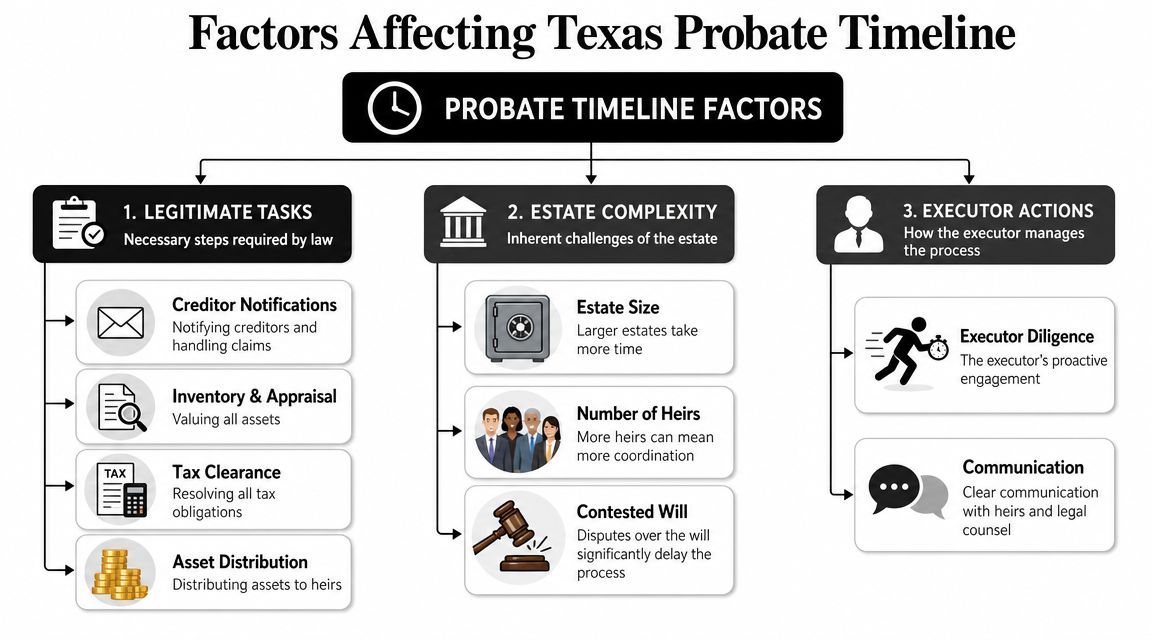
The biggest mistake families make is assuming delay means misconduct. Sometimes it does. Often, it doesn't. Probate takes time because the executor has to clear the runway before anyone can safely receive money.
If you want a useful overview of the mechanics, it helps to understand how an estate bank account works during Texas probate, because that account often becomes the holding place for estate cash while administration is underway.
Creditor claims come first
One reason executors hold funds is simple. They can't responsibly distribute money before they know what claims may come in.
After notice is provided, creditors generally have a 4 month window to file claims against the estate in Texas, and valid claims must be evaluated and paid before beneficiaries receive their shares, as explained in this discussion of post-probate fund distribution timing in Texas.
That waiting period frustrates families, but it serves a practical purpose. If the executor distributes too much too early and later bills appear, the estate may not have enough cash to cover them.
Some assets slow everything down
Not all wealth is liquid. A house can't be split by pressing a button. Mineral interests, business ownership, vehicles, brokerage accounts, personal property, and refunds all create different timing issues.
Common causes of delay include:
- Real estate that must be maintained or sold. The executor may need to secure the property, gather documents, and coordinate a sale before there is cash to distribute.
- Assets that need valuation. Some property has to be identified and appraised before the executor can know what the estate holds.
- Accounts that require paperwork from institutions. Financial companies often need letters testamentary and other documentation before they will release funds.
An executor who distributes too quickly can create more trouble than one who moves carefully.
Taxes, paperwork, and family conflict
Taxes don't always stop distribution, but unresolved tax issues can justify holding money in reserve. The same is true when records are incomplete or a dispute breaks out between heirs.
A practical way to evaluate the delay is to ask whether the executor is dealing with one of these real tasks:
- Collecting and organizing estate records
- Reviewing debts and claims
- Managing or selling property
- Preparing final paperwork and distribution calculations
- Handling objections, disagreements, or court-related issues
If the answer is yes, holding funds may be reasonable. If the answer is no, concern becomes more justified. Families should expect progress, not perfection. But they should still expect progress.
A Realistic Timeline for Estate Fund Distribution in Texas
A family often calls after four or five months and asks the same question: “How long can the executor keep holding the money?” The hard part is that Texas law usually does not give them a single date to circle on the calendar. What it does give them is a series of checkpoints. Those checkpoints create a practical timeline, and they make it harder for an executor to delay distribution without a real reason.
For a broader view of the probate process itself, see this overview of how long probate usually takes in Texas.
A practical timeline, not a fixed deadline
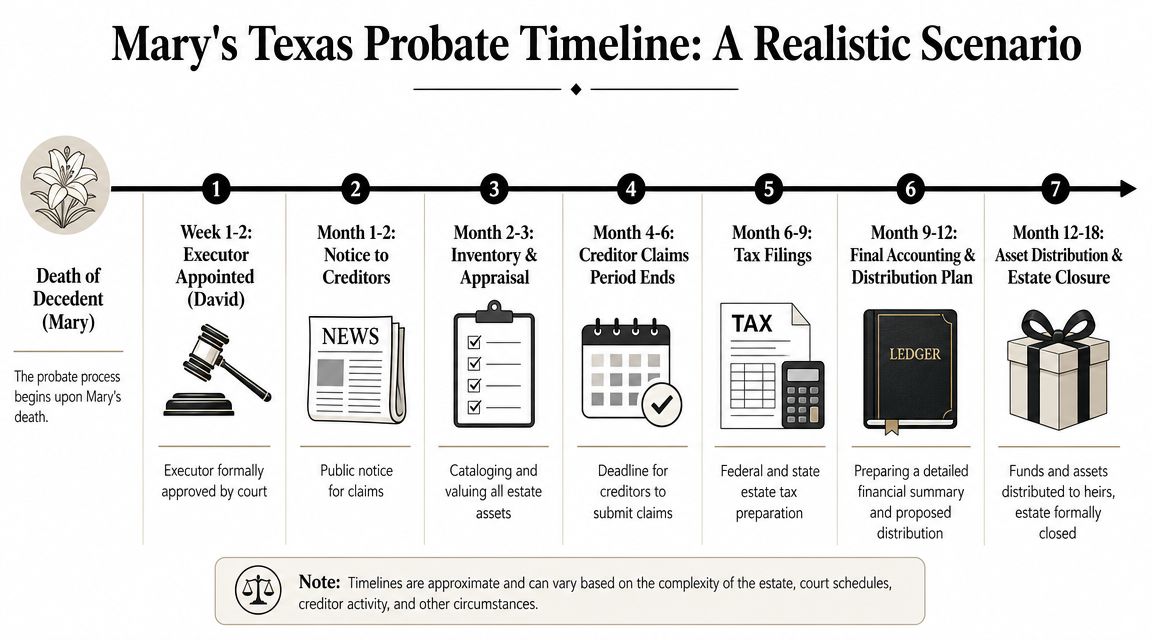
Take a common Texas estate. A mother dies with a will. Her son is named executor. There is a house, a bank account, a car, and personal property. No lawsuit. No unusual business interests. Even then, distribution usually happens in stages, not all at once.
The first stage is getting authority from the court and putting the estate on stable footing. The executor files the probate case, qualifies, gets letters testamentary, opens an estate account, and starts collecting information. Money often should not go out yet because the executor is still figuring out what exists, what is owed, and what needs immediate attention.
Then comes the period that creates the first real soft deadline. Creditors must receive notice, and the executor needs time to see what claims appear and whether they are legitimate. An executor who pays heirs before this work is done can end up having to chase money back or cover a shortfall personally.
Here is the sequence families usually see:
| Stage | What usually happens |
|---|---|
| Opening the estate | Probate is filed, the executor is appointed, and estate accounts and records are gathered |
| Early administration | Assets are identified, property is secured, mail and account statements are reviewed |
| Creditor and claim period | Required notices go out, claims are evaluated, and reserves may be held back |
| Administration and cleanup | Property may be sold, bills are paid, tax issues are addressed, and final numbers are prepared |
| Distribution | The executor calculates shares, keeps a reasonable reserve if needed, and distributes the balance |
What families can usually expect
In a smoother estate, partial progress often happens before the estate is fully closed. For example, the executor may collect cash, pay routine expenses, and wait to distribute until the creditor window has passed and the numbers are reliable. If a house must be cleaned out, repaired, or sold, the timeline stretches because the estate may be asset-rich but cash-poor.
That is why “the executor is still holding funds” does not answer the essential question. The better question is whether the executor is holding funds for a defined administration reason tied to the current stage of the case.
A reasonable timeline usually has visible movement. Court appointment happens. Notices go out. Assets are collected. Claims are reviewed. Property issues are handled. A final accounting or at least a clear summary starts to take shape. If those things are happening, delay may be frustrating but justified.
If months pass and none of those benchmarks are clear, concern becomes more reasonable.
Mary's estate as a working example
Suppose Mary's executor, David, gets appointed and quickly gathers her bank funds. He still may need to wait before making final distributions. A credit card company may submit a claim. The house may need insurance, utilities, yard care, and a sale. Personal property may need to be sorted before the home can be listed. Until those items are resolved, David may need to keep enough cash in the estate to cover them.
That is the practical side of probate that many families do not see. The estate account is not a family checking account with a temporary manager. It is more like a settlement pot. The executor has to know what must be paid before he can know what is safe to distribute.
The right way to judge a delay
A delay usually looks reasonable when the executor can answer three questions clearly:
- What has already been done?
- What still needs to be finished before distribution?
- Why is the current reserve amount necessary?
Those answers matter more than the calendar alone. A simple estate can still take months. A slow executor with no explanation is a different problem. The law gives executors room to act carefully, but not room to hold money indefinitely without being able to justify it.
The Executor's Fiduciary Duty and Potential Liability
An executor is not just a helper with access to the estate account. The executor is a fiduciary. In plain English, that means the law requires the executor to act with a high duty of honesty, care, and loyalty to the estate and its beneficiaries.

This duty is what keeps “no fixed deadline” from turning into “no accountability.” An executor can't withhold money because a beneficiary is difficult, because family relationships are strained, or because the executor doesn't feel like finishing the work.
What fiduciary duty requires
Texas probate guidance explains that an executor's fiduciary duty requires them to preserve assets and maintain records, and if an estate is holding funds well past the first year, the executor should be able to justify the delay with legitimate administration tasks. It also notes that holding funds longer than necessary increases personal fiduciary exposure. You can read that in the Texas State Law Library probate guide for estate executors.
That translates into practical duties such as:
- Keep estate money separate
- Track income and expenses
- Avoid self-dealing
- Communicate enough that beneficiaries understand the status
- Distribute once it is legally safe to do so
What happens when the delay isn't reasonable
When an executor stops communicating or can't explain why funds remain undistributed, legal risk grows. Beneficiaries may seek court involvement. In some cases, they may ask the court to require an accounting, challenge improper conduct, or seek removal of the executor.
If you're trying to assess whether the line has been crossed, this discussion of whether an executor can withhold money from beneficiaries in Texas is a useful starting point.
Silence is rarely neutral in probate. When records are thin and updates stop, suspicion grows quickly.
A simple way to judge the executor's conduct
Ask two questions.
First, is there a real estate-administration reason for holding the funds? Second, can the executor show records that support that reason?
If both answers are yes, the delay may be proper. If both answers are no, the issue may no longer be ordinary probate timing. It may be a fiduciary problem.
Key Takeaways for Heirs and Executors
Most conflict around estate money comes from uncertainty, not law. One person thinks the executor is stalling. The executor thinks the family is being unreasonable. A better approach is to focus on what can be checked, documented, and explained.

Key insight
Texas probate has no single distribution deadline, but it does have practical guardrails. The executor gets time to do the job correctly. The family gets the right to expect movement, records, and an explanation for delay.
For executors and heirs alike, these are the points that matter most:
- For executors, document the reason for every delay. If funds are still being held, you should be able to point to a pending task such as asset review, debt resolution, property issues, or final calculations.
- For heirs, ask focused questions. Instead of “Why is this taking so long?” ask “What remains to be done before distribution can happen?”
- Communication reduces conflict. Informal updates often prevent the kind of mistrust that turns into probate litigation.
- Not every delay is suspicious. Property sales, missing paperwork, debt review, and family disputes can all slow the process.
- Indefinite delay is different from reasonable delay. If there is no explanation, no recordkeeping, and no visible progress, concern is justified.
A practical family checklist
Use this short checklist if you're trying to evaluate where things stand:
- Has the executor identified the main estate assets?
- Is there a clear explanation for why money is still being held?
- Are estate expenses, claims, or property issues still unresolved?
- Has the executor given any written summary or update?
- If the administration has stretched on, is there a documented reason for it?
This is also the point where outside help can be useful. Families sometimes work with a probate attorney, a CPA, a realtor handling estate property, or a firm such as Law Office of Bryan Fagan, PLLC when the process becomes difficult to manage without guidance.
When to Consult a Texas Probate Attorney
Some probate delays are normal. Some are warning signs. Knowing the difference can save a family a great deal of stress.
For executors
An executor should speak with a Texas probate attorney when the estate includes problems that are hard to solve alone. Examples include unclear debts, real estate that is difficult to sell, beneficiaries who are already fighting, or records that don't make sense. Legal advice is also useful when a vulnerable heir may need added protection, which can overlap with planning concerns addressed in Texas guardianship matters.
An attorney can help the executor stay organized, avoid personal liability, and decide when funds can be distributed safely. That kind of guidance often prevents mistakes made out of pressure or confusion.
For heirs and beneficiaries
A beneficiary should consider legal help when the executor goes quiet, refuses to answer basic questions, appears to be using estate property for personal benefit, or keeps funds tied up without a concrete explanation. The issue is not just that probate feels slow. The issue is whether the executor can justify the delay with actual estate work.
A consultation is also wise when family communication has broken down so badly that every update turns into an argument. Probate disputes often get worse when everyone waits too long to ask for clarity.
If you cannot tell whether a delay is ordinary administration or something more serious, that uncertainty alone is a good reason to get legal advice.
The goal is clarity, not conflict
Meeting with a probate lawyer doesn't have to mean a lawsuit is coming. Often, it means getting a timeline, a checklist, and a realistic assessment of what should happen next. That is especially helpful in matters involving Texas probate litigation concerns or estates with multiple heirs and complicated assets.
If you're facing probate in Texas, our team can help guide you through every step, from filing to final distribution. Schedule your free consultation today.
If you're facing probate in Texas, our team can help guide you through every step, from filing to final distribution. Schedule your free consultation today with Law Office of Bryan Fagan, PLLC.