When a loved one's will just doesn't sit right—when it feels like it wasn't truly their voice—it can be an incredibly painful and confusing time. You are not just grieving a loss; you are also facing a document that may not honor their final wishes. Challenging a will in Texas, however, takes more than just a gut feeling. It requires a formal legal objection filed in probate court, built on specific legal grounds and backed by solid evidence needed to contest a will.
This guide will walk you through this difficult process in plain English, helping you understand what to expect and what you’ll need to build a strong case.
Understanding the Grounds for a Will Contest in Texas
When you're grieving, the last thing you want is a legal fight. But Texas law provides clear pathways to make sure a loved one's true final wishes are honored. A will contest isn't about disagreeing with who got what; it's about proving the will itself is fundamentally flawed and legally invalid.
Under the Texas Estates Code, you can formally challenge a will for four primary reasons. Getting a firm grip on these grounds is the first critical step. Each one demands a different type of proof, so figuring out which one fits your situation is essential to moving forward.
The Four Legal Reasons to Challenge a Will
Texas law is very specific about the circumstances that can invalidate a will. Let's break down these complex terms into simple explanations.
-
Lack of Testamentary Capacity: This is a legal way of saying the person who made the will (the testator) wasn't of sound mind when they signed it. Perhaps they didn't understand they were signing a will, had no real grasp of the property they owned, or couldn't even recognize their closest family members. This can be due to conditions like dementia, Alzheimer's, or severe medication side effects.
-
Undue Influence: This happens when someone is manipulated, coerced, or pressured into creating or changing their will. The influencer's own desires overpower the testator's free will, turning the document into a reflection of the manipulator's greed, not the deceased's intentions.
-
Improper Execution: Texas has very strict rules about how a will must be signed and witnessed. If these legal formalities weren't followed—for instance, if there weren't two credible witnesses who signed in the testator’s presence—the will can be thrown out.
-
Fraud or Forgery: This is about outright deception. It could involve tricking the testator into signing a document they think is something else entirely, or it could be as blatant as a forged signature.
For a deeper dive into each of these legal arguments, you can explore the primary grounds for contesting a will in Texas.
To get you started, the table below gives a quick snapshot of these grounds and the kind of initial evidence you'd typically start looking for.
Summary of Texas Will Contest Grounds and Initial Evidence
This table outlines the legal reasons to challenge a will in Texas probate court and the typical starting evidence required for each claim.
| Legal Ground for Contest | Plain-English Explanation | Initial Evidence to Look For |
|---|---|---|
| Lack of Testamentary Capacity | The person was not of sound mind when they signed the will. | Medical records showing cognitive decline, witness statements about confusion, prescription lists. |
| Undue Influence | Someone pressured or forced the person to change their will. | Emails or texts showing manipulation, testimony about isolation from family, suspicious financial transactions. |
| Improper Execution | The will was not signed or witnessed correctly according to Texas law. | Testimony from the witnesses themselves, irregularities on the signature page, lack of a self-proving affidavit. |
| Fraud or Forgery | The signature is fake or the person was tricked into signing. | Handwriting analysis from an expert, testimony about the signing event, different versions of the will. |
Think of this as your starting point. Each piece of evidence helps build a picture for the court, telling a story that the will on paper might be trying to hide.
The Four Pillars for Contesting a Texas Will
If you’re thinking about challenging a will in Texas, your case needs to be built on solid legal ground. You can’t simply contest a will because you feel the outcome is unfair. Instead, your argument must rest on one of four specific legal foundations, or "pillars."
Think of these pillars as the only legitimate reasons the court will consider for invalidating a will. Understanding them is the first step in figuring out if you have a case and what kind of evidence you’ll need to start gathering. While every family's situation is different, nearly every successful will contest traces back to one of these core issues.

Pillar 1: Lack of Testamentary Capacity
This is, by far, the most common reason wills are challenged. In plain English, testamentary capacity means the person signing the will (the "testator") was of "sound mind" at the exact moment the pen hit the paper.
The Texas Estates Code, Section 251.001, is clear: a person must be of sound mind to make a valid will. This doesn't mean they needed to be in perfect physical health or have a flawless memory. It simply means they had to grasp a few fundamental concepts:
- They understood they were signing a will to distribute their property after they died.
- They had a general idea of what property they owned.
- They knew who their closest family members were, like their spouse and children.
The key question is always about the testator's mental state at the time of signing.
Realistic Scenario
Maria's 85-year-old father, David, signed a new will just weeks before his passing, leaving his entire estate to a caregiver he had only known for two months. For years, his previous will had left everything to Maria and her brother. Maria has medical records from her father's neurologist diagnosing him with advanced dementia six months prior. His doctor’s notes consistently describe David as confused and disoriented, providing strong evidence he lacked the necessary capacity to understand the new will.
Pillar 2: Undue Influence
Think of undue influence as a puppeteer pulling the strings. It happens when someone in a position of trust—a caregiver, a new friend, or even a family member—uses their power to manipulate the testator. Their influence is so strong that it overpowers the testator's own free will, resulting in a document that reflects the manipulator’s wishes, not the testator's.
This is more than just giving advice or making a suggestion. Undue influence is about coercion and pressure so intense that the will becomes a product of manipulation. In fact, claims of undue influence and lack of capacity are the two most frequent grounds for will contests, making up about 75% of cases. You can find more insights on will contest statistics on Wikipedia.
A court will look for red flags of manipulation, such as:
- Isolating the testator from family and longtime friends.
- A will that makes an "unnatural" distribution (like disinheriting children in favor of a new acquaintance).
- The influencer was directly involved in getting the new will prepared or signed.
Realistic Scenario
Robert’s uncle, Frank, had always been close to his nieces and nephews. After Frank suffered a stroke, a neighbor began managing all his finances and care. The neighbor prevented family from visiting, telling them Frank was "too tired." After Frank's death, a new will surfaced leaving the entire estate to the neighbor. This isolation, combined with Frank’s vulnerability after his stroke, points directly to undue influence.
Pillar 3: Fraud or Forgery
Fraud and forgery are all about intentional deception. A will contest built on this pillar argues that the document was either created through trickery or is an outright fake.
Fraud can be subtle. For example, someone might tell an elderly person they are signing a power of attorney or a healthcare directive when it's actually a will. Forgery is more direct—it means the signature on the will isn't the testator's at all. Proving these claims often comes down to objective evidence, like the testimony of a handwriting expert who can show the signature is a fake.
Pillar 4: Improper Execution
Texas law has very specific, non-negotiable rules for how a will must be signed and witnessed to be legally valid. These aren't just suggestions; they are strict formalities designed to prevent fraud and confirm the testator's final wishes are clear.
Under the Texas Estates Code, Section 251.051, a standard will must be:
- In writing.
- Signed by the testator (or another person signing on their behalf, in their presence, and under their direction).
- Attested to by two credible witnesses, who are at least 14 years old and who sign the will in the testator's presence.
If any of these steps were botched, the will is invalid. For instance, if the two witnesses signed the document at their own homes a week after the testator signed it, the will was not properly executed and can be thrown out. Consulting an attorney about Wills & Trusts can help avoid these simple but fatal mistakes.
Knowing these four pillars is the crucial first step. It helps you determine if your suspicions are legally valid and points you toward the kind of evidence you’ll need to build a strong case.
How to Gather Evidence for Your Will Contest
Winning a will contest isn't about feelings or suspicions. While your gut might be screaming that something is wrong, a probate court runs on one thing: proof. You need cold, hard evidence that shows one of the four legal grounds for a contest actually happened.
Think of it less like an argument and more like building a case, piece by piece. Your job is to uncover the facts that tell the real story behind how the will was created. Let's walk through the types of evidence you'll need to find and where to look for it.
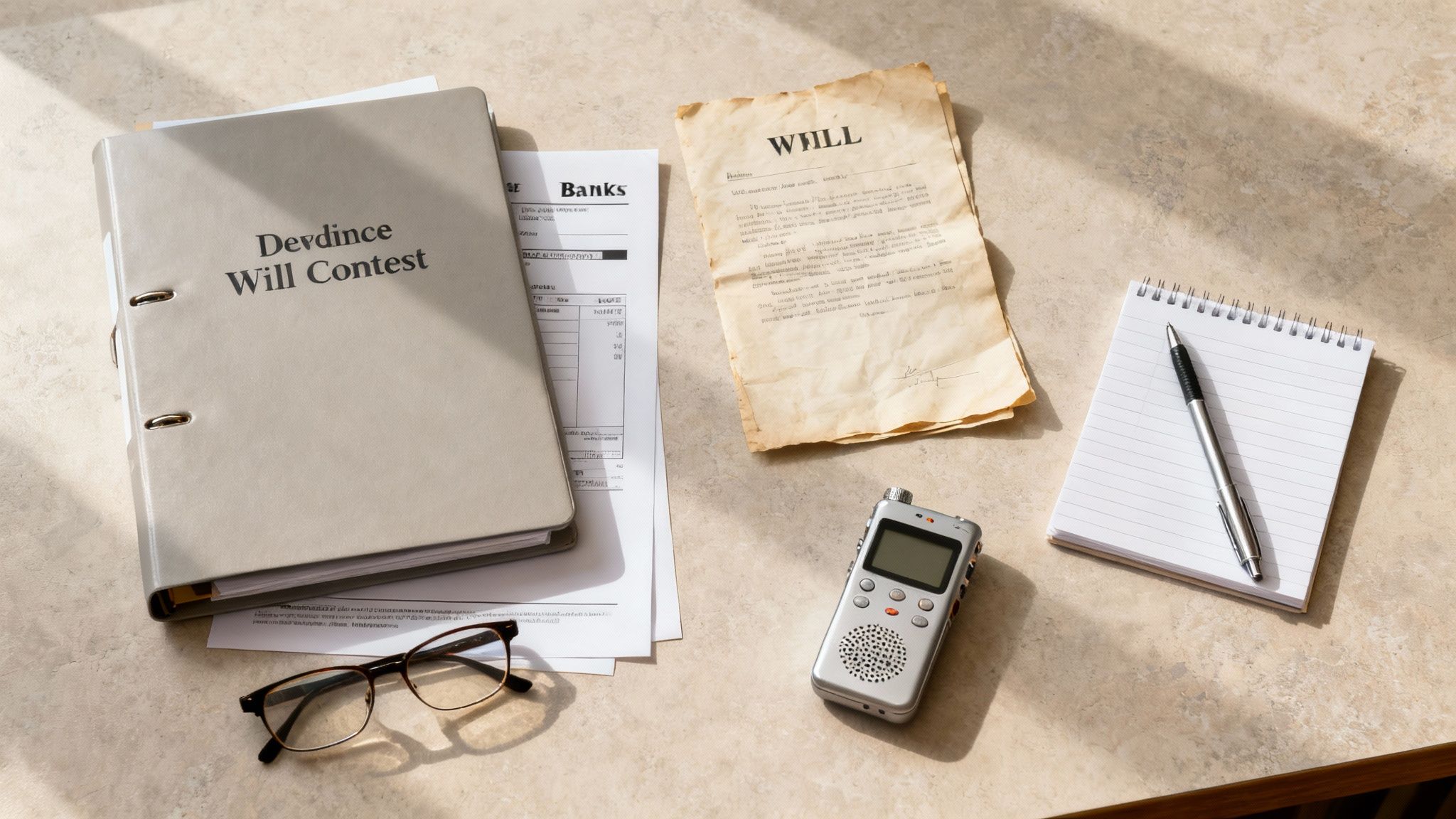
The Paper Trail: Documentary Evidence
Documents are the backbone of any will contest. Why? Because they're objective. They provide a timeline and a factual record that's tough to argue with. This paper trail can reveal everything from the testator's state of mind to suspicious activity around the time the will was signed.
Here’s where to start digging:
- Medical Records: These are absolutely essential for claims about mental capacity. You need to get records from primary care doctors, specialists like neurologists, hospitals, and pharmacies. Look for diagnoses like dementia or Alzheimer's, but also pay attention to doctor's notes mentioning confusion, delirium, or the side effects of medications.
- Financial Statements: Follow the money. Bank and credit card statements can expose unusual patterns, like large, sudden withdrawals or transfers to someone who just appeared in the testator's life.
- Prior Wills and Estate Plans: A history of previous wills often shows a consistent plan. If a new will suddenly appears that completely upends years of established wishes—especially to benefit one person—that’s a huge red flag for the court.
- Personal Communications: Don't overlook emails, text messages, and old-fashioned letters. These can be a goldmine of information, showing the testator's true feelings or documenting a manipulator's behavior.
As you collect these items, having a solid grasp of all key estate planning documents will help you spot what’s out of place or missing.
The Human Element: Witness Testimony
Documents tell you what happened, but witnesses can tell the court why. Their stories provide the context, emotion, and human element that pieces the narrative together. Testimony can transform a dry collection of facts into a compelling story of what really occurred.
Who should you talk to? Think about who saw the testator regularly around the time the will was made.
- Family Members and Close Friends: They knew the testator's personality, their long-held promises, and can speak to any strange changes in their behavior or mental sharpness.
- Caregivers and Medical Staff: Nurses, home health aides, and doctors are invaluable. They have firsthand, professional observations of the testator's day-to-day cognitive function and health.
- Neighbors and Friends: These people can often testify about patterns of isolation. Did a new person suddenly start controlling who could visit?
- The Drafting Attorney: This is a crucial witness. Did they meet with the testator alone? Did the testator seem to fully understand the document they were signing?
The Professional Analysis: Expert Opinions
Some evidence is too complex for a judge or jury to interpret on their own. That’s where expert witnesses come in. They can analyze technical information and offer a credible, objective opinion that gives your claim serious weight.
Two types of experts are common in will contests:
- Medical Experts: A doctor, typically a geriatrician or neurologist, can review all the medical records you’ve gathered. They can then offer a professional opinion on whether the testator likely had the required mental capacity on the day the will was signed.
- Handwriting Analysts: If you suspect forgery, a forensic document examiner is your best bet. They will compare the signature on the contested will to other known, authentic signature samples to determine if it’s a fake.
An expert's report can turn your suspicion into a powerful piece of court-admissible evidence. You can find more on the types of proof used in our guide on the key documents you'll need in Texas probate.
The Big Picture: Patterns of Conduct
Finally, remember that some of the most compelling evidence isn't a single item but a pattern of behavior. This is especially true for undue influence claims, which are often built on a series of subtle actions over time. You need to document any behaviors that show a manipulator was taking control, such as isolation, creating dependency, or controlling information.
Understanding the Burden of Proof in Probate Court
When you decide to challenge a will, your journey through the legal system involves more than just showing up with a stack of evidence. This is where a concept called the burden of proof comes into play. It might sound like dense legal jargon, but the idea is actually quite simple: whoever makes a claim is responsible for proving it.
In a will contest, you are the one making the claim—so you're the one who has to prove it. The executor or the will's beneficiaries don't have to prove the will is legitimate at the start. That responsibility falls squarely on your shoulders.
What is Preponderance of the Evidence?
In most Texas will contests, the legal standard you have to meet is called “preponderance of the evidence.” This is the same standard used in most civil cases, and it basically means you have to show that your claim is more likely to be true than not true.
Think of the scales of justice. To win, you need to pile enough credible evidence on your side to make those scales tip, even if it's just a little. A 51% certainty is all it takes to convince the court that your version of events is the more believable one.
When a Higher Standard of Proof Applies
However, allegations like lack of testamentary capacity or undue influence often demand a more substantial level of proof. Contestants may need to provide clear and convincing evidence—a tougher standard than the one will proponents face—to prove the testator was mentally incapacitated or coerced.
This evidentiary hurdle is a big reason why many will contests fail unless there's powerful proof, like medical records diagnosing dementia around the time of the signing or firsthand witness testimony describing manipulation. You can learn more about the common challenges in will contests on Wikipedia.
Realistic Scenario
Imagine you're contesting your uncle’s will, arguing his neighbor used undue influence. You present evidence showing the neighbor isolated him, took over his finances, and was present when the new will was signed. The neighbor claims they were just being a good friend. To win, you have to convince the judge it's more than 50% likely that the neighbor’s actions were so manipulative they overrode your uncle’s own free will.
Grasping this concept is crucial because it dictates your entire game plan. Your goal is to weave together a narrative so compelling that it meets the specific legal standard the court requires. This is a fundamental piece of any successful probate litigation strategy.
The Timeline and Process for a Texas Will Contest
Dealing with the court system after losing a loved one is overwhelming. But when you also suspect the will is invalid, the thought of a legal challenge can feel like an impossible burden. Let's walk through the actual roadmap of a will contest to demystify the process and help you prepare for what’s ahead.
It all starts with a ticking clock. Under the Texas Estates Code, you generally have just two years from the date the will is officially admitted to probate to file your contest. If you miss this window, the door to challenging the will could be permanently shut.
Step 1: Filing the Lawsuit
The first real step is filing a lawsuit. Your attorney will draft a formal petition and file it with the probate court. This document clearly lays out the legal grounds for your contest (like undue influence or lack of capacity) and summarizes the basic facts supporting your claim. It’s the official notice to the court and the estate's executor that a challenge has begun.
Step 2: Discovery and Evidence Exchange
Once that petition is filed, the case moves into a crucial phase called discovery. This is where both sides formally exchange information and evidence. Think of it as the fact-finding mission of the lawsuit. It involves depositions (sworn testimony given outside of court), written questions, and requests for key documents like medical and financial records.
This infographic gives you a bird's-eye view of how a contestant's claim is weighed in court.
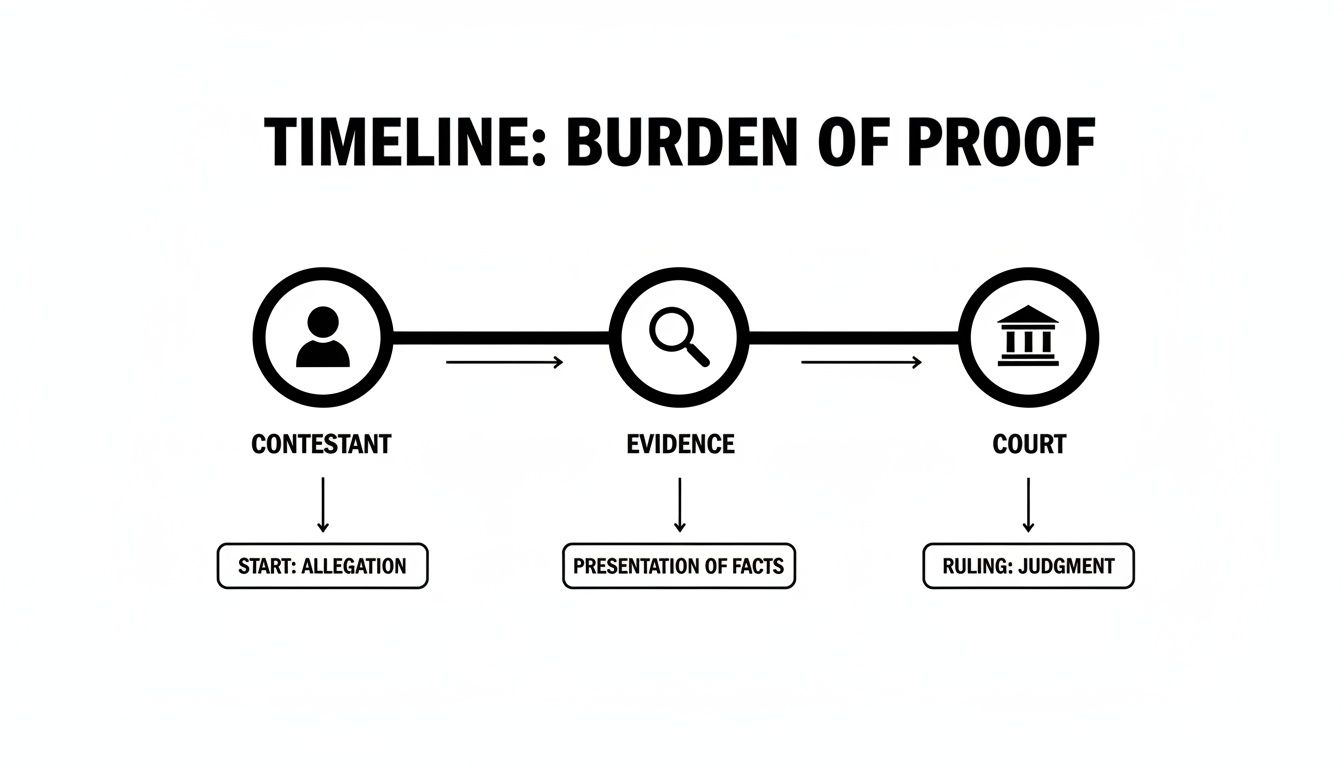
As you can see, the path from making an allegation to getting a final court decision is paved entirely with the strength and quality of the proof you can present.
Step 3: Mediation and Settlement
Here’s something most people don't realize: the vast majority of will contests never actually see the inside of a courtroom. As the discovery process unfolds, the strengths and weaknesses of each side's case become crystal clear. Many Texas courts will require the parties to attend mediation—a confidential meeting where a neutral third party helps guide the conversation toward a resolution.
This is where your evidence truly flexes its muscles. A well-documented, compelling case can create enough pressure to bring the other side to the negotiating table, making a fair settlement far more likely than a risky, expensive trial.
Step 4: Trial
If mediation doesn't work out, the case will head to trial. There, a judge or jury will hear all the evidence and make a final, binding decision. To get a better feel for the broader legal framework, a practical guide on how to settle an estate, including probate can be incredibly helpful.
Knowing these steps from the outset can take away some of the fear and uncertainty, allowing you to focus on what matters most: building the strongest case possible.
Key Insights for Contesting a Will with Confidence
Dealing with the loss of a loved one is a painful journey. When the will they leave behind feels fundamentally wrong—like it doesn't reflect who they were or what they wanted—that journey becomes infinitely more complex. Contesting a will is a major legal undertaking that hinges entirely on specific, credible proof. It’s a situation where raw emotion must be backed up by hard facts.
The core message is simple: your challenge will stand or fall based on the strength of the evidence needed to contest a will. Without solid proof, even the most legitimate concerns won't stand a chance in probate court.
Your Path Forward
As you think about what to do next, keep these critical points at the forefront.
- Act with Urgency: Texas law is unforgiving when it comes to deadlines. Generally, you have just two years from the date a will is officially admitted to probate to file a contest. Moving quickly is essential.
- Focus on the Four Grounds: Your case must align with lack of testamentary capacity, undue influence, improper execution, or fraud. A feeling that the will is "unfair" is not enough.
- Evidence is Everything: Your most powerful allies are documents like medical records and financial statements, combined with compelling witness testimony and expert opinions. Start gathering any potential proof right now.
- Professional Guidance is Key: The legal maze of a will contest is incredibly complex. Partnering with an experienced probate litigation attorney gives you the best possible shot at success.
Takeaway
Undue influence is rarely proven with a single "smoking gun." Instead, it is established by showing a consistent pattern of coercive control that overcame the testator's free will. The court looks at the entire situation to see if coercion is the only reasonable explanation for the will's terms. Understanding the kinds of evidence required is your first and most powerful step toward protecting your loved one’s legacy.
Challenging a will is about more than a legal fight; it's about ensuring a final chapter is written correctly. While the road ahead can feel overwhelming, understanding issues like who pays legal costs when contesting a will can help you plan. With the right evidence and a compassionate legal team, you can seek the justice your family deserves.
If you’re facing probate in Texas, our team can help guide you through every step — from filing to final distribution. Schedule your free consultation today.
A Few Common Questions About Texas Will Contests
The decision to challenge a will is never made lightly. It’s natural to have a lot of practical questions. Let’s tackle some of the most common ones we hear from families in your shoes.
How Much Does It Cost To Contest a Will in Texas?
This is one of the first questions on everyone's mind, and the honest answer is: it depends on the complexity of the case. Many probate litigation attorneys, including our firm, will handle these cases on a contingency fee basis. This means you don’t pay any attorney's fees unless we successfully recover assets on your behalf. Other cases might be handled at an hourly rate, but we ensure all options and costs are transparent from our very first conversation.
Can I Contest a Will if I Was Left Out?
Yes, but only if you have what the courts call "standing." Think of it as your legal ticket to enter the courtroom.
The Texas Estates Code defines standing as being an "interested person" with a direct financial stake in the will. Generally, you have standing if you are:
- A beneficiary named in the current will.
- A beneficiary named in a previous, valid will.
- An heir who would inherit under Texas law if there were no will at all (this is called intestate succession).
If you don't fit into one of these groups, you likely don't have the legal footing to contest the will, no matter how close you were to the person who passed away.
What Happens if a Will Is Successfully Contested?
When a court declares a will invalid, it's legally treated as if it never existed. What happens next depends on the circumstances:
- A Prior Will Is Revived: If there's an older, valid will, the court will often bring it back to life. The estate’s assets will then be divided according to the instructions in that earlier will.
- The Estate Becomes "Intestate": If there isn’t another valid will, the estate is distributed according to Texas's intestacy laws. These laws have a strict, predetermined order for how assets pass to surviving relatives, usually starting with the spouse and children.
Successfully challenging a will is a high-stakes endeavor that requires compelling evidence and a solid grasp of the Texas Probate Process. Our team has walked this path with many families, and we know what it takes to navigate every step with compassion and skill.
If you’re facing probate in Texas, our team can help guide you through every step — from filing to final distribution. Schedule your free consultation today with the Law Office of Bryan Fagan, PLLC at https://www.txprobatelawyer.net.