Skip to content
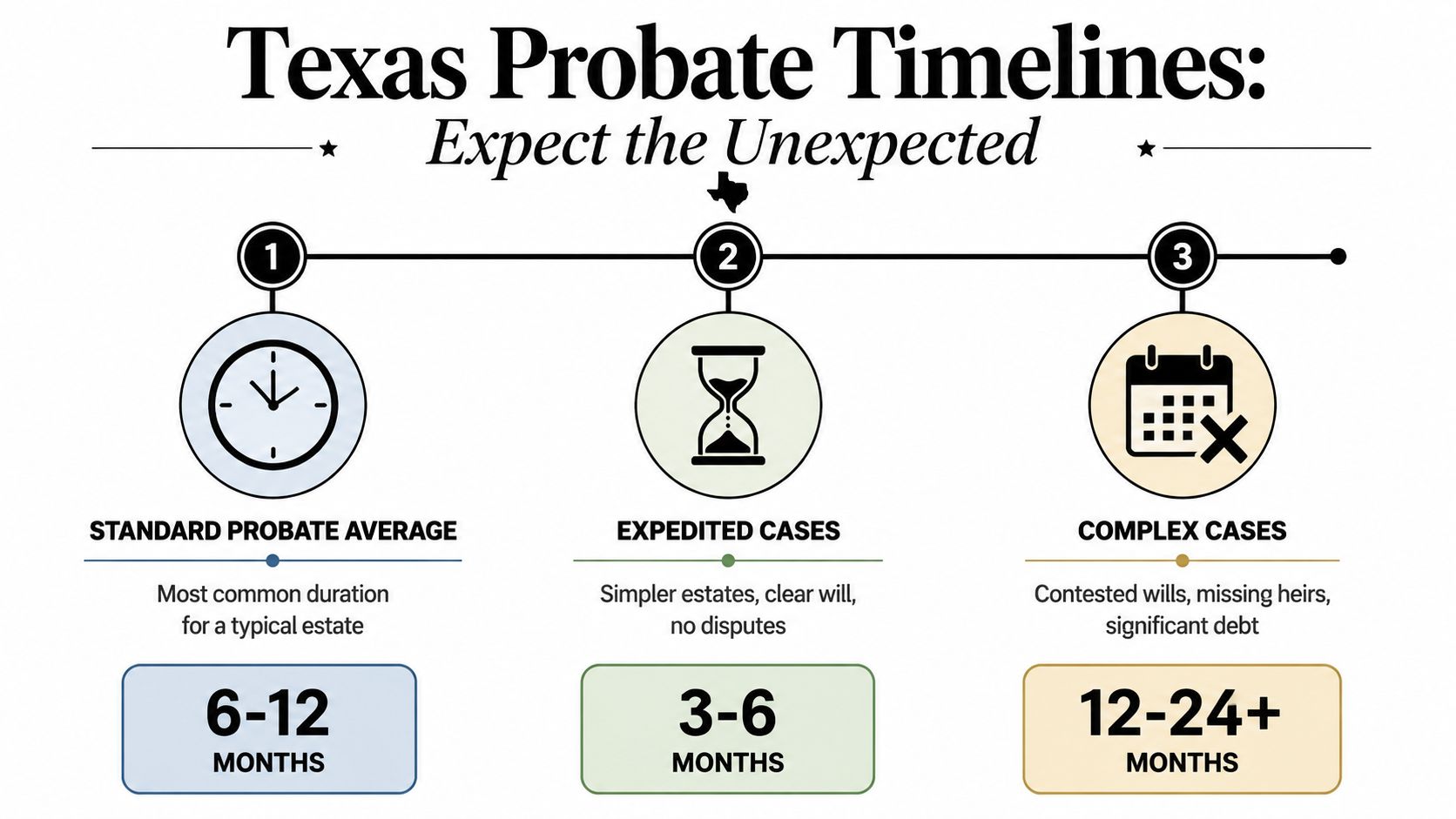
Probate in Texas usually takes 6 to 12 months for a standard estate, but the range is much wider. Some estates move in 2 to 4 weeks through a Small Estate Affidavit, some close in 30 to 60 days through Muniment of Title, and complex or contested matters can last 12 to 24 months or longer.
If you're reading this after losing a parent, spouse, or other close family member, you're probably trying to answer a very practical question while carrying a lot of grief: how long is this going to take, and what do I need to do right now? That uncertainty is normal. Probate has a reputation for being confusing because people talk about it as if it's one single process, when Texas law offers several different paths.
For many families, the timeline depends less on the size of the estate and more on the route the estate has to take. A court-supervised administration moves differently than an independent one. A debt-free estate with real property may qualify for a faster shortcut. A missed filing deadline can turn a manageable case into a much harder one.
Texas Estates Code Titles 2 and 3 govern much of this process, including estate administration, probate of wills, creditor issues, and related procedures. The code can feel technical on paper, but the day-to-day experience is simpler: file the right case, get the right authority from the court, protect the estate, address debts and claims, and then transfer what's left to the right people.
The Short Answer and The Real Answer to Probate Timelines
The short answer is the one most families hear first: formal probate in Texas commonly takes 6 to 12 months. That baseline is supported by this Texas probate timeline discussion, which also notes that Texas is often faster than many other states.
"How long does probate take in Texas" depends on which legal path applies to your family. That's why two estates with similar dollar value can finish on very different schedules. One may qualify for a simplified process with limited court involvement. Another may require repeated hearings, court approval for routine actions, and extra work to handle disputes.
What usually sets the timeline
Three issues usually control the calendar more than anything else:
- The type of administration: Independent administration usually moves faster because the executor can act without returning to court for routine permission.
- The complexity of the estate: Debts, business interests, unclear records, and real property issues all slow things down.
- Whether anyone is fighting: Will contests, heirship disputes, and arguments over property can extend probate far beyond the average.
A helpful way to think about probate is this: the court isn't just processing paperwork. The court is making sure someone has legal authority to act, creditors get proper notice, assets are identified, and the estate is handled under Texas law.
Practical rule: Don't treat the 6 to 12 month average as a promise. Treat it as a starting point until you know which probate path the estate fits.
Why the average can mislead families
Families often hear "six months to a year" and assume they now know the answer. In practice, that number only helps once you know whether the estate calls for standard probate at all. Some estates don't. Others do, but only after a contested issue or missing document turns a straightforward filing into a supervised matter.
That's why a timeline review early in the case matters. A good first step is understanding the major milestones in a probate start-to-finish timeline in Texas. Once you know the route, the waiting starts to feel less mysterious and more manageable.
A Step-by-Step Walkthrough of the Texas Probate Process
A family often calls after a funeral thinking the hardest part is over, then the bank freezes an account or the title company refuses to transfer the house. Probate is the process that gives someone legal authority to act, and the timing usually makes more sense once you see the sequence.
The first step is gathering the documents the court and executor will need. That usually means the death certificate, the original will if there is one, contact information for heirs and beneficiaries, and a working list of assets, debts, and real property. Once that information is in hand, the estate can move to filing a probate application in Texas in the correct county.
The first court steps
After the application is filed, the court clerk posts notice, and there is a built-in waiting period before the hearing can be held. In an uncontested case, the hearing is often brief, but it still matters. The judge decides whether the will should be admitted to probate and whether the proposed executor or administrator is legally qualified to serve. A general overview of that court process appears in this Texas probate process overview.
If the court approves the application, the executor receives authority to act for the estate, often through Letters Testamentary. That is the document banks, brokerage firms, and title companies usually want to see before they will deal with the executor.
One deadline families miss is the four-year filing rule. In many cases, a will must be offered for probate within four years of death. If that deadline is missed, the estate may lose access to the simpler probate path and be forced into a more limited option, if any option remains available. That single issue can change both cost and timing.
The administration phase usually takes longer than families expect
The hearing is only the beginning. Once appointed, the executor has to give required notices, identify estate property, collect records, review debts, and decide what has to be paid before any distribution is made.
Creditors do not get resolved overnight. In formal administration, known creditors may need direct notice, unsecured creditors have a limited period to present claims after proper notice, and careful executors usually avoid early distributions until they understand what the estate owes. Even in a cooperative family, this part often sets the practical floor for the timeline.
Texas executors also face early post-appointment duties, including notice to beneficiaries and, in many cases, an inventory or an affidavit in lieu of inventory. An Executor's Duties in a Texas Probate is a useful reference for what that job involves.
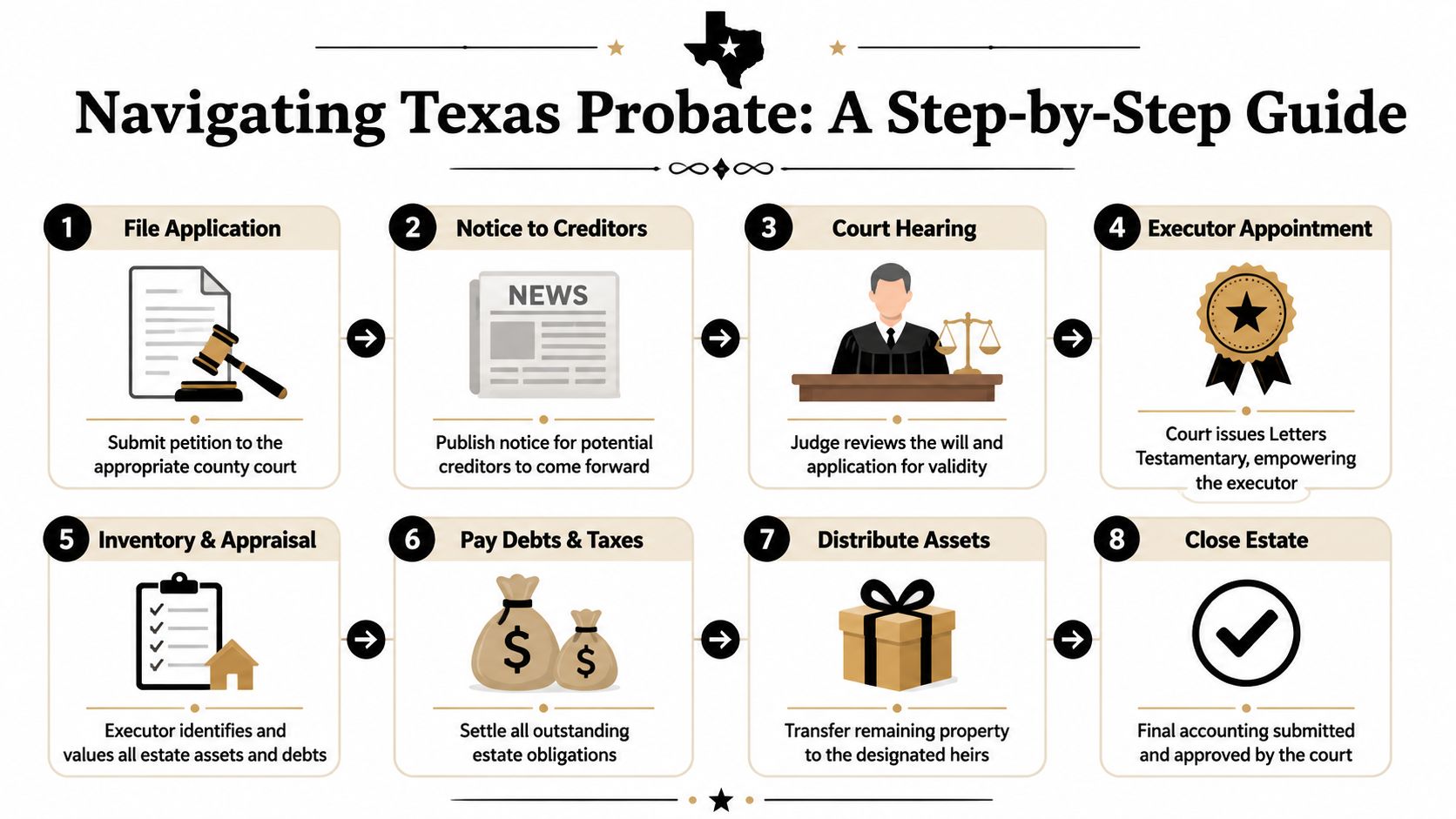
Here is the process in the order families usually experience it:
- Gather core documents such as the death certificate, original will, and basic asset and debt information.
- File the probate application in the proper county.
- Wait through the posting period and attend the hearing.
- Receive court authority to act for the estate.
- Send required notices to beneficiaries, creditors, and other interested parties where the law requires it.
- Identify, secure, and value assets including real estate, bank accounts, vehicles, and personal property.
- Review and handle debts, claims, and expenses before making distributions.
- Transfer remaining property to the people entitled to receive it.
- Complete any closing steps required for that type of administration.
In a clean independent administration, several of these steps can overlap. In a supervised or disputed case, they often happen more slowly and with more court involvement. That difference is why two estates of similar size can finish on very different schedules.
A short video can also help make those stages easier to visualize.
How Different Types of Probate Affect Your Timeline
Two families can walk into the same courthouse in the same week and leave with very different probate calendars. The reason usually is not the estate's dollar value. It is the legal path the estate qualifies for, and whether anyone misses a deadline that changes the available options.
One deadline deserves immediate attention. In many cases, a will needs to be offered for probate within four years of death. Miss that window, and the family may lose access to the simplest route and end up using a more limited procedure, if one is still available. I see families focus on the house, the bank account, or the funeral bill first. The filing deadline can be the issue that matters most.
A side-by-side view
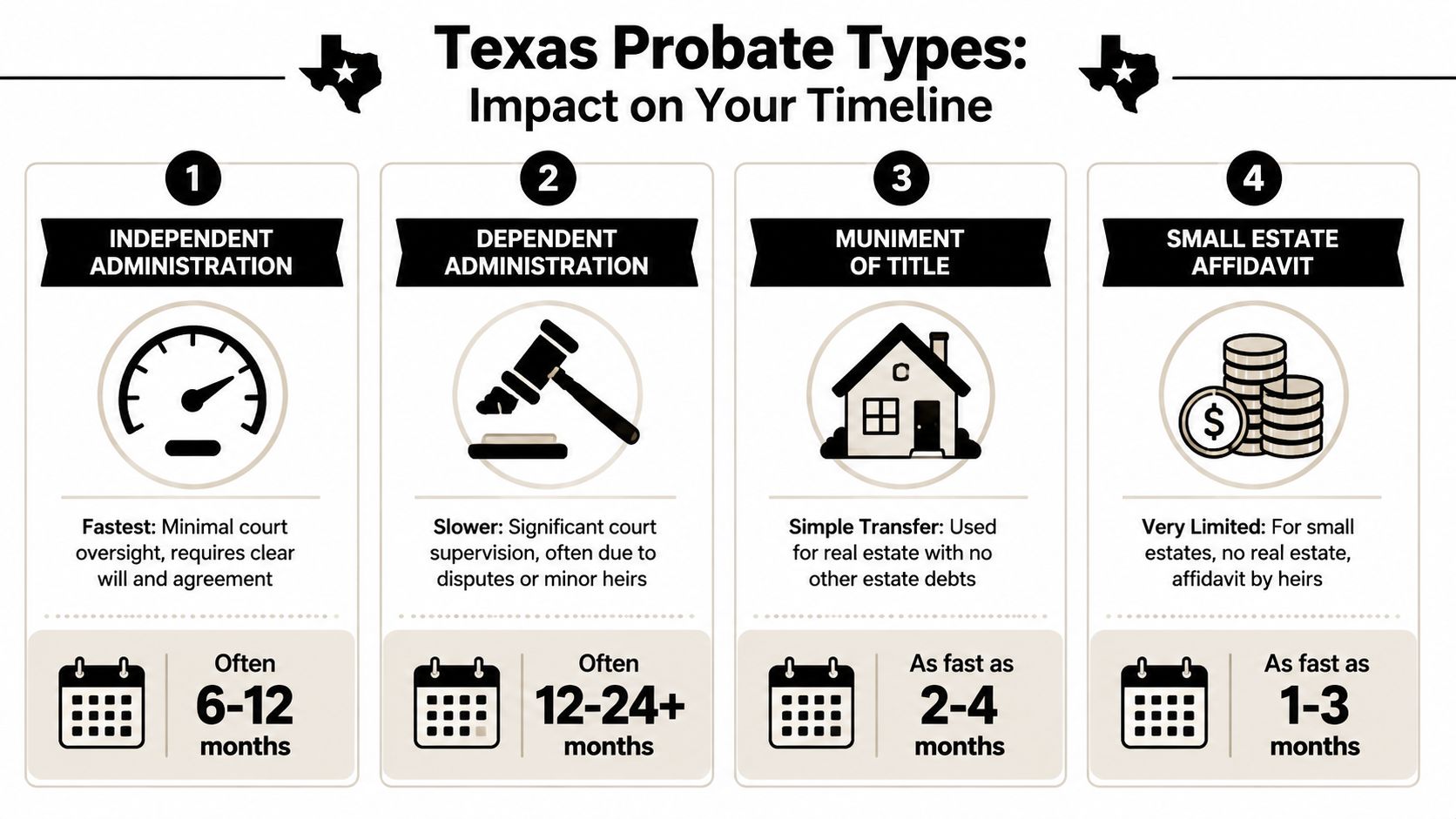
| Probate path | When it usually fits | Typical timing |
|---|---|---|
| Independent Administration | The will authorizes it, or heirs can agree, and the estate does not need close court supervision | Often around 6 months, sometimes longer if asset collection or notices take time |
| Dependent Administration | Heir disputes, creditor problems, minor beneficiaries, or other concerns require repeated court approval | Often 12 to 18+ months |
| Muniment of Title | There is a valid will, no unpaid debts other than liens secured by property, and the main goal is transferring title | Often 30 to 60 days |
| Small Estate Affidavit | The estate meets Texas statutory limits, excludes most real property other than a homestead, and all required heirs can sign | Often measured in weeks, not months, if the paperwork is complete |
Independent administration
This is the path many Texas families hope for, and for good reason. The executor usually gets authority up front and can then handle routine estate work without returning to court for permission each time. That saves time, legal fees, and frustration.
The practical trade-off is responsibility. Independent administration moves faster because the executor has more freedom, but that also means the executor must keep records, give notices, and make careful judgment calls without a judge supervising every step. Families comparing these options can get a clearer sense of the trade-offs in this guide to independent vs. dependent administration in Texas.
Dependent administration
Dependent administration takes longer because court approval often comes in stages. If the personal representative needs to sell property, resolve claims, or distribute funds, the court may need to sign off before the estate can proceed. That creates pauses that do not exist in an independent case.
This route is sometimes necessary. It can protect heirs when there is distrust, conflict, creditor pressure, or a concern that someone may mishandle estate assets. The extra supervision can be worth the time. Families should go into it with realistic expectations about pace.
Muniment of title
Muniment of Title is one of the fastest probate tools in Texas, but it is narrow. It works best when the will is valid, debts are minimal, and the main problem is proving ownership so title to property can pass cleanly.
For example, if a parent died with a house and a will, and there are no unsecured debts to deal with, Muniment of Title may solve the title issue without opening a full administration. In cases involving real property, families often also need accurate valuation records for tax, sale, or reporting purposes. If valuation questions come up, RICS probate assessment services can help document what the property was worth.
Small Estate Affidavit
A Small Estate Affidavit can be faster than formal probate, but only if the estate fits the statute exactly. This strict requirement often leads families to lose time. They hear "small estate" and assume the shortcut applies, then learn the asset mix, debts, heirship issues, or signature requirements prevent approval.
The what-if question matters here. If the estate is modest but includes real property other than a homestead, this option may not work. If all heirs are cooperative and the paperwork is complete, it may move quickly. If one heir cannot be found or asset values are unclear, the shortcut can stall and a different probate path may be necessary.
The right question is not which option sounds fastest. It is which option fits the facts of the estate. That is what determines the timeline.
Key Factors That Can Delay or Expedite Probate
Even after you identify the right probate path, real-world issues still affect the schedule. Some delays come from legal requirements. Others come from paperwork, family dynamics, or asset problems that nobody spots at the start.

What speeds things up
When an estate qualifies for a simpler route, timing improves dramatically. Texas allows alternatives such as the Small Estate Affidavit and Muniment of Title, and this discussion of Texas probate alternatives notes that these options can finish in as little as two months instead of following the standard 6 to 12 month court-supervised path.
Families also move faster when they can quickly gather:
- The original will: Courts and title companies usually need the actual signed document, not a copy.
- A clean asset list: Bank accounts, deeds, vehicle titles, and insurance paperwork reduce guesswork.
- Cooperation among heirs: Agreement doesn't erase legal deadlines, but it often prevents side disputes.
- Prompt action by the executor: Delays often start when nobody takes responsibility for the next step.
What tends to slow things down
Not every estate is difficult, but some issues regularly create drag:
- Real estate title problems: Old deeds, unclear ownership, or property in multiple states complicate transfer.
- Creditor disputes: A questionable claim can require negotiation or litigation before the estate can close.
- Family conflict: If heirs stop trusting each other, routine administration can turn into Probate Litigation.
- Missing records: If the executor can't locate account statements, business records, or beneficiary information, time gets lost rebuilding the file.
A valuation issue can also delay progress, especially when real property is involved and a professional appraisal is needed. For readers who want a general example of how formal property valuation works in an inheritance context, RICS probate assessment services show the kind of documentation and valuation approach that can become relevant when estate assets need independent review.
One practical example
A simple Houston estate with one home, one checking account, and cooperative adult children may move steadily. By contrast, an estate with a rental property, unclear debts, and one heir who believes the executor is hiding information may slow down quickly even before anyone files a formal objection.
That's why the executor's job is partly legal and partly organizational. Good records and calm communication often matter almost as much as the court paperwork.
A Realistic Scenario Navigating Probate in Houston
Maria Rodriguez loses her father in Houston. He left a will naming her as executor, and the family home is the main asset. Her first worry isn't legal theory. It's practical. Can she pay ongoing bills, protect the house, and make sure her siblings receive what their father intended?
She meets with counsel, brings the original will, and confirms that the estate likely fits independent administration. That matters because the family gets a clearer path and fewer court interruptions. The court admits the will, appoints Maria, and gives her the authority she needs to begin acting for the estate.
What the family experiences
At first, the process feels slower than Maria expected. She assumed that once the judge signed the order, she could distribute everything right away. Instead, she learns that probate is a sequence, not a single hearing.
She has to:
- secure the home and gather mail
- notify financial institutions
- collect account information
- work through the required notice steps
- hold off on final distribution until the estate is ready
One sibling wants to keep the house. Another prefers a sale and division of proceeds. Because the family is communicating well, they avoid turning that disagreement into a legal fight. They obtain values, discuss options, and eventually agree that one sibling will buy out the others.
The families who move through probate most smoothly aren't always the ones with the simplest estates. Often they're the ones who keep expectations realistic and keep communication clear.
Why this scenario stays on track
Maria doesn't mix estate money with her own funds. She doesn't promise beneficiaries that checks are coming next week. She keeps records of what comes in and what gets paid out. Those habits reduce suspicion and give everyone a clearer sense of progress.
This kind of case often lands near the middle of the standard Texas timeline. It isn't instant, but it also doesn't spiral into years of litigation. The difference is that the executor follows the court's process, respects waiting periods, and avoids unnecessary conflict.
For many grieving families, that is what a good probate experience looks like. Not fast in the emotional sense, because nothing feels fast after a death. But orderly, understandable, and legally sound.
Common Pitfalls and How to Avoid Them
The costliest mistake is often waiting too long to begin. Texas Estates Code Section 256.003 sets a four-year deadline to file a will for probate, and this discussion of the four-year filing rule explains why many families focus on the 6 to 12 month process while overlooking the deadline that matters more. If that window is missed, the will may be treated as invalid, and the estate may move through a more difficult intestate process under Texas law.
The mistakes that create avoidable trouble
- Waiting because the family is grieving: Grief is real, but delay doesn't protect the estate. It often creates more problems.
- Using estate funds casually: Executors must treat estate money as estate money, not family money.
- Ignoring creditor notices or paperwork: Claims don't disappear because they're inconvenient.
- Failing to communicate with heirs: Silence breeds distrust, and distrust often breeds litigation.
The safer approach
Act early, document everything, and don't guess about procedure. Texas Estates Code Titles 2 and 3 provide the framework, but families don't need to memorize statutes to make good decisions. They need to know when deadlines matter and when a shortcut is legally available.
If the estate includes issues involving an incapacitated heir, a minor beneficiary, or someone who can't manage their own affairs, related planning or court action may also intersect with Guardianship. And if you're trying to reduce the burden your own family will face one day, updating Wills & Trusts is one of the best ways to make future probate more manageable.
Key Insights and Your Next Steps
Takeaway: The average probate timeline in Texas is helpful, but it isn't the answer by itself. The actual answer depends on the estate's path.
Here are the core points to keep in mind:
- Standard formal probate usually takes 6 to 12 months in Texas.
- Independent administration and dependent administration do not move at the same speed.
- Some estates qualify for much faster tools such as Muniment of Title or a Small Estate Affidavit.
- The four-year deadline to file a will matters more than many families realize.
- Organization and communication often determine whether probate stays manageable or becomes a dispute.
Probate doesn't have to remain a black box. Once you identify the correct procedure under Texas law, the timeline becomes clearer and the next steps become easier to manage. If your family is facing uncertainty about an executor, a will, estate debts, or whether a shortcut may apply, getting legal guidance early usually prevents the most expensive mistakes.
If you're facing probate in Texas, our team can help guide you through every step, from filing to final distribution. Schedule your free consultation today with Law Office of Bryan Fagan, PLLC.