Losing a loved one is hard enough. Finding out that a will changed near the end of that person’s life can make grief feel mixed with shock, anger, and doubt.
Many Texas families start searching for answers with one phrase: tortious interference with inheritance texas. It sounds like the legal label for what happened. Someone interfered. An inheritance changed. A family member feels cheated.
That instinct makes sense. But in Texas, that specific claim is no longer recognized. The important news is this: you may still have strong legal options. The path usually runs through probate court, under the Texas Estates Code, not through a separate inheritance-interference lawsuit.
A Painful Question What If You Were Cheated Out of an Inheritance
A common story often begins subtly. A parent becomes frail. A new friend, caregiver, or distant relative starts showing up more often. Phone calls become harder to return. Visits get restricted. Then, after the funeral, the family learns that the will looks nothing like the one everyone expected.
Maybe the family home now goes to one person who only entered the picture late in life. Maybe a child who helped for years is suddenly left out. Maybe an executor won’t share documents and keeps saying, “This is what your mother wanted,” without explaining why.
That’s when people start searching online and find the phrase tortious interference with inheritance. In plain English, it refers to the idea that someone wrongfully prevented you from receiving an inheritance you expected. For a grieving family member, the phrase feels like it finally names the problem.

Why this feels so personal
Inheritance disputes rarely feel like ordinary lawsuits. They usually involve a parent, grandparent, spouse, or sibling. They also raise painful questions that legal papers can’t answer on their own.
- Was my loved one manipulated: Families often worry that someone exploited illness, loneliness, confusion, or dependence.
- Did my loved one know what they were signing: A suspicious signature or sudden estate plan change can trigger real concern.
- Was I cut out because of pressure, not choice: That question often sits at the center of a will contest.
Texas law does recognize those concerns. It addresses them through different legal tools than many people expect.
You are not overreacting if a last-minute will change doesn’t make sense. Suspicion alone isn’t proof, but it is often the reason families begin asking the right questions.
The first point to understand
If you’re dealing with a suspicious estate, don’t get stuck on whether the online search term matches a valid Texas cause of action. What matters most is whether the facts suggest undue influence, lack of capacity, fraud, duress, forgery, or misuse of estate assets.
Those are not technical side issues. In Texas probate court, they are often the primary battleground.
Texas Estates Code Titles 2 and 3 govern much of what happens after death, including probate administration, personal representatives, and the handling of estate property. If a will has been offered for probate, or already admitted, the focus usually turns to whether that document is valid and whether the estate is being administered properly.
The Decisive Ruling Texas Law on Inheritance Interference
A lot of families arrive at this point with a very specific question: if someone manipulated my loved one and changed the inheritance, can I sue that person directly for stealing what should have come to me?
In Texas, the Supreme Court answered that question in Archer v. Anderson. In 2018, the Court held that Texas does not recognize a separate claim for intentional interference with inheritance when probate law already provides remedies for the same kind of misconduct, as discussed in the Archer v. Anderson decision summary.
That ruling matters because it changed the legal answer many families had seen online from older cases.
What happened in Archer
The Archer family claimed that a man named Ted Anderson used undue influence to cause a change in Jack Archer’s estate plan. A jury agreed with the family. But the Austin Court of Appeals reversed, and the Texas Supreme Court agreed with that result.
The key point was not that the Court believed manipulation never happens. The Court recognized that inheritance disputes can involve very real wrongdoing. Its decision was about where those fights must be handled.
Texas said they belong inside probate law, through the remedies the Estates Code and probate courts already provide.
What the ruling means in plain English
A helpful way to understand Archer is to compare it to the difference between using the right key for a lock and trying to force a different tool into it. Families may search for “tortious interference with inheritance texas” because that phrase appears in cases from other states or older Texas appellate opinions. But after Archer, that is no longer the right tool in Texas.
The Court’s message was direct. If someone used undue influence, fraud, duress, forgery, or similar misconduct to affect an estate, the answer is usually a probate claim, not a separate tort lawsuit for inheritance interference.
That distinction can feel technical when you are grieving. It is not just technical. It affects where the case is filed, what evidence matters, and what deadlines control.
Bottom line: Texas families cannot rely on a standalone tortious interference with inheritance claim. They must use the probate remedies that fit the facts.
Why this ruling was so decisive
Before Archer, some Texas appellate courts had allowed this kind of claim. Others questioned it. The Supreme Court ended that split and gave trial courts a clear rule.
For grieving families, the practical takeaway is simple. Do not spend precious time trying to fit your case into a claim Texas no longer recognizes. Focus on the conduct that may have affected the will or estate administration.
If the concern is manipulation, a probate-based undue influence claim is often the right place to start. Our guide on how to prove undue influence explains the kinds of evidence that often matter, such as dependency, isolation, suspicious timing, and sudden estate plan changes.
That shift in focus often brings relief. Even though this specific tort is gone, families still have effective ways to challenge a wrongful will, protect estate property, and ask a Texas probate court to correct what happened. Our firm handles those cases by building the right claim from the facts, not from an outdated label.
Understanding Why Texas Chose This Path
A lot of families ask the same question at this point. If someone lied, pressured, or manipulated their way into an inheritance, why would Texas take away a claim that seems built for that wrong?
The short answer is that the Texas Supreme Court decided probate law already has a place for these disputes. In Archer, the court chose to keep inheritance fights inside the probate system instead of allowing a separate civil tort claim to grow alongside it. You can read more about that split decision in this analysis of the fractured Archer decision.
That may sound abstract when your real concern is simple. You want to know how to fix what happened.
Why the Court saw probate as the proper tool
The court’s reasoning becomes easier to follow if you picture probate as the estate’s main control panel. It is the system Texas already uses to decide whether a will is valid, who should receive property, who has authority to act for the estate, and what to do when someone used pressure, fraud, or concealment.
From the court’s perspective, adding a new tort claim on top of that structure could create confusion instead of clarity. One court might be deciding whether a will is valid while another court considers money damages based on the same alleged misconduct. Deadlines could point in different directions. Estate administration could slow down while family members fight on two tracks at once.
Texas courts generally try to avoid that kind of overlap, especially in probate, where families need a clear answer about who inherits and when property can be distributed.
Judicial restraint, in plain English
Judicial restraint is a formal phrase for a simple idea. Courts usually interpret the law that exists. They are cautious about creating a brand-new claim when the Legislature has already built a detailed statutory system for the same problem.
That mattered here because the Estates Code already gives probate courts tools to address many of the wrongs families describe after a suspicious death. If the issue is undue influence, lack of capacity, fraud, duress, or a problem with the will signing process, those are probate questions. If property was diverted or held unfairly, courts may have equitable remedies available within the estate dispute.
So the court’s message was not that misconduct should go unaddressed. The message was that Texas wants families to use the remedy that fits inside probate.
What this means for your family
This choice by the court frustrates some people at first, and that reaction is understandable. A tort claim sounds broad and flexible. Probate can sound narrow and technical.
In practice, probate is often the more direct route because it targets the transfer itself. Instead of asking a separate court for damages based on lost inheritance, you ask the probate court to decide whether the will, transfer, or estate action should stand at all. That is often the stronger way to protect what should have passed to you.
If you suspect manipulation affected a will, the useful question is not whether Texas still recognizes tortious interference with inheritance. The useful question is whether the facts support a probate claim such as undue influence, fraud, forgery, or lack of capacity. Our guide on how to contest a will and win in Texas probate court explains how that process usually works.
For grieving families, that is the reassuring part. This old label is gone, but the path to relief is not. Our firm helps families build the claim Texas courts will hear, with evidence, deadlines, and probate strategy matched to the facts.
Your Real Legal Options Alternative Claims in Texas Probate Court
Once you set aside the defunct tort claim, the next question is more useful: What can I file in Texas? The answer depends on the facts, but many contested estate cases involve a will contest or related probate claim.
Texas Estates Code Title 2 covers many probate procedures after death, and Title 3 addresses guardianship matters that can become relevant when incapacity issues existed before death. Those statutes matter because they shape who can file, when they can file, and what the court can do.
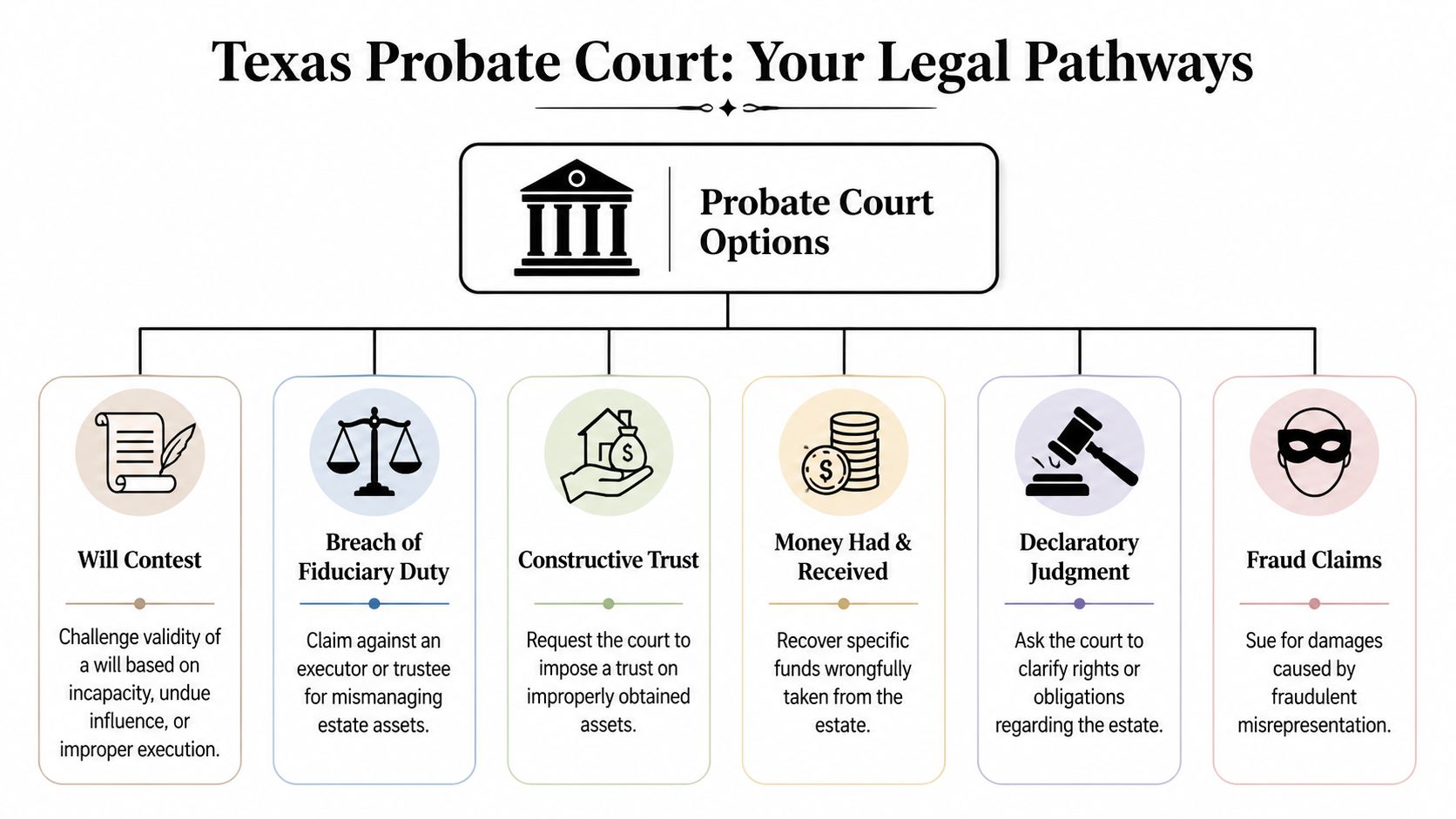
Will contests are often the main path
A will contest asks the probate court to decide whether a will is valid. If the court finds the document invalid, the estate may pass under an earlier valid will or, if none exists, under Texas intestacy rules.
Here are the most common grounds.
Undue influence
This claim argues that someone overpowered the decedent’s free choice and caused a will they would not otherwise have made.
A simple example is a caregiver who isolates an older adult, controls access to visitors, arranges the lawyer meeting, and receives a major gift under a sudden new will. Suspicion alone won’t win the case, but those facts can support an undue-influence challenge.
Common evidence can include:
- Relationship evidence: dependence on the alleged influencer, secrecy, or isolation
- Timing evidence: sudden estate changes during illness or decline
- Participation evidence: the beneficiary’s involvement in preparing or obtaining the will
- Behavior evidence: fear, confusion, or abrupt changes in the decedent’s statements
Lack of testamentary capacity
A person signing a will must understand, at the time of signing, the nature of making a will, the general nature of their property, and the people who would naturally receive it.
Families often get confused here because a person can have good days and bad days. Capacity is not all-or-nothing in the everyday sense. The question is whether the person had the required mental ability when the will was executed.
A realistic example is a father with significant memory problems who no longer recognizes close relatives, cannot identify his assets, and signs a new will during a period of obvious confusion.
Fraud or forgery
Sometimes the issue is not pressure but deception. Fraud can involve tricking someone about what they are signing or misrepresenting facts to induce a will change. Forgery involves a false signature or falsified execution.
These cases often require careful document review, witness testimony, and close attention to the signing ceremony.
Duress
Duress means unlawful pressure or threats. It goes beyond persuasion. It suggests the person signed because they felt they had no real choice.
An example might involve threats of abandonment, exposure of private information, or intimidation aimed at forcing a change in the will.
Courts can also use equitable remedies
A probate court is not limited to declaring a will invalid. Depending on the facts, a court may impose a constructive trust. In plain English, that means the court can treat property as being held for the benefit of the rightful person, even if someone else currently possesses it.
That remedy can matter when assets were wrongfully diverted and undoing the will isn’t enough.
Comparing Valid Will Contest Claims in Texas
| Claim | What You Need to Prove | Common Evidence |
|---|---|---|
| Undue Influence | Another person overpowered the decedent’s free choice and caused the will | Isolation, dependence, unusual estate changes, beneficiary involvement |
| Lack of Testamentary Capacity | The decedent lacked the mental ability required to make a will at signing | Medical records, witness observations, confusion about family or property |
| Fraud or Forgery | The will resulted from deception or a false signature or false execution | Drafting records, signature issues, witness testimony, inconsistent documents |
| Duress | The will was signed because of threats or coercive pressure | Messages, witness accounts, sudden fearful behavior, controlling conduct |
Related claims may also matter
Not every case is only about the will itself. Some involve an executor, trustee, or agent who mishandled property or concealed information. In those situations, related probate litigation may include breach of fiduciary duty, requests for declaratory relief, tracing of funds, or recovery of assets.
If you want a practical overview of contested estate disputes, this page on Probate Litigation is useful. For families reviewing whether the underlying estate plan was drafted clearly in the first place, this overview of Wills & Trusts can help frame the bigger picture. If you’re focused specifically on contesting a document already headed to probate, review how to contest a will and win.
A strong probate case usually starts with a simple question. What exactly happened, who was involved, and what proof exists outside family suspicion?
What probate litigation usually looks like
Most families benefit from seeing the process in sequence.
- A will is filed or admitted to probate: Someone offers the document and asks the court to recognize it.
- An interested person objects or contests: This is often an heir, beneficiary, or someone affected by the outcome.
- The parties gather evidence: Medical records, witness statements, communications, and financial records become important.
- The court hears motions and evidence: Some cases resolve through settlement. Others proceed to trial.
- The court determines validity and remedies: The result may affect who receives property and who serves in a fiduciary role.
A Realistic Scenario What a Texas Will Contest Looks Like
The Garcia family had expected a straightforward probate. Their father, Ernesto, had talked for years about dividing his property among his children. After he died, they learned that a newer will left a large share of the estate to a caregiver who had become heavily involved during his final illness.
One daughter felt guilty for being suspicious. Another was angry. A son kept saying that maybe their father changed his mind. Families often sit in that uncertainty for weeks, unsure whether they’re seeing wrongdoing or just a painful surprise.

The first meeting with probate counsel
The family’s lawyer didn’t start with accusations. The first step was a timeline.
When did Ernesto’s health change. Who took him to appointments. When did the caregiver enter the picture. Who contacted the attorney who drafted the later will. Who was present when Ernesto signed. Those details matter because will contests turn on facts, not assumptions.
The lawyer also explained some plain-English probate terms.
- Probate: the court process for handling a person’s estate after death
- Executor: the person named to administer the estate
- Interested person: someone with a legal stake in the estate, such as an heir or beneficiary
- Letters Testamentary: court authority allowing an executor to act
Building the case
The Garcias began gathering records. Neighbors described how Ernesto had become isolated. One friend said the caregiver often answered Ernesto’s phone and told people he was “too tired” to visit. Medical records suggested periods of confusion. The drafting attorney’s file showed who scheduled the appointment and who was involved around the signing.
That did not automatically prove undue influence. But it gave the family something far more valuable than suspicion. It gave them evidence to test.
The strongest contested estate cases usually come from records, witnesses, and patterns of conduct. They rarely depend on one dramatic moment.
The probate litigation process often includes discovery, which means the formal exchange of information. Parties may request documents, submit written questions, and take depositions. A deposition is sworn testimony taken before trial, usually in a lawyer’s office.
Later in the case, the Garcias’ lawyer questioned the caregiver under oath about access to Ernesto, the drafting process, and prior statements Ernesto had made about his children.
A helpful overview of probate disputes appears in this video:
How cases often resolve
Some will contests settle after discovery reveals weaknesses in one side’s story. Others proceed to a probate trial where the judge hears witness testimony and reviews exhibits. In the Garcia example, the parties might negotiate a resolution. If not, the court could decide whether the newer will is valid.
If the later will is invalid, the court may fall back to an earlier valid will or apply intestacy rules if no valid will exists. That’s why timing and record collection matter so much. Once probate starts moving, every missed step becomes harder to fix.
Critical Deadlines and Evidence for Your Claim
If you suspect wrongdoing, waiting is risky. Texas probate disputes are time-sensitive, and delay can make documents harder to obtain, witnesses harder to find, and assets harder to trace.
Texas law contains deadlines that can affect your rights, including the time to challenge a will after it has been admitted to probate. Because the facts and procedural posture matter, families should get legal advice quickly rather than relying on general internet answers.
What to do immediately
Start with preservation, not confrontation. Angry calls and text messages to the other side usually don’t help. Quiet organization does.
Here’s a practical first-step checklist:
- Collect estate documents: Keep copies of every will, codicil, trust, deed, beneficiary form, probate notice, and court filing you can find.
- Preserve communications: Save emails, text messages, voicemails, letters, and calendar entries that show changes in relationships or access.
- List key witnesses: Write down names and contact information for neighbors, caregivers, clergy, doctors, office staff, and friends who observed the decedent.
- Secure medical information: Identify doctors, hospitals, memory care facilities, and medications relevant to capacity or vulnerability.
- Track financial movement: Note unusual withdrawals, transfers, title changes, or account access near the end of life.
- Build a timeline: Create a dated sequence of illness, isolation, estate changes, and major events.
Evidence that often matters most
Families sometimes think the case turns on one “smoking gun.” More often, it turns on a pattern.
Useful evidence may include:
- Medical records showing confusion, decline, diagnosis, or medication changes
- Attorney drafting files showing who called, who attended, and what instructions were given
- Witness statements from people who saw dependence, pressure, or isolation
- Financial records revealing suspicious activity tied to the same person who benefited
- Prior estate planning documents showing a sudden unexplained departure from longstanding intent
If you’re trying to understand what proof is usually most helpful, review this guide on evidence needed to contest a will.
Why Estates Code procedure matters
Texas Estates Code procedure shapes how and where these disputes unfold. That includes questions about notice, probate filings, appointment of a personal representative, inventories, and objections raised by interested persons. Titles 2 and 3 are especially important for post-death administration and for incapacity-related background issues that may help explain how a vulnerable person was exposed to manipulation.
Bring a lawyer your documents early, even if you’re unsure you have a case. Early review can identify missing records before they disappear.
A probate contest isn’t only about what happened. It’s also about whether you can present the right proof in the right court at the right time.
Key Insight Your Path Forward in a Contested Estate
A contested estate can feel like coming to a locked door after someone you love dies. You were told for years what the plan was, then a new document appears and everything changes. At that moment, the old phrase "tortious interference with inheritance texas" can sound like the answer. In Texas, though, the better path is the one probate courts already use.
Texas does not recognize that tort claim. After Archer v. Anderson, the practical question is not what label sounds strongest. The practical question is which probate remedy fits the facts and can produce relief.
That shift matters for a reason. The Texas Supreme Court chose a narrower route because inheritance disputes already sit inside a detailed probate system with rules about who may object, where claims belong, what deadlines apply, and how a court can correct wrongdoing. In plain terms, the court decided families should use the tools built for estate fights, rather than a separate tort theory outside that structure.

Takeaway
If a loved one’s estate plan changed under suspicious circumstances, your strongest next step is usually a probate-based claim. Depending on the facts, that may mean a will contest based on undue influence, lack of capacity, fraud, duress, or related fiduciary misconduct. It may also include requests for constructive trust or other equitable relief tied to property that was wrongfully diverted.
For grieving families, this can simplify the decision. You do not need to chase a defunct cause of action and hope a court revives it. You need a clear theory, the right evidence, and a filing strategy that fits Texas probate procedure.
That is where experienced counsel makes a real difference. A good probate lawyer helps separate anger from proof, identify the strongest claim, and put the dispute in the correct court before time is lost. Our firm does that work every day. Even though this specific tort is gone in Texas, families still have effective legal options to protect an inheritance and challenge wrongdoing.
Where many families begin
Some families first need to understand the court process before they can decide whether to contest anything. This overview of the Texas Probate Process explains the basic roadmap. If your concerns involve an older adult who may have needed protection before death, or a vulnerable family member who still needs help now, the page on Guardianship may also be useful.
Grief makes legal choices feel heavier and more urgent at the same time. You do not have to solve the whole case in one day. Start by preserving records, writing down what changed and when, and getting legal advice focused on the remedies Texas courts recognize.
If you’re facing probate in Texas, the Law Office of Bryan Fagan, PLLC can help guide you through every step, from filing to final distribution. Whether you’re questioning a suspicious will, trying to protect estate assets, or need clarity about what happens next, our team is here to help. Schedule your free consultation today.