Skip to content
You may be reading this because something doesn't feel right. A parent died. A sibling, stepparent, or other relative was named executor. At first, you tried to be patient because probate takes time and grief drains your energy. Then the questions started piling up. Why won't they share bank information? Why was the house sold so quickly? Why does every request for records turn into an argument?
That suspicion can feel crushing. When the person in charge of the estate is also family, the problem isn't just legal. It's personal, emotional, and disorienting.
If you're wondering, What If the Executor Is Stealing Money From the Estate in Texas?, the most important thing to know is this: you are not stuck. Texas probate law gives heirs and beneficiaries ways to force transparency, stop ongoing harm, remove a dishonest executor, and seek repayment to the estate.
A Devastating Suspicion When You Are Grieving
A common situation starts without fanfare. A daughter loses her father. Her brother is named executor. She expects some delay because there's a house to deal with, bills to sort out, and paperwork with the probate court. But months pass with almost no communication. When she asks basic questions, she gets vague answers. When she asks for records, she's told to “trust the process.”
That kind of silence often creates the first crack in the family's trust.
You may be feeling two kinds of fear at once. One is grief over the person you lost. The other is fear that someone is taking advantage of that loss. Many people second-guess themselves in this moment. They worry they'll look suspicious, unkind, or greedy if they ask hard questions. In reality, asking for information about an estate you are entitled to inherit from is not disrespectful. It is responsible.
Why this hurts so deeply
An executor isn't just handling paperwork. That person is carrying out a loved one's final instructions. When that role is abused, families often feel betrayed twice. First by the death itself, and second by what happens after.
You don't have to choose between protecting your inheritance and preserving your dignity. Texas law allows you to ask for answers in a structured, lawful way.
What most families need first
Before taking action, beneficiaries typically need clarity on three points:
- What an executor is allowed to do. Many disputes start because beneficiaries don't know where the line is between delay and misconduct.
- What warning signs matter legally. Not every mistake is theft, but some patterns should never be ignored.
- What steps protect the estate now. Waiting too long can make recovery harder if money has already been moved.
If you're in that position, calm, methodical action usually works better than confrontation. The law has tools for this. The key is using them early and using them well.
Understanding the Executor's Sacred Duty in Texas
An executor in Texas is not the owner of the estate. The executor is the temporary manager of property that belongs, ultimately, to the estate's creditors and beneficiaries. Texas law treats that role as a fiduciary duty, which is a legal duty of loyalty, care, honesty, and good recordkeeping.

What fiduciary duty means in plain English
Think of the executor as a trusted caretaker holding someone else's property for a limited time. They must protect it, document it, pay proper debts, and distribute what remains according to the will or Texas intestacy rules. They are not free to treat estate money like a personal checking account.
That duty includes practical responsibilities such as:
- Collecting estate assets. Bank accounts, personal property, real estate interests, and other assets should be identified and controlled.
- Paying legitimate obligations. Valid debts, taxes, and administration expenses may need to be paid before distributions are made.
- Keeping clean records. The executor should be able to show what came in, what went out, and why.
- Treating beneficiaries fairly. Favoring one heir, hiding information, or making side deals can create serious legal problems.
If you want a fuller overview of the role, this guide on the duties of an executor of an estate is a useful starting point.
Where executors get into trouble
Trouble often starts when an executor forgets that authority is limited. The job does not permit self-dealing. That means an executor should not transfer estate assets to themselves on favorable terms, use estate funds for personal expenses, or pay themselves beyond what Texas law allows.
Under Texas Estates Code § 352.051 as discussed here, executor commissions are capped at 5% of all amounts the executor receives or pays out in cash. That same source notes that independent administrations make up 70-80% of Texas probates, and disputes arise in an estimated 10-15% of cases annually because there is less court supervision.
That matters because many Texas executors operate with significant day-to-day freedom. Independence can make probate more efficient. It can also create room for abuse when the wrong person is in charge.
A useful way to spot the pattern
If you've ever read about spotting financial advisor misconduct, the same basic principle applies here. A fiduciary must put another person's interests first. Once the fiduciary starts benefiting personally from secrecy, hidden transactions, or unexplained fees, the warning lights come on.
Practical rule: An honest executor may be busy, slow, or disorganized. A dishonest executor is often secretive, defensive, and unable to explain where the money went.
Red Flags An Executor May Be Mismanaging Funds
Most beneficiaries don't discover theft because they catch someone in the act. They notice a pattern. Communication drops off. Deadlines are missed. Assets become harder to trace. The story changes from one conversation to the next.
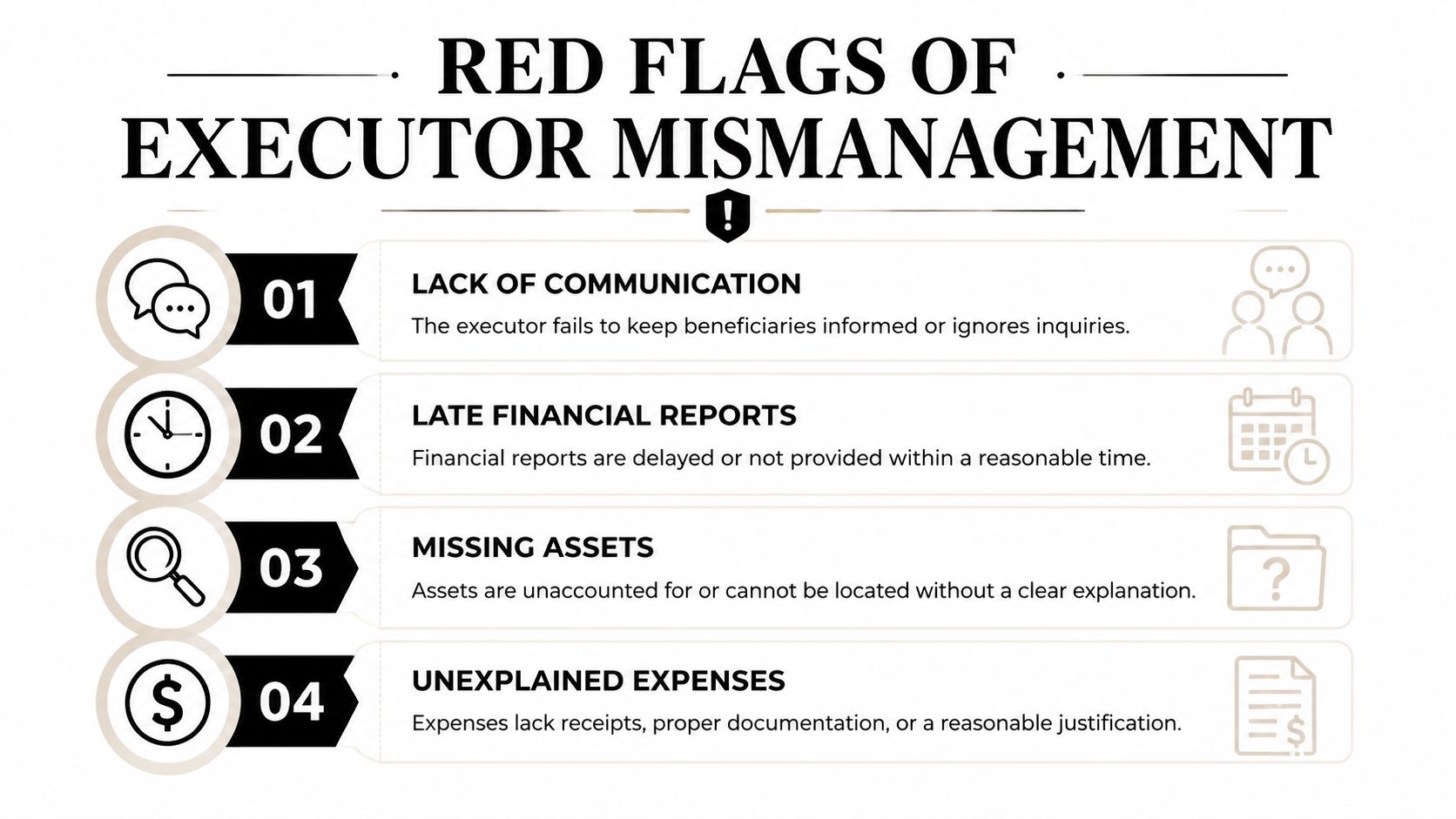
Four red flags that deserve close attention
- Silence when you ask for records. Beneficiaries usually become suspicious when the executor dodges basic questions about bank balances, sales, or estate expenses. Refusing to provide information doesn't prove theft by itself, but it often signals larger problems.
- Missing court-required filings. One of the earliest warning signs is failure to file the estate inventory on time.
- Unexplained withdrawals or expenses. If estate money is leaving the account and there's no clear documentation, the risk rises fast.
- Sales that don't make sense. Property sold too cheaply, quickly, or to insiders can suggest self-dealing.
Why the inventory deadline matters
Texas Estates Code § 351.101 requires the executor to file a detailed inventory within 90 days of appointment. According to BoyarMiller's discussion of executor mismanagement, failure to meet that 90-day deadline is a key red flag. The same source explains that delays in distribution beyond the standard 15-month guideline, when paired with unaccounted withdrawals, often lead to petitions for removal.
That deadline matters because the inventory is the first formal snapshot of what the estate owns. If an executor never identifies the assets clearly, it becomes much easier to hide, transfer, or undervalue them.
A realistic example
Suppose the estate includes a home, a truck, and several bank accounts. You know your mother owned them because you saw the statements and title papers before she died. But the executor never shares an inventory. Months later, the truck is gone, one bank account “must have been smaller than expected,” and the house sold under circumstances no one can explain.
Those facts don't automatically prove theft. They do create a strong need for documentation.
Other signs that often matter in court
| Concern | Why it matters |
|---|---|
| Refusal to answer in writing | Written refusals often become evidence of concealment or noncompliance |
| Personal use of estate property | Living in the house or using estate funds can breach fiduciary duties |
| Excessive fees | Overpaying the executor can point to self-enrichment |
| Sudden pressure to “just sign” | Rushed releases may be an attempt to shut down questions |
One documented case discussed by BoyarMiller involved an executor whose fraud of $150,000 led to an 18-month prison sentence. That example matters because it shows Texas courts do not treat executor theft as a harmless family dispute.
If your instincts are telling you that the records don't match the story, don't ignore that feeling. Probate disputes often begin with details that seemed small at first.
Your First Steps to Protect the Estate
When beneficiaries suspect misconduct, the first goal isn't to win an argument. It's to preserve evidence and stop further loss. You want a clear record of what you asked for, what the executor did, and what information is still missing.

Start with a formal demand for accounting
One of the most important early tools is an accounting. In plain English, that is a detailed report of estate money and property. It should show assets received, bills paid, distributions made, and the current status of the estate.
A beneficiary can seek an accounting through probate court. Texas Estates Code provisions governing accountings are often a key pressure point because a dishonest executor usually struggles when required to produce organized records. This overview of executor accounting requirements in Texas explains the issue in more detail.
Build your file before anyone deletes or loses records
Don't rely on memory. Create a folder, digital or paper, and start organizing every relevant document you have. Include dates, names, and copies.
Useful materials often include:
- The will and probate filings. These show who was appointed and what authority the executor claims to have.
- Emails, texts, and letters. Save every request you made for information and every response you received.
- Financial clues. Old account statements, property tax notices, insurance papers, deeds, vehicle titles, and appraisals can help establish what the estate owned.
- Witness information. Other heirs, neighbors, tenants, or family friends may have seen property being removed or heard statements that matter.
Keep your communication calm and strategic
Emotional messages rarely help. Short, factual written requests are stronger. Instead of accusing the executor of stealing, ask for specific records by a certain date. If the response is evasive, that can be more useful later than a heated phone call.
Action point: Ask for documents, not explanations. Records usually tell the story better than arguments do.
Coordinate with other beneficiaries
If more than one heir has concerns, it often helps to compare notes. One beneficiary may know about a missing account. Another may know a vehicle was sold. A third may have copies of older paperwork.
That kind of coordination can turn a vague suspicion into a documented timeline. It also makes it harder for an executor to isolate one family member and dismiss them as unreasonable.
Forcing Action Legal Remedies in Texas Probate Court
A lot of families reach this point after the same painful pattern. You asked for records. You got excuses. Money seems to have moved, property may be missing, and the executor keeps acting like no one can question them.
Texas probate court is where a beneficiary can turn concern into a court order.

Removal can stop the executor from doing more damage
A Petition for Removal asks the probate judge to take the executor out of office. In practical terms, you are asking the court to change the person holding the keys to the estate.
Texas courts can remove an executor for serious misconduct, misapplication of estate property, failure to file required accountings, conflict of interest, or other behavior showing the estate is not safe in that person's hands. Once the court removes the executor, it can appoint a successor to gather assets, pay proper debts, and finish the administration the right way. If you want a clearer picture of that process, review this explanation of how to sue an executor in Texas probate court.
Sometimes removal is the main goal. Sometimes it is only the first step.
An accounting order forces the paper trail into the open
Probate judges do not have to rely on family arguments. They can order the executor to produce records.
That matters because estate theft and mismanagement often hide behind missing bank statements, unexplained withdrawals, undocumented sales, or distributions that do not match the will. A court-ordered accounting works like an inventory check after someone has been left alone in the stockroom. It requires the executor to show what came in, what went out, and why.
If the records are incomplete or false, that often becomes part of the proof against the executor.
Surcharge makes the executor pay the estate back
A surcharge is a money judgment against the executor for losses caused by misconduct. If the executor took estate funds, sold property below value to help an insider, or caused losses through self-dealing, the court can order repayment from the executor's personal assets.
This remedy matters for one reason above all. It gives heirs a path to restore the estate, not just complain about what happened.
The court may also require the executor to give up any personal profit gained from the misconduct. If they used the estate as their own checking account, probate court can treat that as a debt owed back to the estate.
Real estate cases often require tracing title and sale proceeds
Money in a bank account is one kind of problem. Land, houses, mineral interests, and sale proceeds create a different kind of chase.
If an executor signed a deed, transferred property to a relative, or sold a house and failed to account for the proceeds, the case often turns on county property records, closing documents, title history, and where the money went after the sale. Families dealing with that kind of issue may find practical background in this guide on asset recovery for real estate, especially when the concern involves tracing ownership changes.
What relief the probate court can grant
| Remedy | Plain-English meaning |
|---|---|
| Removal | The executor is taken out of the role |
| Accounting order | The judge requires financial records and explanations |
| Surcharge | The executor must personally repay losses |
| Disgorgement | The executor gives back profits gained through self-dealing |
| Successor appointment | A new fiduciary takes control of the estate |
A probate case is often the moment heirs take back control. The court can freeze confusion into a record, replace the wrong person, and create a direct path to recover what belongs in the estate.
Here's a short overview if you want to hear more about probate disputes and estate recovery:
Understanding Criminal vs Civil Consequences
Families often ask whether they should call the police right away. The answer depends on the facts, but it helps to separate civil and criminal consequences because they serve different purposes.
Civil probate court focuses on protection and recovery
Civil probate court is usually the first and most practical forum. The goal there is to protect estate assets, force the executor to account, remove them if necessary, and recover property or money for the estate.
That's why many beneficiaries start with a petition in probate court rather than waiting for a criminal case. Probate judges can act directly on the administration of the estate.
Criminal law focuses on punishment
Executor theft can also become a criminal matter. Under Texas Penal Code § 31.03 as summarized here, theft from an estate can lead to felony charges when the amount exceeds $30,000. The same source explains that beneficiaries typically begin in civil probate court through a Petition for Removal under Estates Code § 361.001 because that is often the more direct route to recovering assets through remedies like disgorgement and surcharge.
So the two paths are different:
- Civil case asks, “How do we protect the estate and get the money back?”
- Criminal case asks, “Did this person commit a crime, and what punishment follows?”
Why this distinction matters emotionally
Families sometimes feel let down if law enforcement doesn't move immediately. That doesn't always mean the claim lacks merit. In estate disputes, investigators may wait while the probate record develops. A strong civil case often creates a cleaner factual foundation for any later criminal review.
If your immediate concern is preserving inheritance, getting control of the estate back is often the urgent first move.
Common Questions from Heirs and Beneficiaries
At this stage, families are usually asking practical questions, not academic ones. You may be wondering how long you can wait, whether Texas can reach an executor who lives elsewhere, or what to do if you only have suspicions and not proof. Those are the right questions. Probate cases often turn on early action, good records, and using the court process before more money disappears.
How long do I have to take action
Do not assume you have plenty of time.
Some claims against an executor may be subject to deadlines under Texas law, but the safer answer is much simpler. Act as soon as you have a real concern. Delay creates two problems at once. It can affect your legal options, and it gives the executor more time to move money, sell property, or let records go missing.
A probate dispute works a lot like trying to trace water after a leak. The longer it sits, the harder it is to tell where it started and how much damage it caused. If you suspect estate funds are being mishandled, speak with Texas probate counsel promptly and start preserving documents right away.
What if the executor lives out of state
An executor cannot avoid Texas probate court just by living somewhere else. If that person accepted authority over a Texas estate, the Texas court can still require them to account for what they did.
This comes up often when one child moved away years ago but returns after a parent dies to take control of the estate. Distance can slow communication and make excuses easier. It does not remove the executor's duty to follow Texas law.
If you are an heir living outside Texas, that does not prevent you from asserting your rights here either.
Can the executor really be forced to pay money personally
Yes.
If an executor took estate money, used estate property for personal benefit, or caused a financial loss through serious misconduct, the court can order that executor to repay the estate from personal funds. That remedy matters because an estate should not bear the loss caused by the person who was supposed to protect it.
Clients are often surprised by this. They assume the worst consequence is removal. Removal stops the harm. Personal repayment addresses the damage already done.
What if I'm not sure whether it's theft or just incompetence
That uncertainty is common, especially early on.
You do not need to arrive at the courthouse with every answer. In many cases, heirs begin with a pattern, not a confession. Bank records are missing. Questions are ignored. The house was sold, but no one can explain where the proceeds went. Those facts may point to sloppiness, self-dealing, or outright theft. The purpose of an accounting, subpoenas, and discovery is to sort that out.
A careful approach usually works best. Write down what you know, gather what you can, and identify the gaps. The records often tell the story more clearly than family arguments do.
Will the court care if the executor is also a beneficiary
Yes, but being both is not automatically wrongful.
Texas executors are often beneficiaries too. That is normal. The problem starts when the executor treats control like ownership. An executor is holding the estate in trust for everyone entitled to it, not using the estate as a head start on their own inheritance.
For example, an executor cannot justify paying personal bills from estate funds by saying, “I was going to inherit part of it anyway.” That is not how the job works. Fiduciary duties still apply.
What if the estate includes a minor or vulnerable adult beneficiary
That raises the stakes quickly. When estate assets are meant to support a child or a vulnerable adult, delays and missing money can affect housing, care, schooling, or medical needs.
In those cases, the court may scrutinize the administration more closely, and families often need to act faster to prevent further loss. The concern is no longer only fairness between heirs. It is also protection for someone who may not be able to protect himself or herself.
Where do related estate disputes fit in
Executor theft is only one kind of probate fight. In the same case, a family may also be arguing about whether the will is valid, whether a transfer was improper, who owns certain property, or whether a trust is being handled correctly.
These issues often overlap. A missing account may involve both executor misconduct and a dispute about whether an asset belonged to the estate in the first place. That is why strategy matters. Treating each problem as a separate family disagreement can waste time and money. Looking at the whole picture usually gives heirs a better chance to regain control.
Key Insight
The strongest response is usually a calm, documented, step-by-step one.
Ask for records. Save texts, emails, and financial statements. Put concerns in writing. If the executor refuses to be transparent, use the probate court process to force an accounting, restrict their authority, seek removal, and pursue recovery for the estate.
You do not need perfect proof before taking protective action. In many Texas estate disputes, the first real win is getting the court involved before the trail goes cold.