Skip to content
A parent has died. Their house is sitting half-empty. The mail keeps coming. The lawn needs attention. Insurance, taxes, and maybe a mortgage payment are still due.
Most families I speak with are asking the same question: Can we sell the house now, or are we stuck waiting on probate?
That question usually comes with stress layered on top of grief. One sibling wants the property sold right away. Another thinks no one can touch it for months. Someone heard “probate takes a year,” and now everyone feels frozen.
In Texas, the answer is more hopeful than many people expect. In many situations, selling estate property before probate is finished is possible. The key is understanding what kind of authority you have, what the title company will require, and which legal path fits the estate.
If you're trying to make sense of selling estate property before probate texas rules, start with this idea: you usually don't need to wait until the entire estate is closed. But you do need the right legal authority before a clean sale can happen.
A Common Dilemma for Texas Families
Maria’s father dies owning a home in Texas. She lives in another state. Her brother lives nearby, but he can’t afford to keep paying for yard work, utilities, and insurance while the family figures things out.
They know the house probably needs to be sold. What they don’t know is whether they’re allowed to do anything yet.
That’s where many Texas families begin. The house feels like both an asset and a burden. Every week that passes can bring more pressure.
Why the confusion is so common
People often hear one true fact and then draw the wrong conclusion from it.
Yes, probate in Texas can take time. But that doesn't always mean the home must sit unsold until every probate step is complete. In many estates, the main issue isn't whether probate exists. It's whether the person trying to sell has the legal power to sign and transfer title.
That distinction matters a lot.
Practical rule: In Texas, the question usually isn't “Has probate ended?” It's “Has the right person received legal authority to act?”
Texas law gives families several possible routes, and some are much faster than people expect. The right route depends on whether there is a will, whether there are debts, how the property was titled, and whether the estate qualifies for a simplified process.
What families usually need most
When you’re grieving, you don’t need more legal noise. You need a roadmap.
A good starting point looks like this:
- Secure the property: Make sure the home is locked, insured, and maintained.
- Gather the core papers: Find the will, deed, tax records, mortgage information, and death certificate.
- Pause major sale decisions: Don't sign a listing agreement just because a buyer is interested.
- Identify the right probate path: That choice affects timing, risk, and cost.
If this feels overwhelming, that’s normal. Probate law under the Texas Estates Code, especially Titles 2 and 3, gives structure to the process. Once you know which path applies, the situation usually becomes much more manageable.
Understanding the Legal Hurdle Vested vs Marketable Title
A family can know, with complete honesty, “The house is ours now,” and still be unable to close a sale on Friday.
That gap causes a lot of stress in Texas estates.

Under Texas Estates Code § 101.001, a deceased person’s property generally passes immediately to the heirs or beneficiaries, subject to the estate’s debts. Lawyers often call that vested title. In plain English, it means the law recognizes that ownership rights have shifted at death.
But a closing table runs on a different standard. Buyers, lenders, and title companies usually need marketable title, which means the ownership trail is clear enough that the title company is willing to insure the transfer.
A practical comparison helps here. Having vested title is a bit like having the right to a package that was delivered to your family. Having marketable title is having the signed receipt, matching ID, and clean chain of custody that lets everyone else trust the handoff.
That difference explains why families are often confused. You may already have legal rights in the property, yet still need probate papers, an heirship determination, or another approved shortcut before a title company will approve the sale.
Why title companies slow things down
Title companies are not questioning your family’s story. They are checking risk.
Before they insure a sale, they want documents that answer a few basic questions:
- Who owns the property now
- Who has authority to sign the deed
- Whether a will controls the transfer
- Whether unpaid debts, claims, or unknown heirs could later challenge the sale
If those answers are uncertain, the title company may refuse coverage. Once that happens, many financed buyers cannot close, because the lender also wants insured title.
That is why “we inherited it” and “we can sell it today” are not always the same thing.
A short video can help make that legal bottleneck easier to understand.
What probate is really doing for the property
Families sometimes see probate as a waiting period. In real estate cases, it often works more like a title-clearing process.
Probate, or a valid probate alternative, creates reliable proof of four things:
- Who the rightful heirs or beneficiaries are
- Whether the will is valid and can be used
- Who is authorized to act for the estate
- How creditor issues are handled before money is distributed
That framework is what turns an inherited house into a sale-ready house.
For some families, a full administration is the right tool. For others, a simplified option such as Texas Muniment of Title for real property transfers may be faster and less expensive if the facts line up. The key is matching the legal path to the estate’s actual needs, not just pushing for the quickest filing.
The practical question to ask
The useful question is not merely whether title passed at death. In many Texas estates, it did.
The better question is this: What paperwork will a title company accept so the sale can close without avoidable risk, delay, or expense?
That is the decision point for families. If the estate has a will, no serious creditor problems, and the right facts, one path may get you to marketable title quickly. If the family tree is unclear, debts are unresolved, or authority is disputed, a different path is safer even if it takes more work. The same basic concern comes up in other states too, which is why families often research issues like selling a house in probate before deciding how to proceed.
As one Texas probate article explains, title companies often want court-recognized proof of heirship or authority before they will insure a sale, even when heirs believe ownership passed automatically at death (can an heir sell property before probate in Texas).
If you understand the difference between vested title and marketable title, you are already asking the right question. That clarity usually leads to better decisions, fewer surprises at closing, and a faster path to the right result for the family.
Texas's Pathways for Selling Estate Property
The phrase “selling before probate” is commonly understood to mean selling before the entire estate is wrapped up. In Texas, that's often possible. The better question is: Which legal path gets you to a valid sale with the least delay and the least risk?
The path depends on the estate, not your urgency
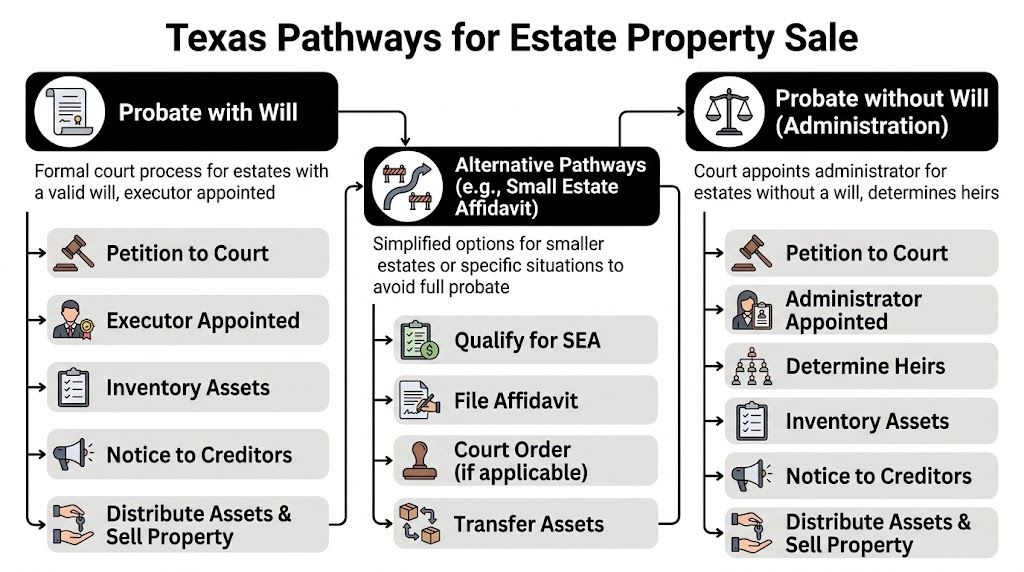
Texas doesn't use one single probate lane for every family. It offers several.
One reason Texas can move more efficiently than some other states is Independent Administration, which is the default probate method in approximately 80% of Texas probate cases and gives executors broad authority to handle estate matters, including real estate, without constant court supervision (Texas probate laws and independent administration).
That matters because it changes the practical meaning of “waiting on probate.” In many estates, the executor doesn't need to wait for final closure. They need the right authority early in the process.
For readers comparing how this issue works elsewhere, this overview of selling a house in probate shows how different probate systems can be from state to state. Texas often gives executors more room to act once authority is established.
The four main routes families should know
Here is a simple comparison:
| Path | Best fit | General effect on sale |
|---|---|---|
| Independent Administration | There is a will or agreement allowing an independent executor to act | Often the most practical route for a standard estate sale |
| Dependent Administration | The court needs to supervise closely, often because of disputes or lack of authority to proceed independently | More court involvement before a sale can close |
| Muniment of Title | There is a valid will and little or no debt requiring full administration | A streamlined way to clear title |
| Small Estate Affidavit | The estate is small enough and meets statutory requirements | May allow a simplified transfer in qualifying cases |
A quick plain-English view
Independent Administration
Think of this as a court-approved green light with fewer stops after it begins. The executor still has duties, but doesn't need to ask the judge for permission at every turn.
Dependent Administration
This is the more supervised lane. The court stays closely involved, which can protect the estate but also slows the sale process.
Muniment of Title
This works more like a title transfer tool than a full administration. If the facts fit, it can be a very efficient answer for real property.
Small Estate Affidavit
This is a simplified option for qualifying smaller estates. It has strict limits, so it isn't available in every case.
A family trying to decide whether muniment might fit their situation can review this explanation of the Texas muniment of title process.
The fastest path isn't always the one people assume. The fastest safe path is the one that matches the estate's actual facts.
Choosing Your Path A Detailed Breakdown
A lot of families reach this point with the same worry. They understand there is more than one probate option, but they do not know which one gets the house sold with the least cost, delay, and risk.
The better question is not only, "Can we sell?" It is, "Which legal path fits this estate well enough to let us sell without creating a bigger problem later?" In probate, speed matters. So does choosing a process that gives the buyer, the title company, and the family confidence that the sale will hold up.
Four facts usually drive the decision:
- Is there a valid will?
- Does the estate have debts that call for a full administration?
- Are the heirs cooperative, or is conflict already present?
- Is the main goal to transfer title to a house, or is there broader estate work to do?
Independent Administration
For many Texas estates, this is the most practical route because it balances court authority with flexibility.
The court admits the will, appoints the executor, and issues Letters Testamentary. Those letters work much like an official badge of authority. Once the executor has them, the executor can often move ahead with estate business, including a sale, without asking the judge to approve each separate step.
A Texas real estate source discussing probate timing explains that families often can act sooner than they expect once authority is issued, even though the full estate may remain open longer. It also compares common timelines for Independent Administration, Muniment of Title, and qualifying small-estate procedures in plain language (Texas probate timeline and when you can sell).
That distinction matters. The estate does not have to be fully wrapped up before a house can often be listed and sold.
A common example helps. A parent leaves a valid will, names one child as executor, and owns a house plus a few bank accounts. The siblings get along. In that setting, Independent Administration is often the lane that gives the family enough authority to act without paying for extra court supervision they may not need.
Dependent Administration
Dependent Administration is the supervised lane.
It usually appears when there is no will, authority is unclear, family members disagree, or the court decides closer oversight is appropriate. If Independent Administration is like driving on a highway with fewer stops, Dependent Administration is more like going through a series of checkpoints. Each checkpoint exists for a reason, but each one can slow the trip.
For a real estate sale, that often means more filings, more notice requirements, and court involvement before closing. Texas law also places price-protection rules on some court-supervised sales. Under the Texas Estates Code, real property sold at a private sale in a dependent administration generally may not be sold for less than 90 percent of the appraised value approved by the court, absent a new appraisal or further court action. You can review that rule in Texas Estates Code Section 356.551 on minimum sale price in certain probate sales.
The practical consequence is straightforward. Even after a buyer is found, the closing may have to wait for court approval. Local court timing varies, so the delay is not the same in every county, but families should expect added steps and a slower path than an independent administration.
That can still be the right choice. In a family with distrust, prior transfers, or arguments about value, added court review can protect the estate from a later claim that the representative sold too cheaply or favored one heir.
Muniment of Title
Muniment of Title is often the fastest clean-title option when the facts fit.
It is a limited probate procedure used when there is a valid will and the estate does not need a full administration because there are no unpaid debts, other than debt secured by real property in some situations. The court admits the will as a muniment of title, and that order serves as the link in the title chain.
This option works well for a family whose main issue is the house itself. If there is little else to collect, no active creditor problem, and no need for an executor to keep managing estate affairs, Muniment of Title may be the lower-cost path.
Families often miss this because the name sounds technical. In plain terms, it is a title-clearing tool. It does less than a full administration, and that is exactly why it can be useful.
Small Estate Affidavit
A Small Estate Affidavit is narrower than many families expect, but in the right case it can save time and expense.
Texas allows this procedure only when the estate meets strict requirements. The dollar limit and asset rules matter, and so do questions about debts, homestead status, and who the heirs are. A family can lose time by forcing this option onto an estate that really needs a different process.
Confusion often starts with the house. People hear "small estate" and assume any modest home qualifies. The law is more specific than that, especially where title and homestead issues are involved. If you want a clearer picture of that simplified route, this explanation of an affidavit of transfer without probate and how it works in Texas can help.
How to choose the fastest safe path
Families sitting around a kitchen table usually need a decision framework more than another definition. Here is the practical version.
If there is a valid will, a named executor, and no major conflict, Independent Administration is often the leading candidate.
If there is a valid will, very little debt, and the primary objective is to clear title to the house, Muniment of Title may be the better fit.
If there is no will, heirs are fighting, or the court needs tighter oversight, Dependent Administration may be required even if everyone wishes it were faster.
If the estate is small and clearly meets Texas requirements, Small Estate Affidavit may offer a simpler route.
Notice the pattern. The best path is the one that matches the estate's actual shape. Choosing a procedure that is too small for the problem can create title trouble. Choosing one that is larger than necessary can add cost and delay.
A realistic family example
Three siblings inherit their father's Texas house. One lives nearby. Two live out of state. There is a will. The house is the main asset. Insurance, taxes, and maintenance are eating into the estate each month.
That family usually has two separate decisions to make. First, which probate path gives them authority soon enough and safely enough. Second, once they have authority, how do they prepare the property for the market so it does not sit too long. If a sale is coming, practical items such as cleaning, repairs, and strategies to stage a house for a fast sale can affect the net result just as much as legal timing.
In that example, Independent Administration may be the sensible route if ongoing authority is needed. Muniment of Title may be better if the estate is simple and the house is the main concern. The answer comes from matching the legal tool to the family's facts, not from choosing the process that only sounds fastest.
The Sale Process and Handling Proceeds
A lot of families feel a brief sense of relief once the executor or administrator has legal authority to act. Then a new question appears: “All right, what do we do now?”
That question matters because an estate sale is a job with rules. The person signing is not selling a personal house in a personal capacity. They are acting for the estate and for everyone who has a stake in it. In probate law, that is called a fiduciary duty. A simpler way to say it is this: you are handling someone else’s property with a high duty of care.

The practical steps in the sale
Once the estate has the right authority in place, the sale usually works best as a controlled sequence, not a rush to listing.
Start with the signature block. The contract needs to name the seller correctly, such as an executor or administrator signing on behalf of the estate. If that capacity is listed incorrectly, the problem may not show up until title review, which is exactly when families want fewer surprises.
Next, choose professionals who understand probate sales. A real estate agent with estate-sale experience can help with pricing, disclosures, and buyer expectations. A title company that sees probate files regularly can spot issues early instead of delaying the closing table. If you want a closer look at title and closing issues that often come up, this guide on selling a house in probate in Texas is a helpful companion.
Then focus on value. The executor does not have to chase the highest number anyone can imagine. The executor should aim for a fair market result and be able to show a reasonable process. That may include reviewing comparable sales, discussing needed repairs, and deciding whether simple preparation will improve the final net proceeds. In many cases, modest cleanup, paint, and basic presentation do more than expensive renovations. These strategies to stage a house for a fast sale can help families decide what work is worth doing before listing.
Disclosures come next. Even if the representative never lived in the home, accuracy still matters. The right approach is to disclose what the estate knows and avoid guessing.
One more point often gets overlooked. Keep records as you go. Save the listing agreement, repair invoices, comparable sales, communications about offers, and the closing statement. If a beneficiary later asks why the home sold for a certain amount, a clean paper trail answers that question far better than memory.
Where the money goes after closing
This is the part that surprises many families.
The wire from closing usually does not go straight to heirs. It should usually go into the estate bank account. That account works like a holding place for estate funds until the representative finishes the estate’s financial obligations in the proper order.
From those proceeds, the representative may need to pay:
- Estate debts
- Administrative expenses
- Property costs such as insurance, taxes, utilities, or cleanup
- Tax obligations and final bills
- Distributions to beneficiaries after the estate is ready
That order protects everyone involved. The estate must be settled before the remaining funds are divided. If an executor sends money out too early, getting it back can be difficult, especially if a creditor appears later or a final expense was underestimated.
A helpful way to view the sale proceeds is as estate property in cash form. The house is gone, but the duty attached to it is still there. Closing is not the finish line. It is the point where careful accounting becomes even more important.
Common Risks and How to Protect the Estate
Moving too fast can create a second problem on top of grief.
The most common mistake I see is not bad faith. It’s urgency. A family wants relief. A buyer is interested. Someone thinks, “Let’s just get it listed now and sort out the legal side later.”
That approach can backfire.
The biggest risks
Some risks are procedural. Others are personal.
Title failure at closing
If authority and title aren't properly established, the title company may refuse to insure the sale.Beneficiary disputes
An heir may claim the property was sold too cheaply, too quickly, or without proper authority.Executor liability
A representative who mishandles a sale can face claims that they failed the estate.Contract problems
A poorly timed listing or contract can collapse, wasting time and damaging buyer confidence.
Out-of-state executors face extra pressure
This issue gets sharper when the executor or major heirs live outside Texas.
According to 2025 Texas probate survey data discussed by The Probate Realtor, 35% of contested estate sales involve out-of-state parties, and those disputes often stem from premature marketing without proper legal authority. The same source reports average legal fees of $25,000 per case in those lawsuits (can you sell a house before probate is granted in Texas).
That doesn’t mean every remote executor is headed for litigation. It means distance often makes communication harder, family assumptions stronger, and procedural mistakes more likely.
A realistic cautionary example
Suppose an executor in Colorado inherits responsibility for a Texas home. A local relative says, “I know a buyer. Let’s sign something now.”
The executor agrees to market the property before formal authority is in place. Another sibling later objects. The title company asks for probate documents the family doesn't yet have. The buyer becomes impatient. The deal falls apart, and now the family is arguing not just about the house, but about who caused the delay.
That chain reaction is common enough that it should be taken seriously.
How to lower the risk
The best protection is not speed alone. It is clean preparation.
Consider these safeguards:
- Wait for legal authority before signing major sale documents
- Use probate-aware contract language when needed
- Document the property condition and pricing basis
- Communicate with all beneficiaries in writing
- Work with a probate attorney before the title company raises objections
Families usually get into trouble when they treat authority as a detail. In probate real estate, authority is the foundation.
If conflict is already brewing, caution matters even more. The law can help move a sale forward, but only if the representative follows the right procedure from the start.
Key Insight Your Executor's Checklist
When families feel overwhelmed, a short checklist is often more useful than another long explanation. Start here.
First things to do
- Secure the home: Change locks if appropriate, protect valuables, keep insurance active, and make sure basic maintenance continues.
- Collect core documents: Find the will, deed, mortgage statements, tax notices, utility information, and death certificate.
- Make a property snapshot: Photograph the home, note its condition, and gather account information tied to it.
Before you try to sell
- Identify the correct legal path: Ask whether the estate fits Independent Administration, Dependent Administration, Muniment of Title, or a Small Estate Affidavit.
- Read the authority documents carefully: If the court issues letters or orders, confirm exactly what authority they grant.
- Don't sign too early: Avoid listing agreements, purchase contracts, or deed documents before authority is clear.
While the estate is being administered
- Open an estate bank account when authorized: Keep estate money separate from personal funds.
- Track every expense: Save receipts for insurance, maintenance, utilities, repairs, and court-related costs.
- Keep beneficiaries informed: Good communication can prevent suspicion and conflict.
Before closing
- Coordinate with the title company in advance
- Confirm how sale proceeds will be handled
- Review whether any court approval is still required
This is the central takeaway: the fastest safe sale comes from matching the estate to the right legal pathway early. Families lose time when they guess.
Navigating Your Next Steps with Confidence
If you're dealing with a loved one’s home right now, take a breath. This process is legal, but it’s also extremely personal. You may be making decisions while grieving, managing family expectations, and trying to prevent the property from becoming a larger burden.
The good news is that selling estate property before probate texas issues are often more manageable than families first assume. In many cases, the sale can move forward before the entire probate case is closed. What matters is choosing the right legal route and respecting the title and authority requirements that make the sale stick.
If you want to keep reading about related issues, these service pages may help:
You don't have to figure this out alone. A careful plan can reduce delay, lower conflict, and help you carry out your loved one’s wishes with far less stress.
If you’re facing probate in Texas, our team can help guide you through every step, from filing to final distribution. Schedule your free consultation today with Law Office of Bryan Fagan, PLLC.