Yes, probate can be reopened in Texas, but only for specific legal reasons such as newly discovered assets, a newly found will, unpaid debts, or fraud that could not reasonably have been discovered earlier. It is a formal court process filed in the same probate court that handled the original estate, and it is not available just because someone is unhappy with the outcome.
That answer matters because many families reach this question at the worst possible time. They thought the paperwork was finished, the property had been divided, and the court process was behind them. Then a deed turns up in a file cabinet, a bank statement arrives in the mail, or a relative says they were never told the estate was even opened.
When that happens, people often ask two different questions at once. First, can probate be reopened in Texas? Second, should it be?
Those are not always the same question. Sometimes reopening is the right move because the estate still has to deal with property or a legal problem the court never addressed. Other times, the better path may involve a different probate remedy, a title fix, or a dispute handled through litigation rather than a full reopening request.
If you're dealing with a surprise after an estate seemed finished, start with solid background on the Texas probate process. Knowing how the original administration worked makes it much easier to understand whether a new court filing is necessary now.
Introduction When You Thought It Was Over

A daughter is sorting through her late father's garage months after everyone believed probate was finished. In an old metal box, she finds stock certificates, a mineral lease, and a note about a bank account no one listed with the court. In that moment, the legal question and the emotional one arrive together. Did we miss something, and are we about to start probate all over again?
Usually, no.
In Texas, a closed probate case can sometimes be brought back before the court for a limited reason. The goal is often much narrower than families expect. The court may need to deal with one newly discovered asset, one unresolved debt, or one issue that was not addressed the first time. A good way to think about it is reopening a file to correct an unfinished item, not rebuilding the entire estate from scratch.
That distinction matters because families often ask only whether they can reopen probate. The better question is whether reopening is the right tool. Sometimes it is. Sometimes a different option is faster, less expensive, and better matched to the problem. This article is meant to help Texas families make that decision with a clear head, especially during a time when clear thinking is hard.
Texas law uses the term subsequent administration for certain post-closing situations. The Estates Code also treats estates differently depending on how the original case was handled, such as independent administration, dependent administration, or muniment of title. Those labels may sound technical, but they affect what the court will require if something turns up later.
Timing also confuses people. A family may say the estate is "over" because the house was transferred and the executor stopped making calls. The court may view closure more formally. If you are unsure whether the original administration ended, this explanation of when probate legally ends in Texas can help you frame the problem before deciding what to file.
One more point causes unnecessary panic. Finding a missed asset does not automatically mean anyone did something wrong. Estates are gathered from paper trails, tax records, mail, deeds, and memory. It is not unusual for property interests, small accounts, or old mineral rights to surface later, especially when the decedent owned property for many years or kept records in several places.
So start with a practical mindset. Identify what was found, ask whether the court still needs to act, and compare reopening probate with the available alternatives. That approach saves time, lowers conflict, and keeps the family focused on solving the actual problem rather than reliving the entire estate process.
Understanding When a Texas Probate Estate Is Legally Closed
People often say an estate is “done” when the family has moved on or when the executor has stopped making calls. Legally, that's not enough. A probate estate is closed when the court process has reached its formal end.
Consider the process of closing the books for a business at the end of a reporting period. You don't just stop working and call it complete. Someone has to finish the accounting, make the distributions, and document that the job has been completed under the rules that apply.
What “closed” usually means in plain English
A legally closed estate generally means the personal representative, often called the executor or administrator, has completed the remaining probate tasks. That often includes identifying known assets, addressing valid debts, and transferring property to the people entitled to receive it.
In many cases, the court also signs an order or accepts filings that bring the administration to a close and discharge the representative from further duty. Once that happens, the representative usually no longer has active authority to act for the estate unless the court gives it again.
That point matters because finding a problem after closure usually requires a new court request rather than an informal fix.
Why families misread the timing
Texas probate doesn't always look the same from one estate to the next. Some estates move through independent administration with less ongoing court supervision. Others involve closer court oversight. Some proceed through muniment of title, which is a narrower probate route used in the right circumstances. Those categories come from the Texas Estates Code framework, especially Titles 2 and 3, and they help explain why one family may think probate “ended” earlier than another family would.
If you're unsure whether the estate was formally closed, review the court file before taking any action. Orders, discharge documents, and final filings usually confirm the official status. This overview of when probate ends in Texas can help you identify the difference between “the work felt finished” and “the case was legally closed.”
A closed estate is a legal status, not just a family impression.
Why that distinction matters before you file anything
If the estate isn't formally closed, the solution may be simpler than reopening. The representative might still have authority to handle the issue within the existing administration. But if the estate is already closed, you're usually dealing with a post-closing court request, and that changes the process, the evidence needed, and the urgency.
That's why the first practical step is often not drafting a petition. It's confirming the exact procedural posture of the estate.
Valid Grounds for Reopening a Probate Case
A reopened probate case usually starts with one practical question. Is there a real estate problem the court still needs to solve, or is the family trying to revisit a painful result that the law treats as final?
Texas probate courts focus on unfinished legal work. If an estate was closed and something later surfaces that affects ownership, notice, debts, or the validity of the will, the court may allow a new proceeding to address that issue. If the problem is only disappointment, suspicion without proof, or a wish to reargue old conflicts, reopening is usually not the right tool.
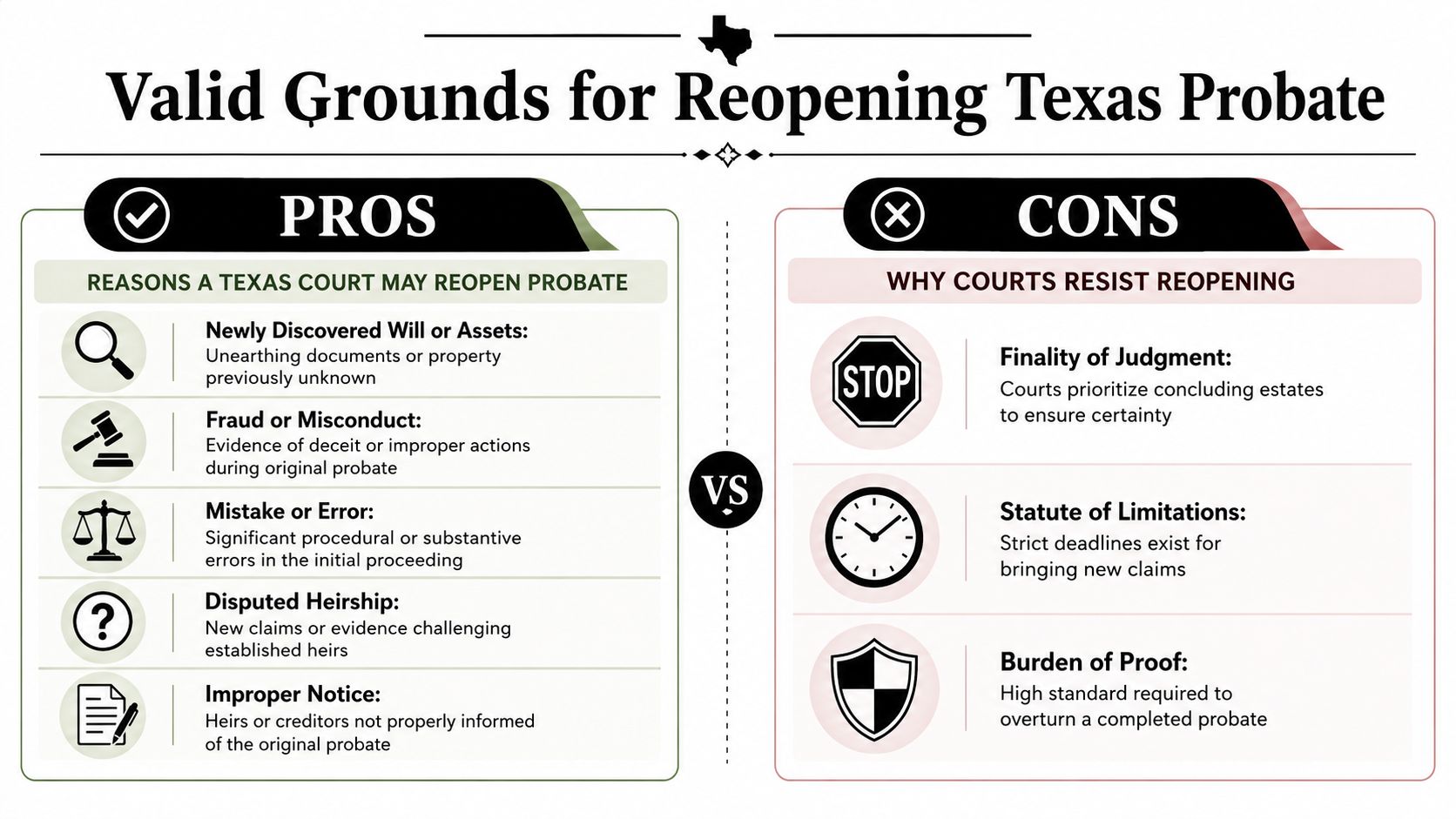
The easiest way to evaluate your situation is to sort it into two buckets. First, did something important exist at the time of the original probate but remain unknown, omitted, or hidden? Second, did a legal defect in the original case prevent the court from making a fully informed decision? Texas law often addresses those problems through later court action, including subsequent administration in the right case. If you want a broader explanation of what families can do after probate has already closed in Texas, that guide helps frame the options.
Newly discovered assets
This is one of the most common reasons families return to probate court.
A parent dies, the estate is handled, property is distributed, and everyone believes the work is done. Months later, a royalty statement arrives for mineral interests no one knew existed. Or a bank sends a dormant account notice in the decedent's name. Or a title company finds a small tract of land that never made it into the inventory.
In that situation, the court is not being asked to relive the whole probate. The court is being asked to deal with property that was never properly administered. Under the Texas Estates Code, that can justify post-closing action if the asset belongs to the estate and still needs authority for collection, transfer, or distribution.
Helpful proof often includes:
- account statements or stock records
- deeds, title papers, or tax records
- correspondence showing how the asset was discovered
- the original probate filings, especially the inventory or papers showing the asset was omitted
A newly discovered will
A different will can change the entire map of the estate. It may name different beneficiaries, appoint a different executor, or revoke an earlier will that was admitted to probate.
Courts do not treat every late-found document as automatically controlling. The document still has to meet legal requirements. The court may also examine why it was not produced earlier and whether time limits affect the request. Still, a newly discovered will is a serious issue because it goes directly to who should inherit and who had authority to act.
For families, this often feels emotionally jarring. A will found in a safe deposit box or desk drawer can reopen old questions very quickly. The court's focus, though, remains narrow. Is this document legally valid, and does Texas law permit the estate to be revisited in light of it?
Fraud, concealment, mistake, or lack of notice
These cases are harder and often more contested.
Sometimes the problem is active concealment. An heir claims someone hid an account, transferred property without disclosure, or gave the court incomplete information. Sometimes the problem is procedural. A required person may not have received notice, or a filing error may have affected who participated and what the judge knew.
Texas courts usually want specifics. Dates matter. Documents matter. The court will want more than a belief that something unfair happened. It helps to show exactly what was concealed or mishandled, who was affected, and how that defect changed the administration of the estate.
A useful way to think about this category is to picture a puzzle assembled with missing pieces. The court may be willing to revisit the case if key facts or required participants were left out. The court is far less likely to reopen matters that were already disclosed, argued, and decided.
The stronger cases for reopening identify a legal defect the court can correct, not a family disagreement the court has already heard.
Unresolved debt or creditor issues
Debt problems can also support reopening, but only in narrower circumstances.
For example, a creditor may claim a valid estate debt was never addressed, or a debt may surface that affects property still tied to the estate. Whether reopening makes sense depends on the estate history, what notice was given, whether claims procedures were followed, and whether assets have already been distributed to heirs or beneficiaries.
This is one area where families should pause before filing. Sometimes a creditor issue belongs in probate court. Sometimes it is better handled through negotiation, title work, insurance, or a separate civil claim. Reopening is a tool, not the answer to every post-death dispute.
Common Grounds for Reopening a Texas Probate Estate
| Grounds for Reopening | Common Example | Evidence Needed |
|---|---|---|
| Newly discovered assets | A forgotten account or tract of land is found after closing | Account records, deed, title paperwork, inventory gap |
| Newly discovered will | A later will is found in a safe deposit box | Original document, witness information, explanation of discovery |
| Fraud or misconduct | Someone hid property or misled the court | Records, correspondence, sworn statements, timeline |
| Mistake or error | Property was distributed based on a serious procedural problem | Court filings, transfer records, documentation of the error |
| Improper notice | An heir or creditor was not properly informed | Notice records, address history, affidavits, returned mail |
| Unpaid valid debt | A legitimate estate debt was not resolved | Bills, contracts, claim documents, probate file history |
What usually does not justify reopening
Families often need this part stated plainly. Probate reopening is not an appeal substitute, and it is not a reset button.
These situations usually are not enough by themselves:
- Unhappiness with the inheritance: A beneficiary believes the outcome was unfair.
- Long-running family conflict: Relatives want the court to revisit personal disputes that were never a probate defect.
- Regret about prior cooperation: Someone signed documents during probate and later wishes they had taken a different position.
- Suspicion without evidence: A person believes property must exist but cannot point to records, documents, or specific facts.
If you are trying to decide what to do, focus on the reason behind the request. Ask: Is there a concrete asset, a newly located will, a notice failure, or a provable mistake that affected the estate? If yes, reopening may be worth discussing with counsel. If no, a different path may save time, cost, and stress.
The Step-by-Step Process for Petitioning to Reopen
Texas law provides a clear path for post-closing action through subsequent administration when new assets or issues arise. A petition must be filed in the same probate court that handled the original estate, and the petitioner must show a legally valid reason. Disagreement with the outcome itself is not sufficient grounds, according to the Texas State Law Library's Texas probate guidance.
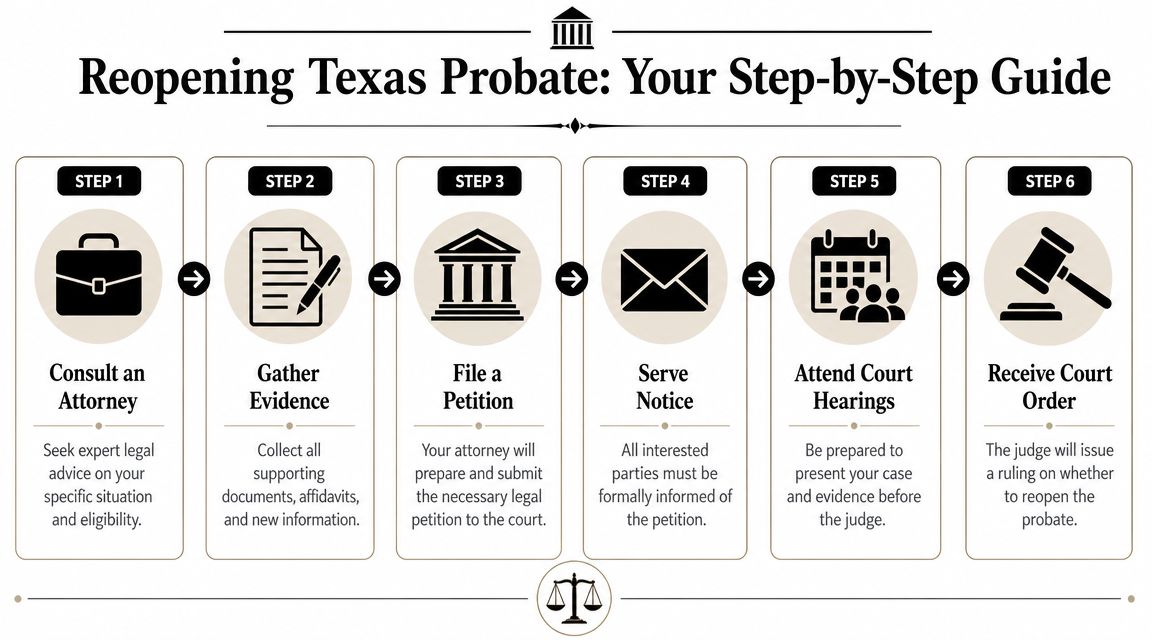
The phrase subsequent administration sounds technical, but the idea is simple. The court is being asked to reopen its supervision for a limited purpose because something the original administration didn't finish still needs legal attention.
Step one starts before the petition
Before filing anything, gather the original probate case information and the new evidence. That often includes the cause number, the county where the estate was probated, the order admitting the will if there was one, and the document or asset that created the new issue.
This is also the stage where families should ask a practical question. Does the issue require reopening, or is there another path that would be cleaner and less expensive?
For some families, consulting a probate attorney at this point prevents a filing that the court would reject. The after probate closed Texas guide is a useful starting point if you're trying to understand that distinction.
What goes into the petition
The petition usually needs to tell the court what happened in the original probate, why the estate needs further action now, and what authority the petitioner wants the court to grant. Depending on the issue, the petitioner may ask the court to reappoint the prior representative or appoint a new one to complete the remaining work.
The petition should connect the facts to the legal reason for reopening. If the problem is a newly discovered asset, identify it clearly. If the issue is a will or notice defect, explain the timeline and attach supporting proof.
Important: Judges usually respond better to a narrow request tied to a specific problem than to a broad filing full of family grievances.
A short visual summary can help make the process easier to follow.
What happens after filing
Once filed, the court may require notice to interested parties. That can include heirs, beneficiaries, creditors, or others affected by the requested action. If someone objects, the matter may become more involved. If the request is narrow and well-supported, the hearing may be relatively focused.
At the hearing, the judge usually wants answers to basic questions:
- Why is the estate back before the court now?
- What proof shows the issue is real?
- Why is subsequent administration the proper remedy?
- Who should have authority to act if the request is granted?
If the court approves the petition, it may reappoint the prior representative or appoint someone new to carry out the limited administration. That person then handles the unresolved task, such as collecting the asset, paying a valid claim, or transferring property correctly.
What families should expect emotionally
This process can feel disappointing because it reopens paperwork after everyone hoped to move on. But in many cases, it's more contained than the original probate. The focus is often one asset, one document, or one dispute that needs a clean legal resolution.
Critical Timelines and Deadlines You Cannot Ignore
Deadlines shape whether a probate problem can still be fixed. Families sometimes assume that if the issue is serious enough, the court will hear it whenever they discover it. That isn't how probate works.
A major benchmark in Texas probate law is the two-year contest window for challenging a will after it has been admitted to probate. Courts enforce this deadline strictly, with only narrow exceptions for issues like fraud that could not have been reasonably discovered earlier, as explained in this discussion of contesting a will after probate in Texas.
Why the two-year rule matters so much
If your reopening request is tied to a challenge to the admitted will, timing can decide the case before the merits are ever reached. The clock starts when the will is admitted to probate, not when the family later decides to investigate.
That catches many people off guard. They may spend months trying to resolve concerns informally, only to realize the court deadline was running the whole time.
Not every probate issue has the same deadline
A newly discovered asset problem may not present the same timing issue as a direct will contest. A lack-of-notice argument may raise different questions than a debt claim. The legal theory matters.
That's why broad internet advice can be dangerous. A person may read about one probate deadline and assume it applies to every post-closing problem. It doesn't.
Delay can turn a fixable probate issue into a closed door.
If you're trying to sort out whether a timing rule affects your rights, this explanation of the statutory limit for probate in Texas and the four-year rule helps place common deadlines in context. It shouldn't replace case-specific legal advice, but it can help you ask better questions quickly.
The practical takeaway on timing
If you find a will, discover a missing asset, suspect fraud, or believe notice was defective, act promptly. Save documents, preserve envelopes, gather dates, and get the probate file. Waiting rarely improves a reopening case. It usually makes proof harder and objections more likely.
A Realistic Scenario Reopening an Estate for a New Asset
The Miller family believed probate was behind them. Their mother's estate had been administered in Texas, the executor had finished the job, and the siblings had divided everything they knew she owned. Then, nearly a year later, one son opened a folder of old insurance papers and found a deed to a small piece of land still titled in their mother's name.
That kind of discovery creates a very specific problem. The family may agree on who should receive the land, but agreement alone does not repair title. If the asset never passed through the estate, the public record still points back to the deceased owner. Later, when someone tries to sell the property, refinance it, or transfer it to the next generation, that gap usually surfaces.
How a probate lawyer evaluates this kind of case
A new asset does not automatically mean the whole estate must be reopened from scratch. In Texas, the better question is narrower: does this newly discovered property require a limited court process so someone has legal authority to deal with it?
That is often how subsequent administration works. It functions like reopening a file for one unfinished task, not replaying every step of the original probate.
So the first review is practical and legal at the same time. Was the estate formally closed? Is the deed valid and clearly tied to the person who died? Did the original probate court already determine the heirs or admit a will? Is anyone disputing who should receive the property?
If the answers line up, the family may ask the same probate court to appoint or reappoint a personal representative for the limited purpose of handling that asset. The court is usually focused on one question: does estate property remain that still needs administration?
Why this option often makes more sense than informal fixes
Families often try the quickest apparent solution first. They talk about signing a private agreement, recording an affidavit, or dividing sale proceeds later. Sometimes those ideas sound reasonable because everyone gets along.
The problem is that title law does not care much about a family handshake. It cares about authority and chain of title.
A judge, title company, or future buyer will want to see how the property legally moved from the deceased owner to the heirs. Reopening for a narrow purpose can be the cleaner choice because it solves the actual bottleneck instead of papering over it.
What the court process may look like in real life
In the Miller family's case, the attorney gathered the deed, probate records, and basic facts showing the parcel had been left out of the original administration. A petition was then prepared asking for subsequent administration in the same court. The request was limited. The family was not claiming fraud, disputing the will, or asking the court to reconsider every earlier distribution.
That limited framing matters. Courts are more receptive when the request matches the problem.
After appointment, the personal representative could sign the documents needed to bring the land into the estate and transfer it correctly. Once that was done, the additional administration could close again.
For grieving families, that can be a relief. The process gives a lawful path forward, and it reduces the chance that a hidden title defect will become an expensive surprise later.
For families dealing with inherited real estate outside Texas, practical ownership questions can overlap with sale issues. A good example is this guide on selling inherited property in Northeast Florida, which shows how probate status and clear title affect a later sale even when relatives agree.
The larger lesson is simple. Reopening probate is usually a tool for solving a defined legal problem. If the issue is one newly found asset, a narrow request is often the most efficient path. Good records and updated estate planning can reduce the chances of this happening again, but when a missed asset does surface, Texas law does provide a way to fix it properly.
Key Takeaways and When to Call an Attorney
A family often reaches this stage with one question: are we dealing with a cleanup issue, or a legal problem that could change who inherits what? That distinction matters because reopening probate is a targeted remedy under Texas law. It is not a general reset button for everything that happened before.
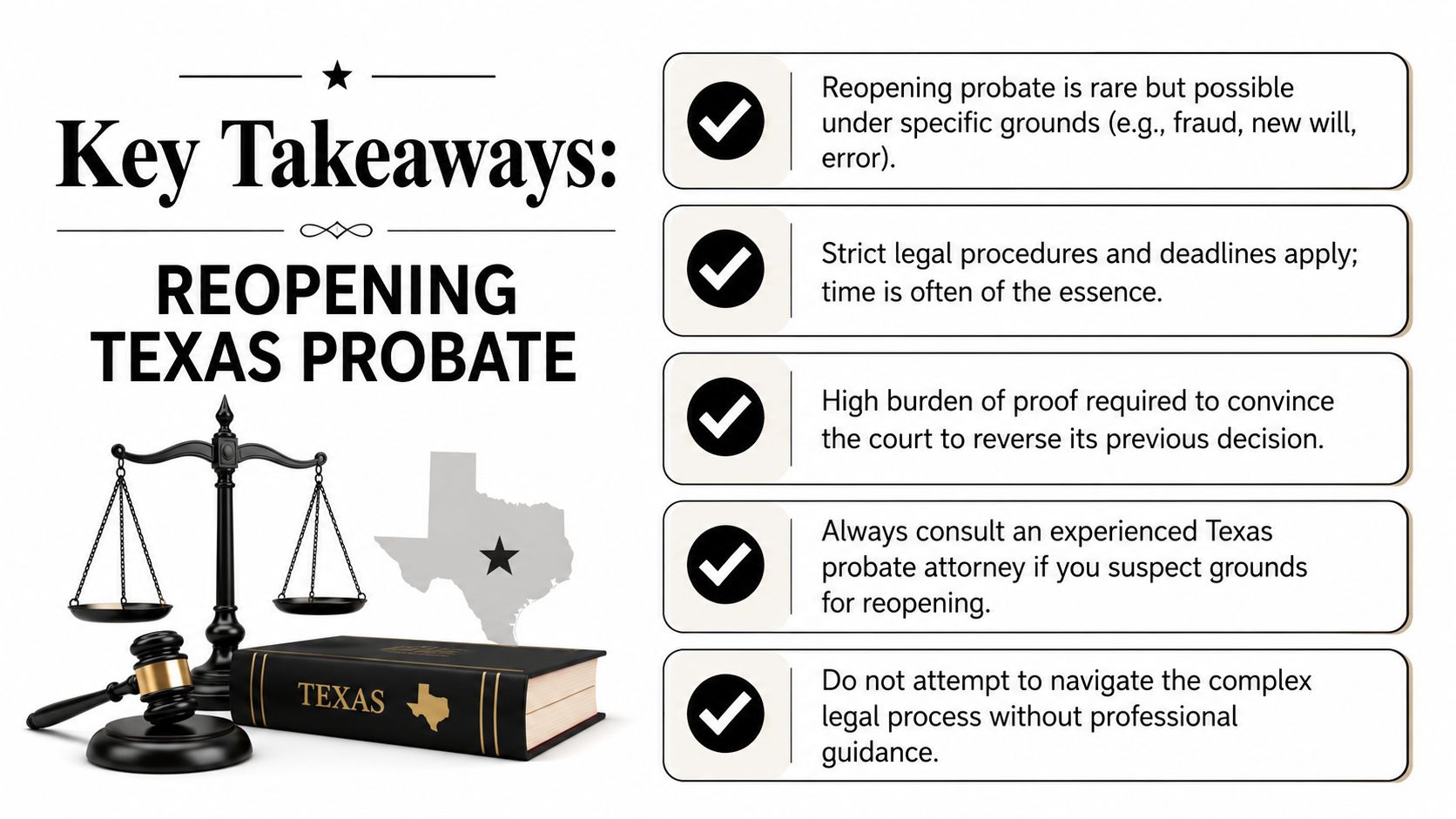
A useful way to evaluate the situation is to sort the problem into one of two buckets. The first bucket involves unfinished administration, such as an asset that was never transferred or a debt that still needs formal handling. The second involves a defect in the original case, such as lack of notice, fraud, or a newly discovered will. The first type often calls for a narrow request. The second usually deserves immediate legal review because it can affect ownership rights, court authority, or both.
Key insight
Use these points as a decision framework:
- Reopening can happen, but only for a specific reason: Texas courts generally expect a defined legal basis, such as omitted property, a later-found will, mistake, fraud, unpaid obligations, or notice problems.
- The same probate court usually stays involved: In many cases, the request is filed in the court that handled the original estate, because that court already has the record and prior orders.
- Final court orders still carry weight: Disappointment with the result, by itself, is usually not enough. The court wants a legal problem it can fix.
- Deadlines can change the answer: A strong claim can still become harder to pursue if too much time passes, especially in will-related disputes.
- The narrowest workable solution is often the best one: If the issue is one asset, one transfer problem, or one notice defect, a focused petition is usually easier and less expensive than trying to reopen every part of the estate.
If you are unsure which bucket your problem fits into, that confusion is normal. Probate law uses procedural terms, but families are usually dealing with practical questions. Can we sell the house? Can the bank release the account? Does this new document change who inherits? Those are the right questions to ask.
Call an attorney promptly if any of these apply
Some situations call for quick legal advice because waiting can limit your options or create title problems later:
- You found a will after the estate was closed: A later-discovered will can affect who serves, who inherits, and whether earlier transfers need to be examined.
- You found property still in the deceased person's name: Real estate, mineral interests, brokerage accounts, and refund checks often require formal authority before they can be collected or transferred.
- You suspect someone hid information or misled the court: Save documents, messages, and financial records before discussing the issue with other family members.
- You believe an heir or creditor did not receive proper notice: Notice errors can change whether earlier orders remain secure.
- A child, incapacitated adult, or vulnerable beneficiary is involved: Extra safeguards may be needed to protect that person's share and manage property correctly.
For readers weighing whether to reopen a case or choose a different path, the Law Office of Bryan Fagan, PLLC handles Texas probate matters involving estate administration, wills and trusts, heirship disputes, and probate litigation. That type of legal review can help a family decide whether reopening probate fits the problem, or whether a more limited remedy would solve it with less time, cost, and stress.
The main takeaway is reassuring. A problem discovered after probate closes does not automatically mean the whole estate must be fought over again. In many Texas cases, the better approach is to identify the exact issue, match it to the right legal tool, and act before delay creates a larger problem.
If you're facing probate in Texas, our team can help guide you through every step, from filing to final distribution. Schedule your free consultation today with Law Office of Bryan Fagan, PLLC.