Losing a loved one often leaves families in two worlds at once. In one world, you're grieving, making funeral arrangements, answering calls, and trying to get through ordinary days. In the other, paperwork starts to appear. A will. A deed. Bank statements. Car titles. Questions nobody feels ready to answer.
One of the most common questions families ask is simple and honest: what if no one files probate in Texas? Sometimes the family wants to wait. Sometimes nobody knows where to start. Sometimes relatives assume a will handles everything automatically. In Texas, though, doing nothing can create legal problems that don't stay small.
Probate is the court process that gives someone legal authority to deal with property after death. Under the Texas Estates Code, especially Titles 2 and 3, that authority matters because property doesn't always move on its own. Some assets pass outside probate. Others stay in the deceased person's name until a court-approved process clears the way.
When Grief and Legal Duties Collide
Maria's father died owning a house, an older pickup, and a checking account. He also left a will naming Maria as executor and dividing everything equally among his children. The family agreed they'd handle it later. Everyone was exhausted. No one wanted to walk into a courthouse while they were still planning the memorial.
Weeks turned into months.
At first, the delay didn't seem serious. The family still had access to the house. They could gather personal belongings. They assumed the bank account would be easy to sort out when they were ready. They told themselves they were waiting for the “right time,” when emotions settled down and life felt manageable again.
That reaction is completely understandable. Grief often makes legal tasks feel impossible.
Grieving families usually aren't avoiding responsibility. They're trying to survive a painful season while dealing with unfamiliar rules.
The trouble is that probate deadlines and title problems don't pause because a family is overwhelmed. If no one takes action, confusion starts to build around who has authority, which assets can be touched, and whether the loved one's written wishes can still be carried out.
Why families often wait
Families usually delay probate for practical reasons, not carelessness:
- They think the will is enough. A will expresses wishes, but it usually doesn't transfer property by itself.
- They expect everything to pass automatically. Some assets do. Others don't.
- They want to avoid conflict. Ironically, delay often creates more conflict later.
- They assume probate means a long court fight. In Texas, some estates qualify for simpler paths.
Texas probate law can feel intimidating, especially when words like executor, intestate, and Letters Testamentary start showing up. In plain English, an executor is the person named to handle the estate. Intestate means the law treats the estate as if there were no valid will controlling the transfer. Letters Testamentary are the court papers that prove the executor has authority to act.
When nobody files, the family usually doesn't get relief. They get uncertainty.
The Immediate Consequences of Not Filing Probate
When probate isn't opened, the biggest problem is authority. Nobody has official court permission to step into the deceased person's shoes for probate assets. That's why property can become stuck, even when everyone in the family agrees about what should happen.
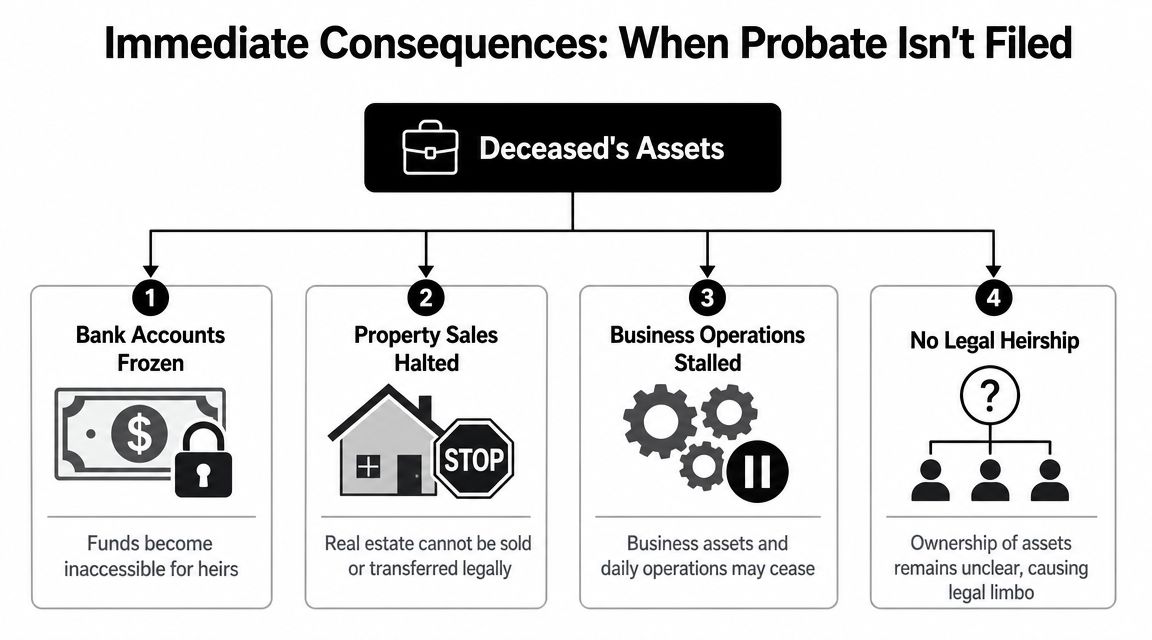
According to the Texas State Law Library probate guide, if no one files probate in Texas, assets that require court authority to transfer can remain stuck in the decedent's name. That same guidance warns that if a house, vehicle, or account lacks a beneficiary designation and no probate is opened, the asset can remain frozen or title-defective even years later.
What “stuck in the decedent's name” means
This phrase sounds technical, but the effect is very real:
- Bank accounts may be inaccessible. The family may know the money is there, but that doesn't mean the bank can release it.
- Real estate can't be cleanly sold or refinanced. If title never moved legally, a buyer or title company may stop the transaction.
- Vehicles may not transfer properly. A car sitting in the driveway still needs legal paperwork to change ownership.
- Business interests can stall. If the deceased owned a business asset, daily decisions may become harder without recognized authority.
A common point of confusion is the difference between probate assets and nonprobate assets. Probate assets are property interests that usually need a legal process before ownership can transfer. Nonprobate assets pass by built-in instructions, like a payable-on-death account or transfer-on-death deed.
Here's a simple comparison:
| Asset type | May pass without probate | May get stuck without probate |
|---|---|---|
| Payable-on-death bank account | Yes | Less likely |
| Transfer-on-death deed | Yes | Less likely |
| House titled only in decedent's name | No automatic transfer | Yes |
| Vehicle with no beneficiary setup | No automatic transfer | Yes |
| Account with no beneficiary designation | No automatic transfer | Yes |
Later in the same discussion, it helps to hear the issue explained visually.
Why bills and decisions become harder
Without probate authority, families can run into a painful catch-22. They may need access to estate funds to handle expenses, but they can't access those funds because no one has been formally authorized. They may also need authority to sign documents, gather information, or deal with institutions that won't accept verbal family agreements.
Practical rule: If an asset doesn't already name a living beneficiary or transfer automatically by law, assume someone should review whether probate or a probate alternative is needed.
That's why the question isn't only, “Can we wait?” The better question is, “Which assets can wait, and which ones can't?”
Alternatives to Formal Probate in Texas
A lot of families hear "probate" and picture a long court battle. In Texas, that is only one path. For some estates, the better question is not whether probate exists. It is which legal tool matches the asset that needs to be transferred.
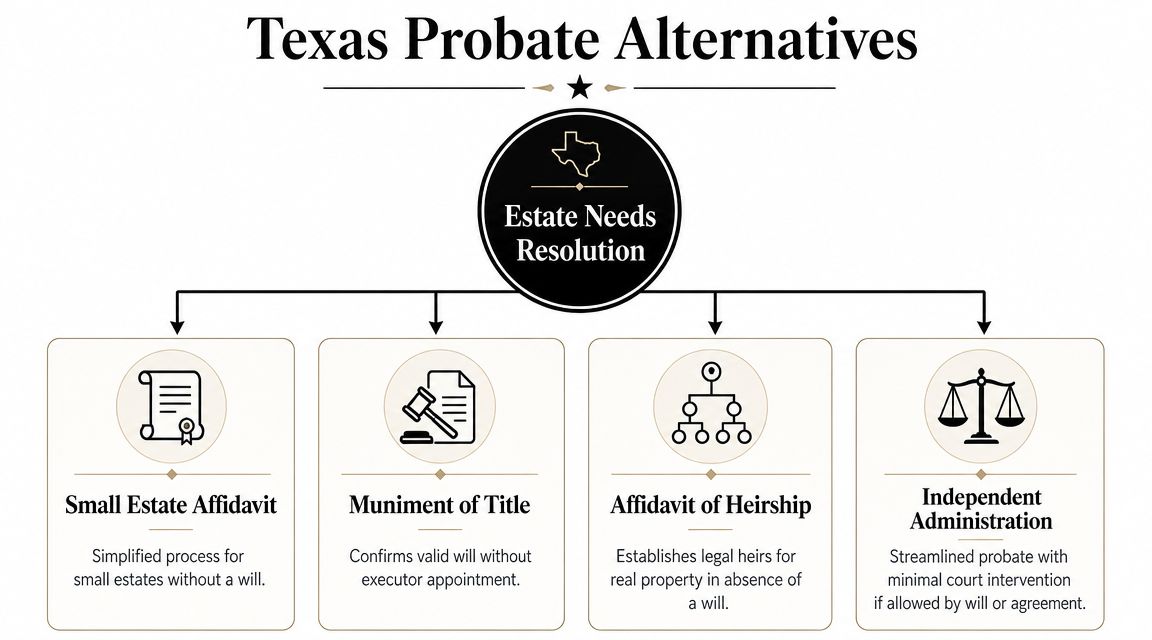
That distinction matters because different assets create different problems. A house with title in the deceased person's name raises one set of issues. A small bank account with no beneficiary raises another. A valid will may help, but only if the family uses the right procedure in time and in the right form.
Texas law provides several shorter, more focused options than full administration. Each one solves a specific problem. None of them is a universal substitute for probate, and none should be treated as a way to ignore the four-year deadline that can later affect whether a will is honored as written.
Small Estate Affidavit
A Small Estate Affidavit can help when someone died without a will and the estate is modest. Earlier Texas-focused guidance in this article explains that this procedure is available only in limited situations and is commonly used to transfer certain assets without opening a full probate administration.
Families often find this tool helpful because it works like a court-approved shortcut. Instead of appointing an executor to handle an entire estate, the affidavit gives heirs a narrower way to show who inherits and collect qualifying property.
It still requires care. The court must be able to see who the heirs are, what property exists, and whether the estate fits the legal requirements. If the paperwork is wrong, the delay can feel almost as frustrating as formal probate.
A typical process looks like this:
- Review what property is in the estate. Some assets are counted differently, and some property does not count toward the limit.
- Confirm the family tree. Texas courts want clarity about spouses, children, and other heirs who may inherit.
- Prepare the affidavit with precision. Names, values, and relationships need to match the facts.
- File in the correct probate court. County procedures can affect review times and required forms.
- Use the signed order and affidavit to collect approved assets.
This option is often useful for bank accounts and similar property. It is less useful when the estate includes disputes, debt problems, or title issues that need broader authority from the court.
Muniment of title
When there is a valid will and the estate does not need a full administration, muniment of title may be the better fit. This procedure asks the court to recognize the will so property can pass under it, usually without appointing an executor for ongoing estate management.
Families often use muniment of title when the main concern is clearing title to a house, land, or another asset that needs a recorded chain of ownership. If you want a closer explanation of how that process works, this guide to muniment of title in Texas walks through the requirements.
The limitation is easy to miss during grief. Muniment of title is a narrow tool, not a reset button. It does not make debt issues disappear, and it does not erase the risk created by waiting too long to bring a will to court.
Affidavit of heirship and similar title tools
An Affidavit of Heirship is different from probating a will. It is a document often used to show family history and support a claim of ownership, especially for real estate. Title companies, buyers, and heirs may rely on it in the right situation, but it does not give the same court-backed authority as a probate order.
A helpful way to view it is this. Probate decides who has legal authority to act for an estate. An affidavit of heirship helps explain who the family members are and how title may have passed after death.
That distinction becomes important when a family is trying to sell a house years later. One buyer or title company may accept an affidavit of heirship after review. Another may insist on a probate proceeding, especially if the facts are unclear, the family tree is complicated, or a will exists but was never admitted.
Before choosing this route, families should slow down and answer a few practical questions:
- Did the person leave a will?
- Are there unpaid debts that require administration?
- Is the main problem clearing title to real estate?
- Do all heirs agree on the family history?
- Will the bank, buyer, or title company accept this document?
Sometimes a limited procedure is enough. Sometimes independent administration is still the safest choice. Sometimes a law firm such as Law Office of Bryan Fagan, PLLC can evaluate which procedure fits the estate and the county's local practice.
Every shortcut in Texas probate solves a particular problem. The safest choice depends on the asset involved, the existence of a will, and how much time has already passed since death.
The Four-Year Rule A Critical Deadline You Cannot Ignore
The most dangerous probate mistake in Texas is often delay that feels harmless.
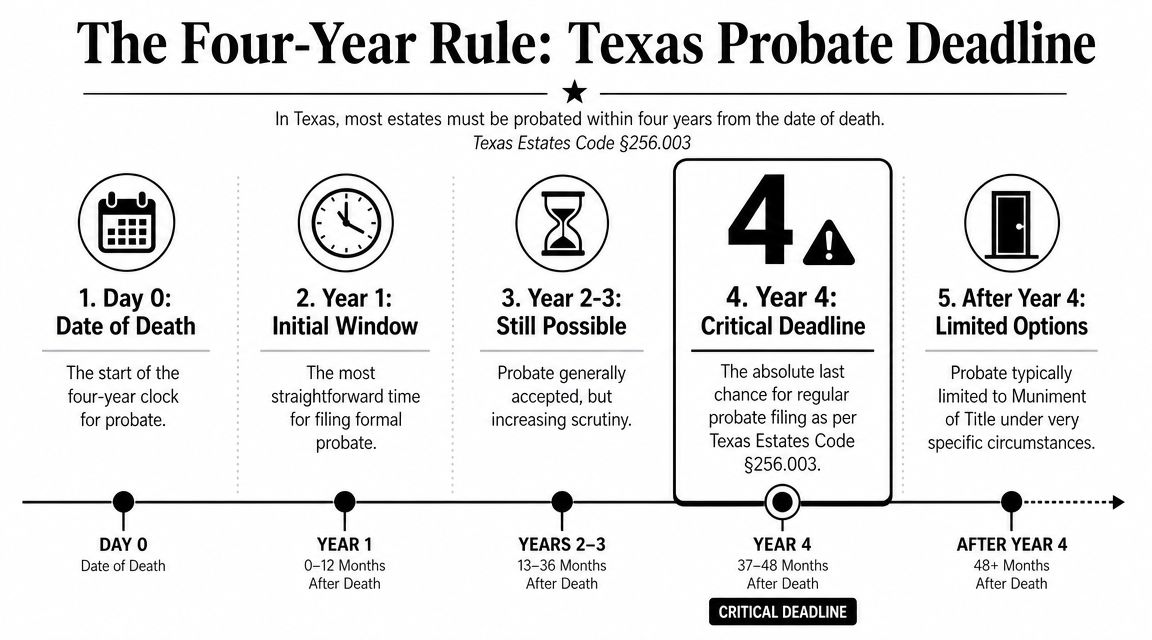
Under Texas guidance discussing the four-year probate rule, a will generally must be admitted to probate within four years of the testator's death. Verified Texas-focused guidance likewise explains that if that deadline is missed, courts commonly treat the estate as if the person died intestate, meaning distribution follows Texas succession law rather than the decedent's written wishes.
That single rule changes everything.
Why this deadline matters so much
Families often assume a valid will stays fully effective forever. In practice, waiting too long can mean the court no longer admits the will in the normal way. If that happens, the estate may be handled under Texas intestacy rules found in the Estates Code, particularly within the portions governing descent and distribution.
Intestacy means the law decides who inherits based on family relationships. That may or may not match what the deceased wanted.
Consider a common example. A father leaves a will giving his home to one child who cared for him, while leaving other assets to his other children. If nobody files probate within the allowed period and the will can't be admitted in the usual way, the home may no longer pass according to that written plan. Instead, Texas inheritance law may control.
Waiting is not a neutral choice
Missing the deadline can create outcomes families never intended:
- Named beneficiaries may lose what the will gave them
- Relatives who were not meant to inherit may gain rights under intestacy
- The executor named in the will may never receive the usual authority
- Property transfers become harder because the legal path changes
A will stored in a drawer is not the same as a will admitted by a probate court.
The Texas Estates Code provision often associated with this issue is Section 256.003, and it's one of the most important timing rules in probate practice. Families don't need to memorize the section number. They do need to know that a long delay can change the outcome of the estate itself, not just the paperwork.
Long-Term Risks Title Clouds, Creditors, and Family Disputes
Some probate problems stay quiet for years. Then a sale, refinance, or family disagreement brings them to the surface all at once.
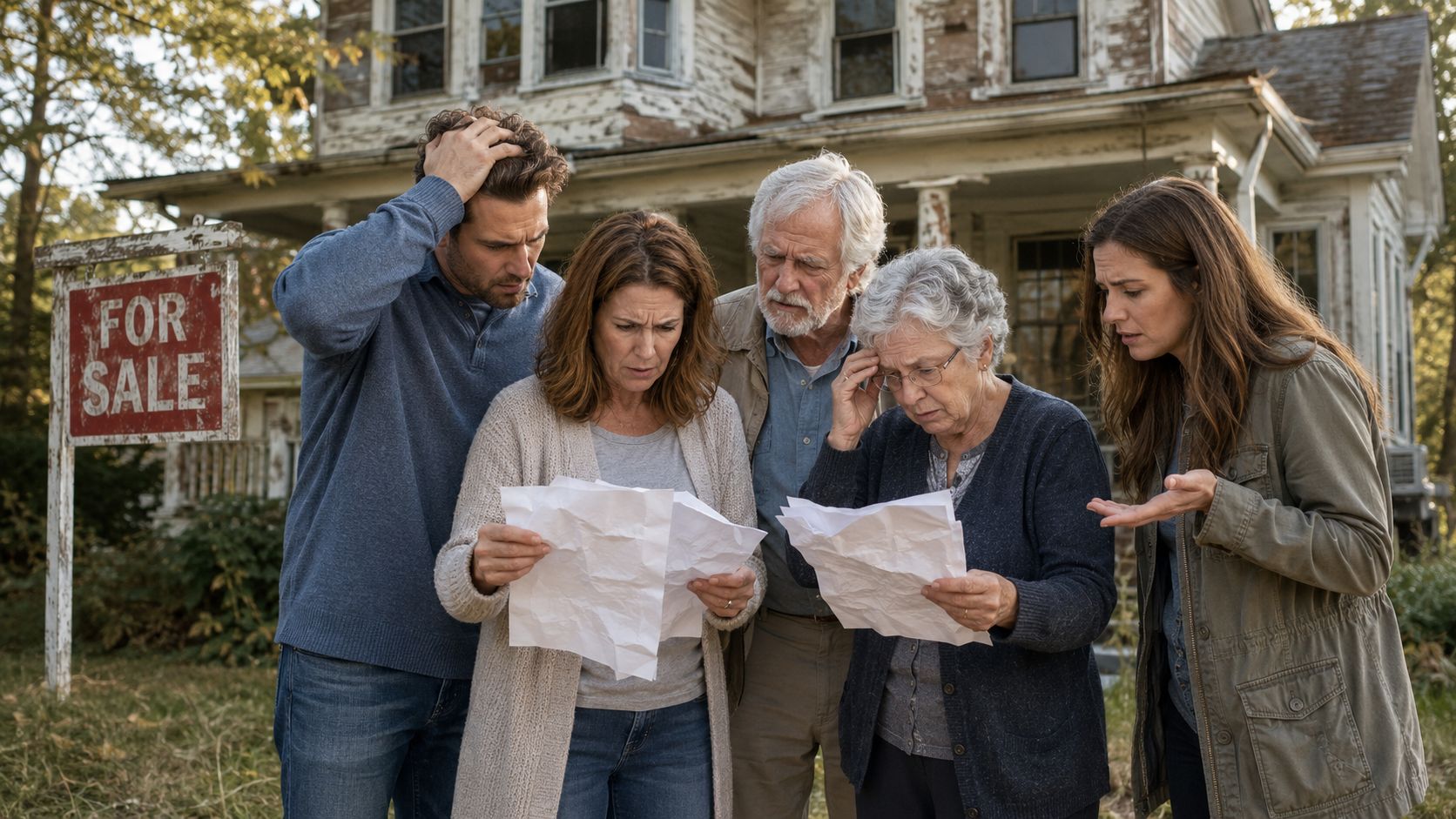
Take a familiar situation. Three siblings inherit their mother's homestead informally, or at least that's what they've believed for years. One sibling pays taxes. Another keeps some furniture there. Nobody opens probate because there's no immediate reason to sell. A decade later, they put the house on the market. The title company discovers the property is still in their mother's name.
Now the family has a title cloud. In plain English, that means the ownership record is unclear or incomplete enough to block a clean transfer.
How title clouds develop
Title trouble usually starts with an unfinished legal step. The family may know who should own the property, but public records may not reflect that ownership. Buyers, lenders, and title companies usually need more than family understanding. They want a legally reliable chain of title.
That's where delayed probate often comes back to hurt the family. A title issue may require heirship proof, corrective filings, or litigation over who inherited and in what shares. If you're already dealing with this kind of problem, this resource on resolving title defects in Texas probate cases explains the issue in more depth.
Other disputes that grow in the dark
When no one opens probate, uncertainty can spread in several directions:
- Creditors may remain an unresolved concern. Without a structured administration, questions about debts can linger.
- Heirs may remember promises differently. One person says Mom wanted the house sold. Another says she wanted it kept in the family.
- Records can disappear. Over time, documents get lost, witnesses pass away, and facts become harder to prove.
- Mineral interests or overlooked property may surface later. Families often discover old assets only when an outside party raises the issue.
Here is the practical difference between an early probate response and a late one:
| Issue | Addressed early | Addressed years later |
|---|---|---|
| House title | Clear path is more likely | Often requires extra corrective work |
| Family agreement | Easier to document | Memories and positions may shift |
| Asset inventory | More available records | Missing papers and uncertainty |
| Estate control | More orderly | Often reactive and disputed |
Families rarely regret getting clarity early. They often regret assuming the problem would stay small.
Who Can Start the Probate Process?
Many people believe only the named executor can begin probate. That's not always true.
Under the Texas Estates Code, an interested person may have standing to participate in probate matters. In everyday terms, that can include people with a financial or legal stake in the estate, such as heirs, beneficiaries, a surviving spouse, or sometimes creditors. The exact role depends on the facts and the kind of proceeding.
Why that matters for your family
If the person named in the will does nothing, someone else may step in. That could be a child who wants title to the house cleared. It could be a beneficiary trying to force movement. In some situations, a creditor may push for administration because money is owed.
That shift can affect control of the process.
- The family may lose the initiative. Instead of choosing the timing and strategy, they respond to someone else's filing.
- Conflict may increase. A delayed estate often raises suspicions about motives, money, or missing documents.
- Court involvement may become more complicated. The longer people wait, the less straightforward the facts tend to be.
A related misunderstanding is that only close relatives matter. In probate, the court focuses on legal interest, not just emotional closeness. That's why families should not assume inaction keeps things private or simple. Sometimes it invites another person to act first.
If you're holding a will or know an estate needs attention, it's wise to determine quickly who has authority, who has standing, and which procedure fits under the Estates Code.
Key Insights and Recommended Next Steps
A common Texas probate problem starts subtly. A parent dies, the family keeps paying the mortgage and taxes, and everyone assumes the will can be handled later. Then a buyer wants proof of ownership, a bank refuses access to an account, or a child named in the will learns that waiting too long may mean the estate is treated under intestacy rules instead of the will.
That is why the next step is not guessing. It is identifying which assets can pass on their own, which assets are frozen until someone has legal authority, and whether the four-year deadline is getting close. Probate works asset by asset, not as one single problem.
Keep these practical points in view:
- Review each asset separately. A life insurance policy with a valid beneficiary designation usually follows that designation. A house, vehicle, or account with no beneficiary often needs probate or another court process before it can be transferred cleanly.
- The four-year rule can change who receives property. In some cases, missing that deadline means the will cannot be used for full probate in the ordinary way. The result can look very different from what the deceased wrote down.
- Real estate problems rarely fix themselves. If title stays in the deceased person's name, selling, refinancing, or even passing the property to the next generation becomes harder.
- Delay creates room for conflict. Relatives may disagree about what was intended. Creditors may press their claims. People who were patient at first may decide to file something in court.
- Texas may offer a different procedure. Depending on the facts, a Small Estate Affidavit, muniment of title, or heirship proceeding may solve part or all of the problem.
Start with the paperwork. Gather the will, death certificate, deeds, mortgage statements, account statements, vehicle titles, beneficiary forms, and any information about debts. Then sort property into two groups. One group is assets that pass automatically by contract or survivorship. The other is assets that still need legal authority to transfer.
That simple sorting exercise often reveals the true risk. If the estate includes a home in the deceased person's sole name, an account with no payable-on-death beneficiary, or property the family hopes to sell soon, delay can cost time, money, and in some cases inheritance rights.
If your family is unsure which Texas procedure fits, getting legal advice early can prevent a much harder cleanup later. Law Office of Bryan Fagan, PLLC works with Texas families on probate administration, Small Estate Affidavits, muniment of title cases, heirship issues, guardianship matters, wills and trusts, and probate disputes. Clear advice at the start can protect title, reduce family conflict, and help your family carry out the decedent's wishes as closely as Texas law allows.